
—The Grand Jury at Washington made three presentments of Ex-Secretary Floyd, first, for maladministration in office; second, for complicity in the abstraction of the bonds; and third, for conspiracy against the Government.—N. Y. Tribune.
Thursday, January 27, 2011
SUNDAY 27
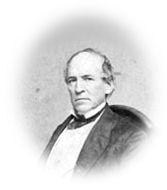
The snow is about 6 or 7 inches deep and some attempts at sleigh riding are made but there seems to be a sad deficiency in vehicles of that kind, but the ring of sleigh bells has been quite common today. It has thawed in the sun all day. I was in at Willards. The House seemed to be quite full. Called at Cramers and spent an hour. Mr Russell from Saratoga there, took tea there. The moon is at its full and it is almost as light as day out. Every one you meet looks grave and anxious.

______
The three diary manuscript volumes, Washington during the Civil War: The Diary of Horatio Nelson Taft, 1861-1865, are available online at The Library of Congress.
Washington, January 27,1861.
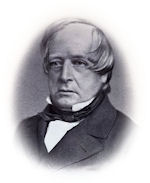
MY Dear Sir,—I have seen in the Star, and heard from other parties, that Major Beauregard, who had been ordered to West Point as Superintendent of the Military Academy, and had entered on the discharge of his duties there, had been relieved from his command. May I take the liberty of asking you if this has been done with your approbation ?
Very respectfully yours,
John Slidell.

The President replies on January 29th.
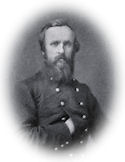
January 27, 1861.—Six States have “seceded.” Let them go. If the Union is now dissolved it does not prove that the experiment of popular government is a failure. In all the free States, and in a majority if not in all of the slaveholding States, popular government has been sucessful. But the experiment of uniting free states and slaveholding states in one nation is, perhaps, a failure. Freedom and slavery can, perhaps, not exist side by side under the same popular government. There probably is an “irrepressible conflict”¹ between freedom and slavery. It may as well be admitted, and our new relations may as well be formed with that as an admitted fact.

_______
¹ This phrase had first been used by William H. Seward in a speech at Rochester, New York, October 25, 1858.
SAVANNAH, GA., January 27, 1861.
I transmit herewith a copy of an order which was handed to me yesterday.
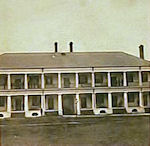
I refused to recognize Colonel Lawton’s authority, or to allow Lieutenant Bassinger to interfere with the barracks or public property. Lieutenant Bassinger, on my refusal to agree to comply with the order which he gave me, called on and obtained assistance from the city police and fastened up my public storeroom. The barracks are now under the charge of the police.
I do not think the State authorities design taking the stores from here at present, or that they will molest me so long as I allow them to keep my storeroom fastened.
Lieutenant Bassinger, an officer of the State, offered to give me any writing I might desire in relation [to] the post and stores, but I refused to take any, or to give him any information. Please inform me if I am to act different from what I have.
……….Very respectfully, your obedient servant,
E. BURT,
Ordnance Sergeant, U.S. Army.
Col. S. COOPER, Adjutant-General U. S. Army, Washington, D. C.
.
[Inclosure.]
.
SAVANNAH, January 26, 1861.
Lieut. W. S. BASSINGER :
SIR: You will immediately take possession of Oglethorpe Barracks, in this city, in the name of the State of Georgia, and under orders of the commander-in•chief.
The present occupants are not to be disturbed, provided they agree to remain subject to my orders, or to any proper authority of this State.
……….Very respectfully, your obedient servant,
A. R. LAWTON,
Colonel, Commanding.
FORT SUMTER, S.C., January 27, 1861.
(Received A. G. O. January 30.)
Col. S. COOPER, Adjutant-General:
COLONEL: I have the honor to state, in reply to your letter of the 24th instant, that our letters, &c., are sent by boat, daily, at 12 m., to Fort Johnson in a sealed package, addressed to the postmaster in Charleston, and that the return boat brings our mail in a package bearing the post-office seal. I am satisfied with the existing arrangement. The governor told Lieutenant Talbot, when he saw him on his return from Washington, that I might, if I chose; send up to the city for my mails, but that he thought it would not be judicious for me to do so. I do not apprehend that there would be the slightest danger of any of my men deserting if thus employed, but think they might be insulted or maltreated. The report to which you refer, about the attempt of the men who were sent to the city to attend a murder trial to desert, is absolutely and entirely false. Lieutenant Davis (who refused to take them, though offered arms by several persons and urged to accept them) says that the men conducted themselves with the greatest propriety, and that, although handsomely entertained, they returned perfectly sober. I have not deemed it advisable to notice in any way the false reports which have originated in Charleston and elsewhere about us. I send herewith a slip containing two such reports. Lieutenant Meade states, and I have no doubt with entire truthfulness, that he made no statement whilst absent to any person about my preferences or my opinions, either military or political, and that the inferences given in the article in the Petersburg paper were not deducible from any facts stated by him. The other article, in the Baltimore paper, stating that a boat containing three of my men was fired into from Sullivan’s Island, is also entirely untrue. I cannot see the object to be attained by the circulation of such untruths. The object of one, which has been repeated more than once, that we are getting fresh provisions from the Charleston market, is apparent enough, viz, to show they are treating us courteously. But even that is not a fact. I send herewith a copy of a letter written to our former beef contractor about furnishing us with meat, &c., to which no reply has yet been received–why, I am unable to ascertain; so that, up to this moment, we have not derived the least advantage from the Charleston markets; and I can confidently say that none of my command desire to receive anything from the city for which we are not to pay. Under the daily expectation of the return of Lieutenant Hall, I have deferred sending in a memorandum of the commissary stores on hand. There are now here 38 barrels pork, 37 barrels flour, 13 barrels hard bread, 2 barrels beans, 1 barrel coffee,½ barrel sugar, 3 barrels vinegar, 10 pounds candles, 40 pounds soap, and 3/4 barrel salt. You will see from this that for my present command (especially after the departure of our women and children) we shall have an ample supply of pork and bread. It is a pity that my instructions had not been complied with, which would have given us the small stores which are now deficient, and which we shall not object to receiving as soon as the safety of our country will admit of our getting them. Nothing of importance to report. The Columbia is still aground in the Maffitt’s Channel.
I am, colonel, your obedient servant,
ROBERT ANDERSON,
Major, First Artillery, Commanding.

[Inclosure No. 1.]
FORT SUMTER, January 24, 1861.
Mr. DANIEL McSWEENEY:
SIR: I am directed by Major Anderson, commanding this post, to ascertain whether you will furnish such fresh beef and vegetables as may be required here; the beef upon the terms of the contract under which you supplied Fort Moultrie; the vegetables to be purchased by you for us at fair market prices; the whole to be delivered as hitherto, four times in ten days, at some wharf in Charleston, for transportation to Fort Johnson, where it will be received by this garrison. This arrangement, which has been approved by the governor of South Carolina, it is desired shall go into effect immediately, and if you consent to it, you can send 184 pounds of flesh beef at a time, at such hour and wherever Quartermaster-General Hatch (120 Meeting street) may advise you. Of the vegetables you will be further directed. Please acknowledge the receipt of this as soon as possible, in order, if necessary, that other arrangements may be made.
Respectfully, your obedient servant,
T. SEYMOUR,
Captain, U. S. Army.
Copy of extracts from Baltimore Sun and Petersburg Daily Express
[By telegraph for the Baltimore Sun.]
THE LATEST FROM THE SOUTH.
FROM SOUTH CAROLINA–A BOAT FROM FORT SUMTER FIRED AT BY THE SOUTH CAROLINIANS—HON. JEFF. DAVIS SPOKEN OF FOR PRESIDENT OF THE SOUTHERN CONFEDERACY.
CHARLESTON, JANUARY 23.–The battery on the beach at Sullivan’s Island fired into a boat from Fort Sumter on Monday. There were three men in it, who approached the beach with muffled oars. The sentry at the battery hailed them and warned them on. Failing to obey the summons, the sentry fired musketry into the boat, when it turned round and went away. Soon after those at the battery heard a noise like the hauling up of a boat at Fort Sumter. One of the men in the boat is said to have been wounded badly. Their object is supposed have been desertion, but some say it was a desperate effort to run the gauntlet of the sentries and spike the guns of the battery.
[The Daily Express, Petersburg, Va., Tuesday morning, January 22, 1861.]
COMING TO THE POINT–A PRACTICAL MOVEMENT.
THE POSITIONS OF MAJOR ANDERSON.–Lieut. R. K. Meade, of the Engineer Corps, at Fort Sumter, has been in our city, on a visit home, for several day’s past. Several gentlemen with whom he has conversed inform us that he speaks in the highest terms of Major Anderson, not only as a brave and fearless soldier, but as a strong and true Southern man, his position in the present state of affairs, however, rendering it impossible for him to take any other position before the people of the South and of the Union. He does not feel in the slightest complimented by the fanatical cannon firing in his honor at the North, and it is with pain, not fear nor even embarrassment, that he realizes the present attitude of the South towards him. That he loves the South, that he prefers it, every social tie gives ample testimony. He is bound by the holy ties of wedlock to one of the fairest of the fair of Georgia, a daughter of General Clinch. He has four devoted brothers, every one of whom, it is said, is a strong secessionist. Add to this that he is a Southerner by birth, and a descendant of Revolutionary sires, we need hardly more to give us assurance that he not only loves his native south, but will at the proper time, and in an honorable manner, draw the sword in her defense. These are simple references from facts as known. Not a syllable has fallen from the lips of Lieutenant Meade to lead to the remotest deduction that Major Anderson will not perform his whole duty to the Government of the United States. But that he will be hand in hand with the South as soon as he may be, with honor, relieved from his portion, we have little to doubt.
MAJOR ANDERSON.–“A Comrade” writes to the Columbus (Ga.) Enquirer concerning the late removal of Major Anderson to Fort Sumter, and in defense of his action and character. The conclusion is: “Major Anderson is a Southern man–born and raised in the noble old ‘Dark and Bloody Ground.’ He will be found on the side of the South when this government is dismembered, and, when his critical position has been properly understood, his name will be fully exonerated from the grave charges which have been made against it by those who have been deplorably misinformed upon all the points of military honor which have governed this truly gallant and meritorious officer.”
FORT SUMTER, S. C, January 27, 1861.
General Jos. G. Totten,
“Every man…, that is discharged is beset as soon as he reaches town for information, and in some instances they have played upon the credulity of their questioners. In other instances, the information given has been magnified and distorted.”
GENERAL: I have the honor to report that since the date of my last letter very little has been done by the troops of South Carolina around us, in consequence of the continued storm of rain and wind that has prevailed. The little that has been done comprises the completion of the mortar battery, situated to the southeast of Fort Johnson, on James Island, and the enlargement of the battery on Cummings Point by extending it towards the east. It now occupies the position shown in red in the marginal sketch. [sketch omitted in this report.] The position of the other battery on Morris Island is also shown in red. This is called by the Charlestonians “Fort Morris,” and I will so designate it in future.
The two or three guard-boats that the authorities have in use are constantly employed in watching the bar, and evidently have signals by which they can communicate intelligence at night as well as in the day. On the morning of the 25th the steamer Columbia, Captain Berry (who was the first to hoist the palmetto flag on board his vessel) in leaving the harbor by the Maffitt Channel, ran on shore between the Moultrie House and Bowman’s Jetty, on Sullivan’s Island. Despite all efforts to get her off at each high tide (and we have had several very high ones since), she still lies in the same position. The probability is that she will go to pieces if it should happen to blow hard from the south or eastward. The cause of this casualty is undoubtedly found in the fact that the taking up of the outer end of Bowman’s Jetty has caused a deposition below it, which has diminished the depth of water, so that a vessel has now to follow a winding course very much like the red [broken] line in the marginal sketch. The difficulty of navigating the sharp turn opposite where the Columbia now lies is very much increased by the opposite effects of flood and ebb tide, the latter tending to set the vessel on shore.
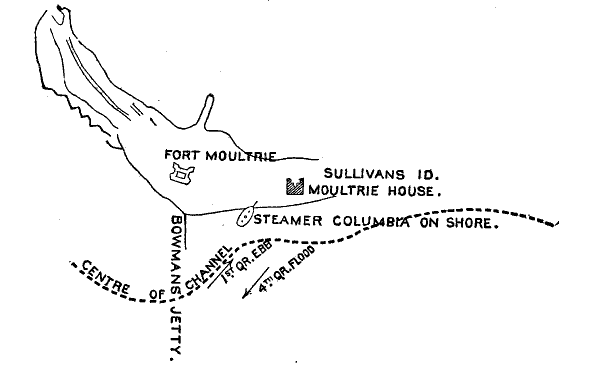
Going out in the haze of the morning, the Columbia probably failed to observe the turn of tide, and could not turn quickly enough, with full head of steam, to clear the beach. Another of the steamers of the same line came in through the main ship channel last evening, being piloted in by one of the guard-boats.
In Fort Sumter everything goes on quite smoothly. I have done little during the past week, on account of the storm, besides policing, removing materials, and strengthening the filling of the openings for the embrasures of the second tier. One 10-inch columbiad has also been put in position on the parade to throw shells into Fort Moultrie, and surrounded by a strong traverse to avoid all danger from a possible bursting of the piece. Although all of the cement and bricks are used up, and the extreme scarcity of fuel does not permit the burning of shells for lime, I can manage with dry stone to strengthen all parts that require it. I do not propose to discharge my force of forty-three men at present, but to employ them at such work as from time to time becomes necessary. All of them will be of great service in case we have to sustain a cannonade, and the majority of them will also be of material aid in resisting a sudden attack. There is not a particle of truth in the many reports that have crept into the papers about mutinies, &c. The soldiers are in excellent spirits and full of confidence. Those of my men that I have discharged of late have left with great reluctance. In fine, the morale at present is very high.
The trouble that I had with my men soon after the command came over, which resulted in a rapid thinning out of the force, has long since ceased. Every man, however, that is discharged is beset as soon as he reaches town for information, and in some instances they have played upon the credulity of their questioners. In other instances, the information given has been magnified and distorted. And in one case, that of Lieutenant Davis, who went to town on the 19th in charge of four soldiers summoned as witnesses in a murder trial, an effort was made to convince him that his men, having been tampered with, had uttered threats against him, and that he should arm himself before trusting himself to come down with them alone in a boat. Lieutenant Davis declined their proffer of arms. It appears that there was no circumstance to warrant this attempt to place Lieutenant Davis in a false position towards his men, and to give cause for reports prejudicial to the fidelity of the soldiers. The report in the papers that the men attempted to jump out of the window to escape, is utterly without foundation. So, also, is the report that a boat from Fort Sumter, in attempting to reconnoiter the battery on Morris Island, had been fired into by the sentry, and one man wounded. No boat has ever left Fort Sumter for such a purpose, and I question whether it was a boat that the sentry fired at. In fact, it is not safe to credit any reports coming from this region, except such as are favorable to the Government of the United-States. Even the statements that emanated from high authority and were widely circulated, to the effect that this command was supplied with fresh provisions, &c., are not strictly true, for we have not as yet received any.
One lot was sent down on the 20th by the State authorities, which Major Anderson declined to receive. His proposition to get them from the regular contractor, and to pay for them, was accepted; but up to this time (10 a.m. of the 27th) we have not received anything from the contractor in town.
Lieutenant Meade returned on Wednesday, the 23, but on account of the storm was not able to get to the fort before the following day. Both he and Lieutenant Snyder having volunteered for the duty, I have entered them upon the regular roster for guard duty, two of the officers of the command being sick, and one absent. It does not interfere with our regular duties.
I have the honor to be, very respectfully, your obedient servant,
J. G. FOSTER


