Following the American Civil War Sesquicentennial with day by day writings of the time, currently 1863.

Friday, January 21, 2011

MONDAY 21

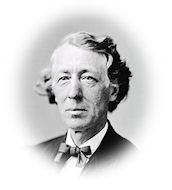
Mr Yulee was in my room today and asked me if I thought it best to “coerce” the seceding states. I told him that I thought it best to protect the public property. But says he that is coercion in the opinion of the seceding States. I told him that it mattered little what the opinions of the Pirates and Freebooters were who now controled those states. The danger of a collision was imenent, but it soon passed off. I cannot restrain myself when talking with these fireeaters and Traitors. Weather delightful today, was down at the Hotels, bot a “Times,” read an hour to wife.

______

The three diary manuscript volumes, Washington during the Civil War: The Diary of Horatio Nelson Taft, 1861-1865, are available online at The Library of  Congress.

—Jefferson Davis, of Mississippi, withdrew from the Senate at Washington to-day. The ordinance of secession having passed the Convention of his State, he felt obliged to obey the summons, and retire from all official connection with the Federal Government.—(Doc. 23.)

At the Brooklyn, N. Y., navy yard, the entire force was put under arms, and held in readiness to act immediately, through some apprehension of an attack by an organized force of persons in sympathy with secession. The guns of the North Carolina were shotted, and a portion of the Brooklyn city military was mustered to cooperate.—Herald, Jan. 22.

—The Georgia State Convention resolved, unanimously:

“As a response to the resolutions of the Legislature of the State of New York, that this Convention highly approves of the energetic and patriotic conduct of the Governor of Georgia in taking possession of Fort Pulaski by the Georgia troops; that this Convention request him to hold possession of said fort until the relations of Georgia with the Federal Government shall be determined, and that a copy of this resolution be transmitted to the Governor of the State of New York.—Times, Jan. 22.

—Wendell Phillips addressed the Twenty-eighth Congregational Society in Boston this afternoon on the “Political Lessons of the Hour.” He declared himself to be a disunion man, and was glad to see South Carolina and other southern slave States had practically initiated a disunion movement. He hoped that all the slave States would leave the Union, and not stand upon the order of their going, but go at once. He denounced the compromise spirit manifested by Mr. Seward and Charles Francis Adams with much severity of language; and there was an occasional stamping of feet and hissing, but no outbreak. Mr. Phillips was escorted home by a few policemen, and a great crowd pushing about him.—Springfield Republican.

—A Union meeting was held to-night at Trenton, N. J., Thomas J. Stryker, Cashier of the Trenton Bank, in the chair.

The Committee on Resolutions reported, deploring the state of the country; recommending, as a means of settling differences, the adoption by the people of the Crittenden resolutions, or some other pacific measure; with such modifications as may be deemed expedient; recommending the Legislature of New Jersey to pass a law to take a vote of the people, yes or no, on the Crittenden resolutions; approving of the course of Virginia in appointing a Commission to go to Washington, and recommending the New Jersey Legislature to do the same.

Speeches were made by Judge Naar, C. W. Jay, and others.

P. O. Dept., Jan’y 21, 1861.

My Dear Sir,—Yours of the 19th inst. is received.

I presume I shall continue to act as P. M. G., as I have been doing since the 1st inst. I do not anticipate that any appointment will be sent to the Senate at least for the present.

I cannot see that there is much if any improvement in the state of things. Yet if the Republicans would only present some reasonable proposition, and vote upon it with anything like unanimity to show that they were willing to do something, it would at once take the wind out of the sails of secession in all the border States, and this would dampen the ardor of the rebels . . . further South.

Very resp’ly and truly yours,

Horatio King.

Nahum Capen, Esq., P. M., Boston, Mass.

HEADQUARTERS OF THE ARMY,
Washington, January 21, 1861.

Bvt. Col. JUSTIN DIMICK,
Lieut. Col., Second Artillery, Commanding Fort Monroe, Va.:

SIR: The General-in-Chief directs that you embark, after arrangements with the commander of the sloop-of-war Brooklyn, one company of the First Artillery with at least three officers, with arms, a good supply of ammunition, and as much subsistence, not exceeding four months’ supply, as the Brooklyn may be willing to receive. Fill up the company to the maximum standard by transfer. Some spare arms should go with it. Issue, or if there be time purchase and ship, a good supply of desiccated vegetables. Superscribe the inclosed sealed orders with the name of the captain designated by you. They are not to be opened until he is at sea.

I remain, sir, very respectfully, your obedient servant,

L. THOMAS,
Assistant Adjutant-General.

P. S.–Put on board, if possible, six field howitzers with their carriages and equipments and one hundred rounds of ammunition.

L. T.

[Inclosure.]

HEADQUARTERS OF THE ARMY,
Washington, January 21, 1861.

[Capt. ISRAEL VOGDES,].

First Artillery, Fort Monroe, Va. :

SIR: You are designated to embark with your company on board the sloop-of-war Brooklyn to re-enforce Fort Pickens, of which you will become the commander as well as of other forts and barracks which it may be in your power to occupy and defend with the co-operation of any naval commander or commanders at hand, although it is understood that Fort Barrancas and probably Fort McRee are already in the hands of the seceders. It is probable that the Brooklyn may be obliged to land you outside the harbor, but it is hoped not so far from Fort Pickens as to be beyond the protection of its guns if the debarkation should be opposed. Of course, the company will be first landed to cover the supplies which are intended for the fort,. The Brooklyn will touch at Key West. Deliver the accompanying letter to Captain Brannan, and desire him to communicate freely with Major Arnold, who sailed eight days ago from Boston to occupy Fort Jefferson, giving him intelligence of your movement, and the intention to re-enforce both Forts Taylor and Jefferson with a company each, hoping and believing that the latter is in the possession of the major.

The General-in-Chief, by whose direction I write, has every confidence in the zeal and ability of the officers of the First Artillery.

I have the honor to be, sir, your most obedient servant,

L. THOMAS,
Assistant Adjutant-General.

P. S.–You are to understand that you are not to attempt any reoccupation or recapture involving hostile collision, but that you are to confine yourself strictly to the defensive.

L.T.

P. S.–The guns, &c., if it has been found possible to get any on board, are intended for Fort Jefferson.

L. THOMAS.

FORT SUMTER, S.C., January 21, 1861.
(Received A. G. O., January 24.)

Hon. J. HOLT, Secretary of War:

“In connection with this subject, I deem it not improper respectfully to suggest that his excellency may do an act of humanity and great kindness if he will permit one of the New York steamers to stop with a lighter and take the women and children of this garrison to that city. The confinement within the walls of this work, and the impossibility of my having it in my power to have them furnished with the proper and usual articles of food, will, I fear, soon produce sickness among them.”

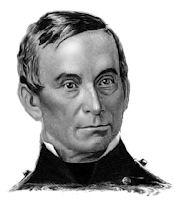
SIR: I have the honor to acknowledge the receipt of your letters, dated the 10th and 19th [16th] instants, and to assure you that I am highly gratified at the unqualified approbation they contain of the course I felt it my duty (under Divine guidance, I trust) to pursue in the unexpectedly perplexing circumstances by which we were surrounded. I shall inclose herewith copies of my correspondence with the officials of this State, and also a copy of the Mercury, which contains an article in reference to supplies for my command. [Mercury article not found.] You will understand at once the reasons for my course, which I hope will meet your approval. So many acts of harshness and of incivility have occurred since my removal from Fort Moultrie, which I have not deemed proper to notice or report, that I cannot accept of any civility which may be considered as a favor or an act of charity. I hope that the Department will approve of my sending (if the governor will permit it) our women and children to New York. They will be in the way here if we should, unfortunately, be engaged in hostilities, and they would embarrass me should I deem it proper to make any sudden move. We are trying daily to strengthen our position. We have now fifty-one guns in position, viz: In barbette, four 42-pounders, three 32-pounders, six 24’s, six 8-inch columbiads, and five 8-inch sea-coast howitzers (24); in casemate, twenty-two 32-pounders and two 42-pounders, (24); and to guard the gateway, which has been nearly closed by a heavy stone wall, three 8-inch sea-coast howitzers; and we are now preparing platforms in the parade for the three 10-inch columbiads, which we are unable to raise to their proper positions. I shall have some of the lower embrasures, in which guns are mounted, closed. This will make our little command more secure. From the perfect isolation of our position here it is impossible for us to ascertain, with any degree of certainty, the character or extent of the preparations which are being made around us. Everything, however, shows that they are exerting all their energies to prevent the entrance of re-enforcements, and to prepare for attacking this work. Saturday night and yesterday (Sunday) they were very actively engaged at work on a battery (commenced Saturday morning) a few hundred yards south of a battery of three guns constructed within the last three weeks in front of Fort Johnson barracks. On Cummings Point, Morris Island, quite an extensive battery or batteries have been constructed within the last week. We think that there may be both mortars and heavy guns at this point. We see them moving heavy timbers, which may be intended for the construction of a bomb-proof. Judging from the great quantity of material which has been landed in that neighborhood, I think it probable that they may have strengthened the battery which fired on the Star of the West. The channel she came in has been closed, pretty effectually I imagine, by four sunken vessels. Sand hills on Morris Island afford such safe positions for batteries that I fear we shall have to waste a great deal of ammunition before we can succeed in dislodging them from its batteries. Several distant shots have been heard from the direction the mouth of Stono Creek. I presume they have closed that by a heavy battery. It is reported that there is a battery guarding the entrance of the Maffitt Channel, and also that there is a battery of heavy guns on Sullivan’s Island (masked from our view by the houses) about three hundred yards to the west of the fort. Fort Moultrie has been  greatly strengthened during the last two weeks. Traverses have been erected along the sea front, and merlons, formed of sand bags and earth, constructed between the guns. These merlons, apparently well built, will afford very good protection for the carriages and men, and defilade the parade and greater portion of the quarters from our direct fire. It seems that they have repaired these carriages, and that all the guns are now in position on the sea front. I am, of course, unable to state with any accuracy the character of the armament of their batteries or the number of men they have under arms; we hear that the garrison on Sullivan’s Island, at Fort Johnson, Castle Pinckney (the parapet of which is strengthened by sand bags), and on Morris Island amount to about two thousand men. In reference to my communications with the Department, you must bear it in mind that that matter is entirely under the control of the governor of this State, who may, whenever he deems fit, entirely prohibit my forwarding any letters, or prevent my sending any messenger, to my Government. I shall, however, as long as I can do so, send daily a brief note to the Department, the reception of which will show that the channel is still open, and the failure will indicate that our communication has been cut off.

Trusting in God that He will be pleased to save us from the horrors of a civil war,

I am, very respectfully, your obedient servant,

ROBERT ANDERSON,

Major, First Artillery, Commanding.


[Inclosure No. 1.]

EXECUTIVE OFFICE, DEPARTMENT OF WAR,
Charleston, January 19, 1861.

Maj. ROBERT ANDERSON:

SIR: I am instructed by his excellency the governor to inform you that he has directed an officer of the State to procure and carry over with your mails each day to Fort Sumter such supplies of fresh meat and vegetables as you may indicate.

I am, sir, respectfully yours,

D. F. JAMISON.

[Inclosure No. 2.]

FORT SUMTER, S.C., January 19, 1861.

Hon. D. F. JAMISON,
Executive Office, Department of War:

SIR: I have the honor to acknowledge the receipt of your communication of this date, stating that you are authorized by his excellency the governor to inform me that he has directed an officer of the State to procure and carry over with my mails each day to Fort Sumter such supplies of fresh meat and vegetables as I may indicate. I confess that I am at a loss to understand the latter part of this message, as I have not represented in any quarter that we were in need of such supplies. As commandant of a military post, I can only have my troops furnished with fresh beef in the manner prescribed by law, and I am compelled, therefore, with due thanks to his excellency, respectfully to decline his offer. If his suggestion is based upon a right, then I must procure the meat as we have been in the habit of doing for years, under an unexpired contract with Mr. McSweeney, a Charleston butcher, who would, I presume, if permitted, deliver the meat, &c., at this fort or at Fort Johnson, at the usual periods for such delivery, four times in ten  days. If the permission is founded on courtesy and civility, I am compelled respectfully to decline accepting it, with a reiteration of my thanks for having made it. In connection with this subject, I deem it not improper respectfully to suggest that his excellency may do an act of humanity and great kindness if he will permit one of the New York steamers to stop with a lighter and take the women and children of this garrison to that city. The confinement within the walls of this work, and the impossibility of my having it in my power to have them furnished with the proper and usual articles of food, will, I fear, soon produce sickness among them. The compliance with this request will confer a favor upon a class of persons to whom similar indulgences are always granted, even during a siege in time of actual war, and will be duly appreciated by me.

I have the honor to be, very respectfully, your obedient servant,

ROBERT ANDERSON,

Major, First Artillery, Commanding Fort Sumter.

P. S.–I hope that the course I have deemed it my duty to take in reference to the supplies will have a tendency to allay an excitement which, judging from the tenor of the paragraphs in to-day’s paper, I fear they are trying to get up in the city.

[Inclosure No. 3.]

HEADQUARTERS QUARTERMASTER’S DEPARTMENT,
Charleston, January 19, 1861.

Major ANDERSON:

DEAR SIR: Inclosed please find copy of letter from Secretary of War. Not waiting your request, I shall send by the mail-boat in the morning two hundred pounds of beef and a lot of vegetables. I requested Lieutenant Talbot to ask you to let me know this evening what supplies you would wish sent daily.

Very respectfully,

L. M. HATCH,

Quartermaster-General, South Carolina Militia.

[Inclosure No. 4.]

HEADQUARTERS QUARTERMASTER’S DEPARTMENT,
Charleston, January 19, 1861.

Colonel HATCH,
Quartermaster-General:

You are ordered to procure and send down with the mails for Fort Sumter to-morrow a sufficient quantity of fresh meat and vegetables to last the garrison of Fort Sumter for forty-eight hours, and inform Major Anderson that you will purchase and take down every day such provisions from the city market as he may indicate.

D. F. JAMISON.

[Inclosure No. 5.]

FORT SUMTER, S. C., January 20, 1861.

Col. L. M. HATCH,
Quartermaster-General:

DEAR SIR: I have the honor to acknowledge the receipt of your note of the 19th instant, and also to state that as no arrangements have been made by me with your government in reference to supplies for this post, I feel compelled to decline the reception of those supplies. I wrote to the honorable Secretary of War yesterday in reference to this matter.

I am, sir, very respectfully, your obedient servant,

R. ANDERSON,

Major, First U.S. Artillery, Commanding.
.

FORT SUMTER, S.C., January 21, 1861.

General Jos. G. TOTTEN,
Chief Engineer U. S. A., Washington, D.C.:

GENERAL: I have the honor to make the following report of the present condition of the batteries around us occupied or being erected by the troops of the State of South Carolina:

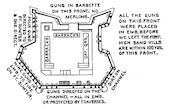
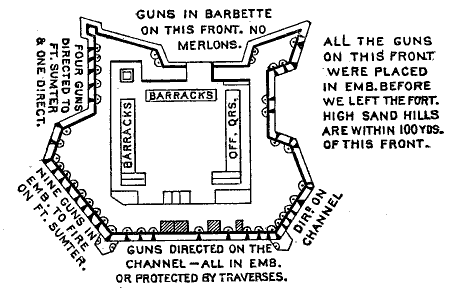
Fort Moultrie.–Until within eight days the work upon this fort, which was executed by several hundred negroes, was confined to the erection of three large traverses on the east half of the sea front, and the enlargement of another that I built upon the same face near the south angle. These traverses were of a size sufficient to contain a temporary bomb-proof shelter, and really served only to screen from our enfilading fire only three guns on the face, and also to cover the south half of the officers’ quarters. The three columbiads at the south angle were not covered. But recently the work of preparation to screen themselves from the fire of Fort Sumter has taken a better turn, and the work done is really important. It consists of high and solid merlons, formed of timber, sand bags, and earth, raised between all the guns that can be brought to bear on this fort, from the west side of their fort, and in placing traverses or merlons so as to screen from enfilading fire all the guns upon the sea front which are arranged to fire upon the channel. The cheeks of the embrasures are of timber, apparently set on end, like palisades, which I think is objectionable; and I also notice that the exterior slope of the merlons is too great to resist the pressure of the earth, and that the sand bags are pressed out in one or two places. These errors are small, however, compared with the great advantage of these merlons, which from their height (about five feet) completely cover the quarters and barracks as high up as the eaves. The following sketch shows pretty nearly the present arrangement of the fronts that I can see:

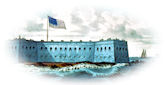
Fort Moultrie, Charleston Harbor, South Carolina

From Fort Sumter seventeen guns in barbette and eight guns in casemate are now ready to fire on Fort Moultrie–twenty-five guns in all.

Of these, four are 8-inch columbiads, five are 8-inch sea-coast howitzers, eight are 42-pounders, and eight are 32-pounders. I have overhauled and fixed each Carriage so that it works easily, and made maneuvering implements, of which there were none here at first. Besides the above, a 10-inch columbiad, is now being bedded by Lieutenant Snyder as a mortar, to throw shells into Fort Moultrie and upon Sullivan’s Island.

Battery on the upper or east end of the island–Of this nothing definite is known, as it is out of sight, and also, I fear, shielded from our fire by intervening sand hills. Its object is to secure the east point of the island, and also have a fire upon the Maffitt Channel.

Battery on Sullivan’s Island west of Fort Moultrie.–This is situated about 300 yards to the west of the fort, and is built across a cross-street at a. (See sketch.) It is said to contain five guns, but being masked by old buildings and fences in front of it, I cannot tell whether or not it is so. It is intended to fire on Fort Sumter.

Castle Pinckney remains apparently as it was when taken, with the exception of sand bags, which are placed around the parapet apparently for the purpose of protecting the heads of their sharpshooters. It is reported that some of the guns have been taken from the Castle to arm the new earth batteries on Morris Island and other places.

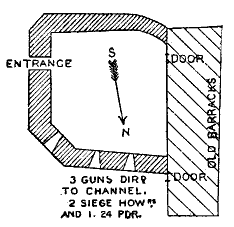
Battery at Fort Johnson.–This is a small earthen battery for three guns in embrasure, intended to fire on the channel. It is situated next to the old barracks, as shown in rough sketch in the margin: I judge of the calibers of the guns by their reports in firing for practice.

imageSecond battery near Fort Johnson.–This is now in the process of construction. It appears to be for mortars, as no embrasures are made. It is of sufficient size for three guns or mortars.

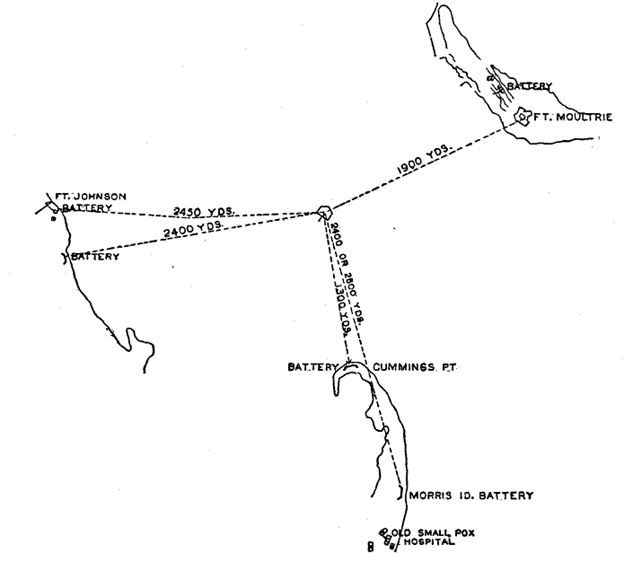
Morris Island Battery.–This is the one that fired on the Star of the West. It is about 2,400 or 2,500 yards from us, and concealed from view by intervening sand hills. It is a gun battery, and did contain two guns at first. Now I am confident that it contains at least four guns. The troops for the service of the batteries are quartered in the buildings constituting the small-pox hospital, over one of which their flag is flying, a red field with white palmetto tree upon it. The flag on Fort Johnson is similar, as is also the one on Castle Pinckney. That on Fort Moultrie is a white field with a green palmetto tree and a red star in the corner.

Battery on Cummings Point.–This is apparently for mortars, and is of sufficient extent to contain six or eight. A large force of negroes has been at work upon it during the last week. A large quantity of timber has been hauled into it, apparently for shell proof shelters as well as platforms; most of the timber was too large for platforms. This battery seems to be for mortars, as no embrasures are yet made. It is within good range of our heavy guns, of which four 8-inch columbiads, three 42-pounders, one 8-inch sea-cost howitzer, and six 24-pounders on the barbette tier bear upon it; besides, two 32-pounders in the lower tier can fire upon it. This will give a powerful fire. Still, they are apparently providing for it. I have no positive knowledge of the proposed armament of this battery, but I have heard twice from persons who would be apt to know that three mortars are already in it. These are probably the two trophy mortars from the arsenal and the 10-inch mortar from Fort Moultrie.

I have heard heavy firing several times, as though for practice, in the direction of the Stono River, and I presume a small battery has been erected there to guard that approach to the city.

Of the garrison of Castle Pinckney I cannot judge very well. Of that for Fort Moultrie and the other batteries on Sullivan’s Island I should judge the number to be about 800. On Morris Island about 500. At Fort Johnson about 100, which will probably be increased with the completion of the second battery to 200.

The temper of the authorities seems to have changed for the better since Mr. Hayne and Mr. Gourdin have been in Washington. The proposition to supply fresh meat and vegetables was made by Governor Pickens on on the 19th, but declined by Major Anderson on the following day. A supply of fresh meat and vegetables that had been sent down yesterday by the South Carolina quartermaster-general was returned. In the letter declining the proffered supply Major Anderson requested Governor Pickens to allow the camp women and children to go to New York in the next steamer, and to allow a lighter to come down to take them and their effects to the steamer as she passes, No answer has yet been received to this request. The temper of the common people is not, however, so easily changed from the high pitch of excitement to which it has been wrought to a suddenly conciliatory course, the reasons for which they do not perceive.

Our hopes for a pacific solution of the present difficulties are very much increased since Lieutenant Talbot’s return.

I have the honor to be, very respectfully, your obedient servant,

J. O. FOSTER,

Captain, Engineers.

image