Following the American Civil War Sesquicentennial with day by day writings of the time, currently 1863.

July 2012

Albany, N. Y.

Newport, R. I., July 20, 1862.

My Dear Mr. Weed,—I have made several attempts to see you during your fleeting visits to New York, but have not been so fortunate as to find you in.

Our national affairs are in a most critical position, more so than they have been at any time since the beginning of this unfortunate war.

What frightens me more than the disasters in the field, is the apathy and distrust which I grieve to say I meet at every step, even from men of standing, and hitherto of undoubted loyalty to the Union.

You know my own feelings and convictions on the subject of our national troubles, and I am sure I can speak to you in all candor, without the fear of having my thoughts misconstrued, though you may, perhaps, not share my views.

My firm conviction is, that any other solution to our present difficulties than a reconstruction of but one government overall the States of our confederacy would entail upon us and our children an inheritance of the most fearful consequences, which would end in the utter disintegration and ruin of the whole country.

There are only two modes by which to prevent such a calamity, which is certainly, at this moment, more threatening than it has ever been before. The one is, by an energetic and unrelenting prosecution of the war to crush the rebellion ; the other would be to negotiate with the leaders of that rebellion (to which it would be madness to withhold the character of a gigantic revolution) and to see whether it may not yet be possible to re-establish a Federal Union.

Both alternatives present difficulties of the gravest nature, and which they did not possess in the same degree at the beginning of the contest.

Our army has been decimated by disease and the casualties of war. I am informed from reliable sources that McClellan has barely seventy thousand men, all told, and Pope’s army, including the corps of McDowell, Sigel, and Banks, is said to number barely forty thousand men. What can we expect to do with such a force against Richmond, which is defended by an enemy having probably double that number under arms, flushed with recent successes, commanded by generals at least equal to ours, directed by one master-spirit, and occupying a central position in a country hostile to us?

It is true the President has called out three hundred thousand men, but it would be a fatal delusion to believe that this number would be sufficient to crush the enemy, even if it were sure that, under the present system of volunteers, the men would come forward.

I think I make a liberal estimate if I put the figure of the Federal armies, all told, at four hundred thousand effective men, and this number will be reduced to at least three hundred thousand before the new levies can be brought into the field.

When we stopped recruiting in the midst of our successes, we dealt a fatal blow to our army, and it is really a wonder to me that our commanding generals consented to submit to such a measure, which crippled them at a time when an overwhelming force became necessary to finish up the good work. It was a policy hardly less suicidal than if we had stopped sending supplies and ammunition to our men in the field. Where we would have found last winter ten men eager to enlist, anxious to share in our trhimphs, we will scarcely now find one, so deep is the gloom and distrust which has taken hold of our people. It would be worse than folly to shut our eyes to this fact. I think ours is the first instance in history where a government shut off supplies of men in the midst of a gigantic war. Look at England. Her enlistments in the Crimean war lasted until the very day of the conclusion of peace.

There is only one way to remedy our fatal error, that is, for the President at once to establish a system of conscription, by which, instead of three hundred thousand, at least five hundred thousand men should be called under arms.

A straightforward proclamation of the President, setting forth the necessities of the case and appealing to the patriotism of the people, will give more confidence than all the ill-concealed attempts at palliating our desperate condition.

Instead of levying new regiments, commanded by inexperienced officers of their own choosing, and who, for a year to come, would barely add any thing to our efficiency in the field, the raw recruits ought to be collected at camps of instruction, in healthy localities, East and West, where, under the direction of West Point graduates, they should be drilled and disciplined.

From thence, as thev are fit for active service, they should be furnished to the army to be incorporated into the old regiments, without reference to States, and only where they are most needed. This is the only way to create for this war an efficient United States army, and will strike a severe blow to that fatal heresy (State sovereignty and State pride) which lies at the bottom of all our misfortunes. Besides, such a mode would be infinitely more economical, and the raw recruits, mixed with our old soldiers, would be, of course, much more reliable and steady under the enemy’s fire than in separate regiments commanded by officers just as inexperienced as themselves.

Simultaneously with these measures, which ought to be taken with the utmost vigor and dispatch, we must infuse more life and energy in our naval department.

The fact is, we have made a great mistake to undertake a war on a gigantic scale by land, where our opponents are, at least, nearly as strong as we are, instead of throwing our best resources and energies upon that mode of warfare where we could have had the enemy at our mercy. Had we, at the very outset of the rebellion, ordered fifty iron gun-boats, even at a cost of one million dollars apiece, we should, before last January, have been in possession of every Southern port. With two hundred thousand men we could have held, by land, the line of the Potomac, Missouri, and Tennessee, and thus hemmed in, we would have brought the South to terms, just as Russia had to sue for peace after the fall of Sebastopol.

I think it is still in our power to accomplish this, though the task has become more difficult since Charleston, Savannah, and Mobile have been so strongly fortified during the last six months. No time, money, and efforts should be spared to build at least twenty more large new iron steamships, with which to take and hold every important city on the rebel coast, from North Carolina to Texas.

If authority for all these measures is not vested in the President, he ought at once to call an extra session of Congress.

I have thus far given you my views of the steps which I consider indispensable, if the sword is to be the arbiter of our future, but is there no other way of saving our country from all the horrors and calamities which even a successful war must entail upon us ?

It may appear almost hopeless to attempt to bring the South back to the Union by negotiation. Men and women alike, in that distracted portion of our country, have become frantic and exasperated by the teachings of unprincipled leaders and the miseries of civil war. Still, I cannot bring myself to the belief that the door to a reconciliation between the two sections is irrevocably and forever shut. The losses and sufferings which have befallen us have been felt tenfold in the revolted States, and the thinking men of the South must see that a continuation of the war must end in the utter destruction of their property and institutions. The frightful carnage of many a battle-field must have convinced each section of the bravery of its opponents, and how much better it would be to have them as friends than foes.

While I am convinced that the President would be willing to see the South in the lawful possession of all its Constitutional rights, I have not lost all hope, that with these rights guaranteed, a re-union of the two sections might be accomplished. In any event, it seems to me that an attempt at negotiation should be made, and that the time for it has not entirely passed away.

If one or two conservative men, who, without holding any official position, possess influence and weight enough with our people and the government to inspire confidence in their statements to the leading men of the South could be found, to proceed under the authority, or at least with the knowledge of the President, to Richmond, in order to open negotiations, I think success might crown their efforts.

It is impossible, and would be presumptuous in me, to point out the conditions of such a compromise, but I think that propositions would prove acceptable to the South which contained in their general outline an amnesty for all political offences during the war, and the calling of a national convention for the purpose of reconstructing the Federal compact, with such modifications in the Constitution as our late sad experience has demonstrated to have become necessary.

The war debts of the North and South might either be borne by each respective section, or better, be funded and assumed bv the general government. The Monroe Doctrine to be strictly and uncompromisingly enforced, which would require and justify a larger standing national armv and navy than heretofore, thus giving us a chance to make provisions for such of their military leaders who, repenting their past errors, are willing again to serve that flag to which, as friends and as foes, they owe all the distinction they have ever achieved.

I know that some of these concessions will be very distasteful to our people—they can be to no one more so than to myself. Every sacrifice must, however, be brought at the altar of our country when we can restore it to peace and prosperity, and with our blood and with our treasure we must also be ready to yield our prejudices, and even our convictions.

I firmly believe that the President would find the hearty support of the vast majority of our people in such a policy, and he ought not to lose any time in carrying out these views. Such men, for instance, as yourself and Governor H. Seymour, would soon be able to find out whether the men who are guiding the destinies of the South could be brought to listen to the dictates of reason and moderation.

Before we enter upon a new phase in this terrible war, which must carry with it horror and misery. far greater than what we have witnessed yet, I cannot but think that patriotism and humanity alike call for an earnest effort toward reconciliation and peace.

If our offers should be rejected, we shall stand justified before God and men, and our good cause will have His blessing and the world’s sympathy.
July 20.—A body of cavalry belonging to Gen. King’s command, left Fredericksburgh, Va,, last night at seven o’clock, and, after a forced march, made a descent this morning at daylight upon the Virginia Central Railroad, at Beaver Dam Creek, destroying the railroad and telegraph lines for several miles, and burning the depot which contained forty thousand rounds of musket-ammunition, one hundred barrels of flour, and much other valuable material, besides capturing the rebel captain who had charge of the property. —(Doc. 154.)

—This morning a slight skirmish occurred at Orange Court-House, Va., between a force of Union troops under the command of Col. Brodhead, First Michigan cavalry, and a body of rebels, resulting in the retreat of the latter, and the occupation of the town by the Nationals. In the evening, the rebels having been strongly re-enforced, Col. Brodhead retired, swimming the Rapidan River with his command without losing a man, and encamped on the bank of that stream in full sight of the rebels.

—Major-General Halleck left St Louis, Mo., this evening for Washington.—A skirmish took place at Turkey Island Bridge, near Haxall Landing, James River, Va., between a body of rebel pickets and a squadron of the Eighth Pennsylvania cavalry, under the command of Capt. P. Keenan.—Philadelphia Press.

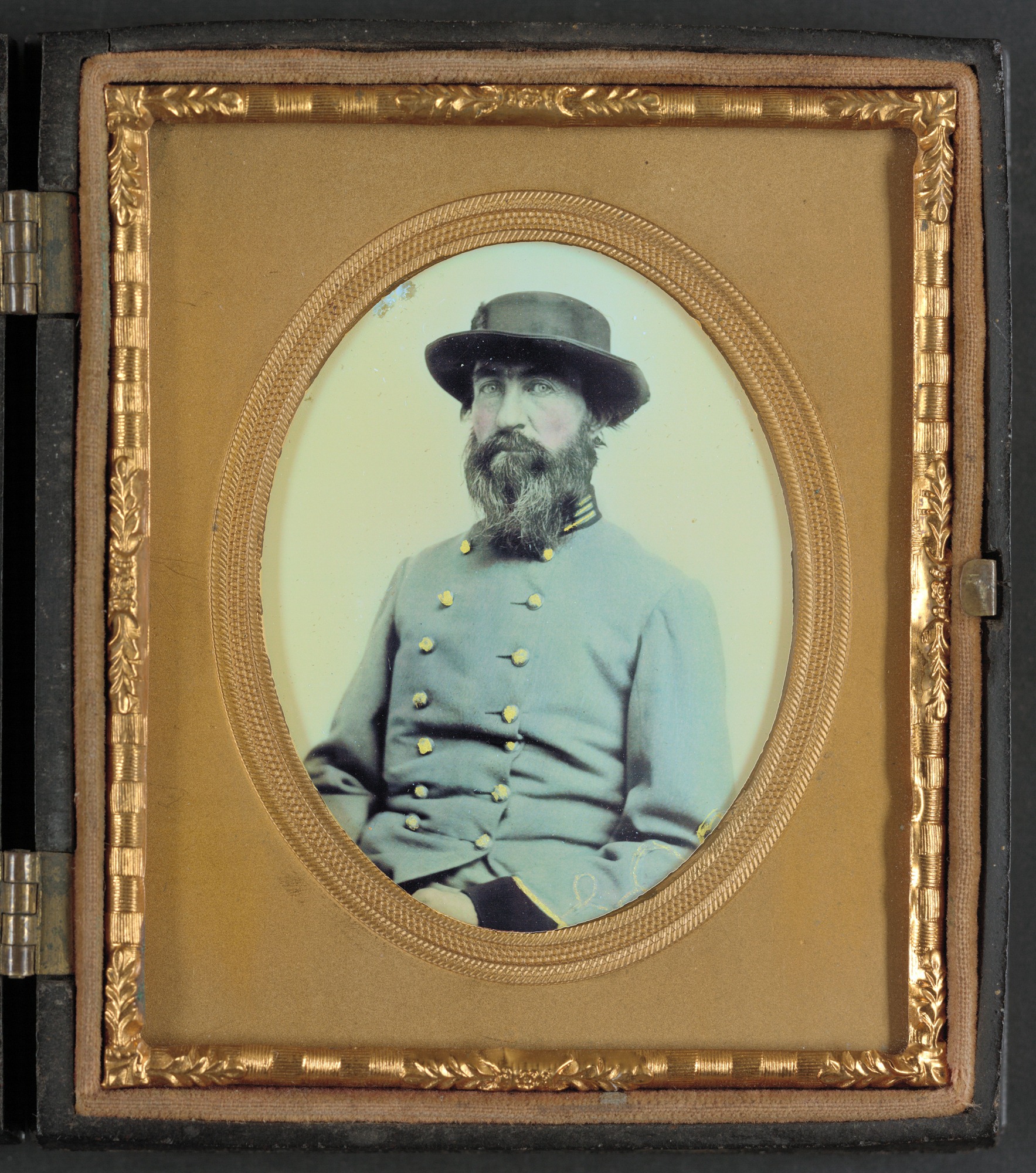
Unidentified soldier in Confederate captain's uniform with black cuffs to indicate that he is a surgeon


Unidentified soldier in Confederate captain’s uniform with black cuffs to indicate that he is a surgeon.

Medium: 1 photograph : sixth-plate ambrotype, hand-colored ; 9.3 x 8.3 cm (case)

Liljenquist Family Collection of Civil War Photographs; Ambrotype/Tintype photograph filing series; Library of Congress Prints and Photographs Division

Record page for image is here.

__________

Note: I digitally enhanced the image to try to bring out the original hand coloring.

JULY 19TH.—This morning early, while congratulating myself on the evidence of some firmness and independence in the new Secretary, I received the following note:

“RICHMOND, July 19th, 1862.

“Mr. J. B. JONES.
“SIR:—I have just been directed by the Secretary of War that he has turned over the whole business of passports to Gen. Winder, and that applications for passports will not be received at this office at all.
“Very respectfully,
“A. G. BLEDSOE,
“Asst. Sec. War.”

Of course I ceased operations immediately. So large a concourse of persons now accumulated in the hall, that it was soon necessary to put up a notice that Gen. Winder would grant them passports. But the current set back again. Gen. Winder refused to issue passports to the relatives of the sick and wounded in the camps, well knowing the generals, his superiors in rank, would not recognize his authority. He even came into the department, and tore down the notice with his own hands.

Saturday, 19th—Everything is very quiet. With the exception of a few cases, the health of the men in camp is generally good. But the men are becoming restless. All would rather be in active service, for this camp service will never bring the war to a close.

19th. Kept up after eleven and packed up. The circumstances of the trouble with Wier are these: On account of drunkenness and his seeming determination to starve us out, Col. S., all the officers in his brigade and most of the others approving, concluded to arrest him; sent the adjutant with a detail of 100 men who ordered him under arrest. He refused the order. The detail presented bayonets and took him prisoner. Took him to Col. S.’s tent, where were officers representing most of the regiments. When he saw Capt. Allen of the Battery, he said, “And are you here?” and burst into tears. I never saw so much excitement. All were glad. Before this Col. S. had determined if rations did not come by Monday to march his brigade north. Left the Indians there, marched 39 miles to our old second camp, slept on the prairie as usual. Nettleton came along slowly during the day. Officers began to be frightened after 4 or 5 hours, and ordered an ambulance to go back for him. Just then he came up.

July 19, 1862.

I don’t know whether I have any business sending such a document as I enclose, but guess its no difference. Two spies came in to-night and report that there are not more than 15,000 or 20,000 of the enemy left at Tupelo and Saltillo. Bragg took a large force with him and went over in the direction of Chattanooga a few days since. A fortnight, nearer a month, since we had quite a large force stationed at Boonville. One of the men started to go back to Rienzi on business, and had not been heard of since until day before yesterday, when his body was found midway between the two places with four bullet holes through it. It lay some distance from the road, and was discovered by a man of the 2d Brigade while looking for water. He was undoubtedly murdered by some citizen. Day before yesterday Mrs. Pierce, wife of a captain in the 36th Illinois, rode out in an ambulance, escorted by a corporal, to get some fruit in the country. A party of guerrillas gobbled the party up while they were inside of our pickets, and took them to Ripley. They sent Mrs. Pierce back yesterday. She was well treated. I guess there are no hopes of a fight there until autumn. I’m getting tired of doing nothing, although I certainly should be satisfied, having easier times than almost any one in the service.

Halleck left here yesterday for Washington. Trains are running down here from Corinth every day now, so we are only three days behind the dates of papers received, which is better than eight or ten, as heretofore. We have had the most splendid rains for a few days, and the weather is very seasonable in temperature. We are living almost wholly on fruit: apples, pears and blackberries, fresh, and peaches and strawberries canned. Don’t want for anything, but I still (so unreasonable is man) at times, think that I’m not enjoying myself as well as I used to in the 8th. I know I couldn’t stay out of the service while the war continues, but I would like so well to have peace once more, and be civilized awhile. There’s a good time coming. Don’t it come slowly? I write all the colonel’s letters now except those to his wife, and shouldn’t wonder if he’d have me do that next. At first he used to read them over very closely, but now he often signs without asking what they are about. To-night he told me was going to make me inspector general for brigade. Making two generals out of one lieutenant isn’t fair. I’m too lazy and modest for such a position and think I can coax him to appoint a chap I have my eye upon.

[London,] Saturday, July 19, 1862

Knowing that you would probably be anxious to hear from us what effect the bad news of June 26-30 might have on our position here, I take the last moment to write in order to tell you what I think we are to expect. Certainly it was a violent blow. We suffered several days of very great anxiety, knowing that the current here was rising every hour and running harder against us than at any time since the Trent affair. This reverse called out at once all the latent hostility here, and there was nothing to do but to give way. I shut myself up, went to no more parties and avoided contact with everyone except friends…. The only bright spot in the week was the reception of your letter. As we had all relied on your being safe in the hospital, or if not there, with your regiment which we knew was not engaged, your letter was quite welcome, as it told us first both of your going in and your coming out. I congratulate you, and apropos to that, I congratulate your General Hunter on his negro-army letter. We all here sustain him and I assure you that the strongest means of holding Europe back is the sight of an effective black army. Nevertheless our trouble here was extreme. As the week passed it was not diminished. Nor is it now, I fear, permanently so. It arrived however at its culminating point last night. It so happened that last night was the occasion of an expected debate in the Commons on a motion in favor of mediation. We had been busy in preparing for it and had assurances that all was right. But lo and behold, at two o’clock yesterday afternoon in rushes a member of the Commons, and half a dozen alarmists in his rear, with an evening paper whose telegraphic column was headed in big letters, “Capitulation of McClellan’s Army. Flight of McClellan on a steamer. Later from America.” This astounding news for a moment made me almost give way. But a single glance at dates showed us that it was an utter swindle, and that we had bulletins from McClellan of two days later than the day of the reported surrender. The next reflexion led us to see that it was intended for the debate of the same evening, and we, who know the seal, recognized the stamp of our old friends the Southern liars, who juggled Georgia out of the Union by telegraph. But the consternation among our friends was incredible and even when they knew it must be false, they still shook and shuddered with terror. Every Englishman believed it, or doubted in a tone that showed he wanted to believe it. As for me, I have come to consider it my whole duty here to keep up the spirits of the community and so did the best I could to laugh the lie off. Luckily its effect on the Commons was very good, for it disposed them to postpone action and tended to quiet them. Palmerston made a good speech, and the motion was not pressed to a division. This morning the Arabia’s news has arrived, three days later, which relieves us again for a time of our anxiety, and induces us to believe that the enemy were as much crippled by their victory as we by our defeat.

Thus the pinch has again passed by for the moment and we breathe more freely. But I think I wrote to you some time ago that if July found us still in Virginia, we could no longer escape interference. I think now that it is inevitable. The only delay thus far has been caused by the difficulty in inducing the five great powers to unite, and Russia and Austria to act with England in any sense favorable to the South. That unity cannot much longer fail to be obtainable. England alone or with France will not move, but their idea is that if all the great powers were to unite in offering mediation, they could by their moral influence alone force some result. If the North defied them, a simple recognition of the South by them would, they think, secure her independence. And this belief is probably correct.

It must now be the effort of the North to cast upon the South the responsibility of standing against a settlement. Here will be three means of hampering European attempts: the slavery question, the boundary question, and the Mississippi; and it is the slavery question from which we can derive the greatest strength in this running battle. You see we are stripping and squaring off, to say nothing of sponging, for the next round. If our armies sustain us, we shall win. If not, we shall soon see the limit of our hopes.

Joseph Howland kept up constant communication with the 16th and his commanding generals, always in the hope of going back, in spite of all discouragements.

Gen. Henry W. Slocum writes to him:

Harrison’s Landing, July 19, ’62.

My dear Colonel: Yours of the 16th has just come to hand. I am sincerely glad that you are doing so well and I shall be rejoiced to see you back. I think the major is doing well, but there is nothing like having the head present. Still I hope you will not think of returning till you are fully recovered. If you come back feeling weak, you will be obliged to leave again. This climate is very debilitating, and nearly all the officers, even the strongest, are affected by it. . . . My advice to you is to remain at home until some move is made here.

. . . As to your conduct and that of your regiment on the 27th, I hear but one opinion—all speak in terms of praise, the strongest terms.

. . . General Franklin told me to say to you that you must not come back till you are well. He (Franklin) is about half sick. I am in the same condition—too sick to be worth much and too well to go home. . . . Remember me to Mrs. Howland and tell Miss Georgy that her favor has been received and that I will “follow them with a sharp stick ” as requested.

Yours truly,

H. W. Slocum.

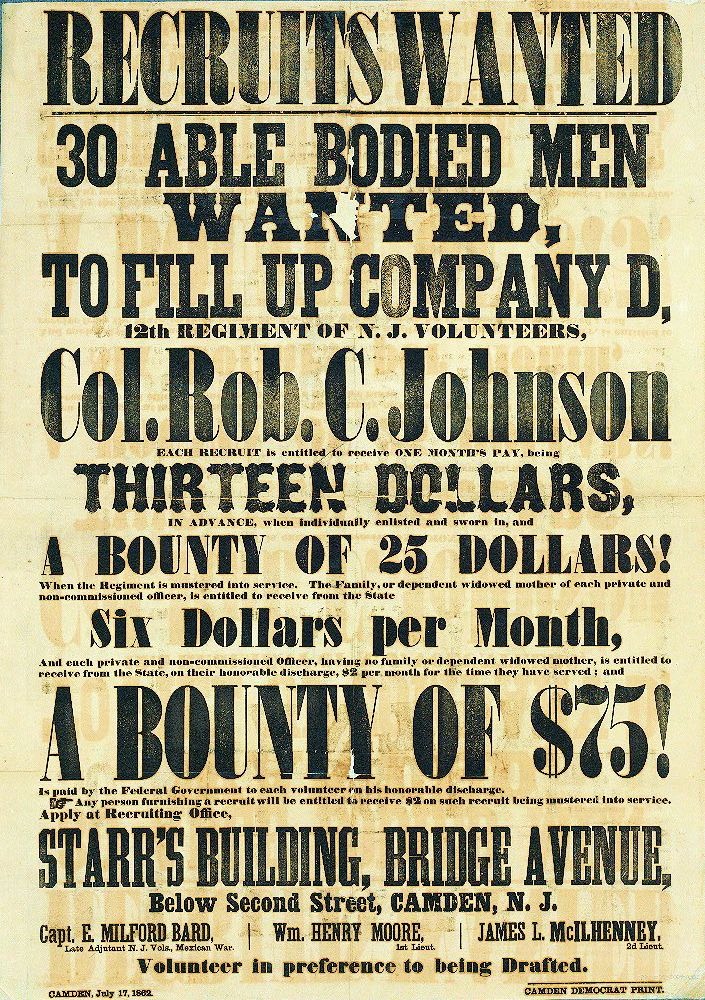
bounty NJ

Recruits wanted 30 able bodied men wanted to fill up Company D, 12th Regiment of N.J. Volunteers, Col. Rob. C. Johnson

July 1862; Poster; 90 x 63 cm

New York Historical Society

Online reference image here.