At eight o’clock on the morning of the 27th I left Chicago for Niagara, which was so temptingly near that I resolved to make a detour by that route to New York. The line from the city which I took skirts the southern extremity of Lake Michigan for many miles, and leaving its borders at New Buffalo, traverses the southern portion of the state of Michigan by Albion and Jackson to the town of Detroit, or the outflow of Lake St. Clair into Lake Erie, a distance of 284 miles, which was accomplished in about twelve hours. The most enthusiastic patriot could not affirm the country was interesting. The names of the stations were certainly novel to a Britisher. Thus we had Kalumet, Pokagon, Dowagiac, Kalamazoo, Ypsilanti, among the more familiar titles of Chelsea, Marengo, Albion, and Parma.
It was dusk when we reached the steam ferry-boat at Detroit, which took us across to Windsor; but through the dusk I could perceive the Union Jack waving above the unimpressive little town which bears a name so respected by British ears. The customs’ inspections seemed very mild; and I was not much impressed by the representative of the British crown, who, with a brass button on his coat and a very husky voice, exercised his powers on behalf of Her Majesty at the landing-place of Windsor. The officers of the railway company, who received me as if I had been an old friend, and welcomed me as if I had just got out of a battle-field. “Well, I do wonder them Yankees have ever let you come out alive.” “May I ask why?” “Oh, because you have not been praising them all round, sir. Why even the Northern chaps get angry with a Britisher, as they call us, if he attempts to say a word against those cursed niggers.”
It did not appear the Americans are quite so thinskinned, for whilst crossing in the steamer a passage of arms between the Captain, who was a genuine John Bull, and a Michigander, in the style which is called chaff or slang, diverted most of the auditors, although it was very much to the disadvantage of the Union champion. The Michigan man had threatened the Captain that Canada would be annexed as the consequence of our infamous conduct. “Why, I tell you,” said the Captain, “we’d just draw up the negro chaps from our barbers’ shops, and tell them we’d send them to Illinois if they did not lick you; and I believe every creature in Michigan, pigs and all, would run before them into Pennsylvania. We know what you are up to, you and them Maine chaps; but Lor’ bless you, sooner than take such a lot, we’d give you ten dollars a head to make you stay in your own country; and we know you would go to the next worst place before your time for half the money. The very Bluenoses would secede if you were permitted to come under the old flag.”
All night we travelled. A long day through a dreary, ill-settled, pine-wooded, half-cleared country, swarming with mosquitoes and biting flies, and famous for fevers. Just about daybreak the train stopped.
“Now, then,” said an English voice; “now, then, who’s for Clifton Hotel? All passengers leave cars for this side of the Falls.” Consigning our baggage to the commissioner of the Clifton, my companion, Mr. Ward, and myself resolved to walk along the banks of the river to the hotel, which is some two miles and a half distant, and set out whilst it was still so obscure that the outline of the beautiful bridge which springs so lightly across the chasm, filled with furious hurrying waters, hundreds of feet below, was visible only as is the tracery of some cathedral arch through the dim light of the cloister.
The road follows the course of the stream, which whirls and gurgles in an Alpine torrent, many times magnified, in a deep gorge like that of the Tête Noire. As the rude bellow of the steam-engine and the rattle of the train proceeding on its journey were dying away, the echoes seemed to swell into a sustained, reverberating, hollow sound from the perpendicular banks of the St. Lawrence. We listened. “It is the noise of the Falls,” said my companion; and as we walked on the sound became louder, filling the air with a strange quavering note, which played about a tremendous uniform bass note, and silencing every other. Trees closed in the road on the river side, but when we had walked a mile or so, the lovely light of morning spreading with our steps, suddenly through an opening in the branches there appeared, closing up the vista— white, flickering, indistinct, and shroud-like—the Falls, rushing into a grave of black waters, and uttering that tremendous cry which can never be forgotten.
I have heard many people say they were disappointed with the first impression of Niagara. Let those who desire to see the water-leap in all its grandeur, approach it as I did, and I cannot conceive what their expectations are if they do not confess the sight exceeded their highest ideal. I do not pretend to describe the sensations or to endeavour to give the effect produced on me by the scene or by the Falls, then or subsequently; but I must say words can do no more than confuse the writer’s own ideas of the grandeur of the sight, and mislead altogether those who read them. It is of no avail to do laborious statistics, and tell us how many gallons rush over in that down-flung ocean every second, or how wide it is, how high it is, how deep the earth-piercing caverns beneath. For my own part, I always feel the distance of the sun to be insignificant, when I read it is so many hundreds of thousands of miles away, compared with the feeling of utter inaccessibility to anything human which is caused by it when its setting rays illuminate some purple ocean studded with golden islands in dreamland.
Niagara is rolling its waters over the barrier. Larger and louder it grows upon us.
“I hope the hotel is not full,” quoth my friend. I confess, for the time, I forgot all about Niagara, and was perturbed concerning a breakfastless ramble and a hunt after lodgings by the borders of the great river.
But although Clifton Hotel was full enough, there was room for us, too; and for two days a strange, weird-kind of life I led, alternating between the roar of the cataract outside and the din of politics within; for, be it known, that at the Canadian side of the Falls many Americans of the Southern States, who would not pollute their footsteps by contact with the soil of Yankee-land, were sojourning, and that merchants and bankers of New York and other Northern cities had selected it as their summer retreat, and, indeed, with reason; for after excursions on both sides of the Falls, the comparative seclusion of the settlements on the left bank appears to me to render it infinitely preferable to the Rosherville gentism and semi-rowdyism of the large American hotels and settlements on the other side.
It was distressing to find that Niagara was surrounded by the paraphernalia of a fixed fair. I had looked forward to a certain degree of solitude. It appeared impossible that man could cockneyfy such a magnificent display of force and grandeur in nature. But, alas! it is haunted by what poor Albert Smith used to denominate “harpies.” The hateful race of guides infest the precincts of the hotels, waylay you in the lanes, and prowl about the unguarded moments of reverie. There are miserable little peepshows and photographers, bird stuffers, shell polishers, collectors of crystals, and proprietors of natural curiosity shops.
There is, besides, a large village population. There is a watering-side air about the people who walk along the road worse than all their mills and factories working their water privileges at both sides of the stream. At the American side there is a lanky, pretentious town, with big hotels, shops of Indian curiosities, and all the meagre forms of the bazaar life reduced to a minimum of attractiveness which destroy the comfort of a traveller in Switzerland. I had scarcely been an hour in the hotel before I was asked to look at the Falls through a little piece of coloured glass. Next I was solicited to purchase a collection of muddy photographs, representing what I could look at with my own eyes for nothing. Not finally by any means, I was assailed by a gentleman who was particularly desirous of selling me an enormous pair of cow’s-horns and a stuffed hawk. Small booths and peepshows corrupt the very margin of the bank, and close by the remnant of the “Table Rock,” a Jew (who, by-the-bye, deserves infinite credit for the zeal and energy he has thrown into the collections for his museum), exhibits bottled rattlesnakes, stuffed monkeys, Egyptian mummies, series of coins, with a small living menagerie attached to the shop, in which articles of Indian manufacture are exposed for sale. It was too bad to be asked to admire such lusus natures as double-headed calves and dogs with three necks by the banks of Niagara.
As I said before, I am not going to essay the impossible or to describe the Falls. On the English side there are, independently of other attractions, some scenes of recent historic interest, for close to Niagara are Lundy’s Lane and Chippewa. There are few persons in England aware of the exceedingly severe fighting which characterised the contests between the Americans and the English and Canadian troops during the campaign of 1814. At Chippewa, for example, Major-General Riall, who, with 2000 men, one howitzer, and two 24-pounders, attacked a force of Americans of a similar strength, was repulsed with a loss of 500 killed and wounded; and on the morning of the 25th of July the action of Lundy’s Lane, between four brigades of Americans and seven field-pieces, and 3100 men of the British and seven field-pieces, took place, in which the Americans were worsted, and retired with a loss of 854 men and two guns, whilst the British lost 878. On the 14th of August following Sir Gordon Drummond was repulsed with a loss of 905 men out of his small force in an attack on Fort Erie; and on the 17th of September an American sortie from the place was defeated with a loss of 510 killed and wounded, the British having lost 609. In effect the American campaign was unsuccessful; but their failures were redeemed by their successes on Lake Champlain, and in the affair of Plattsburgh.
There was more hard fighting than strategy in these battles, and their results were not, on the whole, creditable to the military skill of either party. They were sanguinary in proportion to the number of troops engaged, but they were very petty skirmishes considered in the light of contests between two great nations for the purpose of obtaining specific results. As England was engaged in a great war in Europe, was far removed from the scene of operations, was destitute of steam-power, whilst America was fighting, as it were, on her own soil, close at hand, with a full opportunity of putting forth all her strength, the complete defeat of the American invasion of Canada was more honourable to our arms than the successes which the Americans achieved in resisting aggressive demonstrations.
In the great hotel of Clifton we had every day a little war of our own, for there were but why should I mention names? Has not government its bastiles? There were in effect men, and women too, who regarded the people of the Northern States and the government they had selected very much as the men of ’98 looked upon the government and people of England; but withal these strong Southerners were not very favourable to a country which they regarded as the natural ally of the abolitionists, simply because it had resolved to be neutral.
On the Canadian side these rebels were secure. British authority was embodied in a respectable old Scottish gentleman, whose duty it was to prevent smuggling across the boiling waters of the St. Lawrence, and who performed it with zeal and diligence worthy of a higher post. There was indeed a withered triumphal arch which stood over the spot where the young Prince of our royal house had passed on his way to the Table Rock, but beyond these signs and tokens there was nothing to distinguish the American from the British side, except the greater size and activity of the settlements upon the right bank. There is no power in nature, according to great engineers, which cannot be forced to succumb to the influence of money. The American papers actually announce that “Niagara is to be sold;” the proprietors of the land upon their side of the water have resolved to sell their water privileges! A capitalist could render the islands the most beautifully attractive places in the world.
Life at Niagara is like that at most watering-places, though it is a desecration to apply such a term to the Falls, and there is no bathing there, except that which is confined to the precincts of the hotels and to the ingenious establishment on the American side, which permits one to enjoy the full rush of the current in covered rooms with sides pierced, to let it come through with undiminished force and with perfect security to the bather. There are drives and picnics, and mild excursions to obscure places in the neighbourhood, where only the roar of the Falls gives an idea of their presence. The rambles about the islands, and the views of the boiling rapids above them, are delightful, but I am glad to hear from one of the guides that the great excitement of seeing a man and boat carried over occurs but rarely. Every year, however, hapless creatures crossing from one shore to the other, by some error of judgment or miscalculation of strength, or malign influence, are swept away into the rapids, and then, notwithstanding the wonderful rescues effected by the American blacksmith and unwonted kindnesses of fortune, there is little chance of saving body corporate or incorporate, from the headlong swoop to destruction.
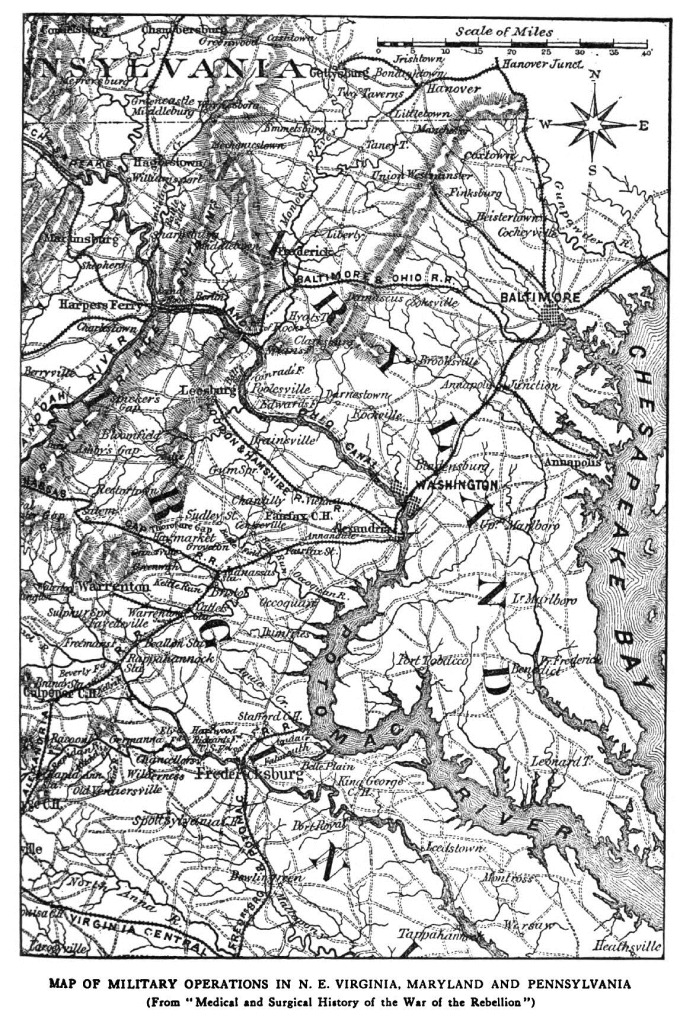
Next to the purveyors of curiosities and hotel keepers, the Indians, who live in a village at some distance from Niagara, reap the largest profit from the crowds of visitors who repair annually to the Falls. They are a harmless and by no means elevated race of semi-civilised savages, whose energies are expended on whiskey, feather fans, bark canoes, ornamental mocassins, and carved pipe stems. I had arranged for an excursion to see them in their wigwams one morning, when the news was brought to me that General Scott had ordered, or been forced to order the advance of the Federal troops encamped in front of Washington, under the command of McDowell, against the Confederates, commanded by Beauregard, who was described as occupying a most formidable position, covered with entrenchments and batteries in front of a ridge of hills, through which the railway passes to Richmond.
The New York papers represent the Federal army to be of some grand indefinite strength, varying, from 60,000 to 120,000 men, full of fight, admirably equipped, well disciplined, and provided with an overwhelming force of artillery. General Scott, I am very well assured, did not feel such confidence in the result of an invasion of Virginia, that he would hurry raw levies and a rabble of regiments to undertake a most arduous military operation.
The day I was introduced to the General he was seated at a table in the unpretending room which served as his boudoir in the still humbler house where he held his head-quarters. On the table before him were some plans and maps of the harbour defences of the Southern ports. I inferred he was about to organise a force for the occupation of positions along the coast. But when I mentioned my impression to one of his officers, he said, “Oh, no, the General advised that long ago; but he is now convinced we are too late. All he can hope, now, is to be allowed time to prepare a force for the field, but there are hopes that some compromise will yet take place.”
The probabilities of this compromise have vanished: few entertain them now. They have been hanging Secessionists in Illinois, and the court-house itself has been made the scene of Lynch law murder in Ogle county. Petitions, prepared by citizens of New York to the President, for a general convention to consider a compromise, have been seized. The Confederates have raised batteries along the Virginian shore of the Potomac. General Banks, at Baltimore, has deposed the police authorities “proprio motu,” in spite of the protest of the board. Engagements have occurred between the Federal steamers and the Confederate batteries on the Potomac. On all points, wherever the Federal pickets have advanced in Virginia, they have encountered opposition and have been obliged to halt or to retire.
As I stood on the verandah this morning, looking for the last time on the Falls, which were covered with a grey mist, that rose from the river and towered unto the sky in columns which were lost in the clouds, a voice beside me said, ” Mr. Russell, that is something like the present condition of our country, mists and darkness obscure it now, but we know the great waters are rushing behind, and will flow till eternity.” The speaker was an earnest, thoughtful man, but the country of which he spoke was the land of the South. “And do you think,” said I, “when the mists clear away the Falls will be as full and as grand as before?” “Well,” he replied, “they are great as it is, though a rock divides them; we have merely thrown our rock into the waters,—they will meet all the same in the pool below.” A coloured boy, who has waited on me at the hotel, hearing I was going away, entreated me to take him on any terms, which were, I found, an advance of nine dollars, and twenty dollars a month, and, as I heard a good account of him from the landlord, I installed the young man into my service. In the evening I left Niagara on my way to New York.

 —Ben. McCulloch, Brigadier-General of the rebel forces, issued a proclamation to the citizens of Arkansas, as follows:—”To defend your frontier, troops of Missouri are falling back upon you. If they are not sustained, your State will be invaded and your homes desolated. All that can arm themselves will rendezvous at Fayetteville, where they will await further orders. All those who have arms of the State, will march to the scene of action, or give their arms to those who will not desert their country in the hour of danger. All organized companies, whether cavalry or infantry, will report at Fayetteville, and will at once be formed into regiments and battalions. The necessary subsistence stores will be forwarded from this post. Rally promptly, then, citizens of Arkansas, and let us drive this Northern horde back from whence they came.”—Memphis Argus, July 1.