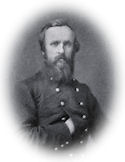
July 24.—A.M. our regiment was reviewed by the Governor and Major-General Frémont. It was a gratifying scene. The Colonel (Frémont—I must always think of the man of fifty-six [as] the colonel) looked well. How he inspires confidence and affection in the masses of people! The night before I was introduced to him at the American. He is a romantic, rather perhaps than a great, character. But he is loyal, brave, and persevering beyond all compare. Lucy and Laura were present.
Sunday, July 24, 2011
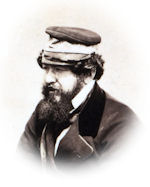
July 24th.—I rode out before breakfast in company with Mr. Monson across the Long Bridge over to Arlington House. General M’Dowell was seated at a table under a tree in front of his tent, and got out his plans and maps to explain the scheme of battle.
Cast down from his high estate, placed as a subordinate to his junior, covered with obloquy and abuse, the American General displayed a calm self-possession and perfect amiability which could only proceed from a philosophic temperament and a consciousness that he would outlive the calumnies of his countrymen. He accused nobody; but it was not difficult to perceive he had been sacrificed to the vanity, self-seeking, and disobedience of some of his officers, and to radical vices in the composition of his army.
When M’Dowell found he could not turn the enemy’s right as he intended, because the country by the Occoquan was unfit for the movements of artillery, or even infantry, he reconnoitred the ground towards their left, and formed the project of turning it by a movement which would bring the weight of his columns on their extreme left, and at the same time overlap it, whilst a strong demonstration was made on the ford at Bull’s Run, where General Tyler brought on the serious skirmish of the 18th. In order to carry out this plan, he had to debouch his columns from a narrow point at Centreville, and march them round by various roads to points on the upper part of the Run, where it was fordable in all directions, intending to turn the enemy’s batteries on the lower roads and bridges. But although he started them at an early hour, the troops moved so slowly the Confederates became aware of their design, and were enabled to concentrate considerable masses of troops on their left.
The Federals were not only slow, but disorderly. The regiments in advance stopped at streams to drink and fill their canteens, delaying the regiments in the rear. They wasted their provisions, so that many of them were without food at noon, when they were exhausted by the heat of the sun and by the stifling vapours of their own dense columns. When they at last came into action some divisions were not in their places, so that the line of battle was broken; and those which were in their proper position were exposed, without support, to the enemy’s fire. A delusion of masked batteries pressed on their brain. To this was soon added a hallucination about cavalry, which might have been cured had the Federals possessed a few steady squadrons to manœuvre on their flanks and in the intervals of their line.
Nevertheless, they advanced and encountered the enemy’s fire with some spirit; but the Confederates were enabled to move up fresh battalions, and to a certain extent to establish an equality between the numbers of their own troops and the assailants, whilst they had the advantages of better cover and ground. An apparition of a disorderly crowd of horsemen in front of the much-boasting Fire Zouaves of New York threw them into confusion and flight, and a battery which they ought to have protected was taken. Another battery was captured by the mistake of an officer, who allowed a Confederate regiment to approach the guns, thinking they were Federal troops, till their first volley destroyed both horses and gunners. At the critical moment, General Johnston, who had escaped from the feeble observation and untenacious grip of General Patterson and his time-expired volunteers, and had been hurrying down his troops from Winchester by train, threw his fresh battalions on the flank and rear of the Federal right. When the General ordered a retreat, rendered necessary by the failure of the attack —disorder spread, which increased—the retreat became a flight which degenerated—if a flight can degenerate— into a panic, the moment the Confederates pressed them with a few cavalry and horse artillery. The efforts of the Generals to restore order and confidence were futile. Fortunately a weak reserve was posted at Centreville, and these were formed in line on the slope of the hill, whilst M’Dowell and his officers exerted themselves with indifferent success to arrest the mass of the army, and make them draw up behind the reserve, telling the men a bold front was their sole chance of safety. At midnight it became evident the morale of the army was destroyed, and nothing was left but a speedy retrograde movement, with the few regiments and guns which were in a condition approaching to efficiency, upon the defensive works of Washington.
Notwithstanding the reverse of fortune, M’Dowell did not appear willing to admit his estimate of the Southern troops was erroneous, or to say “Change armies, and I’ll fight the battle over again.” He still held Mississippians, Alabamians, Louisianians, very cheap, and did not see, or would not confess, the full extent of the calamity which had fallen so heavily on him personally. The fact of the evening’s inactivity was conclusive in his mind that they had a dearly bought success, and he looked forward, though in a subordinate capacity, to a speedy and glorious revenge.
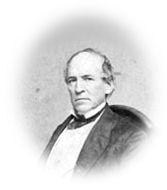
WEDNESDAY, JULY 24, 1861.
This has been a delightful day and one full of excitement and interest. The Ave has been thronged all day with soldiers. Small squads of them have been strolling into the City and all had their story of hair breadth escapes to tell surrounded by an eager crowd of listeners. Most of the Regts who were in the Action have returned to this side and taken up their old quarters, and other fresh troops have been sent over the River. I was at Willards this evening. The City is now overflowing. Sergent M Goodrich stayed with me tonight.

______
The three diary manuscript volumes, Washington during the Civil War: The Diary of Horatio Nelson Taft, 1861-1865, are available online at The Library of Congress.
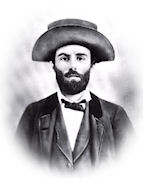
July, Tuesday 24th, 1861.
At the Battle-ground near Bull Bun.
Dear Sisters:
We have had so many small marches and large fights lately that I have had no time to write, and because we left everything but blankets and provisions when we set out to meet the enemy last week—paper among the rest—I borrow this, and am fortunate in doing so. Last Tuesday, the 18th, we, the 7th regiment, hurried up to the aid of the 1st Virginia and some other regiments who were defending Blackford’s Ford, on Bull’s Creek. We went in under a heavy fire of musketry, but we were in some measure protected by trees and the overshooting of the enemy. Colonel Hays considered the fire there very heavy. On Sunday the enemy attacked the whole line guarded by our troops, but at this point, Stony Bridge, the main battle was fought. Our regiment was entrenched where the first battle was fought that morning at the Ford, but gave up the situation to some others, and we were held as a reserve. We were kept marching around, with an occasional bombshot falling about us and taking off a few of our regiment, for I suppose about five hours; then we came here too fast by a long deal for comfort, and arrived almost exhausted, but still, from all accounts, our approach decided the affair, and we were not in the fire of the enemy more than ten minutes or a quarter of an hour before they retired. I cannot give particulars; you will get them from the papers, and I wish you would send brother and sister an account of same.
I have heard many a ball sing its death-note since I saw you, but am as well as ever I was, and honorably so, too. The day after the battle I was in search of water, and strayed over the battlefield; it was wet and foggy, and it did not take me as long to get lost as it did to find my way back to camp again. One of my messmates went to the Colonel and told him that I was long gone, whereupon the Colonel paid me the compliment to be uneasy and to say he would willingly send the whole regiment to my rescue if the enemy had me, adding, that the first day he saw me he knew that I was to be depended upon. I had given the Colonel a cup of coffee that morning; there was almost none in camp, and perhaps that attention and my coming from West Texas helped me to get the compliment. I tell the anecdote to you, knowing that it will please you, as it did me.
Direct to the same place to be forwarded. I have not drawn the money yet. Some of the company fell back, but your brother was not among the number.
Claude.
My position here is much to my satisfaction; the snobs are becoming modest. Colonel Hays’ saying he would turn out the regiment for me was of course only a compliment, but I think he likes me. I would not be anywhere else for anything. Write to Texas for me; our things have not come up yet, so I can not write for myself.
__________

About ten days after this last letter was written Claude LeGrand was shot in the right arm, near the shoulder, at the battle of Port Republic, in the Shenandoah Valley. “After he was wounded, without paying any attention to his own hurt,” writes his niece, Mrs. Weeden, “he assisted in putting others of the wounded into wagons. In helping lift a heavy man his superior officer reproached him for seeming lack of energy. LeGrand replied that he was doing the best he could, as he could not use his right arm. On examination the officer was overcome with sympathy, and told him that he should have been one of the first to receive attention and assisted LeGrand into the wagon himself. He was then jolted over a rough road to Charlottesville, with only straw for a bed and but a bucket of water by his side as dressing for the cruel wound. There he lay in a barn for three days without attention, with the result his arm had to be amputated at the shoulder. He gave great promise as a sculptor, and it can easily be seen what the loss of his right arm meant to him.” Fortunately, there was nursing at the Charlottesville hospitals at this time a friend of Claude LeGrand’s sister, Mrs. Johnston. This was Miss Emily Virginia Mason. She at length discovered young LeGrand among the crowd of wounded men, and nursed him carefully, sending tidings of him to the distracted brother and sisters, who had been for a long time without news of him.
__________
p. 26 – 29, Journal of Julia LeGrand, who at this point is in New Orleans, the journal to be started in December, 1861.
JULY 24TH—Yesterday we received a letter from Col. Bartow, written just before the battle (in which he fell, his letter being received after the announcement of his death), urging the appointment of his gallant young friend Lamar to a lieutenancy. I noted these facts on the back of his letter, with the Secretary’s approbation, and also that the request had been granted, and placed the letter, perhaps the last he ever wrote, in the archives for preservation.
CAMP CHASE, July 24, 1861.
DEAR UNCLE:—I am surrounded by the bustle and confusion attendant upon a hurried leaving of camp. We go tomorrow at 5 A. M. to Zanesville by railroad, thence down the Muskingum on steamboats to Marietta, and on the Ohio to Ripley Landing, a short distance from Point Pleasant in Virginia. We are to be a part of General Rosecrans’ force against Wise.
Last night I had a good chat with Frémont. He is a hero. All his words and acts inspire enthusiasm and confidence. He and the governor reviewed our regiment today. Lucy, Laura, and many friends were present. It was a stirring scene. I wish you could have been here. You would subscribe heartily to General Fremont. Good-bye. My saddest feeling—my almost only sad feeling—is leaving you in such bad health.
Affectionately,
R. B. HAYES.
P.S.—Always send me full sheets of paper—the blank sheet is so useful. The use and scarcity of paper is appalling.
S. BIRCHARD.
July 24th.—Here Mr. Chesnut opened my door and walked in. Out of the fulness of the heart the mouth speaketh. I had to ask no questions. He gave me an account of the battle as he saw it (walking up and down my room, occasionally seating himself on a window sill, but too restless to remain still many moments); and told what regiments he was sent to bring up. He took the orders to Colonel Jackson, whose regiment stood so stock still under fire that they were called a “stone wall.” Also, they call Beauregard, Eugene, and Johnston, Marlboro. Mr. Chesnut rode with Lay’s cavalry after the retreating enemy in the pursuit, they following them until midnight. Then there came such a fall of rain—rain such as is only known in semitropical lands.
In the drawing-room, Colonel Chesnut was the “belle of the ball;” they crowded him so for news. He was the first arrival that they could get at from the field of battle. But the women had to give way to the dignitaries of the land, who were as filled with curiosity as themselves—Mr. Barnwell, Mr. Hunter, Mr. Cobb, Captain Ingraham, etc.
Wilmot de Saussure says Wilson of Massachusetts, a Senator of the United States,¹ came to Manassas, en route to Richmond, with his dancing shoes ready for a festive scene which was to celebrate a triumph. The New York Tribune said: “In a few days we shall have Richmond, Memphis, and New Orleans. They must be taken and at once.” For “a few days” maybe now they will modestly substitute “in a few years.”
They brought me a Yankee soldier’s portfolio from the battle-field. The letters had been franked by Senator Harlan.² One might shed tears over some of the letters. Women, wives and mothers, are the same everywhere. What a comfort the spelling was! We had been willing to admit that their universal free-school education had put them, rank and file, ahead of us literarily, but these letters do not attest that fact. The spelling is comically bad.

______
¹ Henry Wilson, son of a farm laborer and self-educated, who rose to much prominence in the Anti-Slavery contests before the war. He was elected United States Senator from Massachusetts in 1855, holding the office until 1873, when he resigned, having been elected Vice-President of the United States on the ticket with Ulysses S. Grant.
² James Harlan, United States Senator from Iowa from 1855 to 1865. In 1865 he was appointed Secretary of the Interior.
—The Richmond (Va.) Whig of today contains the following:—” The Devoted Band.”—The shortest path to peace is that which carries havoc and desolation to our invaders. It is believed that there are five or ten thousand men in the South ready and willing to share the fate of Curtius and devote themselves to the salvation of their country. It is proposed that all who are willing to make this sacrifice, shall arm themselves with a sword, two five shooters, and a carbine each, and meet on horseback at some place to be designated, convenient for the great work in hand. Fire and sword must be carried to the houses of those who are visiting those blessings upon their neighbors. Philadelphia, and even New York, is not beyond the reach of a long and brave arm. The moral people of these cities cannot be better taught the virtues of invasion than by the blazing light of their own dwellings.
None need apply for admission to “the Devoted Band ” but those who are prepared to take their life in their hand, and who would indulge not the least expectation of ever returning. They dedicate their lives to the destruction of their enemies!
A. S. B. D. B., Richmond.
All southern papers are requested to give this notice a few insertions.
—The Seventh Regiment of Pennsylvania Volunteers, commanded by Colonel E. B. Harvey, arrived at Washington, D. C. The Regiment numbers 1,046 young and intelligent members.—Philadelphia Press, July 25.
—An expedition of 300 men under Lieut. Crosby, U. S. A., left Fortress Monroe to reconnoitre in Back River, Va., where it burned nine sloops and schooners, and made prize one schooner laden with bacon and corn.—N. Y. Times, July 27.
—This day the loyal citizens of Baltimore, Md., presented an American flag to the Massachusetts Eighth Regiment. The flag, which is of the richest banner silk, was presented in an eloquent and apropriate speech by Perley Lovejoy, Esq., which was responded to by Colonel Hinks, who alluded to the many kind friends the regiment had made in the city of Baltimore.—Baltimore American, July 25.
—Heavy offers of men were made to the Government by telegraph from all parts of the North. From Illinois, 17, and from Indiana, 10 regiments were offered. By noon of this day 80,000 men had been accepted.—An order was issued by General Mansfield directing all straggling soldiers to join their respective regiments without delay, and warning that all stragglers found in the streets six hours after the promulgation of the order, would be deemed guilty of disobedience of orders, and would be arrested. —N. Y. Herald, July 25.
—The Third Regiment of Vermont Volunteers, commanded by Colonel W. N. Smith, left St. Johnsbury, Vt., for the seat of war.—N. Y. Commercial, July 25.
—John Bradley, a young man studying for the ministry, son of a wealthy citizen, and Columbus Bradley were arrested this evening, at Alexandria, Va., by the Provost Marshal, as spies taking information to Manassas.—Louisville Journal, July 26.
—First Lieutenant Luigi Vizia, an Italian officer of the engineer department who has been many years in the military service, and who served with credit in the glorious campaign of Italian liberation of Italy, arrived at New York, to offer his services to the American Government. On his way to America he fell in with an agent of the rebel Government who attempted to persuade him to take service under that Government, and offered to pay his passage.— N. Y. Evening Post, July 26.
—The ladies of Harper’s Ferry, Va., presented a Union flag to the Second Regiment of Massachusetts Volunteers to-day, with appropriate ceremonies.—Boston Advertiser, July 31.
——-
Late addition to Volume 3:
July 24.—The Presbytery of South Alabama met at Selma, Alabama, and severed its ecclesiastical connection with the General Assembly of the United States, and recommended a meeting of a Confederate States Assembly at Memphis, Tennessee, on the 4th of December next. Though not in favor of a preliminary convention, yet the Presbytery, in view that such might be the general wish, appointed delegates to one and recommend Atlanta as that place, and the 15th August as the time for holding it.—N. Y. Evening Post, August 12.


