Following the American Civil War Sesquicentennial with day by day writings of the time, currently 1863.

Monday, July 4, 2011

July 4th.—”Independence Day.” Fortunate to escape this great national festival in the large cities of the Union where it is celebrated with many days before and after of surplus rejoicing, by fireworks and an incessant fusillade in the streets, I was, nevertheless, subjected to the small ebullition of the Washington juveniles, to bell-ringing and discharges of cannon and musketry. On this day Congress meets. Never before has any legislative body assembled under circumstances so grave. By their action they will decide whether the Union can ever be restored, and will determine whether the States of the North are to commence an invasion for the purpose of subjecting by force of arms, and depriving of their freedom, the States of the South.

Congress met to-day merely for the purpose of forming itself into a regular body, and there was no debate or business of public importance introduced. Mr. Wilson gave me to understand, however, that some military movements of the utmost importance might be expected in a few days, and that General M’Dowell would positively attack the rebels in front of Washington. The Confederates occupy the whole of Northern Virginia, commencing from the peninsula above Fortress Monroe on the right or east, and extending along the Potomac, to the extreme verge of the State, by the Baltimore and Ohio Railway. This immense line, however, is broken by great intervals, and the army with which M’Dowell will have to deal may be considered as detached, covering the approaches to Richmond, whilst its left flank is protected by a corps of observation, stationed near Winchester, under General Jackson. A Federal corps is being prepared to watch the corps and engage it, whilst M’Dowell advances on the main body. To the right of this again, or further west, another body of Federals, under General M’Clellan, is operating in the valleys of the Shenandoah and in Western Virginia; but I did not hear any of these things from Mr. Wilson, who was, I am sure, in perfect ignorance of the plans, in a military sense, of the general. I sat at Mr. Sumner’s desk, and wrote the final paragraphs of a letter describing my impressions of the South in a place but little disposed to give a favourable colour to them.

When the Senate had adjourned, I drove to the State Department and saw Mr. Seward, who looked much more worn and haggard than when I saw him last, three months ago. He congratulated me on my safe return from the South in time to witness some stirring events. “Well, Mr. Secretary, I am quite sure that, if all the South are of the same mind as those I met in my travels, there will be many battles before they submit to the Federal Government.”

“It is not submission to the Government we want; it is to assent to the principles of the Constitution. When you left Washington we had a few hundred regulars and some hastily-levied militia to defend the national capital, and a battery and a half of artillery under the command of a traitor. The Navy-yard was in the hands of a disloyal officer. We were surrounded by treason. Now we are supported by the loyal States which have come forward in defence of the best Government on the face of the earth, and the unfortunate and desperate men who have commenced this struggle will have to yield or experience the punishment due to their crimes.”

“But, Mr. Seward, has not this great exhibition of strength been attended by some circumstances calculated to inspire apprehension that liberty in the free States may be impaired; for instance, I hear that I must procure a passport in order to travel through the States and go into the camps in front of Washington.”

“Yes, sir; you must send your passport here from Lord Lyons, with his signature. It will be no good till I have signed it, and then it must be sent to General Scott, as Commander-in-Chief of the United States army, who will subscribe it, after which it will be available for all legitimate purposes. You are not in any way impaired in your liberty by the process.”

“Neither is, one may say, the man who is under surveillance of the police in despotic countries in Europe; he has only to submit to a certain formality, and he is all right; in fact, it is said by some people, that the protection afforded by a passport is worth all the trouble connected with having it in order.”

Mr. Seward seemed to think it was quite likely. There were corresponding measures taken in the Southern States by the rebels, and it was necessary to have some control over traitors and disloyal persons. “In this contest,” said he, “the Government will not shrink from using all the means which they consider necessary to restore the Union.” It was not my place to remark that such doctrines were exactly identical with all that despotic governments in Europe have advanced as the ground of action in cases of revolt, or with a view to the maintenance of their strong Governments. “The Executive,” said he, “has declared in the inaugural that the rights of the Federal Government shall be fully vindicated. We are dealing with an insurrection within our own country, of our own people, and the Government of Great Britain have thought fit to recognise that insurrection before we were able to bring the strength of the Union to bear against it, by conceding to it the status of belligerent. Although we might justly complain of such an unfriendly act in a manner that might injure the friendly relations between the two countries, we do not desire to give any excuse for foreign interference; although we do not hesitate, in case of necessity, to resist it to the uttermost, we have less to fear from a foreign war than any country in the world. If any European Power provokes a war, we shall not shrink from it. A contest between Great Britain and the United States would wrap the world in fire, and at the end it would not be the United States which would have to lament the results of the conflict.”

I could not but admire the confidence—may I say the coolness?—of the statesman who sat in his modest little room within the sound of the evening’s guns, in a capital menaced by their forces who spoke so fearlessly of war with a Power which could have blotted out the paper blockade of the Southern forts and coast in a few hours, and, in conjunction with the Southern armies, have repeated the occupation and destruction of the capital.

The President sent for Mr. Seward whilst I was in the State Department, and I walked up Pennsylvania Avenue to my lodgings, through a crowd of men in uniform who were celebrating Independence Day in their own fashion—some by the large internal use of fire-water, others by an external display of fireworks.

Directly opposite my lodgings are the head-quarters of General Mansfield, commanding the district, which are marked by a guard at the door and a couple of six-pounder guns pointing down the street. I called upon the General, but he was busy examining certain inhabitants of Alexandria and of Washington itself, who had been brought before him on the charge of being Secessionists, and I left my card, and proceeded to General Scott’s head-quarters, which I found packed with officers. The General received me in a small room, and expressed his gratification at my return, but I saw he was so busy with reports, despatches, and maps, that I did not trespass on his time. I dined with Lord Lyons, and afterwards went with some members of the Legation to visit the camps, situated in the public square.

All the population of Washington had turned out in their best to listen to the military bands, the music of which was rendered nearly inaudible by the constant discharge of fireworks. The camp of the 12th New York presented .a very pretty and animated scene. The men liberated from duty were enjoying themselves out and inside their tents, and the sutlers’ booths were driving a roaring trade. I was introduced to Colonel Butterfield, commanding the regiment, who was a merchant of New York; but notwithstanding the training of the counting-house, he looked very much like a soldier, and had got his regiment very fairly in hand. In compliance with a desire of Professor Henry, the Colonel had prepared a number of statistical tables in which the nationality, height, weight, breadth of chest, age, and other particulars respecting the men under his command were entered. I looked over the book, and as far as I could judge, but two out of twelve of the soldiers were native-born Americans, the rest being Irish, German, English, and European-born generally. According to the commanding officer they were in the highest state of discipline and obedience. He had given them leave to go out as they pleased for the day, but at tattoo only 14 men out of 1000 were absent, and some of those had been accounted for by reports that they were incapable of locomotion owing to the hospitality of the citizens.

When I returned to my lodgings, the coloured boy whom I had hired at Niagara was absent, and I was told he had not come in since the night before. “These free coloured boys,” said my landlord, “are a bad set; now they are worse than ever; the officers of the army are taking them all away from us; it’s just the life they like; they get little work, have good pay; but what they like most is robbing and plundering the farmers’ houses over in Virginia; what with Germans Irish, and free niggers, Lord help the poor Virginians, I say; but they’ll give them a turn yet.”

The sounds in Washington to-night might have led one to believe the city was carried by storm. Constant explosion of fire-arms, fireworks, shouting, and cries in the streets, which combined, with the heat and the abominable odours of the undrained houses and mosquitoes, to drive sleep far away.

July 4.—This day General Scott promised himself and his Northern friends to dine in Richmond. Poor old renegade, I trust he has eaten his last dinner in Richmond, the place of his marriage, the birthplace of his children, the home of his early friendships, and so near the place of his nativity and early years.

How can he wish to enter Richmond but as a friend? But it is enough for us to know that he is disappointed in his amiable and patriotic wish to-day. So may it be.

I have seen W. H., who has just returned from Fairfax. Last week he scouted near our house, and gives no very encouraging report for us. Our hills are being fortified, and Alexandria and the neighbourhood have become one vast barracks. The large trees are being felled, and even houses are falling by order of the invader! Our prospect of getting home becomes more and more dim; my heart sinks within me, and hope is almost gone. What shall we do, if the war continues until next winter, without a certain resting-place? Our friends are kind and hospitable, open-hearted and generous to a wonderful degree. In this house we are made to feel not only welcome, but that our society gives them heartfelt pleasure. Other friends, too, are most kind in giving invitations “for the war”—” as long as we find it agreeable to stay,” etc.; but while this is very gratifying and delightful, yet we must get some place, however small and humble, to call home. Our friends here amuse themselves at my fears; but should the war continue, I do not think that they have any guarantee that they will not be surrounded by an unfriendly host. They think that they will not leave their homes under any circumstances; perhaps not, because they are surrounded by so much property that they must protect; but the situation will be very trying. Whenever I express a feeling of despondency, Mr. _____ meets it with the calm reply, that the “Lord will provide,” so that I am really ashamed to give place to fear. The situation of the people of Hampton is far worse than ours—their homes reduced to ashes; their church in ruins! That venerable colonial church, in which for generations they have been baptized, received the Holy Communion, been married, and around which their dead now lie. Their very graves desecrated; their tomb-stones torn down and broken; the slabs, sacred to the memory of their fathers, children, husbands, wives, which have been watched and decorated perhaps for years, now converted into dining-tables for the Yankee soldiery. How can human hearts bear such things and live? We have not yet been subjected to any thing of the kind, and I humbly trust that so dire a calamity may be averted.

THURSDAY 4

The weather has been delightful and very favorable to the great Military Review. Twenty three Regiments, or over twenty thousand men, marched past the Prests House on the Ave. It was a great display for NY, for it was a Review of only the NY Regts by Maj Genl Sanford. Genl Scott, the Prest, and Cabinet were out on a platform erected for the occasion. Met Mr VanMaster at Willards, attended the Dress Parade of the 12th, and their festivities in the evening at their camp. Came with the family at 1/2 past nine.

______

The three diary manuscript volumes, Washington during the Civil War: The Diary of Horatio Nelson Taft, 1861-1865, are available online at The Library of  Congress.

July 4th, 1861.—This day, which was once so filled with merriment and pleasure, is now a thing of the past, where we are concerned. Father and my uncles let the negroes go ahead with the usual Fourth of July barbecue. Father said it would not be right to curtail their pleasures because of our own troubles; so they are having a merry time today.

July 4th.—Russell abuses us in his letters. People here care a great deal for what Russell says, because he represents the London Times, and the Times reflects the sentiment of the English people. How we do cling to the idea of an alliance with England or France! Without France even Washington could not have done it.

We drove to the camp to see the President present a flag to a Maryland regiment. Having lived on the battlefield (Kirkwood), near Camden,¹ we have an immense respect for the Maryland line. When our militia in that fight ran away, Colonel Howard and the Marylanders held their own against Rawdon, Cornwallis, and the rest, and everywhere around are places named for a doughty captain killed in our defense—Kirkwood, De Kalb, etc. The last, however, was a Prussian count. A letter from my husband, written June 22d, has just reached me. He says:

“We are very strongly posted, entrenched, and have now at our command about 15,000 of the best troops in the world. We have besides, two batteries of artillery, a regiment of cavalry, and daily expect a battalion of flying artillery from Richmond. We have sent forward seven regiments of infantry and rifles toward Alexandria. Our outposts have felt the enemy several times, and in every instance the enemy recoils. General Johnston has had several encounters—the advancing columns of the two armies —and with him, too, the enemy, although always superior in numbers, are invariably driven back.

“There is great deficiency in the matter of ammunition. General Johnston’s command, in the very face of overwhelming numbers, have only thirty rounds each. If they had been well provided in this respect, they could and would have defeated Cadwallader and Paterson with great ease. I find the opinion prevails throughout the army that there is great imbecility and shameful neglect in the War Department.

“Unless the Republicans fall back, we must soon come together on both lines, and have a decided engagement. But the opinion prevails here that Lincoln’s army will not meet us if they can avoid it. They have already fallen back before a slight check from 400 of Johnston’s men. They had 700 and were badly beaten. You have no idea how dirty and irksome the camp life is. You would hardly know your best friend in camp guise.”

Noise of drums, tramp of marching regiments all day long; rattling of artillery wagons, bands of music, friends from every quarter coming in. We ought to be miserable and anxious, and yet these are pleasant days. Perhaps we are unnaturally exhilarated and excited.

Heard some people in the drawing-room say: “Mrs. Davis’s ladies are not young, are not pretty,” and I am one of them. The truthfulness of the remark did not tend to alleviate its bitterness. We must put Maggie Howell and Mary Hammy in the foreground, as youth and beauty are in request. At least they are young things—bright spots in a somber-tinted picture. The President does not forbid our going, but he is very much averse to it. We are consequently frightened by our own audacity, but we are wilful women, and so we go.

______

¹ At Camden in August, 1780, was fought a battle between General Gates and Lord Cornwallis. in which Gates was defeated. In April of the following year near Camden, Lord Rawdon defeated General Greene.

JULY 4TH.—These simple things provoked some remarks from the young gentlemen in the department, and gave rise to predictions that he would soon supplant us all in the affections of the Secretary. And he is nimble of foot too, and enters the Secretary’s room twice to Col. B.’s or Major T.’s once. I go not thither unless sent for; for in a cause like this, personal advancement, when it involves catering to the caprices of functionaries dressed in a little brief authority, should be spurned with contempt. But Col. Bledsoe is shocked, and renews his threats of resignation. Major Tyler is eager to abandon the pen for the sword; but Congress has not acted on his nomination; and the West Pointers, many of them indebted to his father for their present positions, are inimical to his confirmation.

.john beauchamp jones cartoon

.

.(First cartoon in yesterday’s post.)

.

.


John Beauchamp Jones images.

john beauchamp jones cartoon2

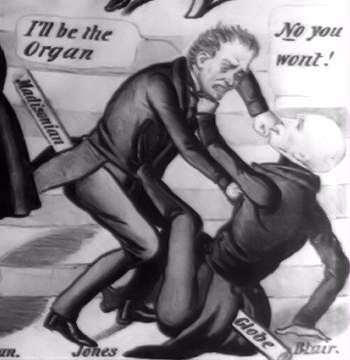
The only actual images of Jones that I have been able to find online are as a minor figure in two political cartoons from before the civil war when he was the editor of a newspaper, the “Madisonian.”
In a second cartoon from 1844, minor characters John Beauchamp Jones and Francis Preston Blair, editors of influential rival newspapers, the “Madisonian” and the “Globe,” fight for the privilege of being the administration organ for the newly elected James K. Polk. (from
original image at Library of Congress)

—Lieutenant-Colonel J. W. Ripley, head of the Ordnance Department, received the brevet of Brigadier-General in the United States Army. A well-merited honor. He is one of the oldest and most valuable officers of the army. He was abroad on leave at the commencement of the rebellion, but hastened home to offer his services. On being asked by a friend if he had returned to engage in the war, he replied: ” Yes, and to give my last drop of blood to defend my Government.” He has disowned his nephew, Major Ripley, who took part in the attack on Fort Sumter.

Captain (now Major) Doubleday of the First Artillery, recently promoted to be a Major in the Seventeenth foot, received his new commission.—Baltimore American, July 5.

—The Mozart Regiment, N. Y. Volunteers, embarked this morning, at Yonkers, and left for Elizabethport, N. J., to take the cars for Washington. The regiment numbered 1,046, and were armed with Enfield muskets. They had two hundred common tents, forty officers’ tents, ten baggage wagons, each drawn by six horses, four hospital ambulances, twenty camp stoves, and two brass 12-pound howitzers.— N. Y. World, July 6.

—A Union meeting was held at the city of Louisiana, Missouri, at which Mr. Charles D. Drake delivered an elaborate speech in defence of the Union and the Constitution.—(Doc. 63.)

—Pursuant to the call of the President of the United States, Congress assembled at Washington this day in special session. Galusha A. Grow, of Penn., was elected speaker of the House, and took the oath of office, which was administered by Mr. Washburne of Illinois. The President’s message was received and read together with reports of the heads of the various departments. The message is brief, and the facts it states are well known; the important points of the document are those which embody the recommendations of the President in relation to the measures to be adopted for the prosecution of the war. Compromise by Congress ho regards as out of the question. The people only can compromise on a question which affects the existence of the nation. He therefore asks that Congress give to the Executive the “legal means to make the contest a short and decisive one, by placing at the control of Government for the work at least four hundred thousand men and four hundred millions of dollars.” That number of men, he says, are ready and willing to take arms for the support of the Government, whilst the amount asked for war purposes is quite within the ability of the country to supply.—(Doc. 65, 66, 67, 68.)

—A Small flag of the Southern Confederacy was raised over a house on an alley in the upper part of the city of Louisville, Ky., to-day. The perpetration of such a deed on such a day is almost sacrilegious. The miserable flag’s time was short. Some patriotic Germans took it down, and bore it away, and burned it. Its ashes are a part of the mud of the streets.— Louisville Journal, July 8.

—The passenger trains on the Louisville and Nashville railroad were seized this morning at Camp Ironsdale, near Mitchellsville, by order of Major-General Anderson, and carried to Nashville, Tenn. The managers had taken all the engines and running stock to Louisville. Ky., against which policy Tennessee had remonstrated, and this seizure was a necessity as a measure of protection. Major-General Anderson informed the agent of the road that no further seizures would be made, and that trains should pass uninterrupted.—Louisville Journal, July 5.

A skirmish took place at Harper’s Ferry, Va., this evening between companies of the New York Ninth Regiment and a detachment of Confederates, who had returned to Harper’s Ferry. A number of men belonging to one of the companies of the New York Ninth crossed over to the Ferry, for the purpose of seeing the work of destruction which had been perpetrated by the rebels, when they were fired upon by a party of men from Bolivar heights. They immediately crossed the river, returned to their encampment, and being reinforced, proceeded at once to the Potomac, opposite Harper’s Ferry, and opened fire upon them. The rebels, concealing themselves in the houses and behind the abutments of the burned bridge, had a decided advantage, and from their position poured a galling fire upon the Federal companies on this side, which were perfectly exposed: yet they stood their ground with almost reckless bravery, until the firing ceased from the opposite side, when they retired with a loss of two killed and three wounded. Several of the rebels were killed, one was killed by a citizen of Harper’s Ferry, who engaged in the fight, he being driven from the place by the rebels.—Baltimore American, July 8.

—The rebels erected a battery, and mounted two rifled cannon at Matthias Point, Va. —N. Y. Times, July C.

—The New Hampshire Legislature adjourned to-day, after a session of thirty days. Resolutions were reported, declaring the war now in progress a war solely for the maintenance of the Government and the suppression of rebellion; declaring against the right of secession; asserting that neither the President nor Congress can constitutionally entertain any proposition which has for its object the dismemberment of the Government or the dissolution of the Union; and finally declaring that the State of New Hampshire pledges her resources for the integrity of the Union, the support of the Constitution, and the enforcement of the laws of the General Government. When these resolutions were put to the vote the members all rose and gave a unanimous aye. Not a member voted in the negative. A militia bill was passed authorizing the Governor to raise three regiments, to each of which he may add a company of artillery, cavalry, and riflemen.—National Intelligencer, July 9.

—The Sixth Regiment of Massachusetts Militia, commanded by Colonel E. F. Jones, were presented with an elegant silk flag, by the loyal citizens of Baltimore, at the Relay House, where had assembled several thousand ladies and gentlemen for the purpose of witnessing the ceremonies. The regiment having been formed in a semicircle, S. J. K. Handy, Esq., advanced, and addressed the command in an eloquent and patriotic strain, presenting the flag in the name of the loyal citizens of Baltimore. Colonel Jones received the flag, and responded briefly to the address. He remarked, among other things, that ladies and gentlemen, representatives of the loyal citizens of Baltimore, had come to place the regiment under an additional obligation, in bestowing such a beautiful flag upon them. An acquaintance which opened in blood had been continued and cultivated with services of great kindness. The command appreciated the many acts which had been bestowed upon their wounded, as well as the kind expressions of the Union-loving citizens of Baltimore. The flag was accepted not only as a token of loyalty, but as an evidence of friendship, which he hoped would continue to grow and strengthen; and when it was unfurled at home, many eyes would be filled with tears in memory of those who had fallen. The presentation laid the old State of Massachusetts under an obligation to the city of Baltimore, and would ever be remembered by her best citizens. In concluding, he assured all present that the object of his regiment was not to oppress, or even to harass the South, but to protect the Capital and preserve the Government. He regretted that his language could but faintly express his feelings, but if his friends could look into his heart they would much better understand him. At the conclusion of his speech three cheers were given for Massachusetts, in response to which nine cheers were given by the regiment for teo loyal citizens of Baltimore. Baltimore American.

—A Correspondent of the Charleston Courier:—”There are some who affect to believe that we shall have a peace before we have a fight. The reaction so long predicted al the North having begun, the circulating petitions of merchants, bankers, clergymen, and other citizens of New York, which are pressing their peaceful influences upon Abraham Lincoln, are also operating here. The question is already being discussed in its various bearings, and the auspicious event has even been assigned a place this side of Christmas.

We have no idea, however, of giving up the contest without, at least, one grand exhibition of the power, the prowess, and the resources of the people who have been stigmatized as “the ruffian rebels of the South.” We went into the war on principle; let us come, out on principle, but not until we have left a mark upon our enemies that shall secure for us for all times to come the respect of the world. The hundred thousand men we have in the field will not be content to lay down their arms in peace, until they have struck a blow that shall quiver through the North; and unless this be done, the millions they have left behind them will have their “welcome home” alloyed by the thought that their husbands, sons, and brothers have returned without teaching that lesson of humiliation to an insolent foe, which, next to the Lord’s Prayer, has been the uppermost desire in every Southern heart.”