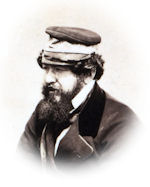
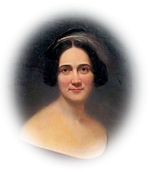
—Alexander H. Stephens delivered an elaborate speech at Augusta, Georgia, defending the cause of secession and pointing out the way to the success of the southern rebellion.— (Doc. 83.)
—This morning a young man presented himself at the quarters of one of the Pennsylvania Regiments, near Shuter’s Hill, opposite Washington, dressed in a suit of blue navy flannel, surmounted with a lieutenant’s epaulettes, and introduced himself as “Lieut. Smith of Company A, 6th Massachusetts Regiment.” Not being suspected at the time, he was allowed to inspect the works at Fort Ellsworth, and to witness the departure of the Zouaves toward Fairfax. Not until he had safely returned to Washington and been carried by the cars some miles on the road to Baltimore, was it discovered that a secessionist had been in camp.—N. Y. Tribune, July 13.
—The companies sent to the relief of Col. Smith, at Monroe, Missouri, returned to Hannibal this evening, and report the road unobstructed between Hannibal and Monroe. On arriving at the latter place, they formed a junction with Col. Smith’s force, which was intrenched in the Academy buildings. The rebels, 1,200 strong, were grouped over the prairie, out of reach of Col. Smith’s rifles. They had two pieces of artillery, which were brought to bear, but the distance was so great that the balls were almost spent before reaching the lines. Col. Smith’s artillery was of longer range, and did considerable execution. The fight lasted until dusk, and the last shot from the Federal side dismounted one of the rebels’ guns. Just at that moment Governor Wood, of Illinois, fell on their rear with the cavalry sent from Quincy and completely routed them, taking seventy-five prisoners, one gun, and a large number of horses. About twenty or thirty rebels were killed. Not one of the Unionists was killed, although several were severely wounded. General Tom Harris, the rebel leader, escaped.—Chicago Tribune, July 12.
—The New-Orleans Delta, of this day, says that further persistence of the Confederate States in the endeavor to obtain the recognition of our nationality is useless. It also says that the British Ministry have not the courage nor the inclination to apply to the Confederate States the rules which they have uniformly applied to other nations. It adds: “Too much importance has been assigned to the idea that France and England would break the blockade to get Southern products.” The editor, therefore, proposes a recall of the Southern Commissioners, and to refuse the recognition of resident Consuls of all the Powers which will not recognize similar officers of the Confederate States abroad.
—The rebels at New Orleans, La., have taken a powerful tug-boat, covered her with railroad iron, and put her machinery below the waterline. They have also built a new boat completely of iron, very sharp, with a sharp point below the waterline, intended to run down the Federal vessels of war. The latter will be commanded by Capt. Seward Porter, formerly of Portland, Maine.—National Intelligencer, July 16.
—The Charleston Mercury of this day publishes the following:—The Sixteenth Regiment S. C. M., comprising eight beat companies, were on the Green yesterday for inspection (?). A more ridiculous farce could not possibly have been enacted than that gone through with yesterday—that is, if regarded in a military point of view. If six hundred citizens, drawn up in two ranks, without arms or equipments, ununiformed, and ignorant of the first principles of a soldier’s duty, can be called a regiment, this was a regiment.
We forego further comment, only remarking, that what is a farce now, to be enjoyed by idle juveniles, may be at no distant day a tragedy over which the State will mourn.
—At St. Louis, Mo., about 400 men belonging to Col. McNeil’s regiment, a reserve corps, visited the State Journal office early this morning, removing the type, paper, etc. They then read an order from Gen. Lyon prohibiting the further publication of that sheet.
Col. McNeil published a proclamation to the people of Missouri, stating that the suppression of the State Journal was in consequence of its giving aid and comfort to those in active rebellion against the authority of the United States Government, encouraging the people to take up arms against that authority, to commit acts of violence and oppression against loyal citizens, and by the fabrication of false reports respecting the United States troops, inciting disaffected citizens to the commission of overt acts of treason, with a view of entirely subverting the Federal authority in the State.—N. Y. World, July 16.
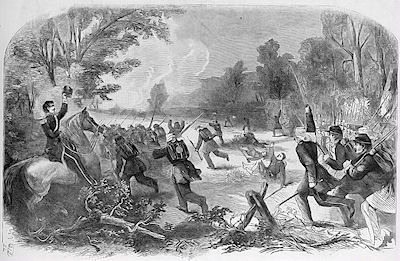
—A Battle was fought this afternoon at Rich Mountain,1 about two miles east of Roaring Run, Va. where the rebels, numbering about two thousand, under command of Col. Pegram, were strongly intrenched.
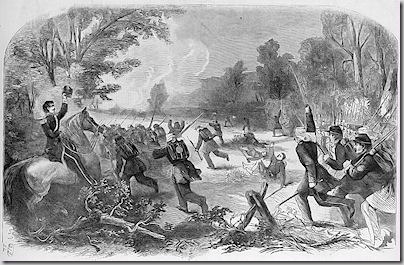 About 3 o’clock this morning Gen. McClellan ordered four regiments—the Eighth, Tenth, Thirteenth Indiana, and Nineteenth Ohio Regiments, under the command of Gen. Rosecrans —to proceed along the line of the hills southeast of the enemy’s intrenched camp on the Beverly road, where it crosses Rich Mountain, two miles east of the enemy’s position, with orders to advance along the Beverly road and attack the east side of the work—Gen. McClellan being prepared to assault the west side as soon as the firing should announce the commencement of the attack. The capture of a courier, who mistook the road through the enemy’s camp for the route of the Federal troops, placed the enemy in possession of intelligence of the movement.
The rebels, about 2,500 strong, with heavy earthwork batteries, were intrenched on the western slopes of the Rich Mountain, about twenty-five miles east from Buckhannon, and two miles west from Beverly, which is on the east side of the mountain. They had selected the forks of the Roaring Creek, which empties after a northerly course into the Tygart’s Valley River, a branch of the Monongahela. The creek crosses the road in two places, about a mile apart.
The morning was cool and bracing, and the Federal troops were in capital spirits. Gen. Rosecrans ordered the brigade to cut a path through a thick growth of mountain pine trees and heavy undergrowth of brush for nearly nine miles, which occupied about ten hours, resting at noon.
Late in the afternoon Gen. Rosecrans came on the rear of the rebels, and, after a desperate fight of an hour and a half, completely routed them, driving them in the utmost disorder into the woods, and capturing all their guns, wagons, and camp equipage, or, as Gen. McClellan says, “all they had.” They also took several prisoners, many officers among them. Sixty of the rebels were killed and a large number wounded. Of the Union troops twenty were killed and forty wounded. Gen. McClellan had his guns mounted to command the rebels’ position, but he found that the gallantry of Rosecrans spared him the trouble of going into action. He is now moving on Beverly, and the advance command of Gen. Rosecrans are within three miles of that place.—(Doc. 84.)
_____
1 Rich Mountain is a gap in the Laurel Hill Range where the Staunton and Weston turnpike crosses it between Buckhannon and Beverly, and about four or miles out of the latter place. It is about as far from Laurel Hill proper, (that is, where the Beverly and Fairmount pike crosses it, and where the enemy is intrenched,) as Beverly is: some 15 or 16 miles. It is also about 25 miles from Buckhannon.— Wheeling Intelligencer.