Following the American Civil War Sesquicentennial with day by day writings of the time, currently 1863.

Friday, July 8, 2011

Post image for “Yesterday we left Georgetown and after two hours march arrived at our present camping ground (in Virginia).”—War Letters of William Thompson Lusk.

Care of Lieut. S. R. Elliott,

10th Co., 79 Regiment, Virginia.

Glebewood, Virginia, July 8th, 1861.

My Dear Mother:

You see from the above that the “sacred soil” continues to be invaded. General Scott is inexorable, so, notwithstanding the protests of the States Right supporters, Regiment after Regiment crosses the line, and the sanctity of the Old Dominion is violated by the desecrating footsteps of the ruthless horsemen. Yesterday we left Georgetown and after two hours march arrived at our present camping ground. A romantic scene it was last night, arriving as we did at an evening hour. But our advent was followed by a dreadful act of destruction! The ruthless invaders charged with full force upon a snake-fence, demolished it, laid the pieces upon four different piles, and set to them the incendiary torch; soon our camp fires were blazing. The men fell into groups, some song-singing, some keeping guard, while here and there hoarse laughter showed that the solemnity of invading the sacred soil did not entirely prevent the outburst of unseasonable hilarity. Then the stars shone brightly, and the comet whisked its tail for us, and the tattoo sounded for sleepy souls to say their prayers before sinking into slumber. But when all was ready, the baggage-wagons were still far from us, lagging sadly behind, so we had no tents to cover us, but lay in the long grass looking upward at the silent stars. Those of us who had brought our blankets were fortunate, those of us who had trusted, in an unsoldierly way, for the wagons to bring them to us, and I was one of those, could do naught else than lie without any barrier between us and the bare soil — “sacred soil” — stickey, clayey soil it was too — of the “Sovereign State of Virginia.” Owing to its quality much of it stuck to us, but it being the real “sacred” stuff you know, made us regard our soiled garments with becoming reverence. We woke early this morning, you can imagine, as the sun rises hot in these regions, but we woke in excellent spirits. Our poor little Lieutenant was found after the Reveille, still enjoying his morning dreams. “Fence him in!” the Captain orders. With the greatest alacrity a couple of men took some rails, and while the youth still slept, built a sort of a chicken-coop around him.

Then a circle laughing and employing derisive epithets was formed about the unfortunate. At these unwonted sounds our little Lieutenant awoke, looking irresistibly comical, in a state of utter bewilderment. As he released himself from his confinement, he looked so pitiable that the mirth excited was only the more increased.

I saw Ned Tyler yesterday. He is looking well. Much better than I had expected. We had a pleasant time together, though our interview was interrupted by our march hitherward. Major-General Tyler, who is to command our Division I believe, also looked well — and full of business.

Good-bye, Mother. In these times let us put our trust in God and accept the inevitable.

Very affectionately,
Willy.

________

The 79th Highlanders,” p. 16.

About July 12th, Col. W. T. Sherman was made commander of the brigade of which the 79th Highlanders formed a part, while Brigadier-General Daniel Tyler of Connecticut, commanded the division.

Near Winchester, July 8, 1861.

The last week has been one of patient waiting for a fight. On Monday, the 1st inst., I was ordered by Col. Jackson to go to Martinsburg and burn some engines, at which I was engaged until Tuesday morning, when I received an order to join my company, accompanied with the information that the enemy was approaching and our force had gone out to give him battle. I obtained a conveyance as speedily as I could, and the first intelligence of the fight I received from my regiment, which I found retreating. My company, I was pleased to learn, had fought bravely. On Wednesday morning we took our stand ten miles this side of Martinsburg, and there awaited the approach of the enemy until Sunday morning, when we retired to this place, three miles from Winchester. This we expect to be our battle-field. When it will take place it is impossible to say. It may be to-morrow, or perhaps not for a month, depending upon the movements of the enemy. I look forward to it without any feeling of alarm. I cannot tell why, but it is so. My fate may be that of Cousin Bob McChesney, of whose death I have but heard. If so, let it be. I die in the discharge of my duty, from which it is neither my wish nor my privilege to shrink. The horsetrade was entirely satisfactory. Act in the same way in all matters connected with the farm. Just consider yourself a widow, and, in military parlance, insist upon being “obeyed and respected accordingly.” Pay your board at Annie’s out of the first money you get. She may not be disposed to accept it, but I insist upon it. I do not wish to pay such bills merely with gratitude. Newman is still in the army, but I have not seen him for a month. I called to see him the other day, but he was not at his quarters.


It is now nearly three months since I left home, and I hardly know how the time has passed. All I know is that if I do my duty, I have but little leisure. I am used to the hardships of the service, and feel that I have the health and strength to bear any fatigue or exposure. Sometimes, as I lie upon the ground, my face to the sky, I think of Matthew’s little verse, “Twinkle, twinkle, little star,” and my mind wanders back to the wife and little ones at home. Bless you! If I never return, the wish which lies nearest to my heart is for your happiness. And now, my darling, again good-bye. Kiss little Matthew and Galla for me, and tell them Papa sends it. Give my love to Pa and Rachel, and for yourself accept all that a fond husband can give.

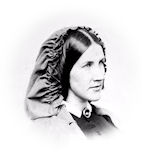
Post image for We—Charley, Eliza and Georgeanna.—left New York, July 2d,  to join the army and Joseph Howland in Washington, stopping on our way over night with Cousin Margaret Hodge in Philadelphia.—Woolsey family letters.
Georgeanna Muirson Woolsey to Cousin Margaret Hodge.

Washington, July 8, 1861.

My dear Cousin Margaret: I should have begun by dating my letter Ebbitt House, we having been established here since Saturday, spending the first three days of our visit, or probation, at the “National,” in the fifth story, a prey to several inconveniences, but refreshingly near processions. Joe sent his man down to meet us, and came himself after evening drill. He looks brown and well; is dashing round on horseback all day from camp to the War Department, and back again to camp, where he must spend seven hours a day drilling. Then all the cracks are filled up with our society out there. We go out every day in time for evening drill, and stay till it is time to shut up for the night, having a nice time in the door of Joe’s tent “in the cool of the day,” and this sort of thing we fondly thought was going to last an indefinite length of time, till yesterday, when Joe surprised us by the news that they were ordered into Virginia, and would leave on Tuesday or Wednesday. The Colonel has been made an acting Brigadier-General, and he and Joe were eight hours in the saddle yesterday, flying round selecting three regiments to form the Brigade with the Sixteenth. Joe has been in today on the same business, being entrusted to decide upon them and take whichever he thought best; and has chosen the Eighteenth, Twenty-first and Thirty-first—all from New York. So on Wednesday I suppose they will move over the bridge, and then we shall deliver our letters of introduction and plunge into occupation of some kind.

Washington is the stillest place for a city I have ever been in; nobody knows anything, or has anything to say. Everything is guess work. A few doleful little boys call the evening papers round the doors of the hotel, but in a tone that fixes a gloom upon you. I hate the “Eve-ening Star” already, and our only news comes via New York. The Tribune, Times and Herald have a great deal of information about what goes on here, and it generally proves true. . . . One longs now and then for a real living and lying “Extra” boy, with his mouth full of fearful statements, all disproved by his paper which you imprudently buy. We went, of course, to the opening of Congress and also to hear President Lincoln’s message, read on the fifth.

Charley has been about visiting the camps at Alexandria, Georgetown and Arlington, but for all this a pass is necessary, which can only be procured through General Mansfield on introduction by some one known to him. If Lenox knows anyone at home who knows the General it would save him half a day to get his letter before coming on. Charley got his through Colonel Davies who is a relative of the General’s. I hope Lenox will come on, but it is too bad that he will not see Joe. . . .

Here comes a regiment down this street. About 15,000 men have gone over into Virginia since we came on. Joe goes up in rank with his Colonel as his aid — is now Captain and Assistant Adjutant General—and the Brigade will be in McDowell’s Division. . . . The regiment has marched past— the Massachusetts Eleventh just from Harrisburg, all in beautiful order, gray uniforms and large clean havelocks. New England doesn’t do anything by halves. . . . And here goes another company, guarding thirteen well-filled baggage wagons and followed by its regiment. We have only to flourish our handkerchiefs and the dear fellows will kiss their hands, twirl their hats and manifest affection for the entire woman population of the North. They are the Fourth Maine, and are going over into Virginia. I must put up my letter and watch them marching along. Our love to the Doctor and the boys.

MONDAY 8

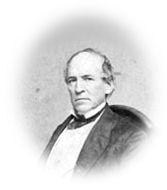
The excitement in the City is now increasing as the troops are moveing and battles expected. Various rumors are afloat from up the River but nothing more than skirmishes have as yet taken place. Four Examiners were removed today and some of the subordinates of the Pat office, other removals are expected. The business of the office is now small. I was on the Ave with Doct Everitt, called upon Genl Dix at Willards, was introduced to officers of the NY 14th Regt.

______

The three diary manuscript volumes, Washington during the Civil War: The Diary of Horatio Nelson Taft, 1861-1865, are available online at The Library of  Congress.

Post image for William Howard Russell’s Diary: Arlington Heights and the Potomac.—Washington.—The Federal camp.—General M’Dowell.—Flying rumours.

July 8th.—I hired a horse at a livery stable, and rode out to Arlington Heights, at the other side of the Potomac, where the Federal army is encamped, if not on the sacred soil of Virginia, certainly on the soil of the district of Columbia, ceded by that State to Congress for the purposes of the Federal Government. The Long Bridge which spans the river, here more than a mile broad, is an ancient wooden and brick structure, partly of causeway, and partly of platform, laid on piles and uprights, with drawbridges for vessels to pass. The Potomac, which in peaceful times is covered with small craft, now glides in a gentle current over the shallows unbroken by a solitary sail. The “rebels” have established batteries below Mount Vernon, which partially command the river, and place the city in a state of blockade.

As a consequence of the magnificent conceptions which were entertained by the founders regarding the future dimensions of their future city, Washington is all suburb and no city. The only difference between the denser streets and the remoter village-like environs, is that the houses are better and more frequent, and the roads not quite so bad in the former. The road to the Long Bridge passes by a four-sided shaft of blocks of white marble, contributed, with appropriate mottoes, by the various States, as a fitting monument to Washington. It is not yet completed, and the materials lie in the field around, just as the Capitol and the Treasury are surrounded by the materials for their future and final development. Further on is the red, and rather fantastic, pile of the Smithsonian Institute, and then the road makes a dip to the bridge, past some squalid little cottages, and the eye reposes on the shore of Virginia, rising in successive folds, and richly wooded, up to a moderate height from the water. Through the green forest leaves gleams the white canvas of the tents, and on the highest ridge westward rises an imposing structure, with a portico and colonnade in front, facing the river, which is called Arlington House, and belongs, by descent, through Mr. Custis, from the wife of George Washington, to General Lee, Commander-in-Chief of the Confederate army. It is now occupied by General M’Dowell as his head-quarters, and a large United States’ flag floats from the roof, which shames even the ample proportions of the many stars and stripes rising up from the camps in the trees.

At the bridge there was a post of volunteer soldiers. The sentry on duty was sitting on a stump, with his firelock across his knees, reading a newspaper. He held out his hand for my pass, which was in the form of a letter, written by General Scott, and ordering all officers and soldiers of the army of the Potomac to permit me to pass freely without let or hindrance, and recommending me to the attention of Brigadier-General M’Dowell and all officers under his orders. “That’ll do, you may go,” said the sentry. What pass is that, Abe?” inquired a non-commissioned officer. “It’s from General Scott, and says he’s to go wherever he likes.” “I hope you’ll go right away to Richmond, then, and get Jeff Davis’s scalp for us,” said the patriotic sergeant.

At the other end of the bridge a weak tête de pont, commanded by a road-work further on, covered the approach, and turning to the right I passed through a maze of camps, in front of which the various regiments, much better than I expected to find them, broken up into small detachments, were learning elementary drill. A considerable number of the men were Germans, and the officers were for the most part in a state of profound ignorance of company drill, as might be seen by their confusion and inability to take their places when the companies faced about, or moved from one flank to the other. They were by no means equal in size or age, and, with some splendid exceptions, were inferior to the Southern soldiers. The camps were dirty, no latrines—the tents of various patterns—but on the whole they were well castrametated.

The road to Arlington House passed through some of the finest woods I have yet seen in America, but the axe was already busy amongst them, and the trunks of giant oaks were prostrate on the ground. The tents of the General and his small staff were pitched on the little plateau in which stood the house, and from it a very striking and picturesque view of the city, with the White House, the Treasury, the Post Office, Patent Office, and Capitol, was visible, and a wide spread of country, studded with tents also as far as the eye could reach, towards Maryland. There were only four small tents for the whole of the head-quarters of the grand army of the Potomac, and in front of one we found General M’Dowell, seated in a chair, examining some plans and maps. His personal staff, as far as I could judge, consisted of Mr. Clarence Brown, who came over with me, and three other officers, but there were a few connected with the departments at work in the rooms of Arlington House. I made some remark on the subject to the General, who replied that there was great jealousy on the part of the civilians respecting the least appearance of display, and that as he was only a brigadier, though he was in command of such a large army, he was obliged to be content with a brigadier’s staff. Two untidy-looking orderlies, with ill-groomed horses, near the house, were poor substitutes for the force of troopers one would see in attendance on a general in Europe but the use of the telegraph obviates the necessity of employing couriers. I went over some of the camps with the General. The artillery is the most efficient-looking arm of the service, but the horses are too light, and the number of the different calibres quite destructive to continuous efficiency in action. Altogether I was not favourably impressed with what I saw, for I had been led by reiterated statements to believe to some extent the extravagant stories of the papers, and expected to find upwards of 100,000 men in the highest state of efficiency, whereas there were not more than a third of the number, and those in a very incomplete, ill-disciplined state. Some of these regiments were called out under the President’s proclamation for three months only, and will soon have served their full time, and as it is very likely they will go home, now the bubbles of national enthusiasm have all escaped, General Scott is urged not to lose their services, but to get into Richmond before they are disbanded.

It would scarcely be credited, were I not told it by General M’Dowell, that there is no such thing procurable as a decent map of Virginia. He knows little or nothing of the country before him, more than the general direction of the main roads, which are bad at the best; and he can obtain no information, inasmuch as the enemy are in full force all along his front, and he has not a cavalry officer capable of conducting a reconnaissance, which would be difficult enough in the best hands, owing to the dense woods which rise up in front of his lines, screening the enemy completely. The Confederates have thrown up very heavy batteries at Manassas, about thirty miles away, where the railway from the West crosses the line to Richmond, and I do not think General M’Dowell much likes the look of them, but the cry for action is so strong the President cannot resist it.

On my way back I rode through the woods of Arlington, and came out on a quadrangular earthwork, called Fort Corcoran, which is garrisoned by the 69th Irish, and commands the road leading to an aqueduct and horse-bridge over the Potomac. The regiment is encamped inside the fort, which would be a slaughter-pen if exposed to shell-fire. The streets were neat, the tents protected from the sun by shades of evergreens and pine boughs. One little door, like that of an ice-house, half buried in the ground, was opened by one of the soldiers, who was showing it to a friend, when my attention was more particularly attracted by a sergeant, who ran forward in great dudgeon, exclaiming “Dempsey! Is that you going into the ‘magazine’ wid yer pipe lighted?” I rode away with alacrity.

In the course of my ride I heard occasional dropping shots in the camp. To my looks of inquiry, an engineer officer said quietly, “They are volunteers shooting themselves.” The number of accidents from the carelessness of the men is astonishing; in every day’s paper there is an account of deaths and wounds caused by the discharge of firearms in the tents.

Whilst I was at Arlington House, walking through the camp attached to head-quarters, I observed a tall red-bearded officer seated on a chair in front of one of the tents, who bowed as I passed him, and as I turned to salute him, my eye was caught by the apparition of a row of Palmetto buttons down his coat. One of the officers standing by said, “Let me introduce you to Captain Taylor, from the other side.” It appears that he came in with a flag of truce, bearing a despatch from Jefferson Davis to President Lincoln, countersigned by General Beauregard at Manassas. Just as I left Arlington, a telegraph was sent from General Scott to send Captain Taylor, who rejoices in the name of Tom, over to his quarters.

The most absurd rumours were flying about the staff, one of whom declared very positively that there was going to be a compromise, and that Jeff Davis had made an overture for peace. The papers are filled with accounts of an action in Missouri, at a place called Carthage, between the Federals commanded by Colonel Sigel, consisting for the most part of Germans, and the Confederates under General Parsons, in which the former were obliged to retreat, although it is admitted the State troops were miserably armed, and had most ineffective artillery, whilst their opponents had every advantage in both respects, and were commanded by officers of European experience. Captain Taylor had alluded to the news in a jocular way to me, and said, “I hope you will tell the people in England we intend to whip the Lincolnites in the same fashion wherever we meet them,” a remark which did not lead me to believe there was any intention on the part of the Confederates to surrender so easily.
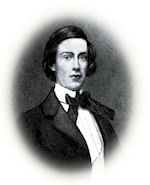
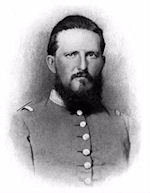
CAMP CHASE, July 8, 1861.

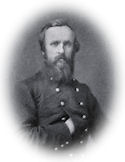
DEAR UNCLE:—Lucy came up to Columbus with Birtie Saturday evening. They have both been out once, and Birch twice to see me in camp. It is very pleasant to see them about. We are jogging on in routine duties. The only variation is the advent of twenty-three Secessionists, held as hostages for Union men seized in Virginia. On the release of the Union men, our prisoners were sent home yesterday.

I fear from the tenor of McLelland’s letters, and what Hale told me, that you are not getting rid of your cough. I hope you will do so soon. It is too bad that you should be unwell now. You would enjoy a little campaigning with me very much, and I would so enjoy having you along. . . .—Good-bye.

R. B. HAYES.

S. BIRCHARD.

Post image for Rebel War Clerk’s diary.—Major John Winder (future commander over Confederate prisons) is applying to be made a general.

JULY 8TH—There is a stout gray-haired old man here from Maryland applying to be made a general. It is Major J. H. Winder, a graduate of West Point, I believe ; and I think he will be successful. He is the son, I believe, of the Gen. Winder whose command in the last war with England unfortunately permitted the City of Washington to fall into the hands of the enemy. I have almost a superstitious faith in lucky generals, and a corresponding prejudice against unlucky ones, and their progeny. But I cannot suppose the President will order this general into the field. He may take the prisoners into his custody—and do other jobs as a sort of head of military police; and this is what I learn he proposes. And the French Prince, Polignac, has been made a colonel; and a great nephew of Kosciusko has been commissioned a lieutenant in the regular army. Well, Washington had his Lafayette—and I like the nativity of these officers better than that of the Northern men, still applying for commissions.

Post image for A Diary of American Events – July 8, 1861

—General Banks, at Baltimore, acting under the direction of authorities at Washington, this morning seized the steamers Mary Washington and George W. Weems, both owned and commanded by the Weems Brothers. These steamers have been running for a number of years between Baltimore and the ports of the Patuxent River, and it is said carried down a number of passengers who joined the Confederate army. The seizure was to prevent their being taken in a similar manner to the St. Nicholas and run into Fredericksburg as prizes. —Baltimore American, July 9.

—To-day orders were received at the headquarters of the army, in New York, to send on to the seat of war at once the company of the First Artillery, part of the Fort Sumter garrison, which remained at Fort Hamilton. Instructions were immediately sent down to the brave fellows, who were under arms for the road in a few moments. The old ensign of Sumter went along with them, as they believe “there would be no luck in the company without it.”—N. Y. World, July 11.

—This day whilst Col. Porter, of the U. S. Army, with a small party of men, was reconnoitering near the lines of the secession army in Virginia, he was approached by a detachment of the Confederate forces, in command of Capt. Taylor, of Kentucky, bearing a flag of truce. Col. Porter, on bringing the detachment to a halt, was informed that Capt. Taylor was the bearer of a sealed letter from Gen. Davis to President Lincoln, which statement was verified by an endorsement to that effect on the back of the letter, written and signed by Gen. Beauregard at Manassas Junction, and requesting that safe conduct might be given to Capt. Taylor.

Col. Porter accordingly sent Capt. Taylor, accompanied by an officer and an orderly, to the head-quarters of Gen. McDowell, at Arlington, where they arrived at seven o’clock in the evening, and were detained there until the visit of Capt. Taylor was made known to Lieut.-General Scott, upon whose order he was conducted to the General’s head-quarters in Washington, where Gen. Scott received the letter of Gen. Davis, and sent it to the President, the bearer of the letter being in the mean time detained at head-quarters.

The President, having read the letter, informed Gen. Scott that he might send the messenger back, and Capt. Taylor immediately took his departure for Arlington, and thence proceeded on his way back to Richmond.

No answer to the letter was given by the President, and it is conjectured that the mission was merely a ruse to get a view of the main works of defence, and ascertain the means at the command of the Government for a forward movement. Certain it is the messenger was not enabled to carry back with him any very encouraging tidings. One object may have been to occupy the attention of our authorities and delay matters for a few days, so as to allow time for aid from Manassas to Johnston at Winchester.—(Doc. 73.)

—Tm following official order appeared today:

“Henceforward the telegraph will convey no despatches concerning the operations of the Army not permitted by the Commanding General.

Winfield Scott”

Department of War, July 8, 1861.

The above order is confirmed.

Simon Cameron, Secretary of War.

—The Second Regiment of Massachusetts Volunteers, Col. George H. Gordon, left Boston for the seat of war at Martinsburg. The regiment consists of one thousand and fifty men. They wear the regulation black felt hat, turned up at teo side. Their coats are made of serviceable blue cloth and their pants of blue flannel. Since the men first went into camp at West Roxbury, they have been put through the most rigid discipline, and are therefore now prepared to meet the enemy under any circumstances. The camp equipage of the regiment, consisting of twenty-five wagons and one hundred horses, left in advance of the troops during the afternoon. Each company is supplied with three thousand ball cartridges and seven days’ rations. The officers seem to have been well chosen. Among those in command of companies are sons of the late Rufus Choate, Thomas G. Gary, and the Hon. Josiah Quincy, Jr. The staff are all well mounted.

—Capt. Thomas, or the “French lady” who a short time previously captured the steamer St. Nicholas on. the Patuxent River, was himself captured by the Baltimore police.—(Doc. 74.)

—The De Kalb Regiment N. Y. S. V., under the command of Colonel Leopold von Gilsa, left New York for the seat of war.—N. Y. Evening Pots, July 8.