Following the American Civil War Sesquicentennial with day by day writings of the time, currently 1863.

July 2011

(July 21 & 22)

IN the order prescribed by the regulations, for a force feeling the enemy preparatory to an attack, we marched forward, passing over the open field and into a piece of full grown timber, apparently the slope of a considerable hill. As we slowly ascended the rising ground, suddenly a loud screeching noise overhead sent more than half the regiment pell mell the other side of a fence that ran along the road side. Here we crouched down flat on our bellies, our hearts in our mouths, just as a shell exploded a little beyond us. It was from the rebel batteries in front, and the first any of us had ever heard, and it certainly did seem a terrible thing, rushing through the air like an immense sky rocket, then bursting into a thousand pieces, carrying death and destruction to everything in its course. The stampede was only momentary, but very funny; the boys jumped back again; in fact, almost as quickly as they had dispersed, and then stood steady in the ranks, watching the advance of the Rhode Islanders. When the latter had emerged into the clearing, beyond the woods, our regiment wheeled to the right, into line of battle, and followed the advancing line. In the meantime, several shells came over the woods, generally passing far to the rear before bursting, doing no harm other than making us a little nervous. Just as we emerged from the woods, the Rhode Islanders reached the crest of the hill and immediately opened fire, and the rattle of musketry became so heavy we could hear no commands, and the smoke so thick, we could see nothing at all in front; away off to the right, however, we saw little white puffs of smoke, indicating the position of the rebel batteries, which began to drop their shells about us, much to our confusion; while we were peering into the dense smoke in front, wondering how the enemy looked, an order came directing us to move forward and go into action. We marched immediately, reached the crest of the hill, and amid the rattle of musketry, the booming of guns, and screeching of shells, lay down and commenced firing. Before we had time to get well at work, along came Griffith’s light battery at full gallop, scattering the right of our regiment badly; we got together again as quickly as possible, but were five and six files deep, narrowing the front of the regiment, and rendering about half of us useless. I was in this struggling crowd, and with many others, tried hard to get the line straightened out, but the objection many of the fellows had to take the front rank prevented our doing much of anything, so I crept up to the front, determined at least to get a sight of the enemy, and a shot if possible. I soon reached a position where I could look over the hill, and there sure enough, nearly at the bottom, just in front of a clump of trees, stood a long line of rebel infantry firing away at our men. I took a shot immediately, and then loaded and fired as quickly as I could, very much excited, but now not at all afraid, except of the men in rear who persisted in firing over our heads, although they could see nothing to fire at, and stood no possible chance of hitting anything, except the back of our heads, which was not comfortable to think of. The musket balls whistled around us, and every now and then, one of our fellows dropped his gun and rolled over, shot; however, the noise of the musketry, and booming of the cannon, drowned all cries, and kept up the excitement, so that we thought only of firing and trying to hit somebody. We lay in this position a good while, keeping up a rattling fire, when the order was passed along the line to stand up and fire; the regiment jumped to its feet, just as a wild unearthly yell rung out below, and the rebel line dashed forward, charging directly up the hill at us. We had a beautiful chance now and blazed away into the advancing line without let or hindrance, but still they came on until some of them got within thirty yards of us, and I really thought they were going to reach us and give us a chance to bayonet them, but suddenly they hesitated, then turned back, and ran away. Now we yelled, and together with our boat howitzers, poured a rattling fire into them, killing and wounding a good many; they ran until they reached the woods, then reformed, and actually tried it again, but this second attempt was a mere farce. The batteries shelled them until they completely disappeared, leaving us in undisputed possession of the field. Our fighting was done and very soon we were relieved by the Sixty-ninth New York and a New Hampshire regiment, who followed up the enemy, while we fell back to the edge of the woods, stacked arms, and answered to roll call. We had lost seventeen men killed outright, and forty wounded; all the rest were accounted for; we then buried the dead and carried such of the wounded as had not already been cared for back to the field hospital, after which we compared notes and congratulated each other on the success of the fight. There served with us throughout the whole fight a tall, elderly gentleman, wearing plain clothes and a tall silk hat, in the front rank, who loaded and fired away in the most deliberate manner, apparently wholly indifferent to danger; he must have done a good deal of execution, as the excitement did not seem to affect him in the least. They say he is a noted abolitionist, and desired to do his share in the field, as well as in the forum; I am sorry I cannot remember his name. With a regiment of such men as he, what might we not have done?

Soon after we retired, General McDowell rode up, dressed in full uniform, including white kid gloves, and told us we had won a great victory, and that the enemy were in full retreat; we cheered him vociferously, and felt like veritable heroes.

The enemy having disappeared, some of us concluded to walk over the battle field, see how it looked, and pick up something as a souvenir of the fight. The Sixty-ninth and Seventy-ninth New York and the splendid line of the marine corps, in their white cross belts, were moving without opposition, away off to the right, apparently intending to follow the enemy to Richmond. Butler and I strolled down the hill side, and were soon amongst the dead and dying rebels, who up to this time had been neglected. What a horrible sight it was! here a man, grasping his musket firmly in his hands, stone dead; several with distorted features, and all of them horribly dirty. Many were terribly wounded, some with legs shot off; others with arms gone, all of them, in fact, so badly wounded that they could not drag themselves away; many of the wretches were slowly bleeding to death, with no one to do anything for them. We stopped many times to give some a drink and soon saw enough to satisfy us with the horrors of war; and so picking up some swords, and bayonets, we turned about and retraced our steps. Suddenly a minnie ball whistled past us, making the dust fly just in front, where it lodged; we thought it must be from some of our men mistaking us for rebels, and so hurried along to join our regiment when, nearly at the summit of the hill, a whole volley of musket balls whizzed about us, one of them striking my companion, who dropped to the ground as though he had been killed, and I really thought he was; in looking him over, I found he was shot through the knee and quite unable to stand, or walk; promising to bring him assistance, I started on the run, found the regiment, and with several good fellows quickly returned, picked up our comrade and carried him to the rear, and left him with the surgeons. This turn in affairs greatly puzzled everybody, and the only conclusion arrived at was, that some of our troops had mistaken us for the enemy. About half an hour after this, our attention was attracted to the distant hills and open ground by long lines of infantry extending across the whole face of the battle ground; the sound of distant musketry came floating along, followed by an occasional cannon shot. Presently the lines grew more distinct, finally developing into well defined lines of battle, marching in our direction; everybody was now alert; wondering what was going to happen; at last the glittering bayonets, reflecting the summer sun, were easily distinguished, and there was no longer a doubt but what the rebels had reformed, and with new forces were going to renew the fighting. The musketry increased and several batteries opened in our direction, but there were no indications on our part of making any resistance to the rapidly advancing foe; so far as we could see over the wide extended fields, not a single line of battle on our side was in position; the regiments about us had been gradually withdrawing, until few were left. All the guns had gone, except our two howitzers, and there was no general officer on the ground. As the long line came nearer and nearer, Colonel Martin ordered us to fall in, and with muskets in hand, we stood, simply watching the gradual approach of this overwhelming force, and the disappearance of our troops; wondering what had become of all the masses of men we not long ago thought numerous enough to thrash the world; now there was nobody left, and our colonel at length ordered us to counter march to the rear, and follow the crowd. We still supposed there was a new line forming in rear of us, and that in the confusion, our regiment had escaped attention, consequently, at first were not much alarmed, but as we continued going to the rear and saw no signs of fresh dispositions, we came to the conclusion we were running away, following the route we had marched over with so much confidence in the morning; presently we came up with the rear of the troops that had preceded us, but looked in vain for new defensive dispositions. Everywhere was hurry and confusion, the wagons and batteries filled the roads, while the men spread out on either side, gradually losing their formations and fast becoming reckless. There was no rear guard, nor any arrangements for holding the enemy in check, and if they really had appeared, they might have captured us all without difficulty. Now every one was anxious to be first, and so by degrees, the men of various regiments got mixed up together, and thus, finding themselves without officers, accelerated their steps until at last it became a precipitate flight to the rear.

In the course of the afternoon, when the woods were one mass of men, without a semblance of order, a report spread that the Black Horse cavalry were advancing! instantly, every man of us backed up to a tree, and it was really wonderful how almost instantaneously the woods seemed clear of men; with three or four of us around a tree, bayonets fixed, awaiting in fearful suspense, we looked quite formidable, but were in fact, very weak kneed.

After waiting a time, and seeing nothing of the foe, we spread out again, hurrying along to get across the Bull Run stream. By this time the men were throwing away their blankets, knapsacks, and many of them their guns, in order to fly the faster; and when the enemy began shelling the woods we were in, the panic was complete, and all semblance of order was lost; at a bridge where the ambulances were crossing, several shells burst in succession, completing the disaster. Confusion became confounded; men, horses, mules, wagons, ambulances, and batteries were inextricably mixed together, and the mass rushed forward, abandoning everything in their flight; in many cases, the drivers of wagons and ambulances cut loose their teams and galloped to the rear, leaving their wagons and contents to block the road, thus cutting off all chance for escape for those in rear of them. On the bridge over the Bull Run were several ambulances, filled with wounded men, so jammed together that none of them could move. Some shells from the enemy’s guns dropped in amongst them, killing some of the wounded, scaring away the drivers, and effectually blockading the bridge for good. The panic was complete. The wounded, deserted in the ambulances, yelled for succor in vain; the whole crowd were utterly demoralized. Colonel Martin and the regiment up to this time had kept tolerably well together, but here the general frenzy took possession of us, too, and the cry of “every man for himself, and the devil take the hindmost,” was the only rule observed.

About the stream, the loss of material was immense; our two boat howitzers were abandoned here, after doing very effective service. There were hundreds of wagons, ambulances, forges, guns, muskets, myriads of blankets, knapsacks and every kind of accoutrement; the ground, in fact, being literally covered with material, the men throwing away indiscriminately all that they had to facilitate their flight. When we arrived at the stream the bridge was completely blockaded, so we took to the water with the crowd, and found it nearly up to our waists; we were almost dying with thirst and stopped to drink and fill our canteens; the water was liquid mud, but more precious to us just then than gold; standing amongst myriads of men and horses, I drank and drank, until I must have swallowed at least a quart; it did refresh us amazingly; we had marched all the previous night; fought all the morning, and had been running away all the afternoon, with nothing at all to eat since the evening before, and as the heat was intense, and the dust horrible, one may imagine our condition.

It did us good to see many batteries boldly ford the run, descending the steep bank and climb the opposite side in a most business like manner. I can truthfully say up to this time none of us had seen or heard of a general officer or aid-de-camp nor any one making any effort to stem the tide of disorder south of the stream.

After crossing the river, the crowd kept on in just the same disorder; but, as they got more fatigued they threw away more of their equipment, and so by degrees, about one half of them threw away their arms, as well as clothing. Amongst the infantry, there was no longer a pretense of formation; the crowd scattered over a wide area of fields and roads, observing only one rule, of keeping in the direction of Washington. As our organization fell to pieces at the run, half a dozen of us agreed for our own safety to stick together at all hazards, retain our arms and accoutrements, and pretend we were soldiers. The country was now open, giving an extended view of the situation as far as we could see; to the right and left, crowds of men, wagons and guns, all mixed together, were hurrying along spread all over the country.

We trudged along wearily enough, at last reaching Centreville, and then sat down to rest and eat, expecting the crowd would do the same, but their fears still urged them forward, and they surged through, and around the village, in one continuous mass of disorder. We rested about an hour, then started ahead again, keeping along with the crowd still as dense as ever. Not long after passing Centreville, the crowd in front suddenly halted as if by magic; right in front, drawn up in battle array, stretched a long dark line of infantry, completely blocking the way; to our disordered imagination there could be but one explanation, the enemy had in some way gotten in our rear, and cut us off; no man dared to advance, and for a time we were motionless, lost in amazement. Presently the men on the extreme right began a movement to slip around the flank, hoping in this way to elude the new danger; but just then several mounted men rode forward, and announced the troops in front as friends, being in fact, a line of New Jersey troops, formed to stem the surging tide of disorder, by offering a shelter, sufficiently strong to restore confidence. What a relief it was! we were now safe from pursuit, and could rest our weary feet. We marched along with the crowd, passed through the new line, and sat down, intending to go no further, utterly exhausted and demoralized. We threw ourselves on the ground, and watched with much anxiety, the efforts made to stop the fugitives. Staff officers, cavalrymen, and infantry, all exerted themselves strenuously to halt the crowd, and form them anew, in rear of the fresh men, but without success; the crowd continued pressing to the rear determined only to stop, under the forts at Washington. We remained till after dark getting a little rest, but keeping our eyes on the Jerseymen. About eight o’clock two of the regiments near us were ordered back to Vienna, so we fell in with them, and continued our retreat from this point, in much better company. We marched wearily along, foot sore, and since night set in, extremely nervous. In every piece of woods through which we marched we heard the dreaded sighing of the minnie ball, and saw dark shadowy forms, which took the shape of Black Horse Cavalry. We knew better, but our nerves gave out, I expect, and we could not help ourselves. As everything in life must come to an end sooner or later, so this trying march to Vienna ended also, something after midnight. The Jerseymen turned into a field to the right of the road, formed in close column of division, stacked arms, and lay down and slept. We begged some bread of them; half a loaf each, which we lost no time in eating, then lay down and slept. We had no covering, as our regiment was ordered to remove their blankets before the fight, and never had a chance to get them again, but we slept for all that, and only waked, after a vigorous shaking; about three o’clock in the morning, the Jerseymen were ordered to fall back on account of the advancing enemy, and there was nothing else to be done but go with them. What unwelcome news! My feet were so covered with blisters, and swollen, that at first I could not stand on them, and it seemed out of the question to use them at all, but we had heard of the guerillas, and feared capture, so were bound to move. I tore my pocket handkerchief into strips and bound each toe, separately; the soles, and heels, and in that shape started off; at first I could scarcely stand, but, as my feet warmed up they felt better, and I was able to keep up with the regiment, until we got to within about seven miles of Washington. There we parted with the Jerseymen, and went to a farm house, where after much parleying, we hired a man to carry us to the long bridge, for fifty cents apiece. As soon as the springless wagon was hitched up, we jumped in, and felt that our troubles were all over. In due time we arrived before the tete de pont at the long bridge, paid and dismissed our farmer friend, and started to cross over, but the sentry stopped us and refused to let us cross. The sergeant of the guard was deaf to our entreaties, and we fell back in dismay; presently, someone suggested that, by taking the tow path to the Georgetown bridge, about three miles up the river, we could cross, and so, nothing daunted by the pouring rain, we started off and for two hours struggled over the worst road, in the worst weather, imaginable. When we arrived, we were disgustingly covered with red clay mud, from head to foot, and altogether in a pitiful condition; filled with anxiety, we went up to the bridge and found a regiment apparently going over, and so fell in rear of it, but when nearly up to the entrance, it filed off to the right, leaving us in the lurch once more. Nothing remained now but to go up boldly and ask permission to cross, which we did, and were delighted when told to go ahead; we lost no time in passing the guard, and with light hearts, but dreadfully weary feet, trudged along, and were soon across and looking out for some means of getting to the Navy Yard, many miles away. Very soon afterward a couple of gentlemen rushed up to us, grasped us by the hand, and hustled us into a carriage; they said they were New Yorkers and had heard all about the gallant behavior of the Seventy-first, and that they were there for the express purpose of taking care of some of the boys. They were full of sympathy, and took great interest in us, and so we began to think a little better of ourselves. They took us to the Metropolitan Hotel, where they ordered dinner, wine, etc., and made us sit down, wet and muddy as we were, and eat and drink. It was wonderful how we recovered under this generous treatment, and in a couple of hours, were so refreshed that we took leave of our fellow townsmen with many and hearty thanks, and went straight to the Navy Yard, almost falling asleep on the way.

Arriving, I found my companion Dodd occupying our old bunk in tranquil security, not having heard of the misfortune that had befallen the army. He came to the rescue, and like the good fellow he was, never ceased till I was encased in dry clothes, and snugly packed away in my old place, and fast asleep.
JULY 21ST.—The President left the city this morning for Manassas, and we look for a battle immediately. I have always thought he would avail himself of his prerogative as commander-in-chief, and direct in person the most important operations in the field; and, indeed, I have always supposed he was selected to be the Chief of the Confederacy, mainly with a view to this object, as it was generally believed he possessed military genius of a high order. In revolutions like the present, the chief executive occupies a most perilous and precarious position, if he be not a military chieftain, and present on every battle-field of great magnitude. I have faith in President Davis, and believe he will gain great glory in this first mighty conflict.

Early in the evening Secretary Walker returned from tea in great excitement. He strode to and fro in the room where we were sitting, d——g his office. He said a great battle was then going on, and he wished himself present participating in its perils. Again he denounced the office he filled—and seemed, for a time, almost frantic with anxiety. He said all young men ought to be in the field, and this was understood by those present, who had merely shouldered their pens.

Before long the hall of the department was filled with people eager to hear the news; and as successive dispatches were received, the excitement increased. All the cabinet were in our office; and Hon. Howell Cobb, President of Congress, making deductions from the dispatches, announced his belief that it was a drawn battle. This moved the wrath of Col. Bledsoe, and he denounced Cobb. Mr. Hunter did nothing but listen. It was night, now. Finally, Mr. Benjamin, who had gone to the Spottswood Hotel, where Mrs. Davis resided, returned with news that stopped every detracting tongue. Mrs. D. had just got a dispatch from the President announcing a dearly-bought but glorious victory. Some of the editors of the papers being present, and applying to me for a copy of the dispatch, Mr. Benjamin said he could repeat it from memory, which he did, and I wrote it down for the press. Then joy ruled the hour! The city seemed lifted up, and every one appeared to walk on air. Mr. Hunter’s face grew shorter; Mr. Reagan’s eyes subsided into their natural size; and Mr. Benjamin’s glowed something like Daniel Webster’s after taking a pint of brandy. The men in place felt that now they held their offices for life, as the permanent government would soon be ratified by the people, and that the Rubicon had been passed in earnest. We had gained a great victory; and no doubt existed that it would be followed up the next day. If so, the Federal city would inevitably fall into our hands; and this would soon be followed by the expulsion of the enemy from Southern soil. All men seemed to think that the tide of war would roll from that day northward into the enemy’s country, until we should win a glorious peace.

Sunday, 21.—We were at church this morning and heard Bishop Meade, on the subject of “Praise.” He and his whole congregation greatly excited. Perhaps there was no one present who had not some near relative at Manassas, and the impression was universal that they were then fighting. This suspense is fearful; but we must possess our souls in patience.

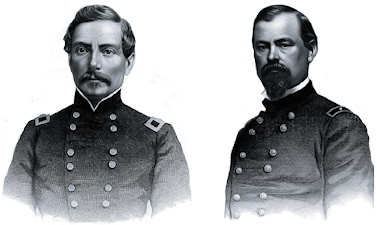
beauregard and mcdowell

P.G.T Beauregard and Irwin McDowell


July 21.—This day the battle of Bull Run, Va., was fought between the national forces under General McDowell and the rebels under Beauregard. Shortly after 5 A. M., three hours later than ordered, the national army moved from Centreville in three divisions, commanded respectively by Gens. Richardson, Tyler and Hunter. Richardson’s (one brigade) moved on the road from Centreville to Manassas, to where that road crosses Bull Run, at Blackburn’s Ford, and there opened fire upon the enemy with artillery. This movement, the extreme left of all the operations of the day, was intended as a feint, and to hold the enemy in check in case of disaster to the national forces on the right, as the enemy’s movement forward here would imperil the retreat. Tyler’s Division (three brigades and two U. S. batteries) moved on the Warrenton Turnpike to the Stone Bridge that crosses Bull Run. Beyond this bridge the enemy was in position with artillery, and had impeded the road by a heavy abatis. Hunter’s Division (5 brigades, 4 batteries and cavalry), which was the main body, moved along the same road with Tyler’s Division until they had crossed a small stream called Cub Run, and then between Cub Run and Bull Run turned off to the right and made its way through the woods to a position on Bull Run, three miles above the Stone Bridge. At this point, Sudley’s Springs, there was an undefended ford, and here the men began to cross the stream. They got over very slowly, as many stopped to drink. Clouds of dust in the air indicated that the enemy was moving in force from Manassas toward the right, and it became possible that he would reach the point of passage and attack before the Union force was all across the stream; therefore the regiments were ordered to break from the line of march and cross separately, and a division under Col. Heintzelman moved forward, cutting a road through the woods as it went toward a point on Bull Run, half way between the undefended ford at Sudley’s Springs and the Stone Bridge. Gen. Tyler also was ordered to press his feint at Stone Bridge, in hope to divert some portion of the heavy force that the enemy was sending across the front toward the right. When the first brigade of Hunter’s command (Burnside’s) reached and formed in the open space beyond Bull Run, the rebels at once opened fire with artillery, and soon after with infantry. The national forces received the enemy’s fire very steadily, and supported by a battalion of regular infantry, and the first regiment that had crossed from Heintzelman’s command, drove the enemy before it, and forced his position at the Stone Bridge.

Thus two brigades (Sherman’s and Keyes’) of Gen. Tyler’s Division stationed on the Warrenton road, were enabled to cross, and to drive the right of the enemy, commanded by Gen. Beauregard in person, from the front of the field. The contest then became severe for a position in front and to the right of Stone Bridge but to the left of the ford at Sudley’s Springs. Here was a hill with a farm house on it; from behind this hill the enemy’s batteries annoyed the Union forces. Upon it, therefore, the attack was pressed very warmly by the brigades of Wilcox, Howard, Franklin and Sherman, a part of Porter’s brigade, and the cavalry under Palmer, and by the Rhode Island, Rickett’s and Griffin’s batteries. Rickett’s battery became an object of the enemy’s special attention, and he made strenuous attempts to carry it. Three times he was repulsed, and the third time was even driven from his own position, and entirely from the hill. From the Stone Bridge westward, the Warrenton Road was now entirely in the possession .of the national troops, and the engineers were completing the removal of the abatis, that the remainder of Tyler’s Division (Schenck’s brigade and the batteries) might pass the bridge. The enemy was broken and disheartened. But it was now nearly 4 o’clock in the afternoon, and the Union men had been in battle since ten o’clock in the morning, had previously marched nine miles, and had made no regular meal. Some of though regiments also had become shaken in the severe work that had been done, and were unsteady; and at this time the enemy received reinforcements from Winchester, being that portion of General Johnston’s command which had previously come up. These forces immediately attacked “on the right, and towards the rear of the right,” and opened a fire of musketry which threw the Union men into disorder. From this disorder they never recovered. Though every effort was made to rally them, it was in vain with the bulk of the force: the battalion of regulars alone formed, and moved to the attack. They held the rebels in check for a short time, when, as it was evident that no more could be done, the order to retreat was given. The retreat became a rout, and the rout a panic. Col. Porter’s force of regulars still maintained their order, however, and covered the passage of the stream, beyond which it was covered by Richardson’s Division, and a brigade (Blenker’s) of Miles’ Division.

The whole Union force, men of all arms, in the main action, and exclusive of Richardson’s and Miles’ Divisions, the actual force with which we crossed Bull Run, was 18,000 men. Those two divisions if included would swell the force to 35,000 men. One division of the army (Runyon’s) was left at Vienna, its foremost regiment being seven miles back of Centreville.

Southern accounts of the battle make it appear that the rebels had 40,000 men upon the field, and 25,000 in reserve at Manassas, and on the road beyond. The National loss in killed and wounded was 1,590; killed alone, 479. Many of the wounds were very slight. The enemy reports his own loss at 1,593; killed alone, 393.—(Docs. 1, 2, 3, 4, 5, 6, 7, 8, 9, 10 and 111.)

—Colonel Einstein of the Twenty-Seventh Pennsylvania Regiment, returned late this evening to the field of battle at Bull Run, and brought off six pieces of artillery, which he delivered to the commanding officer on the Potomac.— Philadelphia Press, July 24.

—P. G. T. Beauregard was promoted to the rank of General in the rebel army. The New Orleans Delta in noting the fact says: “We have been furnished with a copy of the letter of President Davis, written on the field of battle after the glorious victory at Manassas, acquainting Brig.-Gen. Beauregard of his promotion to the rank of General, the highest grade in the army of the Confederate States. This most richly deserved promotion and honor could not be conveyed in more just, tasteful, and appropriate terms.—The Generals of the Army of the Confederate States are Samuel Cooper, Robert E. Lee, Joseph E. Johnston, and P. G. T. Beauregard.”

LETTER OF PRESIDENT DAVIS.

Manassas, Va., July 21, 1881.

Sir: Appreciating your services in the battle of Manassas, and on several other occasions during the existing war, as affording the highest evidence of your skill as a commander, your gallantry as a soldier, and your zeal as a patriot, you are promoted to be General in the Army of the Confederate States of America, and with the consent of the Congress will be duly commissioned accordingly. Yours, &c,

Jeff. Davis.

Gen. P. G. T. Beauregard, &c., &c, Ac.

__________

—The schooner S. J. Waring, captured by the privateer Jeff. Davis, on the night of the 18th instant, arrived at New York. When fifty miles south of Charleston, S. C, the colored steward, William Tillman, killed three of the prize crew with a hatchet. The other two were captured, but set at liberty on promising to work the vessel. Their names were James Milnor and James Dawsett, of New Jersey. Tillman, with the aid of the rest of the crew, except one man named Donald McLeod, who refused to assist on the recapture of the vessel, brought her to New York.—N. Y. World, July 22.

Post image for William Howard Russell’s Diary: Rumors from Bill Run.

July 20th.—The great battle which is to arrest rebellion, or to make it a power in the land, is no longer distant or doubtful. M’Dowell has completed his reconnaissance of the country in front of the enemy, and General Scott anticipates that he will be in possession of Manassas to-morrow night. All the statements of officers concur in describing the Confederates as strongly entrenched along the line of Bull’s Run covering the railroad. The New York papers, indeed, audaciously declare that the enemy have fallen back in disorder. In the main thoroughfares of the city there is still a scattered army of idle soldiers moving through the civil crowd, though how they come here no one knows. The officers clustering round the hotels, and running in and out of the bar-rooms and eating-houses, are still more numerous. When I inquired at the head-quarters who these were, the answer was that the majority were skulkers, but that there was no power at such a moment to send them back to their regiments or punish them. In fact, deducting the reserves, the rear-guards, and the scanty garrisons at the earth works, M’Dowell will not have 25,000 men to undertake his seven days’ march through a hostile country to the Confederate capital; and yet, strange to say, in the pride and passion of the politicians, no doubt is permitted to rise for a moment respecting his complete success.

I was desirous of seeing what impression was produced upon the Congress of the United States by the crisis which was approaching, and drove down to the Senate at noon. There was no appearance of popular enthusiasm, excitement, or emotion among the people in the passages. They drank their iced water, ate cakes or lozenges, chewed and chatted, or dashed at their acquaintances amongst the members, as though nothing more important than a railway bill or a postal concession was being debated inside. I entered the Senate, and found the House engaged in not listening to Mr. Latham, the Senator for California, who was delivering an elaborate lecture on the aspect of political affairs from a Republican point of view. The Senators were, as usual, engaged in reading newspapers, writing letters, or in whispered conversation, whilst the Senator received his applause from the people in the galleries, who were scarcely restrained from stamping their feet at the most highly-flown passages. Whilst I was listening to what is by courtesy called the debate, a messenger from Centreville, sent in a letter to me, stating that General M’Dowell would advance early in the morning, and expected to engage the enemy before noon. At the same moment a Senator who had received a despatch left his seat and read it to a brother legislator, and the news it contained was speedily diffused from one seat to another, and groups formed on the edge of the floor eagerly discussing the welcome intelligence.

The President’s hammer again and again called them to order; and from out of this knot, Senator Sumner, his face lighted with pleasure, came to tell me the good news. “M’Dowell has carried Bull’s Run without firing a shot. Seven regiments attacked it at the point of the bayonet, and the enemy immediately fled. General Scott only gives M’Dowell till mid-day tomorrow to be in possession of Manassas.” Soon afterwards, Mr. Hay, the President’s secretary, appeared on the floor to communicate a message to the Senate. I asked him if the news was true. “All I can tell you,” said he, “is that the President has heard nothing at all about it, and that General Scott, from whom we have just received a communication, is equally ignorant of the reported success.”

Some Senators and many Congress men have already gone to join McDowell’s army, or to follow in its wake, in the hope of seeing the Lord deliver the Philistines into his hands. As I was leaving the Chamber with Mr. Sumner, a dust-stained, toil-worn man, caught the Senator by the arm, and said, “Senator, I am one of your constituents. I come from town, in Massachusetts, and here are letters from people you know, to certify who I am. My poor brother was killed yesterday, and I want to go out and get his body to send back to the old people; but they won’t let me pass without an order.” And so Mr. Sumner wrote a note to General Scott, and another to General Mansfield, recommending that poor Gordon Frazer should be permitted to go through the Federal lines on his labour of love; and the honest Scotchman seemed as grateful as if he had already found his brother’s body.

Every carriage, gig, waggon, and hack has been engaged by people going out to see the fight. The price is enhanced by mysterious communications respecting the horrible slaughter in the skirmishes at Bull’s Run. The French cooks and hotel-keepers, by some occult process of reasoning, have arrived at the conclusion that they must treble the prices of their wines and of the hampers of provisions which the Washington people are ordering to comfort themselves at their bloody Derby. “There was not less than 18,000 men, sir, killed and destroyed. I don’t care what General Scott says to the contrary, he was not there. I saw a reliable gentleman, ten minutes ago, as cum straight from the place, and he swore there was a string of waggons three miles long with the wounded. While these Yankees lie so, I should not be surprised to hear they said they did not lose 1000 men in that big fight the day before yesterday.”

When the newspapers came in from New York I read flaming accounts of the ill-conducted reconnaissance against orders, which was terminated by a most dastardly and ignominious retreat, “due,” say the New York papers, “to the inefficiency and cowardice of some of the officers.” Far different was the behaviour of the modest chroniclers of these scenes, who, as they tell us, “stood their ground as well as any of them, in spite of the shot, shell, and rifle-balls that whizzed past them for many hours.” General Tyler alone, perhaps, did more, for “he was exposed to the enemy’s fire for nearly four hours;” and when we consider that this fire came from masked batteries, and that the wind of round shot is unusually destructive (in America), we can better appreciate the danger to which he was so gallantly indifferent. It is obvious that in this first encounter the Federal troops gained no advantage; and as they were the assailants, their repulse, which cannot be kept secret from the rest of the army, will have a very damaging effect on their morale.

General Johnston, who has been for some days with a considerable force in an entrenched position at Winchester, in the valley of the Shenandoah, had occupied General Scott’s attention, in consequence of the facility which he possessed to move into Maryland by Harper’s Ferry, or to fall on the Federals by the Manassas Gap Railway, which was available by a long march from the town he occupied. General Patterson, with a Federal corps of equal strength, had accordingly been despatched to attack him, or, at all events, to prevent his leaving Winchester without an action; but the news to-night is that Patterson, who was an officer of some reputation, has allowed Johnston to evacuate Winchester, and has not pursued him; so that it is impossible to predict where the latter will appear.

Having failed utterly in my attempts to get a horse, I was obliged to negotiate with a livery-stable keeper, who had a hooded gig, or tilbury, left on his hands, to which he proposed to add a splinter-bar and pole, so as to make it available for two horses, on condition that I paid him the assessed value of the vehicle and horses, in case they were destroyed by the enemy. Of what particular value my executors might have regarded the guarantee in question, the worthy man did not inquire, nor did he stipulate for any value to be put upon the driver; but it struck me that, if these were in any way seriously damaged, the occupants of the vehicle were not likely to escape. The driver, indeed, seemed by no means willing to undertake the job; and again and again it was proposed to me that I should drive, but I persistently refused.

On completing my bargain with the stable-keeper, in which it was arranged with Mr. Wroe that I was to start on the following morning early, and return at night before twelve o’clock, or pay a double day, I went over to the Legation, and found Lord Lyons in the garden. I went to request that he would permit Mr. Warre, one of the attaches, to accompany me, as he had expressed a desire to that effect. His Lordship hesitated at first, thinking perhaps that the American papers would turn the circumstance to some base uses, if they were made aware of it; but finally he consented, on the distinct assurance that I was to be back the following night, and would not, under any event, proceed onwards with General McDowell’s army till after I had returned to Washington. On talking the matter over the matter with Mr. Warre, I resolved that the best plan would be to start that night if possible, and proceed over the long bridge, so as to overtake the army before it advanced in the early morning.

It was a lovely moonlight night. As we walked through the street to General Scott’s quarters, for the purpose of procuring a pass, there was scarcely a soul abroad; and the silence which reigned contrasted strongly with the tumult prevailing in the day-time. A light glimmered in the General’s parlour; his aides were seated in the verandah outside smoking in silence, and one of them handed us the passes which he had promised to procure; but when I told them that we intended to cross the long bridge that night, an unforeseen obstacle arose. The guards had been specially ordered to permit no person to cross between tattoo and daybreak who was not provided with the countersign; and without the express order of the General, no subordinate officer can communicate that countersign to a stranger. “Can you not ask the General?” “He is lying down asleep, and I dare not venture to disturb him.”

As I had all along intended to start before daybreak, this contretemps promised to be very embarrassing, and I ventured to suggest that General Scott would authorise the countersign to be given when he awoke. But the aide-de-camp shook his head, and I began to suspect from his manner and from that of his comrades that my visit to the army was not regarded with much favour—a view which was confirmed by one of them, who, by the way, was a civilian, for in a few minutes he said, “In fact, I would not advise Warre and you to go out there at all; they are a lot of volunteers and recruits, and we can’t say how they will behave. They may probably have to retreat. If I were you I would not be near them.” Of the five or six officers who sat in the verandah, not one spoke confidently or with the briskness which is usual when there is a chance of a brush with an enemy.

As it was impossible to force the point, we had to retire, and I went once more to the horse dealer’s, where I inspected the vehicle and the quadrupeds destined to draw it. I had spied in a stall a likely looking Kentuckian nag, nearly black, light, but strong, and full of fire, with an undertaker’s tail and something of a mane to match, which the groom assured me I could not even look at, as it was bespoke by an officer; but after a little strategy I prevailed on the proprietor to hire it to me for the day, as well as a boy, who was to ride it after the gig till we came to Centreville. My little experience in such scenes decided me to secure a saddle horse. I knew it would be impossible to see anything of the action from a gig; that the roads would be blocked up by commissariat waggons, ammunition reserves, and that in case of anything serious taking place, I should be deprived of the chance of participating after the manner of my vocation in the engagement, and of witnessing its incidents. As it was not incumbent on my companion to approach so closely to the scene of action, he could proceed in the vehicle to the most convenient point, and then walk as far as he liked, and return when he pleased; but from the injuries I had sustained in the Indian campaign, I could not walk very far. It was finally settled that the gig, with two horses and the saddle horse ridden by a negro boy, should be at my door as soon after daybreak as we could pass the Long Bridge.

I returned to my lodgings, laid out an old pair of Indian boots, cords, a Himalayan suit, an old felt hat, a flask, revolver, and belt. It was very late when I got in, and I relied on my German landlady to procure some commissariat stores; but she declared the whole extent of her means would only furnish some slices of bread, with intercostal layers of stale ham and mouldy Bologna sausage. I was forced to be content, and got to bed after midnight, and slept, having first arranged that in case of my being very late next night a trustworthy Englishman should be sent for, who would carry my letters from Washington to Boston in time for the mail which leaves on Wednesday. My mind had been so much occupied with the coming event that I slept uneasily, and once or twice I started up, fancying I was called. The moon shone in through the mosquito curtains of my bed, and just ere daybreak I was aroused by some noise in the adjoining room, and looking out, in a half dreamy state, imagined I saw General M’Dowell standing at the table, on which a candle was burning low, so distinctly that I woke up with the words, “General, is that you?” Nor did I convince myself it was a dream till I had walked into the room.

Joseph Howland writes from Camp near Centreville.

July 20th.

We march at 6 p. m., and there will be a great battle within twenty-four hours unless the rebels retreat. Our brigade takes the advance on the left wing. We can see the enemy from a high hill near here concentrating their troops. Our pickets were firing all night, and we slept on our arms. I am well, though I feel the want of sleep and the constant anxiety. We are all in good heart, officers and men.

SATURDAY 20

I have been about the office writing letters &c most of the day. Saw Doct Smith this morning. He insists that I shall be re-instated. The excitement in the City is great as the two Armies are now near each other and a decisive battle must take place — in a day or two. A number of Congressmen have gone over to the Army today, as yesterday Congress adjourned over till Monday. It is understood that there has been no fighting today.

______

The three diary manuscript volumes, Washington during the Civil War: The Diary of Horatio Nelson Taft, 1861-1865, are available online at The Library of  Congress.

Post image for Nocturnal advance.–Centreville.–Bull Run.–Marching to Battle.–Diary of Josiah Marshall Favill.

July 19th and 20th.—Nothing worthy of especial mention the last two days; reports say the rebels are seventy thousand strong, with ten thousand additional men near at hand, strongly posted behind the run, with all commanding points well fortified. We have made many reconnoisances and find the enemy’s position in front and left too strong for direct attack and so the plan now is to move the bulk of the army, under cover of the thick woods, to the right, and attack in earnest; in the mean time, making demonstrations directly in front, and on the left, with force enough to take advantage of any weakness that may be discovered. All the preliminary arrangements are made, and we are entirely prepared. Saturday night taps sounded as usual at nine o’clock and we all tucked ourselves under the blankets and lay down for a good night’s sleep; we had hardly got comfortably fixed, when we were ordered to get up and fall in silently. We got up wondering what was the occasion of this nocturnal disturbance, but quietly rolled and slung our blankets, fell into line, and answered to the roll call. We were ready to start by twelve o’clock but those ahead of us did not get out of our way till nearly two o’clock, so we sat down in the ranks and waited our turn. It was a brilliant moonlight night, and we could see the long line of flashing bayonets filing off to the right, looking like an immense silver sea serpent. From Centreville to Fairfax court house, all the troops were in motion, and where an hour before everything was quiet and still, now the ground trembled with the tramp of armed men, and innumerable horses. We stepped out promptly at last, glad to be in motion,; taking the Warrington road through Centreville, we marched some distance, then turned off to the northward, on a wood road, and were hid from view by the dark, gloomy shadows of a pine forest. Everyone knew the object of the movement, and was anxious to get well in rear of the rebel left before daylight, and take him by surprise. For nearly three hours, our march lay through the dark pines; finally about break of day, we emerged into open fields, and saw away off to the front and right the Bull Run and Blue Ridge mountains, with pleasant fields, and shady woods, laying quietly at their feet. It was so still and peaceful that it was hard to believe this beautiful Sunday morning we were going to fight a battle.

We halted now awhile, giving the stragglers a chance to come up, and all of us a much needed rest, as we were very much fatigued, besides being hungry, and longed to make some coffee, but the orders were imperative, no fires! no noise! very shortly, several shots were fired directly in our front, the bugles sounded the assembly and we fell in; the First and Second Rhode Island regiments were deployed in line of battle, and with a regiment of regular cavalry out as flankers, and several companies of infantry deployed as skirmishers in front advanced in the direction of the firing, we following in column, well closed up, a short distance in rear, a battery moving immediately in our front. The stately and well ordered advance to our first battle was most impressive. Not a word was spoken, every man busy with his own emotions and trying to do his duty.

July 20.—R. P. arrived to-night from Norfolk. He passed Manassas yesterday, and saw J. very busy with the wounded. The fight of the 18th quite severe; the enemy were very decidedly repulsed; but another battle is imminent. We were shocked by the death of Major C. Harrison. J. wrote to his father. He fears to-morrow may be a bloody Sabbath. Oh, that Providence would now interpose and prevent further bloodshed! Oh, that strength may be given to our men. Let not the enemy overcome them. Oh, God of Nations! have mercy on the South!

The fight on Thursday lasted several hours; our loss was fifteen killed, about forty wounded; in all about eighty to eighty-five missing. It is believed that at least 900 of the enemy were left on the field; 150 of their slightly wounded have been sent to Richmond as prisoners. Their severely wounded are in the hands of our surgeons at Manassas.

JULY 20TH.—The Secretary works too much—or rather does not economize his labor. He procrastinates final action; and hence his work, never being disposed of, is always increasing in volume. Why does he procrastinate? Can it be that his hesitation is caused by the advice of the President, in his great solicitude to make the best appointments? We have talent enough in the South to officer millions of men. Mr. Walker is a man of capacity, and has a most extraordinary recollection of details. But I fear his nerves are too finely strung for the official tread-mill. I heard him say yesterday, with a sigh, that no gentleman can be fit for office. Well, Mr. Walker is a gentleman by education and instincts; and is fastidiously tenacious of what is due a gentleman. Will his official life be a long one? I know one thing—there are several aspiring dignitaries waiting impatiently for his shoes. But those who expect to reach the Presidency by a successful administration of any of the departments, or by the bestowal of patronage, are laboring under an egregious error. None but generals will get the Imperial purple for the next twenty years —if indeed the prematurely made “permanent” government should be permanent.