Following the American Civil War Sesquicentennial with day by day writings of the time, currently 1863.

July 2012

July 15.—A body of Union troops, numbering about six hundred men, under the command of Major Miller, Second Wisconsin cavalry, attacked the combined rebel forces of Rains, Coffee, Hunter, Hawthorne, and Tracy, numbering about sixteen hundred, at a point eight miles beyond Fayetteville, Arkansas, and routed them with great loss.—David E. Twiggs, who was dismissed from the United States army for treason, died at Augusta, Ga.

—This morning the rebel iron-clad ram Arkansas passed down the Yazoo River into the Mississippi, and landed under the batteries at Vicksburgh, passing through and receiving the fire of the Union fleet of gunboats and mortars. The ram returned the fire, but, except killing and wounding a number of men on several of the gunboats, without material damage to the fleet. The ram, though struck by a great number of shot, was not much injured.—At about six o’clock in the evening, the whole Union fleet got under way, and while the mortars attacked the land batteries, the gunboats, in the hope of sinking the Arkansas, poured their broadsides into her, but without effect. The bombardment lasted for an hour, when the fleet dropped below the city, and came to anchor.—(Doc. 152.)

—The town of Henderson, Ky., was entered by a band of rebel guerrillas, who broke into the soldiers’ hospital, (whose inmates had been removed to Evansville, Ind.,) robbing it of its blankets, sheets, etc., and then left, without doing any further mischief.

—In consequence of the difficulty of procuring small change, caused by the premium on specie, postage-stamps were now first spoken of as a substitute.—New-York World, July 15.

—The rebel Colonel Morgan visited Midway, Ky., at noon to-day, and cut the telegraph wires and tore up the railroad. He took away with him every thing he could convert to his use. He had four twelve-pound howitzers. In the evening he left for Georgetown, and encamped there on Gano’s farm.

—At Cleveland, Ohio, the City Council appropriated thirty-five thousand dollars to aid in recruiting for the new regiments.—At Detroit, Michigan, a meeting was held to facilitate the raising of new regiments. Patriotic resolutions were passed.

—A very large gathering of citizens was held in the Capitol Park, at Albany, N. Y. Great enthusiasm was manifested. Governor Morgan presided, and among the Vice-Presidents were Mayor Perry, Senator John V. L. Pruyn, John Tracy, General Cooper, and other prominent citizens. Strong resolutions in favor of the new levy, and recommending an extra session of the Legislature, to authorize the giving of a State bounty to volunteers, were introduced by George Dawson, chairman of the committee, and unanimously adopted. Speeches were made by Lyman Tremain and others.

—The Ninth regiment of Vermont volunteers, under the command of Col. George I. Stannard, left Brattleboro this morning at nine o’clock, en route for the seat of war. This was the first regiment recruited under the call of July first, for three hundred thousand additional troops.

—A large and enthusiastic public meeting was held this day in Union Square, New-York, in behalf of the Union and in support of the Government in its efforts to suppress the rebellion. Speeches were made by Mayor Opdyke, General Fremont, General Walbridge, President King, Professor Lieber, Rev. Dr. Vinton, Rev. Dr. Hitchcock, Rev. Dr. Clarke, E. D. Smith, William Allen Butler, and others. — New York Tribune, July 16-17.
July 14TH—Jackson and Ewell and Stuart are after Pope, but I learn they are not allowed to attempt any enterprise for some weeks yet. Fatal error, I fear. For we have advices at the department that Pope has not now exceeding 20,000 men, but that all the rolling stock of the Baltimore and Ohio Railroad is ordered West to bring reinforcements. Besides, the United States Government is calling for 600,000 additional men. Then again, McClellan and Burnside will form a junction with Pope, and we will be outnumbered. But the President and Gen. Lee know best what is to be done. We have lost many of the flower of Southern chivalry in the late conflicts.

There will be a period over the next day or so when this civil war blog will be not be available or have an appearance different from normal.  I am in the process of doing some much needed site maintenance.

The database for the blog has been giving me problems for some time now.  It hasn’t been anything severe, but it has been annoying.

Now, though, posts are not being published at the time they are scheduled for.  This means that I have manually post each and everyone.  That’s why it appears that there are batches being published at the same time instead of being published periodically through the day.

I am replicating everything on another site.  Once I’ve completed that, I will “scrub” the database and start rebuilding the site.  Hopefully, I will have it all done by the end of the weekend.

Mike Goad

Daily Observations from The Civil War

dotcw.com


July 14th, 3 P.M.

Another pleasant excitement. News has just arrived that Scott’s cavalry was having a hard fight with the Yankees eight miles from town. Everybody immediately commenced to pick up stray articles, and get ready to fly, in spite of the intense heat. I am resigned, as I hardly expect a shelling. Another report places the fight fourteen miles from here. A man on horseback came in for reinforcements. Heaven help poor Howell, if it is true. I am beginning to doubt half I hear. People tell me the most extravagant things, and if I am fool enough to believe them and repeat them, I suddenly discover that it is not half so true as it might be, and as they themselves frequently deny having told it, all the odium of “manufacturing” rests on my shoulders, which have not been accustomed to bear lies of any kind. I mean to cease believing anything, unless it rests on the word of some responsible person. By the way —the order I so confidently believed, concerning the proclamation, turns out not quite so bad. I was told women were included, and it extended to houses as well as public ones, though I fortunately omitted that when I recorded it. When I read it, it said, “All discussions concerning the war are prohibited in bar-rooms, public assemblies, and street corners.” As women do not frequent such places, and private houses are not mentioned, I cannot imagine how my informant made the mistake, unless, like me, it was through hearing it repeated. Odious as I thought it then, I think it wise now; for more than one man has lost his life through discussions of the kind.

Monday, 14th—The weather is very warm; it is sweltering. I was detailed with a squad of men from our regiment under command of the quartermaster to go out with the trains to get some corn and fodder for the mules and horses. The Government has adopted the policy of paying for all material taken on a foraging expedition. But this is upon one condition only, viz.; the quartermaster issues a requisition on the Secretary of War for all material taken, and then if the owner of the property can prove his loyalty to the Government, he will get his pay for the same; if he cannot prove it, he will be classed as a rebel and will get nothing.

Ditto, July 14, 1862. Monday. — I rode today with Captain Gilmore and Avery to the mouth of Bluestone and a ford on New River. The pickets are so placed that an enterprising enemy would by crossing New River and passing by mountain paths to their rear, cut them off completely.

14th. Monday. Read in “Guy Mannering.” Rained very heavily most all day. Thunder. Got wet in tent. An alarm. Large detachment sent out. 1st and 2nd Battalions went, Archie and Thayer too. Major was angry that they went. Major, field officer of the day.

Written from the Sea islands of South Carolina.

[Diary] July 14, Monday.

Edisto is evacuated! — and all the negroes brought to these islands. Some time ago the superintendents, Mr. Delacroix being an earnest one, petitioned for guns to arm their negroes. General Hunter granted them, but General Wright, I think that was the name, prevented or delayed their delivery. When the troops from Port Royal went North, General Hunter ordered the withdrawal of the troops occupying Edisto, so as to concentrate his small force. Mr. Bryant and one other went to him and asked him whether he meant to leave them defenceless. He said he could not protect them there — that they might come within our lines, and he would delay the removal of the soldiers till they had time to procure transportation for the people. When Mr. Bryant returned and the negroes were informed of the intended evacuation, they were in great distress. They said at first that they only wanted guns, but when they found that the superintendents were to leave, they made up their minds, after considerable advising, that they had better follow the Yankees. So they collected their fowls and pigs and crowded into the transports. Instead of being only one day going from Edisto to Beaufort, the delay made by their baggage transportation kept them out overnight, hungry, comfortless. A few old people had determined not to leave the home they loved so much, and they waited on shore till the last moment and then came hurrying down to the shore. The people were landed at Beaufort, but that town was overcrowded with refugees already, so, after being disembarked on the wharf, and I think staying there a night, they had to take a steamer again and then were taken to St. Helenaville, where they were settled.

Mr. Barnard had been indefatigable in helping his people and he seemed to suffer all their privations himself and all their sorrow at leaving their home. He made himself almost ill by his over-exertion. The people are but half-sheltered now, and he is so anxious.

The first thing I saw this morning was the yard full of carts and people. Such crowding, hurrying, ordering, competing — all eager for the goods now that they have a little money to purchase with. They kept it up till nearly dark, though I had to pack some boxes.

Mr. Ruggles was here to dinner and the captain of the black regiment and six of his men afterward. Captain Randolph stayed all night.

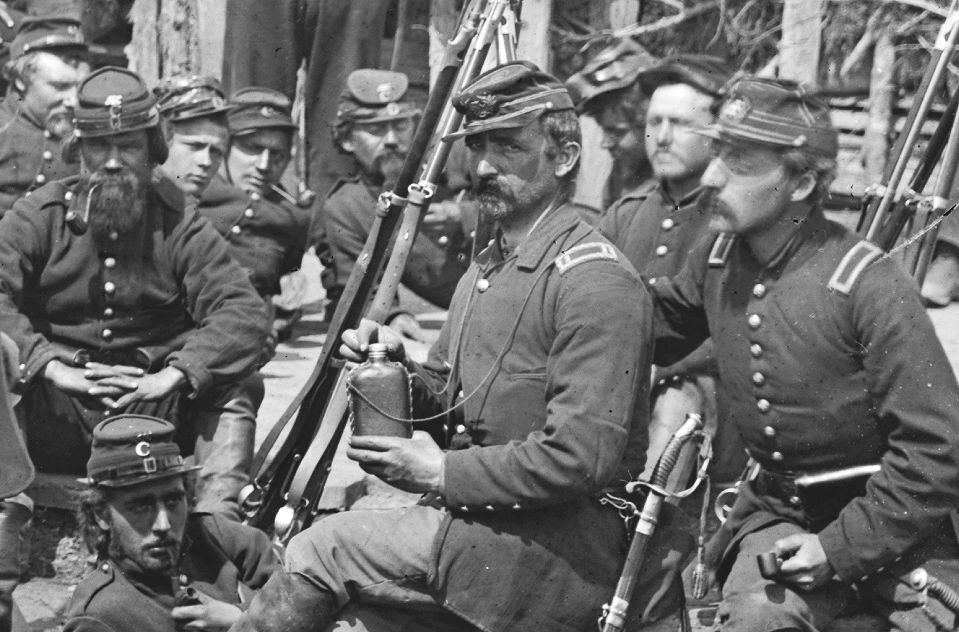
More Men of Co. C, 41st New York Infantry at Manassas, July 1862

Cropped from a larger image – Manassas, Va. Men of Co. C, 41st New York Infantry.

Photo taken by Timothy H. O’Sullivan

Library of Congress Prints and Photographs Division Washington, D.C. 20540 USA

Record page for image: http://www.loc.gov/pictures/item/cwp2003000102/PP/

July 14.—General Pope issued an address “to the officers and soldiers of the army of Virginia, “informing them that by special assignment of the President of the United States, he had assumed command of the army.—(Doc 160.)

—A band of rebel guerrillas, under John Morgan, destroyed the long bridge on the Kentucky Central Railroad, between Cynthiana and Paris, Kentucky.—In the United States Senate, a resolution of thanks to Flag-Officer Foote, for his gallant services at the West, was adopted.

—An enthusiastic meeting of the citizens of Utica, N. Y., was held in that town for the purpose of promoting enlistments into the army under the call of President Lincoln for more men. Speeches were made by Ex-Governor Seymour, Judges Denio and Bacon, Francis Kiernan, E. H. Roberts, Charles W. Doolittle, and others. Resolutions offering extra bounties to volunteers were adopted.

—President Lincoln sent to Congress a message embodying the draft of a bill to compensate any State which should abolish slavery within its limits, the passage of which, substantially as presented, he earnestly recommended.—(Doc. 151.)