Following the American Civil War Sesquicentennial with day by day writings of the time, currently 1863.

July 2012

July 16.—The United States War Department received from William H. Aspinwall, of New York, a present of his check for twenty-five thousand two hundred and ninety dollars and sixty cents, as his share of profit on a contract for arms purchased by Howland & Aspinwall, and sold to the Government. The Secretary of War ordered “that the check be transferred to the Secretary of the Treasury, and that the thanks of the Department be rendered to Mr. Aspinwall for the proof he has furnished of the disinterested and patriotic spirit that animates the citizens of the United States in the present contest against treason and rebellion, giving assurance that a government supported by citizens who thus prefer the public welfare to their private gain, must overcome its enemies.”

—Gen. Halleck, on retiring from the command of the army of the Mississippi, issued an address to the troops, expressing his high appreciation of the endurance, bravery, and soldierly conduct which they had exhibited on all occasions during the campaign.

—The British schooner Agnes was captured off Abaco Island, by the United States steamer Huntsville, commanded by Lieut. Rogers.—Official Report.

—Governor Pierpont, of Virginia, issued a proclamation calling upon the people to furnish the State’s quota of troops, under the call of President Lincoln for three hundred thousand men. To aid the work, he desired the Senators and members of the House of Delegates to act as agents in procuring volunteers in their respective districts.

—Yesterday John B. Clarke, of the rebel Senate, addressed a letter to G. W. Randolph, the rebel Secretary of War, inquiring whether the “Partisan Rangers” were to be considered as belonging to the rebel army, and whether the rebel government would not claim for them the same treatment as prisoners which was exacted for prisoners of war; and to-day the Secretary replied that partisan rangers were a part of the provisional army of the States in rebellion, and were subject to all the regulations adopted for its government, and entitled to the same protection as prisoners of war.—(See Supplement.)

Mecklenburg County, July 15.—Mr. _____ and myself summoned here a short time ago to see our daughter, who was very ill. Found her better—she is still improving.

Richmond is disenthralled—the only Yankees there are in the “Libby” and other prisons. McClellan and his “Grand Army,” on James River, near Westover, enjoying mosquitoes and bilious fevers. The weather is excessively hot. I dare say the Yankees find the ” Sunny South” all that their most fervid imaginations ever depicted it, particularly on the marshes. So may it be, until the whole army melts with fervent heat. The gun-boats are rushing up and down the river, shelling the trees on the banks, afraid to approach Drury’s Bluff. The Northern papers and Congress are making every effort to find out to whom the fault of their late reverses is to be traced. Our people think that their whole army might have been captured but for the dilatoriness of some of our generals. General Magruder is relieved, and sent to take command in the West.

July 15TH —Gen. Pendleton has given McClellan a, scare, and might have hurt him if he had fired lower. He planted a number of batteries (concealed) on the south side of the river, just opposite the enemy’s camp. The river was filled with gun-boats and transports. At a signal, all the guns were fired, at short range, too, for some minutes with great rapidity, and then the batteries were withdrawn. I happened to be awake, and could not conjecture what the rumpus meant. But we fired too high in the dark, and did but little execution. Our shells fell beyond the enemy’s camp on the opposite side of the river. We lost a few men, by accident, mostly. But hereafter in “each bush they fear an officer.”

Tuesday, 15th—No news from Richmond.

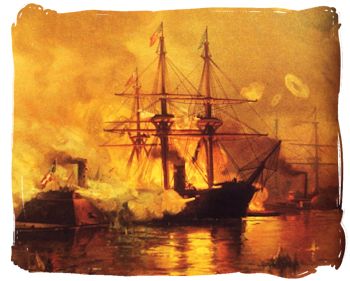
July 15th. Has changed the affairs of the fleet materially. Before daylight a firing of cannon had been heard up the river, and a gunboat had been dispatched to reconnoitre. As time passed, the firing neared us, and soon cannon balls could be seen dropping into the river below a-bend which hid objects from our view. The enemy proved to be the rebel ram Arkansas, which had chased our gunboat down the Yazoo river, and now came booming along, firing at our ships as she came. As no danger was apprehended, our ships were all lying without steam, and so near together that for one to fire endangered the rest.

All hands were called to quarters, and the ram came on and passed us, while each vessel which could fire upon her, did so, but we were not able to sink or disable her. Preparations were immediately made to follow her, and on the same evening our ships got under way, resolved to run down by the batteries and destroy the ram if possible. We commenced firing about dark, the ball being opened by Commodore Davis’s iron-clads, and in twenty minutes from the time of opening fire, we were in full blast. We passed slowly by the city, receiving fewer shots than formerly and being unable to discover the ram, which had been secreted behind a huge wharf-boat, and consequently we were unable in the darkness to harm her. We came to anchor below the city, and found our casualties to be, in killed three, and Captain Broome and Mr. Hoffman severely, and four of the crew slightly, wounded.

Green Meadows, July 15, 1862. Tuesday. — Captain Drake with Companies H and I returned this morning. The mounted men crossed the ford just above Bluestone on New River. The water was too deep and current too strong for footmen. They (the horsemen) called at Landcraft’s, Young’s, etc., etc. They learned that the only enemy now in Monroe is probably the Forty-fifth [Virginia], some cavalry, and artillery; and they have withdrawn from the river towards Centreville or some other distant part of the county. All others gone to or towards the Narrows or railroad.

At 9 o’clock I took four companies, A, C, E, and K, and the band and went to Packs Ferry. There the men went in swimming. Crossed 262 of them in the flying bridge — an affair like this [a crude pen sketch is given] — which swings from side to side of the river by force of the current alone. The bow (whichever way the boat goes) is pulled by means of a windlass up the stream at a small angle. The men enjoyed the spree.

We returned at 6:30 P. M. The scenery is of the finest; the river is a beautiful clear river. Strange, no fish except catfish, but they are of superior quality and often of great size.

The enemy shows signs of activity in Tennessee again. Our men will have a hard time during the next two or three months trying to hold their conquests. We will have our day when cold weather and high water return, not before. About Richmond there is much mystery, but supposed to be favorable.

15th. Stayed in camp and read “Guy Mannering,” good story. Pastured my horse and Brownell’s.

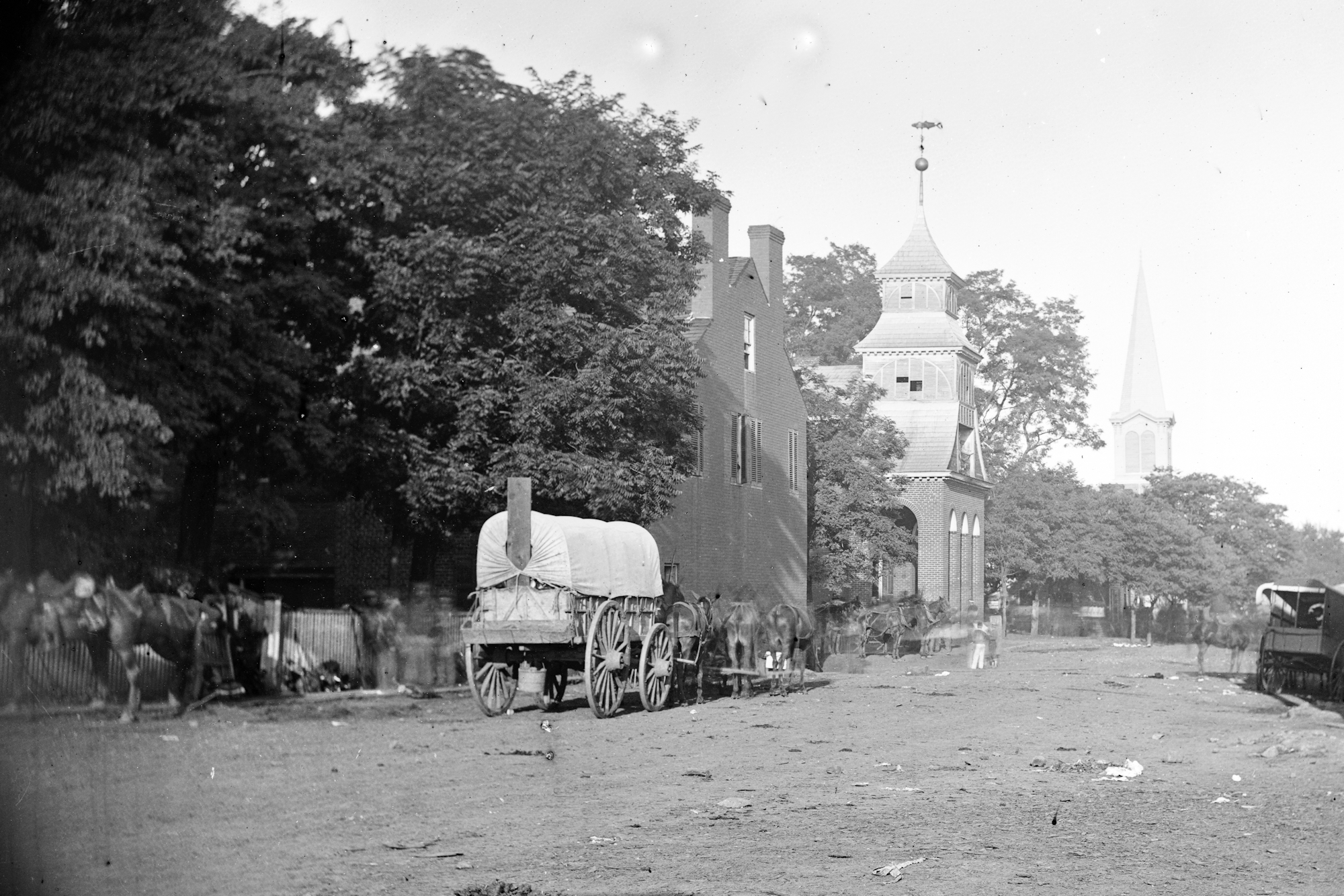
Culpeper Court House, Va. Street scene -- 1862

During the Civil War, Culpeper was a crossroads for a number of armies marching through central Virginia, with both Union and Confederate forces occupying the town by turn. (Wikipedia)

Library of Congress:

Photo taken by Timothy H. O’Sullivan

Library of Congress Prints and Photographs Division Washington, D.C. 20540 USA

Record page for image: http://www.loc.gov/pictures/collection/cwp/item/cwp2003000109/PP/

Tuesday, July 15, 1862.—Sunday night about ten we reached the place where, according to our map, Steele’s Bayou comes nearest to the Mississippi, and where the landing should be, but when we climbed the steep bank there was no sign, of habitation. Max walked off into the woods on a search, and was gone so long we feared he had lost his way. He could find no road. H. suggested shouting and both began. At last a distant halloo replied, and by cries the answerer was guided to us. A negro said “Who are you? What do you want?” “Travelers seeking shelter for the night.” He came forward and said that was the right place, his master kept the landing, and he would watch the boat for five dollars. He showed the road, and said his master’s house was one mile off and another house two miles. We mistook and went to the one two miles off. There a legion of dogs rushed at us, and several great, tall, black fellows surrounded us till the master was roused. He put his head through the window and said,—”I’ll let nobody in. The Yankees have been here and took twenty-five of my negroes to work on their fortifications, and I’ve no beds nor anything for anybody.” At 1 o’clock we reached Mr. Fetler’s, who was pleasant, and said we should have the best he had. The bed into whose grateful softness I sank was piled with mattresses to within two or three feet of the ceiling, and, with no step-ladder, getting in and out was a problem. This morning we noticed the high-water mark, four feet above the lower floor. Mrs. Fetler said they had lived up-stairs several weeks.

______

Note: To protect Mrs. Miller’s job as a teacher in New Orleans, the diary was published anonymously, edited by G. W. Cable, names were changed and initials were often used instead of full names — and even the initials differed from the real person’s initials.

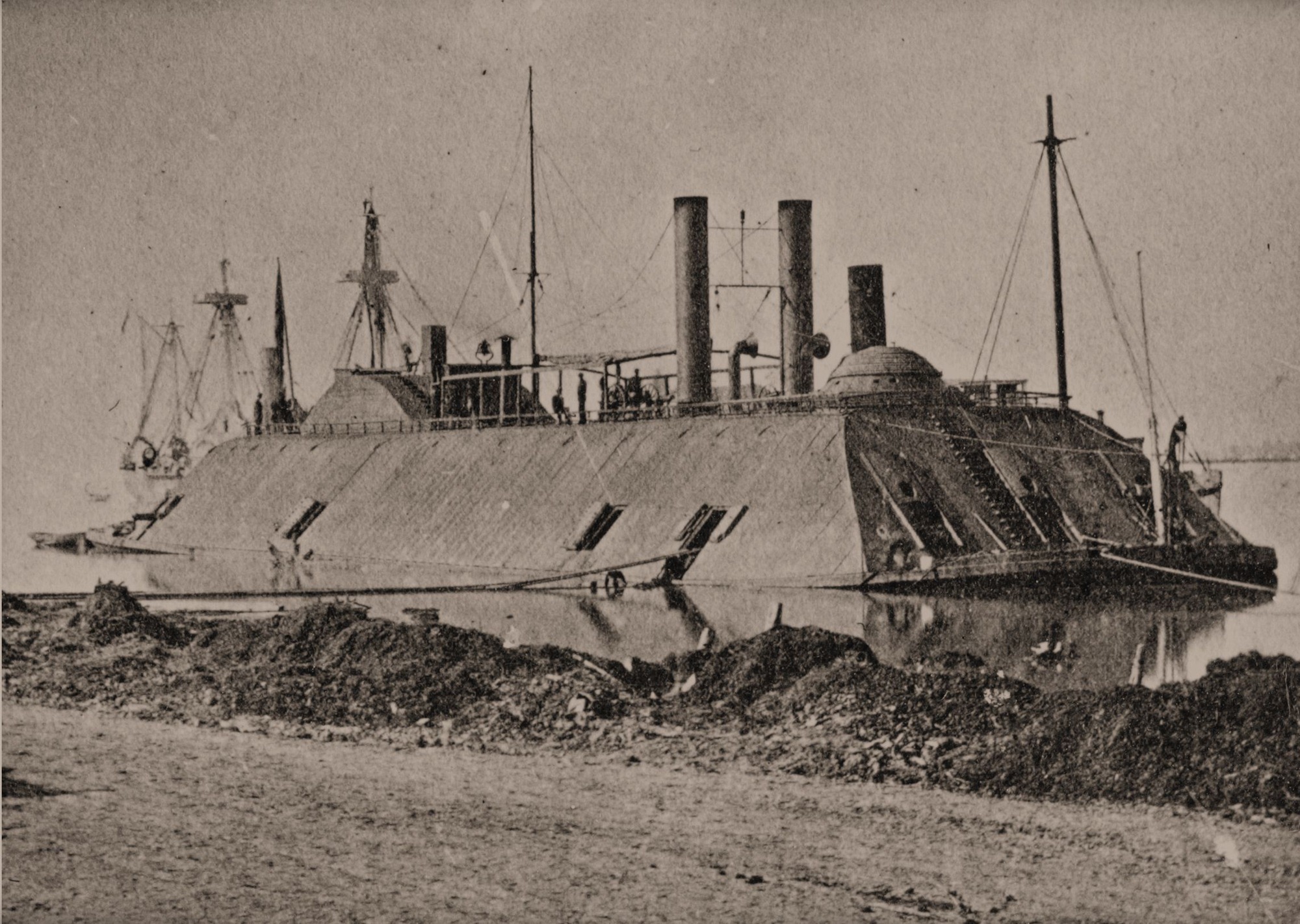
USS Essex - 1s02823u

US Navy Naval Historical Center:

USS Essex, a 1000-ton ironclad river gunboat, was converted in stages from the steam ferry New Era. Originally constructed at New Albany, Indiana, in 1856, the ship was purchased in September 1861 by the U.S. Army for its Western Gunboat Flotilla. Modified into a 355-ton “timberclad” gunboat, and retaining the name New Era, she took part in an expedition up the Cumberland River in November 1861. Renamed Essex soon thereafter, she received iron armor and other changes and was then actively employed in operations during early 1862, engaging Confederate gunboats near Lucas Bend, Missouri, on 11 January. On 6 February, she was badly damaged by enemy gunfire during an attack on Fort Henry, Tennessee.

During subsequent repairs, Essex‘ Commanding Officer, William D. Porter, spared little expense (albeit without official authorization) in upgrading his ship into one of the most powerful ironclads on the Western Rivers. Lengthened, widened, reengined, rearmored and completely altered in appearance, Essex was back in service in time for operations against Vicksburg, Mississippi, in July. On the 22th of that month she ran past the enemy fortress city, engaging and damaging the Confederate ironclad Arkansas along the way. After joining Rear Admiral Farragut’s squadron as the only Federal ironclad on the lower Mississippi, she helped repel an attack on Baton Rouge, Louisiana, on 5 August and was instrumental in the destruction of the Arkansas the next day.

Essex was formally transferred to the Navy in October 1862 and remained active on the rivers through the rest of the Civil War. She bombarded Port Hudson, Louisiana, and helped with the occupation of Baton Rouge in December 1862. In May-July 1863 she participated in the capture of Port Hudson. She took part in the Red River expedition in March-May 1864. Essex was decommissioned in July 1865. After her sale to private interests in November of that year, she reverted to the name New Era. She was scrapped in 1870.

Library of Congress:

Summary: Photo shows the USS Essex, launched in 1856 as the New Era and acquired during the American Civil War by the US Army in 1861 for the Western Gunboat Flotilla. Transferred to the US Navy in 1862 and participated in several operations on the Mississippi River, including the capture of Baton Rouge and Port Hudson in 1863.

“Probably Baton Rouge, La.” handwritten on back of card.

Library of Congress Prints and Photographs Division Washington, D.C. 20540 USA

Record page for image: http://www.loc.gov/pictures/item/97501522/