Following the American Civil War Sesquicentennial with day by day writings of the time, currently 1863.

July 2012

Eliza Woolsey Howland to her sister, Georgeanna.

Fishkill, July 13.

Except for seeing how much good the rest and the home scenes are doing Joe, I would much rather be at Harrison’s Point. He is improving nicely. His wound is not healed yet, but the inflammation has all gone and it looks better every day, . . . and but for a good deal of debility and shakiness of leg and hand, he would be quite himself. . . . Did they tell you of the demonstration the village people had prepared, and how we had to change our time of coming and telegraph secretly to Mr. Masters at Newburgh in order to escape it? They had actually arranged to take the horses out of the carriage and drag Joe home themselves. Fancy the struggle we should have had, to maintain an expression of mingled gratification and humility all through the three miles!

Joe received the other day the company reports of the 16th’s part in Friday’s battle, and their simple story is exceedingly touching—all of them speaking particularly of the coolness and cheerfulness of the men. Lieutenant Corbin, who wrote the little poem, makes out the report of Company C, which in its quaintness and simplicity reminds one of the old days of knight errantry. “Four of my men,” he says, “fell dead fighting bravely and pleasantly.” Company C, you know, is the color company, and of them he says, “The colors, which my company had the honor to guard, were safely kept, though they bear many an evidence of the hot fire in which they stood.” The reports are nearly all equally simple, and one captain says, speaking of the order to cross and reinforce Porter, “This seemed highly pleasing to the boys, and with elastic step we took up our march for Gaines’ Mill.” Joe says they came out of the fight, too, with equal bravery and cheerfulness, and he got a smile from every man he looked at that day. They all seem to want him back again, and his great anxiety is to be with them.
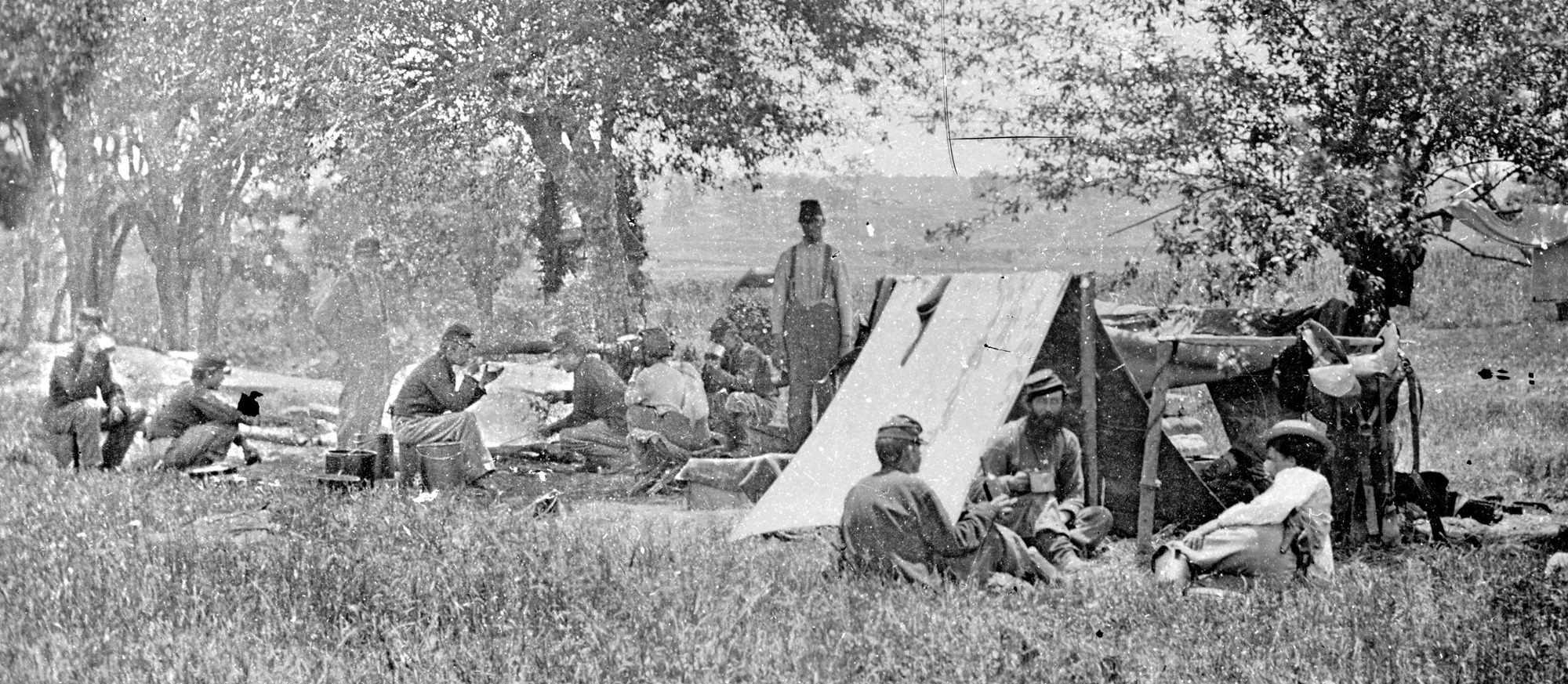
Bull Run, Virginia. Federal encampment at Blackburn's Ford  - 01153a

Title: Bull Run, Virginia. Federal encampment at Blackburn’s Ford

Caption from negative sleeve: Picket Station, Bull Run, Federal Encampment at Blackburn’s Ford on Bull Run, July 4, 1862.

Photo taken by Timothy H. O’Sullivan

Library of Congress Prints and Photographs Division Washington, D.C. 20540 USA

Record page for image: http://www.loc.gov/pictures/item/cwp2003005565/PP/

Sunday, July 13, 1862. (Under a tree on the east bank of the Mississippi.)—Late on Saturday evening we reached a plantation whose owner invited us to spend the night at his house. What a delightful thing is courtesy! The first tone of our host’s welcome indicated the true gentleman. We never leave the oars with the watchman; Max takes those, Annie and I each take a band-box, H. takes my carpet-sack, and Reeney brings up the rear with Annie’s. It is a funny procession. Mr. B.’s family were absent, and as we sat on the gallery talking it needed only a few minutes to show this was a “Union man.” His home was elegant and tasteful, but even here there was neither tea nor coffee.

About eleven we stopped here in this shady place. While eating lunch the negroes again came imploring for tobacco. Soon an invitation came from the house for us to come and rest. We gratefully accepted, but found the idea of rest for warm, tired travelers was for us to sit in the parlor on stiff chairs while the whole family trooped in, cool and clean in fresh toilets, to stare and question. We soon returned to the trees; however, they kindly offered corn-meal pound-cake and beer, which were excellent. If we reach Fetler’s Landing to-night, the Mississippi-River part of the journey is concluded. Eight gunboats and one transport have passed us. Getting out of their way has been troublesome. Our gentlemen’s hands are badly blistered.

______

Note: To protect Mrs. Miller’s job as a teacher in New Orleans, the diary was published anonymously, edited by G. W. Cable, names were changed and initials were often used instead of full names — and even the initials differed from the real person’s initials.

July 13th.—Halcott Green came to see us. Bragg is a stern disciplinarian, according to Halcott. He did not in the least understand citizen soldiers. In the retreat from Shiloh he ordered that not a gun should be fired. A soldier shot a chicken, and then the soldier was shot. “For a chicken!” said Halcott. “A Confederate soldier for a chicken!”

Mrs. McCord says a nurse, who is also a beauty, had better leave her beauty with her cloak and hat at the door. One lovely lady nurse said to a rough old soldier, whose wound could not have been dangerous, “Well, my good soul, what can I do for you?” “Kiss me!” said he. Mrs. McCord’s fury was “at the woman’s telling it,” for it brought her hospital into disrepute, and very properly. She knew there were women who would boast of an insult if it ministered to their vanity. She wanted nurses to come dressed as nurses, as Sisters of Charity, and not as fine ladies. Then there would be no trouble. When she saw them coming in angel sleeves, displaying all their white arms and in their muslin, showing all their beautiful white shoulders and throats, she felt disposed to order them off the premises. That was no proper costume for a nurse. Mrs. Bartow goes in her widow’s weeds, which is after Mrs. McCord’s own heart. But Mrs. Bartow has her stories, too. A surgeon said to her, “I give you no detailed instructions: a mother necessarily is a nurse.” She then passed on quietly, “as smilingly acquiescent, my dear, as if I had ever been a mother.”

Mrs. Greenhow has enlightened Rachel Lyons as to Mr. Chesnut’s character in Washington. He was “one of the very few men of whom there was not a word of scandal spoken. I do not believe, my dear, that he ever spoke to a woman there.” He did know Mrs. John R. Thompson, however.

Walked up and down the college campus with Mrs. McCord. The buildings all lit up with gas, the soldiers seated under the elms in every direction, and in every stage of convalescence. Through the open windows, could see the nurses flitting about. It was a strange, weird scene. Walked home with Mrs. Bartow. We stopped at Judge Carroll’s. Mrs. Carroll gave us a cup of tea. When we got home, found the Prestons had called for me to dine at their house to meet General Magruder.

Last night the Edgefield Band serenaded Governor Pickens. Mrs. Harris stepped on the porch and sang the Marseillaise for them. It has been more than twenty years since I first heard her voice; it was a very fine one then, but there is nothing which the tooth of time lacerates more cruelly than the singing voice of women. There is an incongruous metaphor for you.

The negroes on the coast received the Rutledge’s Mounted Rifles apparently with great rejoicings. The troops were gratified to find the negroes in such a friendly state of mind. One servant whispered to his master, “Don’t you mind ’em, don’t trust ’em” —meaning the negroes. The master then dressed himself as a Federal officer and went down to a negro quarter. The very first greeting was, “Ki! massa, you come fuh ketch rebels? We kin show you way you kin ketch thirty to-night.” They took him to the Confederate camp, or pointed it out, and then added for his edification, “We kin ketch officer fuh you whenever you want em.”

Bad news. Gunboats have passed Vicksburg. The Yankees are spreading themselves over our fair Southern land like red ants.


July 13.—The railroad bridge over the Rapidan River, at Rapidan Station, Va., was destroyed by a party of Union troops under the command of Major James M. Deems. On proceeding towards the bridge, and when about six miles from Fairfax, they were fired upon by a force of the enemy, and a sharp skirmish ensued, resulting in the defeat of the rebels, who were driven for a distance of ten miles. On arriving at the bridge, another party of rebels were encountered, who, after a short fight, were dispersed. Besides destroying the bridge, the Unionists cut the telegraph wire and destroyed the battery at the station.—(Doc. 149.)

—A party of rebel guerrillas entered Memphis, Mo., captured the militia troops stationed there, drove out the Union men, and robbed the stores.

—Great excitement existed in Louisville, Lexington, Bowling Green, Danville, Frankfort, Covington, and other towns in Kentucky, in anticipation of a visit from the rebel guerrillas under John Morgan. In order to be prepared for such an event, General Boyle, commanding the Union forces at Louisville, issued the following order: “It is ordered that every able-bodied man take arms and aid in repelling the marauders. Every man who does not join will remain in his house forty-eight hours, and be shot down if he leaves it.” General Ward, commanding at Lexington, issued an order directing that “all able-bodied citizens of Lexington and Fayette County are to report themselves at the Court-House Square, in Lexington, forthwith. Those having arms will bring them; those having none will be armed.”

—Mukfreesboro, Ky., was captured by the rebel forces under the command of Brig.-General Forrest—(Doc. 88.)

July 12 — To-day we moved again, and we are now camped a quarter mile west of the pike, and two miles below Harrisonburg.

June 12th [sic].

Brother writes that rumors of the capture of Baton Rouge by our troops have made him very uneasy about us; and he wishes us to go down to New Orleans if possible. I wish we could. The impression here, is that an attack is inevitable, and the city papers found it necessary to contradict the rumor of Ruggles having occupied it already. I wish mother would go. I can see no difference there or here, except that there, we will be safe, for a while at least. . . .

I grow desperate when I read these Northern papers reviling and abusing us, reproaching us for being broken and dispersed, taunting us with their victories, sparing no humiliating name in speaking of us, and laughing as to what “we’ll see” when we vile rebels are “driven out of Virginia, and the glorious Union firmly established.” I can’t bear these taunts! I grow sick to read these vile, insulting papers that seem written expressly to goad us into madness! . . . There must be many humane, reasonable men in the North; can they not teach their editors decency in this their hour of triumph?

12th.—This night closes the period of one year’s service in the United States. One year ago to-morrow, our regiment changed its situation from State to United States, and when I review that period, and recall the sufferings I have witnessed, the treason and incompetency which have thwarted the well laid plans of the government, the repeated failures of our leaders to embrace most favorable opportunities to crush the rebel armies and to arrest the war, I despair of accomplishing decisive results till we have a change of leaders. But I have a gratifying consciousness of having, up to the ability which God has given me, performed every duty to my country with as little selfishness as man’s frailty will permit. I cannot recall an instance where fatigue, the fear of danger, or even sickness, has been permitted to interpose between my comfort and my efforts to relieve the sufferings of the soldier in whatever form presented. I have had much reason to regret that my efforts were not more effective, but never that I have neglected their performance; nor has it been a source of less thankfulness to me that I have been so small a portion of time unable to labor.

Saturday, 12th—We had company inspection again as usual. A good many negroes are coming into camp. Some of the men who are strong enough to work and who want to be free are given work on the fortifications. A number of the officers are adopting negro boys as servants, and some of the most intelligent boys are being sent North to be educated.

July 12, 1862. Saturday. — Received orders today to move to Green Meadows tomorrow. It is said to be a fine camping place, and although our present camp is the prettiest I have ever seen, we are glad for the sake of change to leave it.