12th. Saturday. Wrote a letter to Uncle and Aunt Branch. My horse got away suddenly and I did not find him until morning.
July 2012
Headquarters,
U. S. Forces En Route To F. Monroe,
July 12th, 1862.
My dear Mother:
When I wrote you a few hurried, peevish lines, by the last steamer, I then had little thought we were so soon to be summoned to a different sphere of action, and that, had my longing to see you at home been really gratified, I would have returned only to be mortified by being absent from duty at a time when every man should be standing steadily at his post. So you see my lucky star is always dominant. Just when I thought my fate intolerable, I was merely being providentially detained that nothing might prevent me from the fulfilment of my duty. Ten Regiments from the Department of the South, six under Stevens and four under Wright, are ordered to Fortress Monroe, we know not yet whether to reinforce Pope or McClellan. Few of us regret to leave this unholy soil and wretchedly mismanaged department, where we have been sure only of mismanagement and disgrace. I am sorry Rockwell could not go with us. He would have liked to have done so, but a demand was made for infantry alone.
It is a good thing for me that I have escaped from the Southern climate, having been long enough exposed to feel as though every fibre of my body was involved in a malarious atmosphere. A change of climate and a persistent employment of quinine, the Doctor says, are all I need, though were times less stirring, he would probably prescribe in addition a few days at home. I shall probably lose the letters you will write relative to Lilly’s wedding, but you must not forget to let me know all about it in whatever new sphere I may be placed. I suppose you had better address the first letter to the care of General Stevens near Fortress Monroe, and so soon as may be, I will let you know a more definite address.
I enclose the $25.00 for Lilly’s bridal gift. I could not enclose it in my last, as it was then some time since I had seen the paymaster. I hope I may have an opportunity to see you all this summer, but it looks dubious. Next to Lilly’s wedding, I was very anxious to be present at my class meeting, which takes place the end of this month. Hall will be there and many old friends. It will seem strange enough to get among civilized people once more, and there will be so many changes too. Walter, an aged paterfamilias. Lilly and Hall, both old domestic bodies. Hunt in a new house. Horace alone will be left unchanged.
Are any of my friends desirous of making a profitable speculation? A sure and magnificent fortune may be realized from the sale of ginger-pop at Hilton Head. Blind Dennis is doing a flourishing business in the lemonade line, and will certainly before long be putting up a superb house on Washington Street, in Burdick’s best style. The ginger-pop trade, I predict, will be one of the most remunerative branches of business ever opened at Port Royal. It even bids fair to prove as handsome a thing as negro-philanthropy, which in shrewd hands has proved a most capital paying business, and then the sale of ginger-pop is eminently more respectable. At any rate it is a pet idea of mine, and I would like to see the experiment tried.
Well, good-bye. I hope to hear good news on arriving at Fortress Monroe. Love to all.
14th. Still on shipboard but near Fortress Monroe.
Lilly’s wedding day. Miles of friends — little children’s voices — church bells — sweet thoughts. I shall feast to-day for all that though, on hard tack and salt horse with a quinine pill by way of dessert. So goes the world.
Good-bye, my dear Mother. Blessings on you all.
Lovingly,
Will.
“Wilson Small,” July 12.
Dear Mother,—I wrote this morning by Dr. Ware, who left us on the mail-boat, that I should start for home to-morrow morning. Meantime our plans are changed. A flag-of-truce came down to-day to the “Maritanza,” requesting us to go up and get our wounded who were left along the line of march, — four thousand of them, it is said. So the whole hospital fleet is to run five miles up the river, under convoy of the gunboats, to Haxall’s or Carter’s Landing. We are all ready, and waiting the order to start.[1]
Captain Sawtelle paid us a visit to-day, — the first for a week. He is promoted to Colonel Ingalls’s position; Colonel Ingalls to that of General Van Vliet; while the General is on his way to Washington for unknown honors, — all this in just acknowledgment, I suppose, of their admirable management at White House. Captain Sawtelle thinks our losses have been greatly over-estimated, as a very large number of stragglers have come in this week. He places the number of killed, wounded, and missing at twelve thousand. The artillery corps of one hundred and fifty-six guns lost one hundred and forty-three men, — not a man to each gun. He told us that almost the last thing he did at White House was to order the engines upon the railroad to be run, with all the cars, to the end of the track and precipitated into the river. Just as the order was being executed, the train almost in motion, he recollected that a gunboat had gone up beyond the bridge, and that the train would block the river. He then ordered the cars and the engines to be piled up and fired, which, together with the White House, made the great blaze which we saw; the White House was fired by a drunken soldier.
I never felt the slightest desire to witness a battle until I listened to the accounts they all give of the battle of Malvern Hill, where our whole artillery was massed on the hill-side and hurled back a column of thirty thousand men as it debouched with three heads. I listened to the guns; and even where we were it was a mighty thunder.
I have had one pleasant day, or part of a day. I was sitting alone, the rest were out rowing on the river, when I heard the regular beat of man-of-war’s oars, and presently a trig captain’s gig came alongside, and Captain George Rodgers, of the “Tioga,” ran upstairs.[2] I was delighted; it is really so much to see an old friend here. He urged me to go on board the “Tioga,” and promised to take me first to the “Monitor,” and then down the river to shell out a battery which was troublesome. I forgot I was tired and ill; I felt a momentary pang at my dirty dress: but I put on a clean white apron, and went off with alacrity. Things did not turn out quite favorably. When we reached the ” Monitor” the men were bathing, and we had to give up our visit. And we had scarcely reached the lovely “Tioga,” when a clumsy brig got foul of her, tearing away part of her paddle-box; and we did not get free till half-past ten at night, when there was nothing for me to do but go back at once to the ” Small.”
The “Tioga” is a picture, — just out of dock, lovely in model, and brilliant in paint and brass. She carries eight guns, — one a ten-inch Dahlgren, the other a ten-inch rifled Parrott. Captain Rodgers gave me a piece of the only Confederate balloon (captured on the “Teaser “), made of ladies’ silk dresses of every pattern and color. The piece I have is partly a brown stripe, and partly a green chini.
The other day as we came up the river, returning from Washington, we were ordered by the gunboat on guard to go single file past some wooded bluffs. The “Juniata” was ahead of us, when a shot; went through her pilot-house and hit the bell-wire, making the signal to stop. The engineer obeyed it and stopped the boat, when a second shot fell between us, — otherwise the “Small” might have caught it. Captain Rodgers told me he was convoying us, and had just left us, as he thought, beyond all danger from Fort Powhatan, when the shots were fired. He ran up immediately; but before he could get a gun sighted, the fellows had limbered up, and were off. It was a light four-gun battery. These batteries give a great deal of trouble, but, so far, have done very little damage. The men make breast-works of felled trees behind other trees which conceal them. Our gunboats keep up a constant straggling fire into the woods to prevent the enemy from settling in one spot. It was to dislodge one of these batteries, which seemed to have taken up a position near Fort Powhatan, that the “Tioga” was ordered down the river, when, unfortunately, she collided with the brig.
[1] The enemy sent down only four hundred men, keeping the rest as prisoners. The former were shipped on board the “Spaulding” and another vessel.
[2] Captain Rodgers was killed in the turret of the monitor “Catskill” which he commanded before Charleston, S.C., in 1863. He was passing a U. S. A. General Hospital where I was stationed, the day after he received his appointment to her. He landed, and ran up to my quarters to tell me of it. I congratulated him. “Yes,” he said, ” I am appointed to my coffin,” —alluding to the build of the vessel.
Charles William Woolsey to his brother-in-law, Joseph Howland,
Wilson Small, Harrison’s Landing,
Saturday, July 12th.
Dear Joe: I saw, to-day, your adjutant, surgeon, and quartermaster; the former is much better, he says, and is going home in a day or two. He reports the 16th in good condition and in excellent spirits. This is unmistakably the case with the whole army. Exhausted and disappointed they naturally are (or were), but they have never lost heart, and the morale of our army is as good as ever. Having but little to do on the boat I have been on shore about the camps for a day or two, and have got a good idea of the strength of our position. It seems to me impregnable even without the earthworks we have thrown up at the weakest points. With these, we are very strong and can surely hold our own. Taking Richmond, however, is quite a different thing.
Send us the “Fishkill Standard” containing the account of the “ovation,” and do not stand too long poised on one leg when you harangue the assembled multitude from the Tioronda balcony.
Georgy is going home soon, and perhaps myself. Love to E.
Yours affectionately,
C. W. W.

Georgeanna Woolsey’s journal.
July 12.
Lying off Harrison’s Point in sight of the hospital on shore to which we went the other evening. The fifty tents we brought from Washington are going up and are partly filled— men on cots, and not very ill. The place is to be used as a rest for a few days for men who can then join their regiments. The Medical Department is greatly improved, and the Sanitary Commission, who were chiefly instrumental in putting in the new Surgeon-General (Hammond), who in his turn has put in all the good new men, finds its work here at an end, and might as well retire gracefully. Four thousand sick have been sent north from Harrison’s. Soup, and food generally, are being cooked all the time, without the aid of the Sanitary Commission, and they would leave now but for the flag of truce sent in by Lee to arrange for the bringing away of our wounded left behind in the retreat. The transports are under orders.
Commodore Wilkes is here in charge of the gun-boat fleet, and Captain Rodgers sent his small boat for us the other day, and took us all over his vessel and then over the Monitor and the Maratanza. The Galena was full of cannon ball holes. The Maratanza gave me a piece of the balloon found on the rebel gun-boat Teaser. It was made of the old silk dresses of the ladies of Richmond, forty or more different patterns. They gave me, too, the signal flag of the little imp. We went over her to see the damage the shell did her, bursting into the boiler and disemboweling her.
The army is quiet and resting, and the surgeons of the regiments have been coming in constantly to the Sanitary Commission supply boat with requisitions for the hospitals. We are giving out barrels of vegetables. The Small will run up the river and be ready to fill a gap in bringing off our wounded prisoners, and it will be a comfort to do something before going home ignominiously. The last two weeks of waiting has been wearing to us all, and Miss Wormeley is a fascinating wreck.
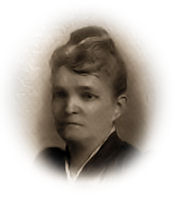
Saturday, July 12, 1862. (Under a cotton-shed on the bank of the Mississippi River.)—Thursday was a lovely day, and the sight of the broad river exhilarating. The negroes launched and reloaded the boat, and when we had paid them and spoken good-bye to them we felt we were really off. Every one had said that if we kept in the current the boat would almost go of itself, but in fact the current seemed to throw it about, and hard pulling was necessary. The heat of the sun was very severe, and it proved impossible to use an umbrella or any kind of shade, as it made steering more difficult. Snags and floating timbers were very troublesome. Twice we hurried up to the bank out of the way of passing gunboats, but they took no notice of us. When we got thirsty, it was found that Max had set the jug of water in the shade of a tree and left it there. We must dip up the river water or go without. When it got too dark to travel safely we disembarked. Reeney gathered wood, made a fire and some tea, and we had a good supper. We then divided, H. and I remaining to watch the boat, Max and Annie on shore. She hung up a mosquito-bar to the trees and went to bed comfortably. In the boat the mosquitoes were horrible, but I fell asleep and slept till voices on the bank woke me. Annie was wandering disconsolate round her bed, and when I asked the trouble, said, “Oh, I can’t sleep there! I found a toad and a lizard in the bed.” When dropping off again, H. woke me to say he was very sick; he thought it was from drinking the river water. With difficulty I got a trunk opened to find some medicine. While doing so a gunboat loomed up vast and gloomy, and we gave each other a good fright. Our voices doubtless reached her, for instantly every one of her lights disappeared and she ran for a few minutes along the opposite bank. We momently expected a shell as a feeler.
At dawn next morning we made coffee and a hasty breakfast, fixed up as well as we could in our sylvan dressing-rooms, and pushed on, for it is settled that traveling between eleven and two will have to be given up unless we want to be roasted alive. H. grew worse. He suffered terribly, and the rest of us as much to see him pulling in such a state of exhaustion. Max would not trust either of us to steer. About eleven we reached the landing of a plantation. Max walked up to the house and returned with the owner, an old gentleman living alone with his slaves. The housekeeper, a young colored girl, could not be surpassed in her graceful efforts to make us comfortable and anticipate every want. I was so anxious about H. that I remember nothing except that the cold drinking-water taken from a cistern beneath the building, into which only the winter rains were allowed to fall, was like an elixir. They offered luscious peaches that, with such water, were nectar and ambrosia to our parched lips. At night the housekeeper said she was sorry they had no mosquito-bars ready and hoped the mosquitoes would not be thick, but they came out in legions. I knew that on sleep that night depended recovery or illness for H. and all possibility of proceeding next day. So I sat up fanning away mosquitoes that he might sleep, toppling over now and then on the pillows till roused by his stirring. I contrived to keep this up till, as the chill before dawn came, they abated and I got a short sleep. Then, with the aid of cold water, a fresh toilet, and a good breakfast, I braced up for another day’s baking in the boat.
[If I had been well and strong as usual the discomforts of such a journey would not have seemed so much to me; but I was still weak from the effects of the fever, and annoyed by a worrying toothache which there had been no dentist to rid me of in our village.]¹
Having paid and dismissed the boat’s watchman, we started and traveled till eleven to-day, when we stopped at this cotton-shed. When our dais was spread and lunch laid out in the cool breeze, it seemed a blessed spot. A good many negroes came offering chickens and milk in exchange for tobacco, which we had not. We bought some milk with money.
A United States transport just now steamed by and the men on the guards cheered and waved to us. We all replied but Annie. Even Max was surprised into an answering cheer, and I waved my handkerchief with a very full heart as the dear old flag we have not seen for so long floated by; but Annie turned her back.

______
¹ Restored omission
Note: To protect Mrs. Miller’s job as a teacher in New Orleans, the diary was published anonymously, edited by G. W. Cable, names were changed and initials were often used instead of full names — and even the initials differed from the real person’s initials.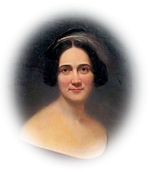
July 12th.—At McMahan’s our small colonel, Paul Hayne’s son, came into my room. To amuse the child I gave him a photograph album to look over. “You have Lincoln in your book!” said he. “I am astonished at you. I hate him!” And he placed the book on the floor and struck Old Abe in the face with his fist.
An Englishman told me Lincoln has said that had he known such a war would follow his election he never would have set foot in Washington, nor have been inaugurated. He had never dreamed of this awful fratricidal bloodshed. That does not seem like the true John Brown spirit. I was very glad to hear it—to hear something from the President of the United States which was not merely a vulgar joke, and usually a joke so vulgar that you were ashamed to laugh, funny though it was. They say Seward has gone to England and his wily tongue will turn all hearts against us.
Browne told us there was a son of the Duke of Somerset in Richmond. He laughed his fill at our ragged, dirty soldiers, but he stopped his laughing when he saw them under fire. Our men strip the Yankee dead of their shoes, but will not touch the shoes of a comrade. Poor fellows, they are nearly barefoot.
Alex has come. I saw him ride up about dusk and go into the graveyard. I shut up my windows on that side. Poor fellow!
July 12.—The Senate of the United States adopted the Confiscation Bill as it passed in the House of Representatives yesterday, by a vote of twenty-seven to thirteen.—The advance of Gen. Curtis’s army under General Washburn reached Helena, Ark., at nine o’clock this morning, having left Clarendon, on the White River, yesterday, at six A.M., and made a forced march of sixty-five miles in a day and a night.
Gen. Curtis left Batesville on the twenty-fourth ult. with twenty days’ rations, and after a halt of five days at Jacksonport, to concentrate the forces on his outposts, he took up his line of march, and his entire command are now en route for Helena.
From eight to twelve hundred rebels, under Matlock, who were on his front, fired on forage trains from canebrakes, and barricaded all the roads leading southward with trees felled by negroes, and placed every conceivable obstacle in the way of his men, but he overcame them all.
Gen. Washburn had a number of skirmishes on the route, in all of which the rebels were whipped, and with considerable loss to them, though with few casualties to the National troops.
—A fight took place at Lebanon, Ky., between a small body of Union troops, under the command of Colonel Johnson, and a force of rebel cavalry under John Morgan, resulting in the defeat of the Unionists and the capture of the town by the rebels.—(Doc. 87.)
—Large and enthusiastic meetings, for the purpose of promoting enlistments into the army under the call of President Lincoln for three hundred thousand additional troops, were this day held at Boston, Cambridge, Roxbury, Brookline, Somerville, Maiden, Springfield, and West-Cambridge, Mass., and at Portland, Maine. Speeches by distinguished and prominent citizens were made in each place. In several of the towns large sums of money were collected for the purpose of paying extra bounties to the volunteers.
—President Lincoln received the Senators and Representatives of the slaveholding Border States at the Presidential mansion, and addressed them on the subject of emancipation.
—General Smith, of the rebel army, issued an address to the forces under his command at Vicksburgh, Miss., thanking them for their bravery in resisting the attack made by the Union forces on the city.—The rebel General Albert Pike, in command of Fort McCulloch, Indian Territory, forwarded his “unconditional and absolute” resignation to Jeff Davis.
—The British schooner Julia, of Digby, N. S., captured by the National gunboat Kittatinny in Barrataria Creek, La., and the schooner Uncle Mose, captured by the gunboat Tahoma on the coast of Campeachy, arrived at Key West, Fla.— Colonel Thomas Cass, of the Ninth Massachusetts regiment, died at Boston from the effects of wounds received before Richmond.
—Fairmont, Missouri, was this day surprised by a band of bushwhackers, who plundered the town and carried off several of its inhabitants.
—The New-Orleans (La.) Delta, of this date, speaking of the sanitary condition of that city, said:
In the memory of the “oldest inhabitant,” our city was never more healthy at this season of the year. For this great blessing we are greatly indebted to Gen. Butler’s idea of relieving the poor, and at the same time getting said poor to clean up the streets. The order was intrusted to Gen. Shepley, who very judiciously selected Col. T. B. Thorpe to superintend the distribution of the charity of the Government, and see that the thousand laborers, the recipients, did their duty. The result is, that our city is a model of cleanliness.
—A fight took place at Culpepcr, Va., between a body of Union troops, under the command of Gen. Hatch, and a force of rebel cavalry, in which the rebels were routed, having had one killed, five wounded, and leaving eleven prisoners in the hands of the Unionists.
—The Unionists of North-Alabama having been much abused and persecuted by the rebels in that region, a body of Union troops, under the command of Colonel Streight, Fifty-first Indiana, were sent to relieve and protect them.—(Doc. 86.)
—The Union ram Switzerland, under the command of Lieut.-Col. Ellet, made a reconnoissance up the Yazoo River, for the purpose of ascertaining if the rebels had erected any breastworks along its banks.
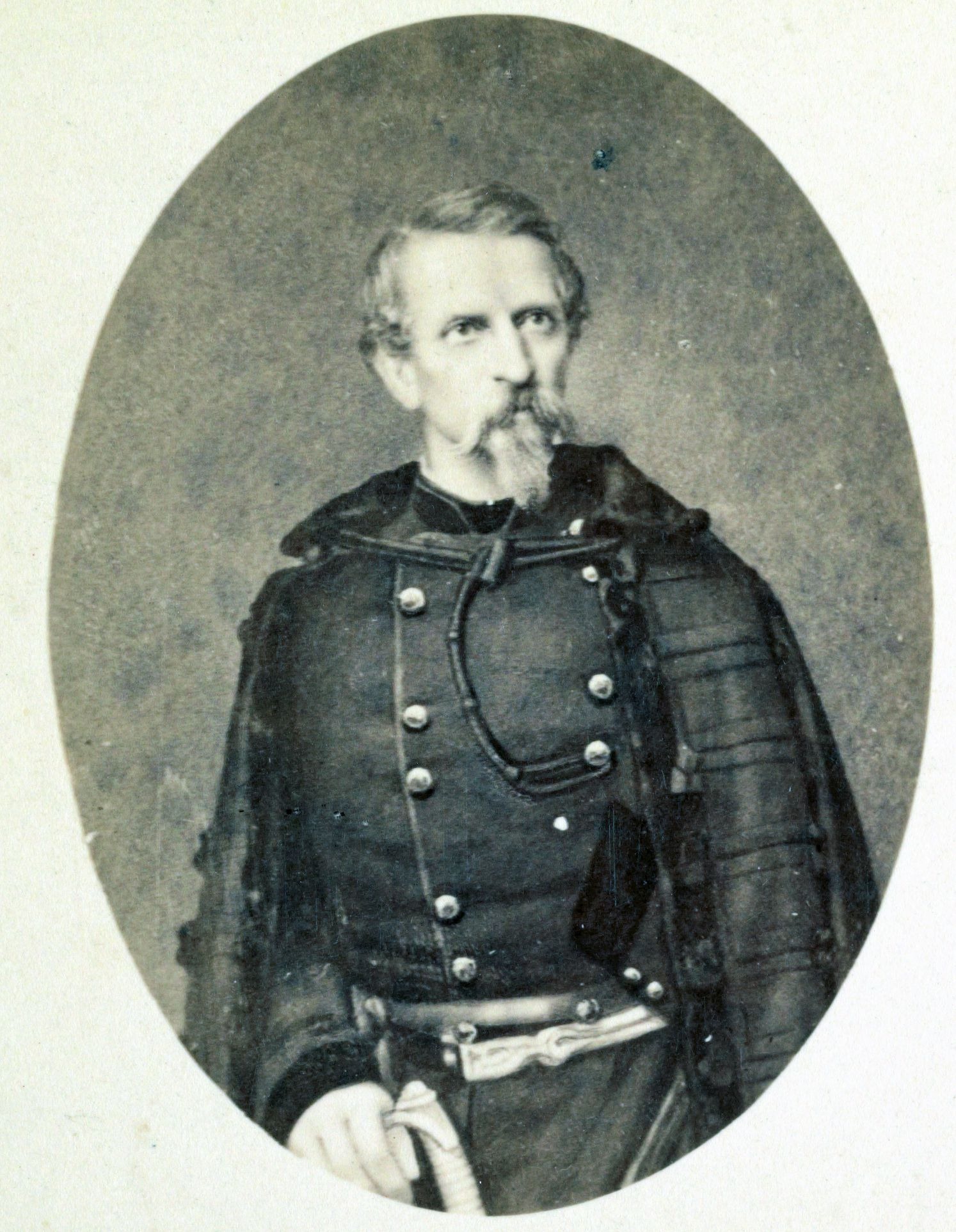
Philip Kearny, Jr. (/ˈkɑrniː/; June 2, 1815 – September 1, 1862) was a United States Army officer, notable for his leadership in the Mexican-American War and American Civil War. He was killed in action in the 1862 Battle of Chantilly. (Wikipedia)
Date Created/Published: Hartford, Conn. : Taylor & Huntington, No. 2 State St., 1862 July.
Library of Congress Prints and Photographs Division Washington, D.C. 20540 USA
Record page for image: http://www.loc.gov/pictures/item/2011661087/

July 11TH—Gen. Howell Cobb has been sent down the river under flag of truce to negotiate a cartel with Gen. Dix for the ex-change of prisoners. It was decided that the exchange should be conducted on the basis agreed to between the United States and the British Government during the war of 1812, and all men taken hereafter will be released on parole within ten days after their capture. We have some 8000 prisoners in this city, and altogether, I dare say, a larger number than the enemy have of our men.


