Following the American Civil War Sesquicentennial with day by day writings of the time, currently 1863.

July 2012

To Mrs. Lyon.

July 5, 1862.—I had a very pleasant visit from Dr. Miller, of Geneva. He is appointed surgeon of the 6th Wisconsin Battery, Captain Dillon, which is at Rienzi, nine miles from us. He stayed all night with us, and then went to his post. I enjoyed his visit very much indeed.

Colonel Heg called to see me yesterday. His regiment, the 15th, is encamped near us. Out of 750 men we have here in camp, not more than 40 are sick, none seriously so. My own health is perfect, not a throb of pain, scarcely of weariness, and the health tingling to my very toes’ ends.

We hold ourselves in readiness to march any hour, and in any direction. We think that Beauregard’s army has not gone to Richmond, but that a part of it is at Vicksburg and the balance about fifty miles south of us on the Mobile & Ohio R. R., near Okolona. I think we shall neither attack them nor be attacked by them very soon. Their cavalry scouts have been within twenty miles of us at Booneville and had a skirmish with our cavalry. Things look better at Richmond since McClellan has changed his front, contracted his lines, and got out of the swamps.

July 5, 1862. Saturday. — A fine, warm day. I rode with Avery and an escort of twelve dragoons under Captain Harrison (a Union doctor of Monroe County), to look for a new camping ground, ten or twelve miles from here, at or near Jumping Branch, on the pike leading from Raleigh to Packs Ferry. The village last winter was the rendezvous of the enemy who were threatening Raleigh and was burnt, except two or three houses, by Major Comly to get rid of the nest. We dined with an intelligent Union farmer, a Mr. Upton, whose house was spared. A good spring for the men’s use and a tolerable stream for the animals and washing. But no camping ground which we would take in exchange for Flat Top as long as water can be got here.

While at Mr. Upton’s, we heard from an artilleryman that after we left camp news was received at headquarters that McClellan had entered Richmond yesterday! Prior advices led us strongly to hope, almost to believe, it was true. We all said we believed it. How suddenly McClellan loomed up into a great general — a future (not distant future) President! We thought of a speedy end of the war and a return home; of the loved ones’ happiness at home! I could toast McClellan, “slow but sure,” “better late than never,” and the like.

On reaching camp our hopes were cruelly dashed. The only dispatches received, meagre, ambiguous, and obscure, indicate disaster rather than victory! That after six days’ hard fighting McClellan has lost fifteen to twenty thousand [men] and is twenty or thirty miles further distant from Richmond than when the battle began! No disaster is told other than this; but if it is true that he has been beaten back to a point thirty-five or forty miles from Richmond, we are where I feared we were on the third. But these dispatches are so deceptive as to complicated and extensive movements that I must hear further before I give up to such gloomy anticipations. But I am anxious!

5th. Issued rations to two battalions. The reaction of the 4th was visible among the boys. Slept on the prairie by my horse.

Camp near James River,
July
5, 1862.

Dear Cousin L.:—

The past ten days seem to me more like some fearful dream than anything else, and I shall not be able to give an intelligent account of what has passed in that time.

For two weeks previous to the 26th of June I had been unfit for duty. On that day the fighting began on the right wing. We were marched from place to place, but did not fire a gun. We slept in an open field till 3 o’clock a. m., Friday, when we fell back with the rest of the right wing to a position along the stream at Gaines’ Mill. The enemy followed soon after daylight and the fight recommenced. Butterfield’s brigade formed the left flank of our line. We were told that the retreat was a feint to draw the enemy into a trap and that we were to hold our present position. The Eighty-third was posted in a gully on this stream, and on the hill behind us the Forty-fourth and Twelfth New York and Sixteenth Michigan formed the second line, in position to fire over our heads. The enemy came up and were twice repulsed with terrible loss, but only to return with renewed vigor. It was a singular situation of ours— lying in the hollow with the balls of two opposing lines flying over our heads, but we were cool, and confident of victory. Suddenly we found out that the enemy was firing on us from the rear, and instantly all was confusion, but only for a moment. Our men faced about, formed, and advanced on them, and then commenced a scene such as I hope never to see again. It appears that the enemy broke through the line somewhere on our right. The order was sent for our brigade to fall back across the river, but the aide sent to our regiment was shot and we did not receive the order. The rest of the brigade was gone and we left alone to fight a brigade of the enemy. Our colonel fell dead at the first fire and the major immediately after. Our senior captain was shot and we were almost without officers. My two tent mates were wounded, and after that, they tell me, I acted like a madman. God only knows why or how I came out alive. I had three guns shot to pieces in my hands, a rammer shot in two, and I was struck in three places by balls. One that cut my gun in two lodged in my left shoulder, one went through my canteen and struck my left leg, and one just grazed my left eyebrow. The deepest was not over half an inch and is almost well now.

We were surrounded on three sides and at last we retreated and crossed the river. The bridge was torn up, and when I got to the river I threw my cartridge box on my shoulder and waded through the water up to my armpits. We left our knapsacks and our all in the hollow where we first formed line, and everything was lost. Blankets, tents and everything, fell into the enemy’s hands. I had $1.50 in stamps, a lot of paper and envelopes, gold pen, ink, $5 in money (all I had, except a little change) and other articles that money could not buy, but all are gone now. We have only such things as we could pick up here and there to keep us from the storms. Our regiment lost in that bloody field two hundred and thirty-six killed, wounded and prisoners, and our colonel and major. The papers have told you about the falling back of the army to the James river, and you know more of this probably than I do. I only know where we went and what we did, and not much about that. The fight reached us again on Monday. We were ordered out to support our batteries, and through Monday and Tuesday we were constantly exposed to the shells and grape of the enemy.[1] About sundown Tuesday night the remnant of our brigade went out again to the front.[2] Here the rebels swarmed out of the woods, seemingly without end, and though again and again repulsed, and the field piled with their dead by the deadly fire of our rifles and showers of grape, they still came on, determined to drive us from our position, but they could not do it. Night finally put an end to the roar of the musketry and artillery, and we still held our position. Our regiment, after firing an hour and using all their ammunition, was relieved by a regiment of the Irish brigade (God bless them!) and we fell back. Sergeant Wittich of Company I went out twenty rods in front of our line and brought off a stand of rebel colors. Our last corporal, Walter Ames, who brought the colors safely off the bloody field of Gaines’ Mill, was shot through the heart while waving them in front of our lines in this last fight.

As we were going on to the field Tuesday night I picked up a tent that had been dropped and slung it across my shoulder. That tent stopped a ball that otherwise would have entered my heart, and after firing seventy rounds I came out still unhurt. It seems to me almost a miracle that I am yet alive and able to write. But we have had hard times. We were marched off at midnight, where, we knew not or cared not, but we took the road down the river and marched some ten miles. It commenced raining hard at daylight and continued all day, and now, here we are, somewhere on the James river, just where I don’t know, but where I hope we will rest a little.

It is again clear and warm, and our little regiment numbering one hundred and ten men is beginning to feel a little refreshed. We have not had half rations for some time, but now they begin to come more regularly. The box you were so kind as to send me I never expect to see. I am afraid it was destroyed at White House. I am sorry for your sake that you could not have the satisfaction of knowing that it reached its destination, and I do not doubt that I should have done full justice to your bounty if I could have received it, but such are the fortunes of war; and, if I can only get plenty of hard tack, I believe I shall come out all right yet. I appreciate your kindness as much as if I had received it.

I received a letter from Father yesterday. Our folks were all in good health and thankful for my escape at Hanover Court House. I thought that was a battle, but now it seems like a mere skirmish.

I received your letter last Sunday, but you will readily see why I could not answer it before. Yesterday was the first that we could write at all, and I thought I must write home first and to the parents of my two tent mates, who have no other acquaintance in the regiment. I hope you will write again as soon as you can. I love to get your letters always and particularly at such a time as this. Address as before, “Army before Richmond.”


[1] Battles of White Oak Swamp and Glendale.

[2] Battle of Malvern Hill.

Abby Howland Woolsey to her sister, Eliza.

8 Brevoort Place, Saturday, July 5th, ’62.

My dear Eliza: Georgy’s and Charley’s letters from Harrison’s have just arrived, the last date being a postscript Thursday, July 3, which brings us into close correspondence again you see. These letters have relieved the painful anxiety that began to possess us, about Joe’s condition and whereabouts. We thought perhaps that if his wound were really slight, he had been tempted to rejoin the regiment, and had shared in that horrible battle of White Oak Swamp. . . . Mother says that if it is Charley’s desire to stay a little while longer, she consents; he is evidently so useful, that she should not have the heart to insist on his coming back. As for Georgy, if you leave her behind, we shall never forgive you. She must come. Mother cannot stand the anxiety much longer, nor can Georgy bear the constant strain. By-and-by, perhaps, if necessary, she could go back; now she must come home with you. We should be better pleased to have Charley and all once more together, at the end of this battle-year, and before we all begin on other years of separation and distress. Have C. come too. Poor, poor Colonel Marsh! mortally wounded at Gaines’ Mill. What a mercy it would have been had he been killed on the spot. . . We shall never know all that this week of desperate fighting has cost us; our dead and wounded being left behind, or crawling painfully along in the trail of the retreating army. Here and there an officer picked up in a passing ambulance, as Joe rescued the four you speak of. Our great, beautiful “Army of the Potomac,” dwindled down to an exhausted handful. . . . Fifty thousand in all destroyed by fever and wounds, in McClellan’s brief campaign! No wonder if the President has hesitated to send more troops to be used up in swamps, when so little was being done to show for it. . . . Any fool might have known that Beauregard and the bulk of his army had come to Richmond; but then our generals are not even fools, but something less if possible. . . . It may be God’s will to destroy this nation by inches. It is certainly the devil’s will to put dissension into the hearts of our leaders, and blundering darkness into their minds. God overrules all evil, even this, I suppose, to his own glory. I have no question that this and all other defeats are intended to drive us, as a nation, to a higher moral ground in the conduct and purpose of this war. As things stand, the South is fighting to maintain slavery, and the North is trying to fight so as not to put it down. When this policy ceases, perhaps we shall begin to have victory, if we haven’t already sinned away our day of grace.

I don’t know who kept Fourth of July yesterday; there was not much for public rejoicing, though many families had private mercies and deliverances, like ours, to be thankful for. Hatty and Carry went with the Bucks to Bedloe’s Island, with a tug load of ice cream and cake, and flowers, and flags, and a chest of tea, forty quarts of milk, and butter, and handkerchiefs, papers and books, to set out a long table and give a treat to two hundred in hospital there. To their distress they found that H—— B—— (malisons on him) had ordered away the day before, back to their regiments (via Fort Monroe I suppose), all who were strong enough to move about. They cannot possibly carry their knapsacks or guns, and must go into hospital again from relapse.

The forty convalescents left on the Island had a glorious feast, the doctor giving his full consent that even the twelve sick ones, in bed, should have as much ice cream as they wanted. Mr. Lasar, the singer, and one or two others, went about twice in the course of the day, from tent to tent, singing patriotic songs and hymns, winding up with “Lord, dismiss us,” by particular request of the men; and then the men escorted the whole party, after tea, back to the tug, with three cheers and overwhelming thanks. Each man had at least a quart of ice cream, Carry thinks, and each a glass of Catawba wine, and a good slice of cake, and no doubt there will be many made sick, and the ladies will be blamed as the cause.

If you have a hold on Hammond, do get him to look into the hospital rations in the hospitals here: Bedloe’s and David’s Islands. There seems to be no “special diet” provided—nothing but coffee (no tea), dry bread and stew, rank with onions and white with grease. I have written to the ladies at New Rochelle, begging them to take David’s Island in hand, and open a “ladies’ kitchen,” a “gruel kitchen,” as Sarah says theirs in New Haven is called. But they say the surgeon looks with disfavor on the visits of ladies, and they feel “satisfied that the men are well taken care of.” . . . They will find out by-and-by that surgeons and hospital stewards are not all angels in uniform. . . .

People kept coming yesterday, having seen Joe’s name in the newspaper lists, and to-day we have notes of inquiry from all directions. . . .

Edward Walker’s account of the fight at Gaines’ Mill agrees with the Tribune reporter’s —black masses of men coming upon our guns with orderly joy determined to take them, and falling under our fire in solid blocks, others pressing forward to fill the gaps.


The Daniel Webster was now filling up again with wounded and sick taken on at Harrison’s Landing,—J. H. [Colonel Joe Howland] among them,—and, with [his wife] Eliza as hospital nurse-in-charge, it sailed July 5th for New York. Charley and G. [Georgeanna] stayed on a little longer, till the army fell back towards Washington.
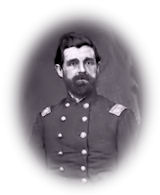
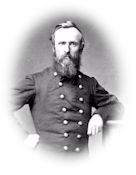
Saturday, 5th.—Returned to Mouse Creek; started for home 2 P. M. Arrived Varnells’ 5 P. M. Went out to Lowe’s and stayed all night. Got home 10 A. M.


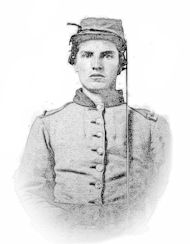
(Note: picture is of an unidentified Confederate soldier.)

Celebrating the Fourth of July.

July 5. The Fourth was celebrated with salutes from the forts, batteries and gunboats, morning, noon and night. There were gala times in Camp Oliver last night. A huge bonfire was set from a pyramid of 75 barrels of resin, and when well on fire it lighted up the camp in grand style. All the regimental bands were present, and under the direction of P. S. Gilmore, leader of the 24th Massachusetts regimental band, were consolidated, and gave a grand concert with artillery accompaniment. The effect was very fine. The camp guard was taken off and all went in for a good time. The parade ground was covered with officers and soldiers from other camps, and officers and marines from the boats and citizens generally. The delighted darkies were on hand in force. It far surpassed anything they had ever heard or dreamed of. They are very fond of music, and gathered in great numbers in the vicinity of the bands, never noticing the battery which stood a short distance away, or if they did it was a sealed book to them and a harmless looking battery enough. After the bands had played a few selections they struck up Hail Columbia; and when in quick succession three or four of those guns were let off, there was a great scarcity of darkies. They are terribly frightened at artillery firing, and will make the distance between themselves and the guns as far and as quick as possible. The celebration was kept up till near midnight; everybody seemed to enjoy it and had a good time. If we were behind Boston in orations, floral exhibitions and the like of that, we certainly were ahead of them in music, salutes and fireworks.

July 5th. The army is formed in very close order, nearly all the corps being camped in close column of division. We are told the entire front does not exceed five miles, therefore the troops must be packed pretty closely together. The general plan of the camp is seen from the sketch; it is impregnable, and can be defended easily against all comers and if that were all expected of the army, it would be entirely satisfactory, but it is a poor place for an aggressive, invading army.

The army now settled down for a comfortable rest, and the administrative bureaus began their activity, the executive officers working from morning till night. After the tremenduous campaign just closed, there is an immense amount of work to do. Every man must be satisfactorily accounted for, as well as every article of public property. Our losses cannot have been less than six or eight thousand men, and a fabulous lot of stores, of every description. All of this must be accounted for, and the reason given for its abandonment, or destruction. The muster rolls require the greatest care, to avoid doing injustice, for every man reported absent without leave, must be restored to his place by court martial, which is slow and uncertain. In the meantime the man, if again with his regiment, is debarred from drawing pay, or doing duty, and is a source of weakness, rather than strength to his regiment. Consequently, adjutants are busy people in camp, as well as regimental quartermasters, who have to re-equip the whole command wherever necessary. I have only one clerk, and write every morning till noon. Weather frightfully hot, and the water very poor; each regiment has its well, which is nothing more than a hole eight to ten feet deep, collecting the surface water; the soil being mostly sand, the water easily percolates through it. Many of the men have been taken sick since we arrived, perhaps as much from their past experiences as from the poor water here.

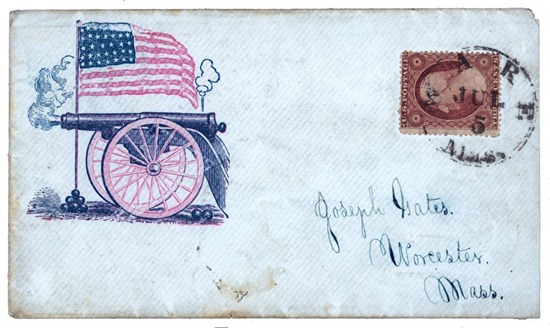
Civil War envelope showing a firing cannon and an American flag standing in a pile of cannon balls

Civil War envelope showing a firing cannon and an American flag standing in a pile of cannon balls.

Addressed to Joseph Gates, Worcester, Mass.; postmarked; bears 3 cent stamp.

Collection: Liljenquist Family Collection of Civil War Photographs (Library of Congress)

This envelope and additional information may be found here at the Library of Congress

July 5th, 1862.—Brother Junius spent the day with us yesterday. He gave us such an entertaining account of the winter on the St. Johns. He likes army life better than he expected. He says he never was fond of hunting and when he has to really go “Man-hunting” he will not like it at all.

He thinks they will break camp about the middle of August.