Following the American Civil War Sesquicentennial with day by day writings of the time, currently 1863.

Tuesday, April 5, 2011

April 5th.—Dined with the Southern Commissioners and a small party at Gautier’s, a French restaurateur in Pennsylvania avenue. The gentlemen present were, I need not say, all of one way of thinking; but as these leaves will see the light before the civil war is at an end, it is advisable not to give their names, for it would expose persons resident in Washington, who may not be suspected by the Government, to those marks of attention which they have not yet ceased to pay to their political enemies. Although I confess that in my judgment too much stress has been laid in England on the severity with which the Federal authorities have acted towards their political enemies, who were seeking their destruction, it may be candidly admitted, that they have forfeited all claim to the lofty position they once occupied as a Government existing by moral force, and by the consent of the governed, to which Bastilles and lettrés de cachêt, arbitrary arrests, and doubtful, illegal, if not altogether unconstitutional, suspension of habeas corpus and of trial by jury were unknown.

As Col. Pickett and Mr. Banks are notorious Secessionists, and Mr. Phillips has since gone South, after the arrest of his wife on account of her anti-federal tendencies, it may be permitted to mention that they were among the guests. I had pleasure in making the acquaintance of Governor Roman. Mr. Crawford, his brother commissioner, is a much younger man, of considerably greater energy and determination, but probably of less judgment. The third commissioner, Mr. Forsyth, is fanatical in his opposition to any suggestions of compromise or reconstruction; but, indeed, upon that point, there is little difference of opinion amongst any of the real adherents of the South. Mr. Lincoln they spoke of with contempt; Mr. Seward they evidently regarded as the ablest and most unscrupulous of their enemies; but the tone in which they alluded to the whole of the Northern people indicated the clear conviction that trade, commerce, the pursuit of gain, manufacture, and the base mechanical arts, had so degraded the whole race, they would never attempt to strike a blow in fair fight for what they prized so highly in theory and in words. Whether it be in consequence of some secret influence which slavery has upon the minds of men, or that the aggression of the North upon their institutions has been of a nature to excite the deepest animosity and most vindictive hate, certain it is there is a degree of something like ferocity in the Southern mind towards New England which exceeds belief. I am persuaded that these feelings of contempt are extended towards England. They believe that we, too, have had the canker of peace upon us. One evidence of this, according to Southern men, is the abolition of duelling. This practice, according to them, is highly wholesome and meritorious; and, indeed, it may be admitted that in the state of society which is reported to exist in the Southern States, it is a useful check on such men as it restrained in our own islands in the last century. In the course of conversation, one gentleman remarked, that he considered it disgraceful for any man to take money for the dishonor of his wife or his daughter. “With us,” he said, “there is but one mode of dealing known. The man who dares tamper with the honor of a white woman, knows what he has to expect. We shoot him down like a dog, and no jury in the South will ever find any man guilty of murder for punishing such a scoundrel.” An argument which can scarcely be alluded to was used by them, to show that these offences in slave States had not the excuse which might be adduced to diminish their gravity when they occurred in States where all the population were white. Indeed, in this, as in some other matters of a similar character, slavery is their summum bonum of morality, physical excellence, and social purity. I was inclined to question the correctness of the standard which they had set up, and to inquire whether the virtue which needed this murderous use of the pistol and the dagger to defend it, was not open to some doubt; but I found there was very little sympathy with my views among the company. The gentlemen at table asserted that the white men in the slave States are physically superior to the men of the free States; and indulged in curious theories in morals and physics to which I was a stranger. Disbelief of anything a Northern man—that is, a Republican—can say, is a fixed principle in their minds. I could not help remarking, when the conversation turned on the duplicity of Mr. Seward, and the wickedness of the Federal Government in refusing to give the assurance Sumter would not be relieved by force of arms, that it must be of very little consequence what promises Mr. Seward made, as, according to them, not the least reliance was to be placed on his word. The notion that the Northern men are cowards is justified by instances in which congressmen have been insulted by Southern men without calling them out, and Mr. Sumner’s case was quoted as the type of the affairs of the kind between the two sides.

I happened to say that I always understood Mr. Sumner had been attacked suddenly and unexpectedly, and struck down before he could rise from his desk to defend himself; whereupon a warm refutation of that version of the story was given, and I was assured that Mr. Brooks, who was a very slight man, and much inferior in height to Mr. Sumner, struck him a slight blow at first, and only inflicted the heavier strokes when irritated by the Senator’s cowardly demeanor. In reference to some remark made about the cavaliers and their connection with the South, I reminded the gentlemen that, after all, the descendants of the Puritans were not to be despised in battle: and that the best gentry in England were worsted at last by the train-bands of London, and the “rabbledom” of Cromwell’s Independents.

Mr., or Colonel, Pickett, is a tall good-looking man, of pleasant manners, and well educated. But this gentleman was a professed buccaneer, a friend of Walker, the grey-eyed man of destiny—his comrade in his most dangerous razzie. He was a newspaper writer, a soldier, a filibuster; and he now threw himself into the cause of the South with vehemence; it was not difficult to imagine he saw in that cause the realization of the dreams of empire in the south of the Gulf, and of conquest in the islands of the sea, which have such a fascinating influence over the imagination of a large portion of the American people. He referred to Walker’s fate with much bitterness, and insinuated he was betrayed by the British officer who ought to have protected him.

The acts of Mr. Floyd and Mr. Howell Cobb, which must be esteemed of doubtful morality, are here justified by the States’ Rights doctrine. If the States had a right to go out, they were quite right in obtaining their quota of the national property which would not have been given to them by the Lincolnites. Therefore, their friends were not to be censured because they had sent arms and money to the South.

Altogether the evening, notwithstanding the occasional warmth of the controversy, was exceedingly instructive; one could understand from the vehemence and force of the speakers the full meaning of the phrase of “firing the Southern heart,” so often quoted as an illustration of the peculiar force of political passion to be brought to bear against the Republicans in the Secession contest. Mr. Forsyth, struck me as being the most astute, and perhaps most capable, of the gentlemen whose mission to Washington seems likely to be so abortive. His name is historical in America—his father filled high office, and his son has also exercised diplomatic function. Despotisms and Republics of the American model approach each other closely. In Turkey the Pasha unemployed sinks into insignificance, and the son of the Pasha deceased is literally nobody. Mr. Forsyth was not selected as Southern Commissioner on account of the political status acquired by his father; but the position gained by his own ability, as editor of “The Mobile Register,” induced the Confederate authorities to select him for the post. It is quite possible to have made a mistake in such matters, but I am almost certain that the colored waiters who attended us at table looked as sour and discontented as could be, and seemed to give their service with a sort of protest. I am told that the trades-people of Washington are strongly inclined to favour the southern side.
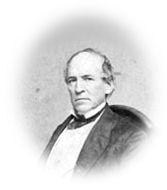
FRIDAY 5

Warmer today but a white frost this morning. Gardens are being made now and the Peach trees are blossoming. The grass is quite green in the public grounds and the trees are leafing out, and the City will soon assume a gay and beautiful appearance. Did not go on to the Ave tonight. Have had a man at work cleaning out the celler (my wood house) and doing some work in the yard. Got a load of manure. The man is coming tomorrow to spade up the little garden & I will plant it. Boys are much exercised over the first litter of chickens. 11 o’clock.

______

The three diary manuscript volumes, Washington during the Civil War: The Diary of Horatio Nelson Taft, 1861-1865, are available online at The Library of  Congress.

MONTGOMERY, April 5, 1861.

General BRAGG, Pensacola, Fla.:

Can you prevent re-enforcements being landed at other points on Santa Rosa Island other than the docks? Do you mean by “attack” the opening of your guns upon the fort or upon the ships? If the former, would your operations be confined to battering the fort? Telegraph, and write, also, fully.

L. P. WALKER.

NAVY DEPARTMENT,
Washington, April 5, 1861.

Capt. SAMUEL MERCER,
Commanding U.S.S. Powhatan, New York:

SIR: The United States steamers Powhatan, Pawnee, Pocahontas, and Harriet Lane will compose a naval force, under your command, to be sent to the vicinity of Charleston, S. C. for the purpose of aiding in carrying out the objects of an expedition of which the War Department has charge.

The primary object of the expedition is to provision Fort Sumter, for which purpose the War Department will furnish the necessary transports. Should the authorities at Charleston permit the fort to be supplied, no further particular service will be required of the force under your command, and after being satisfied that supplies have been received at the fort, the Powhatan, Pocahontas, and Harriet Lane will return to New York, and the Pawnee to Washington.

Should the authorities at Charleston, however, refuse to permit or attempt to prevent the vessel or vessels having supplies on board from entering the harbor, or from peaceably proceeding to Fort Sumter, you will protect the transports or boats of the expedition in the object of their mission–disposing of your force in such manner as to open the way for their ingress and afford, so far as practicable, security to the men and boats, and repelling by force, if necessary, all obstructions towards provisioning the fort and re-enforcing it; for in case of resistance to the peaceable primary object of the expedition a re-enforcement of the garrison will also be attempted. These purposes will be under the supervision of the War Department, which has charge of the expedition. The expedition has been intrusted to Capt. G. V. Fox, with whom you will put yourself in communication, and co-operate with him to accomplish and carry into effect its object.

You will leave New York with the Powhatan in time to be off Charleston Bar, ten miles distant from and due east of the light-house, on the morning of the 11th instant, there to await the arrival of the transport or transports with troops and stores. The Pawnee and Pocahontas will be ordered to join you there at the time mentioned, and also the Harriet Lane, which latter vessel has been placed under the control of this Department for this service.

On the termination of the expedition, whether it be peaceable or otherwise, the several vessels under your command will return to the respective ports as above directed unless some unforeseen circumstance should prevent.

I am,  respectfully,

your obedient servant,

GIDEON WELLES,

Secretary of the Navy.

FORT SUMTER, S.C., April 5, 1861.
(Received A. G. O., April 8.)

Col. L. THOMAS, Adjutant-General U.S. Army:

“… that orders had been received from Montgomery not to allow any man in the ranks, or any laborers, to leave Fort Sumter, and not to allow Major Anderson to obtain supplies in Charleston; that Mr. Crawford, a commissioner from the Confederate States, now in Washington, had sent a dispatch to him stating that he was authorized to say that no attempt would be made to re-enforce Fort Sumter with men or provisions…,”

COLONEL: I have the honor to report everything still and quiet, and to send herewith the report of Lieutenant Snyder, who I sent yesterday with a short note and a verbal message to the governor of South Carolina. No reply has been received to my note.

I cannot but think that Mr. Crawford has misunderstood what he has heard in Washington, as I cannot think that the Government would abandon, without instructions and without advice, a command which has tried to do all its duty to our country.

I cannot but think that if the Government decides to do nothing which can be construed into a recognition of the fact of the dissolution of the Union, that it will, at all events say to me that I must do the best I can and not compel me to do an act which will leave my motives and actions liable to misconception.

I am sure that I shall not be left without instructions, even though they may be confidential. After thirty odd years of service I do not wish it to be said that I have treasonably abandoned a post and turned over to unauthorized persons public property intrusted to my charge.

I am entitled to this act of injustice at the hands of my Government, and I feel confident that I shall not be disappointed. What to do with the public property, and where to take my command, are questions to which answers will, I hope, be at once returned. Unless we receive supplies I shall be compelled to stay here without food or to abandon this post very early next week.

Confidently hoping that I shall receive ample instructions in time.

I am colonel, very respectfully, your obedient servant,

ROBERT ANDERSON,

Major, First Artillery Commanding.

[Inclosure.]

FORT SUMTER S.C., April 4, 1861.

Maj. ROBERT ANDERSON,
First Artillery, U. S. Army Commanding Fort Sumter :

MAJOR: In compliance with your directions, I went, under a flag of truce, to the city of Charleston, in company with Captain Talbot, and had an interview with Governor Pickens and General Beauregard. In the interview with the governor, Captain Talbot only being present, I stated all the circumstances connected with the visits of Captain Seymour and myself to Cummings Point and the schooner Rhoda H. Shannon, which had been fired into by the batteries on Morris Island, on the 3d instant. I called his attention to the fact that he had not complied with his own proposition, to warn all vessels bearing the United States flag not to enter the Harbor. The governor replied that he and General Beauregard, with their staff officers, were standing on the piazza of the Moultrie House on Sullivan’s Island, and saw the whole affair, and that my statement corroborated entirely his own personal observation, although it differed slightly from the report of Colonel De Saussure, the commanding officer on Morris Island. The governor said that the commander of the vessel whose duty it was to warn vessels not to enter the harbor had left his post, and had reported that the weather was too boisterous and the sea too rough for him to go out to the schooner Shannon; that this commander had already been sent for, and would be dismissed; that the commander of the cutter would be reprimanded for not going out and examining whether the Shannon were disabled; and that peremptory orders had been sent to Morris Island to stop this random firing.

The governor also said that if Major Anderson deemed it his duty to send out, under unfavorable circumstances, and examine the condition of the schooner Shannon, it was doubly theirs, imposed by humanity, and also by the commercial interest of their harbor.

General Beauregard was invited in, and I repeated what I had said to Governor Pickens to him. The general replied in the same terms as the governor, adding that the practice firing on Morris Island would take place at particular hours.

There was an objection made to Captain Talbot leaving Fort Sumter for Washington, but this was finally overruled and the captain allowed to depart. The governor said that orders had been received from Montgomery not to allow any man in the ranks, or any laborers, to leave Fort Sumter, and not to allow Major Anderson to obtain supplies in Charleston; that Mr. Crawford, a commissioner from the Confederate States, now in Washington, had sent a dispatch to him stating that he was authorized to say that no attempt would be made to re-enforce Fort Sumter with men or provisions, but that Mr. Lincoln would not order Major Anderson to withdraw from Fort Sumter, and would leave him to act for himself; also, advising the governor not to allow any supplies to be sent from the city to Fort Sumter.

I called the attention of both General Beauregard and Governor Pickens to the schooner lying near the left flank of Fort. Sumter. They said they knew nothing of her, but would send and ascertain, and direct her to move further from the fort. Governor Pickens remarked that as they were now acting under the authority of the Confederate States he had consulted with General Beauregard, who was now in command of the troops stationed here.

I am, sir, very respectfully, your obedient servant,

G. W. SNYDER,

First Lieut. of Engineers, U. S.. Army.

—–

FORT SUMTER, S. C., April 5, 1861.

General Jos. G. TOTTEN,
Chief Engineer U. S. A., Washington, D.C.:

GENERAL: I wrote yesterday by Captain Talbot, who left here at 12 m., as bearer of dispatches from Major Anderson to the Government. Lieutenant Snyder accompanied him to the city as bearer of a communication to the governor and General Beauregard, relating to the firing upon the schooner Rhoda G. Shannon, and to the presence of the revenue cutter so near the walls of this fort. The result of this mission, so far as I understand it, is this: First., Captain Talbot, after some consultation, was permitted by the authorities to proceed to Washington. Second, it was stated that no Engineer employé or enlisted man would be permitted to leave the fort until the command was withdrawn, in consequence of a dispatch from Commissioner Crawford, at Washington, to the effect that “I am authorized to say that this Government will not undertake to supply Fort Sumter without notice to you [Governor Pickens]. My opinion is that the President has not the courage to execute the order agreed on in Cabinet for the evacuation of the fort, but that he intends to shift the responsibility upon Major Anderson by suffering him to be starved out”; and that no more supplies for the fort could come from the city. Third, that more stringent orders would be given to regulate the firing from the batteries and to restrict random firing, not, however, changing in the least the order to fire on any vessel attempting to force her way in after being warned off. Fourth, disclaiming any knowledge of the revenue cutter so near the walls, and expressing a determination to investigate the subject.

In returning from the city Lieutenant Snyder called for the mail at Fort Johnson, where he also took on board a small supply of beef and cabbages, which had come from the city the day before, too late for our boat. Soon after the return of the boat from town, the cutter moved her anchorage to a position about four hundred yards from the left shoulder angle. My force is now at work putting up splinter-proof traverses on the terre-plein.

My supplies of provisions that I laid in before the commencement of the investment were yesterday reduced to one half-barrel of cornmeal, one-seventh barrel of grits, and eleven codfish. Everything else that is necessary for the support of the Engineer force is drawn from the scanty stores of the command.

There appears to be no unusual activity in the surrounding batteries, owing, perhaps, to a high wind which has prevailed for three days.

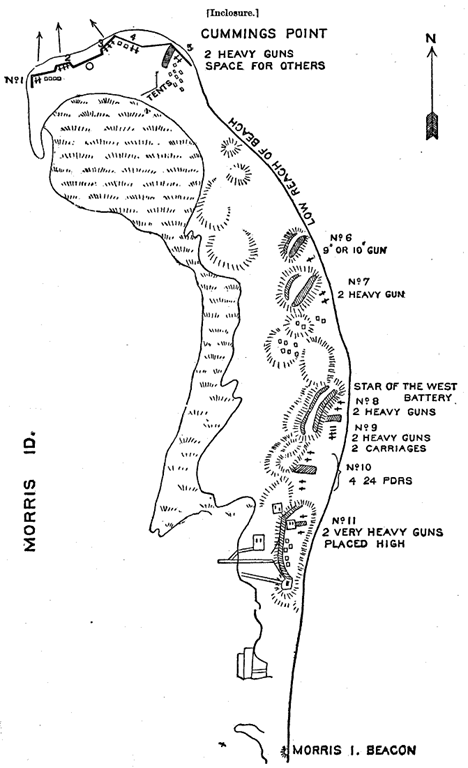
I inclose a sketch of the batteries and number of guns, based upon the observations of Lieutenant Snyder. Captain Talbot can give you any detailed information that may be required.

I have the honor to be, very respectfully, your obedient servant,

J. G. FOSTER,

Captain, Engineers.

Morris Island, Charleston Harbor, April 5, 1861, Operations in Charleston Harbor, South Carolina

(click on image for larger version)

WASHINGTON, April 5, 1861.

Hon. ROBERT TOOMBS, &c., Montgomery, Ala.:

The movement of troops and preparation on board of vessels of war, of which you have already been apprised, are continued with the greatest activity. An important move requiring a formidable military and naval force is certainly on foot. The statement that this armament is intended for St. Domingo may be a mere ruse.

We are, however, most creditably informed that Commodore Stringham, who takes charge of the squadron, sails for St. Domingo.

Having no confidence in the administration, we say, be ever on your guard. Glad to hear that you are ready. The notice promised us will come at the last moment if the fleet be intended for our waters.

CRAWFORD.

ROMAN.

FORSYTH.