Following the American Civil War Sesquicentennial with day by day writings of the time, currently 1863.

Sunday, April 24, 2011

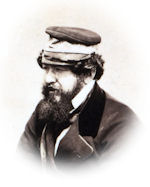
April 24th.—In the morning we found ourselves in chopping little sea-way for which the “Nina” was particularly unsuited, laden as she was with provisions and produce. Eyes and glasses anxiously straining seawards for any trace of the blockading vessels. Every sail scrutinized, but no ‘stars and stripes’ visible.

Our captain—a good specimen of one of the inland-water navigators, shrewd, intelligent, and active—told me a good deal about the country. He laughed at the fears of the whites as regards the climate. “Why, here am I,” said he,” going up the river, and down the river all times of the year, and at times of day and night when they reckon the air is most deadly, and I’ve done so for years without any bad effects. The planters whose houses I pass all run away in May, and go off to Europe, or to the piney wood, or to the springs, or they think they’d all die. There’s Captain Buck, who lives above here,—he comes from the State of Maine. He had only a thousand dollars to begin with, but he sets to work and gets land on the Macamaw River at twenty cents an acre. It was death to go nigh it, but it was first-rate rice land, and Captain Buck is now worth a million of dollars. He lives on his estate all the year round, and is as healthy a man as ever you seen.”

To such historiettes my planting friends turn a deaf ear. ” I tell you what,” said Pringle, “just to show you what kind our climate is. I had an excellent overseer once, who would insist on staying near the river, and wouldn’t go away. He fought against it for more than five-and-twenty years, but he went down with fever at last.” As the overseer was more than thirty years of age when he came to the estate, he had not been cut off so very suddenly. I thought of the quack’s advertisement of the “bad leg of sixty years standing.” The captain says the negroes on the river plantations are very well off. He can buy enough of pork from the slaves on one plantation to last his ship’s crew for the whole winter. The money goes to them, as the hogs are their own. One of the stewards on board had bought himself and his family out of bondage with his earnings. The State in general, however, does not approve of such practices.

At three o’clock p.m., ran into Charleston harbor, and landed soon afterwards.

I saw General Beauregard in the evening; he was very lively and in good spirits, though he admitted he was rather surprised by the spirit displayed in the North. “A good deal of it is got up, however,” he said “and belongs to that washy sort of enthusiasm which is promoted by their lecturing and spouting.” Beauregard is very proud of his personal strength, which for his slight frame is said to be very extraordinary, and he seemed to insist on it that the Southern men had more physical strength, owing to their mode of life and their education, than their Northern “brethren.” In the evening held a sort of tabaks consilium in the hotel, where a number of officers—Manning, Lucas Chesnut, Calhoun, &c.—discoursed of the affairs of the nation. All my friends, except Trescot, I think were elated at the prospect of hostilities with the North, and overjoyed that a South Carolinian regiment had already set out for the frontiers of Virginia.
WEDNESDAY 24

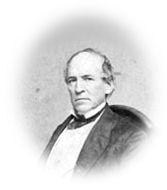
Another warm day with some rain in the afternoon. The day has passed off much as yesterday. No troops from the North. No mails since Friday, and in fact no news at all from the North. It is thought that there are troops enough here now for the safety of the City, as matters now look. But large bodies of Virginians have gathered near Alexandria and also north of us, and a decent may be made upon us anytime, but we are geting used to strange things now. I am alone in the room at the office now and have to do all the writing. Charley dined with us today.

______

The three diary manuscript volumes, Washington during the Civil War: The Diary of Horatio Nelson Taft, 1861-1865, are available online at The Library of  Congress.

Wednesday morning, 24th. Reveille at daybreak, when we fell in and stood under arms for half an hour, when, finding everything quiet, and no enemy in sight, we broke ranks and prepared breakfast. Authentic reports came in early that the railroad between this place and the junction has been destroyed, and all the bridges burnt. We have orders to march immediately after breakfast, but cannot do so until transportation for officers’ baggage, ammunition, etc., has been found; the quartermaster is at work, and has many varieties of wagons already engaged, drawn by mules, oxen, cows, and horses. The camp is still abundantly supplied by the colored folks with eatables, and we have filled our haversacks with boiled eggs, corn bread, and home-made pies.

The following statement in Hayes’s handwriting, evidently prepared about this time, shows what plans the citizens of Cincinnati were making to defend the city against possible attack from Kentucky.

To be ready on the day that Kentucky secedes to take possession of the hills on the Kentucky side which command Cincinnati, or the approaches to it, and prepare to hold them against any force.

a. Regiments ready to cross on short notice with arms; ammunition, provisions, tools, etc., for entrenching; cannon, boats, and all essentials.

b. Cut off telegraphic communication south from Covington and Newport.

c. Also railroad communication.

d. Take all boats; fortify all hills, etc.

e. The prevention of raids to rob banks, etc.

Spies to Frankfort with passwords for dispatches, etc.

RALEIGH, April 24, 1861.

Hon. L. P. WALKER

You shall have from one to ten thousand volunteers in a few days, with arms, and I wish them to go as State troops. Many of our men will enlist in Confederate Army. Will have a regiment ready in four days. Funds will be required for transportation, as I cannot lawfully draw on the State treasury for this purpose. I am anxious to send at least three regiments. Our legislature will meet in few days. I will not await, however.

JOHN W. ELLIS.

April 24.—Martial music is heard everywhere, day and night, and all the trappings and paraphernalia of war’s decorations are in great demand. The ladies are sewing everywhere, even in the churches. But the gay uniforms we see to-day will change their hue before the advent of another year. All history shows that fighting is not only the most perilous pursuit in the world, but the hardest and the roughest work one can engage in. And many a young man bred in luxury, will be killed by exposure in the night air, lying on the damp ground, before meeting the enemy. But the same thing may be said of the Northmen. And the arbitrament of war, and war’s desolation, is a foregone conclusion. How much better it would have been if the North had permitted the South to depart in peace! With political separation, there might still have remained commercial union. But they would not.

—A remarkable feature in the present war excitement is the alacrity with which citizens of foreign birth or origin, and even those who are not naturalized at all, are hastening to the defence of the Government and the national flag. There is hardly a foreign country represented in the North, the children whereof are not organizing regiments and tendering their services to the Government. —N. Y. Herald, April 27.

—Rumors of an attack on Fort Pickens continue to receive credence in some quarters.

—The Portsmouth (Va.) Transcript of the 23d April says:—”Despatches received last night give important and glorious news. Fort Pickens was taken by the South. The loss on our side is said to be heavy. One despatch states the loss on the side of the South at 2,500 men; but the victory is ours.”

Immediately after the above, the Baltimore Sun says that it is enabled to state “on the authority of a private despatch, received in this city last night, that the report of the battle is incorrect.”

—The Twenty-fifth Regiment of N. Y. State Militia, from Albany, with a party of regulars and one hundred and seventy-five men of the Seventh New York Regiment left New York for the seat of war— N. Y. Tribune, April 25.

—A volunteer company was organized at Sag Harbor, and $3,000 subscribed by the citizens for the benefit of the families of the volunteers.—Idem, April 26.

—Daniel Fish, gunmaker, of the city of New York, was arrested and handed over to the custody of the United States Marshal on a charge of treason, and misprision of treason, in having sent off large quantities of arms for the use of the Southern traitors. The correspondence and bills of lading found in his possession abundantly sustain the charge. A man calling himself Dr. Sabo, was also arrested, and is now in the bands of the United States authorities for recruiting men for the Southern navy. The papers which he used for the purpose were headed “United States of America,” and purported to be authorized by the United States Collector and Naval Officer of Charleston. As there are no such officers at that port acting in behalf of the United States of America, it is evident that the intention was to enlist men under a false pretence, and, after getting them to Charleston, impress them into the service of the C. S. A.—N. Y. Tribune, April 25.

—Messrs. Hotchkiss & Sons, of Sharon, Connecticut, offered the Governor of their State a bronze rifled cannon, (16-pounder,) and all of their patent projectiles which can be fired from it during the war. Gov. Buckingham has accepted the gift. They also offered to produce additional rifled cannon and projectiles at cost—Idem.

—Beriah Magoffin, Governor of Kentucky, issued a proclamation calling upon the State to place herself in a state of defence; and convening the Legislature on the 6th day of May, to take such action as may be necessary for the general welfare.—(Doc. 94.)

—The Navy Department at Washington signified its approbation of the loyalty, spirit, and good conduct of William Conway, an aged seaman, doing duty as Quartermaster in the Warrington Navy Yard, Florida, at the time of its surrender, in promptly and indignantly refusing to obey, when ordered by Lieutenant F. B. Renshaw to haul down the national flag.—National Intelligencer, May 3.

—There was an immense Union meting at Detroit, Michigan. General Cass presided and delivered a short but effective speech.—(Doc. 95.)

—Two thousand federal troops are stationed at Cairo, Illinois. Of these, says the Charleston Courier of the 30th April, “fully three hundred are supposed to be negroes, and the remainder have been picked up from the gutters of Chicago, and among the Dutch. A force of one thousand firm-hearted Southern men would drive them from the place, if the attack was properly made.”

—The members of the Brown High School at Newburyport, Mass., raised the American flag near their school building in the presence of a large concourse of citizens. Patriotic speeches were made by Caleb Cushing and others.—(Doc. 96.)

—John Letcher, governor of Virginia, issued a proclamation authorizing the release of all private vessels and property seized by the State except the steamships Jamestown and Yorktown; advising the people to return to their usual avocations, promising them protection, and appealing to them “not to interfere with peaceable, unoffending citizens who preserve the peace and conform to our laws.”—(Doc. 97.)