Following the American Civil War Sesquicentennial with day by day writings of the time, currently 1863.

Thursday, April 21, 2011

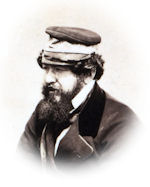
April 21st.—In the afternoon I went with Mr. Porcher Miles to visit a small farm and plantation, some miles from the city, belonging to Mr. Crafts. Our arrival was unexpected, but the planter’s welcome was warm. Mrs. Crafts showed us round the place, of which the beauties were due to nature rather than to art, and so far the lady was the fitting mistress of the farm.

We wandered through tangled brakes and thick Indian-like jungle, filled with disagreeable insects, down to the edge of a small lagoon. The beach was perforated with small holes, in which Mrs. Crafts said little crabs, called “fiddlers” from their resemblance in petto to a performer on the fiddle make their abode; but neither them nor “spotted snakes” did we see. And so to dinner, for which our hostess made needless excuses. “I am afraid I shall have to ask you to eke out your dinner with potted meats, but I can answer for Mr. Crafts giving you a bottle of good old wine.” “And what better, madam,” quoth Mr. Miles, “what better can you offer a soldier? What do we expect but grape and canister?”

Mr. Miles, who was formerly member of the United States Congress, and who has now migrated to the Confederate States of America, rendered himself conspicuous a few years ago when a dreadful visitation of yellow fever came upon Norfolk and destroyed one-half of the inhabitants. At that terrible time, when all who could move were flying from the plague-stricken spot, Mr. Porcher Miles flew to it, visited the hospitals, tended the sick; and although a weakly, delicate man, gave an example of such energy and courage as materially tended to save those who were left. I never heard him say a word to indicate that he had been at Norfolk at all.

At the rear of the cottage-like residence (to the best of my belief built of wood), in which the planter’s family lived, was a small enclosure, surrounded by a palisade, containing a number of wooden sheds, which were the negro quarters; and after dinner, as we sat on the steps, the children were sent for to sing for us. They came very shyly, and by degrees; first peeping round the corners and from behind trees, oftentimes running away in spite of the orders of their haggard mammies, till they were chased, captured, and brought back by their elder brethren. They were ragged, dirty, shoeless urchins of both sexes; the younger ones abdominous as infant Hindoos, and wild as if just caught. With much difficulty the elder children were dressed into line; then they began to shuffle their flat feet, to clap their hands, and to drawl out in a monotonous sort of chant something about the “River Jawdam,” after which Mrs. Crafts rewarded them with lumps of sugar, which were as fruitful of disputes as the apple of discord. A few fathers and mothers gazed at the scene from a distance.

As we sat listening to the wonderful song of the mocking-birds, when these young Sybarites had retired, a great, big, burly red-faced gentleman, as like a Yorkshire farmer in high perfection as any man I ever saw in the old country, rode up to the door, and, after the usual ceremony of introduction and the collating of news, and the customary assurance “They can’t whip us, sir!” invited me then and there to attend a fête champêtre at his residence, where there is a lawn famous for trees dating from the first settlement of the colony, and planted by this gentleman’s ancestor.

Trees are objects of great veneration in America if they are of any size. There are perhaps two reasons for this. In the first place, the indigenous forest trees are rarely of any great magnitude. In the second place, it is natural to Americans to admire dimension and antiquity; and a big tree gratifies both organs— size and veneration.

I must record an astonishing feat of this noble Carolinian. The heat of the evening was indubitably thirst-compelling, and we went in to “have a drink.” Among other things on the table were a decanter of cognac and a flask of white curacoa. The planter filled a tumbler half full of brandy. “What’s in that flat bottle, Crafts?” “That’s white curacoa.” The planter tasted a little, and having smacked his lips and exclaimed “first-rate stuff,” proceeded to water his brandy with it, and tossed off a full brimmer of the mixture without any remarkable ulterior results. They are a hard-headed race. I doubt if cavalier or puritan ever drank a more potent bumper than our friend the big planter.
SUNDAY 21

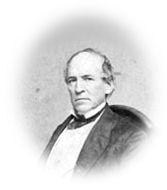
This has been a pleasant but anxious day. We seem to be surrounded by enimies, and enimies in our midst. No troop have yet arrived since the Mass. Regt. How anxiously have we looked for the 7th Regt of NY today. I left the National tonight at 11 o’clock but could get no reliable information. We may be in the midst of bloodshed any hour, and I am looking for an outbreak or attack all the time. Famine stares us in the face unless the routes are kept open. Where are the expected troops?

______

The three diary manuscript volumes, Washington during the Civil War: The Diary of Horatio Nelson Taft, 1861-1865, are available online at The Library of  Congress.

(Sunday, April 21st)

I LEFT home at 7 A. M., satchel in hand, crossed the ferry, and soon arrived at the armory. It was already filled with men of the regiment receiving their arms and equipments. We were furnished with a Springfield musket, bayonet, cartridge-box, cap-pouch, haversack, and blanket. Our new uniform were not ready, and so the greater part of the regiment appeared in every-day clothes and hats. Every company had a few regularly equipped men, however, so that we had some little military appearance. The greatest difficulty was an absence of knapsacks, which necessitated carrying valises, a very awkward arrangement, giving us more the appearance of a lot of emigrants than a regiment of soldiers.

About two hours after I joined every man had been furnished with all there was for him, and we were standing for the first time shoulder to shoulder in the ranks. The roll was called, and all present mustered into the state’s service. Immediately afterwards we marched downstairs into Bond Street, wheeled into column by platoons, and marched into and then down Broadway to Cortlandt Street, thence to pier 4, North River, where we embarked on board the steamship R. R. Cuyler.

On reaching the street from our armory we found ourselves almost unable to move on account of the enormous crowd, a magnificent crowd too, overflowing with enthusiastic loyalty and good nature, filling the air with endless cheers and patriotic songs; there were many, too, who shed tears, — mothers, wives, sweethearts, sisters, who were seemingly alone fearful of results. I felt very sorry for many of them. It is easy for us, amidst constant excitement and ever-varying circumstances, to keep our spirits up, but to these poor women at home, who can only wait, it must be very trying.

As the head of the column turned down Broadway it was confronted by a dense mass of humanity, filling the street from side to side. The doors, windows, and roofs of every building on Broadway and those adjoining, commanding a view of the line of march, were jammed with crowds of people waving handkerchiefs and flags, and cheering with all their might and main. At the corners of some of the streets were steam fire-engines tooting their whistles, and everywhere myriads of starry banners fluttering in the breeze. The police, gradually and with much difficulty, forced a passage through this immense crowd, and we followed marching to the music of our splendid band, amid the yells and cheers of the ever-increasing multitudes. They not only cheered and sang and shook hands and hugged us, but filled us up with every imaginable thing; as we were obliged to halt every few minutes, they closed in amongst us and delayed our progress sadly. We were nearly three hours in marching from Astor Place to Cortlandt Street, and on account of our baggage, very much fatigued. Individually, I got along very well, wearing a uniform frock coat, and carrying all that I had wrapped in a rubber blanket strapped to my back. Most of the men, however, carried valises in their hands. At last we reached the dock and marched directly on board the ship. She had capacity for about three hundred souls; we mustered eleven hundred in all, and hardly managed to find standing room. However, we got on board, and very shortly afterwards the vessel’s lines were cast off, the whistle blew, and the good ship left her dock and headed down the stream amid the most tremendous cheering, yelling, and screeching one can possibly imagine.

The docks and vessels in the vicinity were crowded with people, many of whom amused themselves bombarding the ship with oranges; myriads of handkerchiefs and small flags and lusty arms waved us an affectionate good-bye, and amidst this glorious and magnificent send-off, we steamed away and were soon well down the lower bay, our destination unknown, except that we were to meet the enemies of our country. We go forward in a great cause, confident of victory, delighted with the surroundings, and happy in the knowledge that the whole city we leave behind us look upon us as their representatives, and will diligently look after our necessities while we look after the enemy.

New Market, April 21,1861.

Reached here this morning in good health and in  spirits as good as could he expected, considering the  bloody prospect ahead and the sad hearts left at home. It is bad enough. I have no time to think of my business at home. My duties now for my State require every energy of mind and body which I can devote to them. Do just as you please. If you think proper stay in town and leave all matters and keys on the farm in charge of John Fitzgerald.


April 21st.— Received several letters to-day which had been delayed in their transmission, and were doubtless opened on the way. One was from my wife, informing me of the illness of Custis, my eldest son, and of the equivocal conduct of some of the neighbors. The Rev. Mr. D, son of the late B——p, raised the flag of the Union on his church.

The telegraphic wires are still in operation.

—The railroad between Philadelphia and Baltimore was taken possession of by the U. S. Government. Orders were given from the Navy Department at Washington to the officers of the various United States vessels, that all persons found sailing under Jefferson Davis’ letters of marque and reprisal be treated as pirates. That the contumacious be immediately hung from the yard-arms, and the crew and the more penitent officers be placed in irons to await their trial as ocean brigands.—Times, April 21.

—The people of Oswego and Rochester, N. Y., Toledo, Dayton, and Zanesville, Ohio, subscribed large sums of money for the support of the volunteers and their families; at the latter place, large property holders agreed to give rent free to volunteers during their absence.— Albany Journal.

Scott telegraphed to Senator Crittenden of Kentucky, as follows:

“I have not changed; have no thought of changing; always a Union man.”—(Doc. 78.)

—George William Brown, mayor of Baltimore, Md., had a consultation with the President of the United States, in reference to the passage of northern troops through Baltimore. On his return from Washington, the Mayor submitted to the people a statement as to his interview with the President.—(Doc. 79.)

—The Worcester third battalion of Rifles, arrived at New York. They are commanded by Major Charles Devens, and number 266 men, officered as follows: Company A, Worcester City Guard, Capt. A. B. R. Sprague; First Lieut., J. Pickett; Second Lieut., O. Moulton; Third Lieut., G. Egra.

Company C, Emmett Guard, Capt McConville; First Lieut., F. McCafferty; Second Lieut., M. O. Driscoll; Third Lieut., T. O’Niel; Fourth Lieut., — Melvin.—Times, April 22.

—A mass meeting of citizens, numbering many thousands, was held in Boston, Mass., this forenoon, and was addressed by Fletcher Webster, Charles L. Woodbury, and many distinguished citizens. The meeting was to raise a regiment for Fletcher Webster, and was completely successful. The most intense enthusiasm prevailed among the crowd. The meeting continued till nearly night. It was a remarkable expression of the entire voice of our people.—N. Y. Tribune, April 22.

—The First Regiment of Rhode Island Volunteers passed through New York, on their way to the South. Governor Sprague accompanies these troops, as commander in chief of the Rhode Island forces. His staff consists of Colonels Frieze, Goddard, Arnold, Capt. A. W. Chapin, Assistant Adjutant-General.—(Doc. 80.)

—The Sixth, Twelfth, and Seventy-first Regiments, New York State Militia, left New York for Washington this day, (Sunday.) The people were early astir, and by 10 o’clock every available spot where a human being could stand, was occupied, throughout the entire length of Broadway; and from near Canal-street to Grace Church, not only the sidewalks, but the whole of the street, was densely thronged. Every window, door, stoop, balcony, and house-top, were alive with human beings, of every age, sex, and condition, awaiting the marching of the Regiments, which it was known would depart during the day for the seat of Government, or other destination where their services might be required. It was some time after the bells had summoned the worshippers to their respective churches before the troops made their appearance. As they marched along, no language can do justice to the enthusiasm with which the assembled multitude greeted them. Cheers from ten thousand voices swelling in prolonged chorus, the waving of handkerchiefs by fair hands, the display of flags and streamers throughout the route of march, made the scene one of the most animated and exciting ever witnessed in the city.—Times, April 22.

—The United States branch mint at Charlotte, North Carolina, was seized by the State authorities. No resistance was offered. Colonel Bryce now holds it with a military force, under orders from Governor Ellis.—N. Y. Evening Post, April 29.

—Wendell Phillips delivered a discourse in Boston on the present rebellion. Some time ago he made a speech deprecating, in the most emphatic manner, any appeal to arms, as certain to result in the renewed and permanent triumph of slavery. The people of the North, he said, would not fight, and the first result of a military demonstration would be the complete surrender of the North, and the concession of everything that might be demanded at their hands.—(Doc. 81.)

—Andrew Johnson, U. S. Senator from Tennessee, passed through Lynchburg, Va., on his way from Washington to Tennessee. A large crowd assembled and groaned at him. They offered every indignity, and efforts were made to take him off the cars. Mr. Johnson was protected by the conductor and others. He denied sending a message asserting that Tennessee should furnish her quota of men.—Commercial Advertiser, April 26.

—The citizens of Baltimore were fearfully excited on account of a rumored descent upon them by Federal troops from Cockeysville, seventeen miles distant from the city; but at night the excitement subsided on receiving intelligence that the troops had been turned back to Harrisburg, Pa., by order of Gen. Scott.—N. Y. Tribune, April 26.

—In nearly all the churches in New York—and probably in a majority of churches throughout the country—the sermons of to-day were mainly in reference to the war. Many congregations have made the day an occasion for patriotic contributions for the outfit of volunteers, or for the support of their families. In the Church of the Puritans in Brooklyn, (although Mr. Beecher, the pastor, was absent, and the services were conducted by Rev. H. D. Northrup of Brooklyn,) a letter was read from the Thirteenth Regiment N. Y. S. M., asking for uniforms for recruits—and the response was a collection of about $1,100 for that patriotic purpose. In the Broadway Tabernacle, the pastor, Rev. J. P. Thompson, D. D., preached a sermon in the evening on “God’s Time of Threshing.” The choir performed “The Marseillaise” to a hymn composed for the occasion by the pastor. A collection was taken for the Volunteers’ Home Fund amounting to $450—to which a member of the congregation afterwards added $100. Dr. Bethune’s sermon was from the text: “In the name of our God we will set up our banners.” In Dr. Bellows’ church the choir sang “The Star-Spangled Banner,” which was vigorously applauded by the whole house. At Grace church (Episcopal) Dr. Taylor began by saying, “The Star-Spangled Banner has been insulted.” The gallant Major Anderson and his wife attended service at Trinity. At Dr. McLane’s Presbyterian church, Williamsburg, “The Star-Spangled Banner” was sung. Dr. T. D. Wells (Old-School Presbyterian) preached from the words: “He that hath no sword, let him buy one.” Dr. Osgood’s text was: “Lift up a standard to the people.” Many of the churches—of all denominations—are sending some of their most active members to the field as volunteers.—Independent, April 25.

—The Fifth Regiment of Massachusetts Militia, Col. Lawrence, with the Boston Flying Artillery, Major Cook, left Boston for New York at 7 o’clock this morning. The Third Battalion of Rifles, Major Stevens, left Worcester last night for New York. Massachusetts has within six days responded to the President’s proclamation, with five full regiments of infantry, a battalion of rifles, and a splendid corps of flying artillery. The artillery take six brass 6-pounders, with horses fully equipped.—N. Y. Times, April 22.

—A meeting of Californians was held in New York to take measures for the formation of a California Regiment. The meeting was organized by the nomination of J. C. Birdseye as chairman, and speeches were made, and resolutions sustaining the Union and the Government were adopted.—(Doc. 82.)

—The Liverpool (Eng.) Times publishes a remarkable article on the political troubles in the United States.—(Doc. 88.)

—The burial of the American flag was publicly celebrated at Memphis, Tennessee.—N. Y. Express, April 29.