
April 26th — To-day I recognize Northern merchants and Jews in the streets, busy in collecting the debts due them. The Convention has thrown some impediments in the way; but I hear on every hand that Southern merchants, in the absence of legal obligations, recognize the demands of honor, and are sending money North, even if it be used against us. This will not last long.
Tuesday, April 26, 2011
Note: This particular diary entry—a document written in 1861—includes a term that is offensive to many today. No attempt will be made to censor or edit 19th century material to today’s standards.
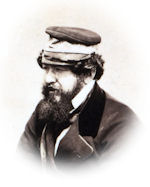
April 26th.—Bade good-by to Charleston at 9:45 A.M. this day, and proceeded by railway, in company with Mr. Ward, to visit Mr. Trescot’s Sea Island Plantation. Crossed the river to the terminus in a ferry steamer. No blockading vessels in sight yet. The water alive with small silvery fish, like mullet, which sprang up and leaped along the surface incessantly. An old gentleman, who was fishing on the pier, combined the pursuit of sport with instruction very ingeniously by means of a fork of bamboo in his rod, just above the reel, into which he stuck his inevitable newspaper, and read gravely in his cane-bottomed chair till he had a bite, when the fork was unhitched and the fish was landed. The negroes are very much addicted to the contemplative man’s recreation, and they were fishing in all directions.
On the move again. Took our places in the Charleston and Savannah Railway for Pocotaligo, which is the station for Barnwell Island. Our fellow-passengers were all full of politics—the pretty women being the fiercest of all—no! the least good-looking were the most bitterly patriotic, as if they hoped to talk themselves into husbands by the most unfeminine expressions towards the Yankees.
The country is a dead flat, perforated by rivers and watercourses, over which the rail is carried on long and lofty trestle-work. But for the fine trees, the magnolias and live oak, the landscape would be unbearably hideous, for there are none of the quaint, cleanly, delightful villages of Holland to relieve the monotonous level of rice swamps and wastes of land and water and mud. At the humble little stations there were invariably groups of horsemen waiting under the trees, and ladies with their black nurses and servants who had driven over in the odd-looking old-fashioned vehicles, which were drawn up in the shade. Those who were going on a long journey, aware of the utter barrenness of the land, took with them a viaticum and bottles of milk. The nurses and slaves squatted down by their side in the train, on perfectly well-understood terms. No one objected to their presence—on the contrary, the passengers treated them with a certain sort of special consideration, and they were on the happiest terms with their charges, some of which were in the absorbent condition of life, and dived their little white faces against the tawny bosom of their nurses with anything but reluctance.
The train stopped, at 12:20, at Pocotaligo; and there we found Mr. Trescot and a couple of neighbouring planters, famous as fishers for “drum,” of which more by-and-by. I had met old Mr. Elliot in Charleston, and his account of this sport, and of the pursuit of an enormous sea monster called the devil-fish, which he was one of the first to kill in these waters, excited my curiosity very much. Mr. Elliot has written a most agreeable account of the sports of South Carolina, and I had hoped he would have been well enough to have been my guide, philosopher, and friend in drum fishing in Port Royal; but he sent over his son to say that he was too unwell to come, and had therefore dispatched most excellent representatives in two members of his family. It was arranged that they should row down from their place and meet us to-morrow morning at Trescot’s Island, which lies above Beaufort, in Port Royal Sound and river.
Got into Trescot’s gig, and plunged into a shady lane with wood on each side, through which we drove for some distance. The country, on each side and beyond, perfectly flat—all rice lands—few houses visible— scarcely a human being on the road—drove six or seven miles without meeting a soul. After a couple of hours or so, I should think, the gig turned up by an open gateway on a path or road made through a waste of rich black mud, “glorious for rice,” and landed us at the door of a planter, Mr. Heyward, who came out and gave us a most hearty welcome, in the true Southern style. His house is charming, surrounded with trees, and covered with roses and creepers, through which birds and butterflies are flying. Mr. Heyward took it as a matter of course that we stopped to dinner, which we were by no means disinclined to do, as the day was hot, the road was dusty, and his reception frank and kindly. A fine specimen of the planter man; and, minus his broad-brimmed straw hat and loose clothing, not a bad representative of an English squire at home.
Whilst we were sitting in the porch, a strange sort of booming noise attracted my attention in one of the trees. “It is a rain-crow,” said Mr. Heyward; “a bird which we believe to foretell rain. I’ll shoot it for you.” And, going into the hall, he took down a double-barreled fowling-piece, walked out, and fired into the tree; whence the rain-crow, poor creature, fell fluttering to the ground and died. It seemed to me a kind of cuckoo—the same size, but of darker plumage. I could gather no facts to account for the impression that its call is a token of rain.
My attention was also called to a curious kind of snake-killing hawk, or falcon, which makes an extraordinary noise by putting its wings point upwards, close together, above its back, so as to offer no resistance to the air, and then, beginning to descend from a great height, with fast-increasing rapidity, makes, by its rushing through the air, a strange loud hum, till it is near the ground, when the bird stops its downward swoop and flies in a curve over the meadow. This I saw two of these birds doing repeatedly to-night.
After dinner, at which Mr. Heyward expressed some alarm lest Secession would deprive the Southern States of “ice,” we continued our journey towards the river. There is still a remarkable absence of population or life along the road, and even the houses are either hidden or lie too far off to be seen. The trees are much admired by the people, though they would not be thought much of in England.
At length, towards sundown, having taken to a track by a forest, part of which was burning, we came to a broad muddy river, with steep clay banks. A canoe was lying in a little harbor formed by a slope in the bank, and four stout negroes, who were seated round a burning log, engaged in smoking and eating oysters, rose as we approached, and helped the party into the “dug-out,” or canoe, a narrow, long, and heavy boat, with wall sides and a flat floor. A row of one hour, the latter part of it in darkness, took us to the verge of Mr. Trescot’s estate, Barnwell Island; and the oarsmen, as they bent to their task, beguiled the way by singing in unison a real negro melody, which was as unlike the works of the Ethiopian Serenaders as anything in song could be unlike another. It was a barbaric sort of madrigal, in which one singer beginning was followed by the others in unison, repeating the refrain in chorus, and full of quaint expression and melancholy:—

“Oh, your soul! oh, my soul! I’m going to the churchyard to lay
this body down;
Oh, my soul! oh, your soul I we’re going to the churchyard to lay
this nigger down.”

And then some appeal to the difficulty of passing “the Jawdam,” constituted the whole of the song, which continued with unabated energy through the whole of the little voyage. To me it was a strange scene. The stream, dark as Lethe, flowing between the silent, houseless, rugged banks, lighted up near the landing by the fire in the woods, which reddened the sky—the wild strain, and the unearthly adjurations to the singers’ souls, as though they were palpable, put me in mind of the fancied voyage across the Styx.
“Here we are at last.” All I could see was a dark shadow of trees and the tops of rushes by the river side. “Mind where you step, and follow me close.” And so, groping along through a thick shrubbery for a short space, I came out on a garden and enclosure, in the midst of which the white outlines of a house were visible. Lights in the drawing-room—a lady to receive and welcome us—a snug library—tea, and to bed: but not without more talk about the Southern Confederacy, in which Mrs. Trescot explained how easily she could feed an army, from her experience in feeding her negroes.
FRIDAY 26
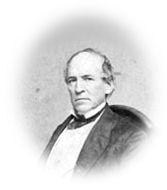
This has been a fine day and one of much excitement in the City. I was at the Pat office as usual when I heard Martial Music and immediately the Rhode Island Regiment with Gov Sprague at their head marched in at the East Wing and up into the large Hall as their quarters. About 2000 have arrived today, and a large number are expected tomorrow. Was at “Willards” tonight, a great crowd. Saw the first trophy of the war — a Secession flag taken over at Arlington in V.a. without any opposition. It is now near 11 o’clock.

______
The three diary manuscript volumes, Washington during the Civil War: The Diary of Horatio Nelson Taft, 1861-1865, are available online at The Library of Congress.
(April 26)
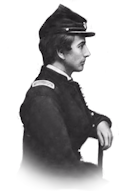
At 6 P. M. of the 25th we fell in, and to the music of the drums and fifes, began our first real march; we stepped out at a brisk pace, full of enthusiasm, thoroughly rested, and ready for anything required of us; reports of the close proximity of the enemy were abundant, which kept us well closed up throughout the day, and after dark, the rockets and blue lights discharged in various directions stimulated us to constant and renewed exertions. These signs of hostilities greatly interested us, and made us think we were already in an enemy’s country. About midnight we suddenly came upon a brilliant scene, being a bivouac of the First and Second Rhode Island regiments. There were more than a hundred fires burning, and the picturesque groups sitting around them gave us a delightful little view of campaigning most unexpectedly. The Rhode Islanders cheered us heartily, and as soon as we halted, invited us to share their hot coffee, which we were not slow to do.
We rested here over an hour, the Rhode Islanders preceding us by about an hour; we were greatly fatigued, as the roads were very heavy, being knee-deep in sand, and were loath to move forward again, but it had to be done, and footsore and weary, valises and bundles in one hand, guns in the other, we started off again, to march the remainder of the thirty miles. Many of the fellows lightened their burdens by throwing away some of their things, their views of the necessities of military life undergoing very serious changes as they encountered the hardships of campaigning. I was sorely tempted to throw away something myself, but held on to the end, although greatly exhausted.
The night was dark but fine, and as soon as we got warmed up again, we stepped out at a lively gait, smoking, telling stories, and helping each other; about two o’clock a couple of rockets were suddenly discharged almost directly in front of us; the regiment was halted, and a company deployed as skirmishers, while the remainder formed in hollow square by the roadside. It was rumored there were a couple of rebel cavalry regiments in the neighborhood, and we supposed they were probably going to attack us. As soon as the square was formed, the men were told to sit down, arms in hands, and there we sat in perfect silence, while the skirmish line advanced to discover the enemy. We talked in whispers, gave each other our home address in case of accident, then quietly awaited results. All of a sudden a strong beautiful tenor voice broke the silence, singing, “Vive l’ America.” It was Pendergast, a noted professional singer, and was indeed exquisite, rendered unusually so, of course, by the surroundings. It was strange, romantic, and delightful, and I know I shall always remember it most distinctly. After nearly an hour’s delay, the company ahead reported the coast clear, so we fell in and resumed the march. One of the funny things about this march was the depressing responses of the natives to our frequent inquiries as to the distance to the junction, the invariable replies being nine miles, and it began to look as though that nine miles was interminable. At last, just about the dawn of day, we reached the little station and village known as the junction, closed up the ranks, stacked arms, and lay right down in the street, and fell fast asleep.
About seven o’clock we were on the alert again, and quickly transformed the nice rail fences into roaring camp-fires, around which we prepared our coffee and ate our breakfast. Afterwards we went foraging, capturing chickens, ducks, pigeons, and whatever was eatable, and had lots of fun; as the government had not provided us with anything to eat here, we were obliged to help ourselves or fast, and under such circumstances we did not hesitate. The natives protested in vain; hungry soldiers must eat, and if the government cannot provide, the country must do so, and the people will be obliged to charge up their losses to the calamity of war.
We remained all day and quite recovered from our thirty-mile march. About five P. M. a long train of cattle-cars came in from Washington, to which we were promptly transferred, and arrived at our journey’s end, Washington, about six o’clock the following morning, marching directly to the navy yard, where quarters were already prepared for us.
RALEIGH, April 26, 1861
L. P. WALKER:
I have sent Colonel Holmes to take command of coast defenses, with full instructions. I regard the Cape Fear as perfectly secure. He can judge of that, however.
JOHN W. ELLIS.
U. S. FRIGATE SABINE,
Off Pensacola, April 26, 1861.
ORDER:
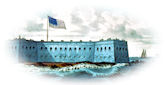
Colonel Brown thinks it probable that an attempt may be made by General Bragg to land forces on Santa Rosa Island with a view of making approaches by land against Fort Pickens, in which case he asks the co-operation of the squadron to prevent it. You will therefore have as many men ready to land as can be spared with safety to your ship. The signal of danger will be two rockets thrown up from the fort, which are to be answered by the ships. On seeing this signal you will immediately have your boats manned and armed for service. A detachment of soldiers will leave the fort at the same time, and march along the beach on the sea side toward the ships, displaying two red lights. They will form near the beach, opposite the ships, to cover the landing of the seamen. Their position being known by the red lights, the boats will land as near them as possible, and the men formed to unite with the soldiers in executing whatever orders are given by the commanding officer.
H. A. ADAMS,
Captain, U. S. Navy, Senior Officer Present.
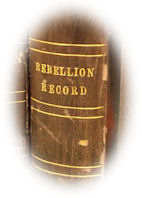
—Governor Brown of Georgia issued a proclamation prohibiting the payment of all debts to Northern creditors till the end of hostilities, and directing the payment of money into the State Treasury, to be refunded to depositors with interest at the end of the war.—Montgomery Weekly Post, May 1.
—The enthusiasm of the people at the West in rallying for the defence of the Union, far exceeds the expectations of the most sanguine Republicans. Throughout the entire Northwest there is a perfect unanimity of sentiment. Ten days ago, men who now cry, down with the rebels, were apologizing for the South—justifying its action, and wishing it success. Every town in Illinois is mustering soldiers, and many of the towns of five or six thousand inhabitants have two and three companies ready for action. Companies are also formed for drill, so that, in case of need, they will be prepared to march at any moment. Money is poured out freely as water, and ladies unite in making shirts, blankets, and even coats and pants for the soldiers. Arrangements have been made to take care of the families of the soldiers during their absence. All say, none shall fight the battles of their country at their own expense.— Cor. Boston Transcript, May 1.
—The steamer Daniel Webster from New York, arrived at the bar at the month of the Mississippi, and received orders to return immediately for fear of seizure. The tug boat Tuscarora came alongside, and took four passengers off. The Webster left before the others could get ashore.—N. Y. Commercial, May 1.
—A meeting of the citizens of the Seventeenth Ward, N. Y., was held, to take action in behalf of the families of volunteers from that district.
B. R. Winthrop occupied the chair. Resolutions were adopted, and speeches were made by F. A. Conkling, Chauncey Schaeffer, John Cochrane and others.—N. Y. Tribune, April 27.
—A Union meeting at Bedford, Westchester county, N. Y., this afternoon, on the occasion of raising the flag, was addressed by Senator Hall, John Jay, Rev. M. Bogg, of the Episcopal Church, Rev. Mr. Ferris, Dr. Woodcock, Dr. Shores, Mr. Hart, Captain of the Bedford company, Mr. Brown, of the Croton Falls Company, and others.—N. Y. Times, April 27.
—John W. Ellis, governor of North Carolina, issued a proclamation calling an extra session of the General Assembly of the State, and deprecating the proclamation of President Lincoln asking for troops.—(Doc. 108.)
—The bridges over Gunpowder River on the Philadelphia, Wilmington and Baltimore Railroad were burned by the rebels of Baltimore. The bridge over Bush River, on the same route, was destroyed last evening about sundown.—N. Y. Herald, April 28.
—The Baltimore Sun of to-day, has a leader which seems to indicate that the conservative influence is gaining ground in that city. It emphatically declares that it is not a secession paper. It says that the passage of an ordinance of secession by the Legislature would be an arrogation of power not vested in it. It favors calling a State Convention, the delegates to be elected directly from the people. It denies the stories of violence to Union men at Baltimore. There is a great feeling among business men of the city for the re-establishment of trade, and silent conservatism is changing gradually to open Unionism—N. Y. Times, April 27.
—A large meeting of the ladies of Syracuse, N. Y., was held, to organize for providing supplies for the volunteers. Mrs. E. W. Leavenworth was made president, Mrs. H. W. Chittenden, vice-president, and Mrs. J. B. Burnet, treasurer.
The Common Council of Buffalo, N. Y., yesterday appropriated $85,000 to equip the Sixty-fifth and Seventy-fourth Regiments.—N. Y. Times, April 27.
—The Seventh Regiment of New York took the oath to support the Constitution of the United States, at the War Department, in Washington; not a man flinched; the scene was most impressive.
—Moses Herrick of the Beverly Company, Eighth Massachusetts Regiment, met with an accident by the discharge of a gun.—N. Y. Tribune, April 29.
—The Federal Government is taking most energetic measures to carry out the blockade of the ports of the seceded States. All the available war vessels are put into service. Mercantile steamers are also taken up, and such as are not used for purposes of transportation are being fitted out as gunboats, to cruise off the coast and run up shallow waters.—N. Y. Herald, April 27.
—William Burton, governor of Delaware, issued a proclamation calling out volunteers to defend the Union.—(Doc. 104.)
—A meeting of the ladies of the congregation of Trinity church, and of St. Paul’s, St. John’s, and Trinity chapels, in New York, to the number of about one hundred and fifty, took place in the Sunday-school room, of St. John’s chapel, for the purpose of providing articles for the hospitals and the use of the United States Army. —N. Y. Courier & Enquirer, April 27.
—The steam-tug Yankee, armed with two heavy guns, left New York to join the blockade of the Southern ports.—N. Y. Commercial Advertiser, April 27.


