Following the American Civil War Sesquicentennial with day by day writings of the time, currently 1863.

Monday, May 9, 2011

Note: This particular diary entry—a document written in 1861—includes terms and topics that may be offensive to many today.  No attempt will be made to censor or edit 19th century material to today’s standards.

May 9th.—My faithful Wigfall was good enough to come in early, in order to show me some comments on my letters in the “New York Times.” It appears the papers are angry because I said that New York was apathetic when I landed, and they try to prove I was wrong by showing there was a “glorious outburst of Union feeling,” after the news of the fall of Sumter. But I now know that the very apathy of which I spoke was felt by the Government of Washington, and was most weakening and embarrassing to them. What would not the value of “the glorious outburst” have been, had it taken place before the Charleston batteries had opened on Sumter—when the Federal flag, for example, was fired on, flying from the “Star of the West” or when Beauregard cut off supplies, or Bragg threatened Pickens, or the first shovel of earth was thrown up in hostile battery? But no! New York was then engaged in discussing State rights, and in reading articles to prove the new Government would be traitors if they endeavored to reinforce the Federal forts, or were perusing leaders in favor of the Southern Government. Haply, they may remember one, not so many weeks old, in which the “New York Herald” compared Jeff Davis and his Cabinet to the “Great Rail Splitter,” and Seward, and Chase, and came to the conclusion that the former “were gentlemen”—(a matter of which it is quite incompetent to judge)—”and would, and ought to succeed.” The glorious outburst of “Union feeling” which threatened to demolish the “Herald” office, has created a most wonderful change in the views of the proprietor, whose diverse-eyed vision is now directed solely to the beauties of the Union, and whose faith is expressed in “a hearty adhesion to the Government of our country.” New York must pay the penalty of its indifference, and bear the consequences of listening to such counselors.

Mr. Deasy, much dilapidated, returned about twelve o’clock from his planter, who was drunk when he went over, and would not let him go to the beaver-dam. To console him, the planter stayed up all night drinking, and waking him up at intervals, that he might refresh him with a glass of whisky. This man was well off, owned land, and a good stock of slaves, but he must have been a “mean white,” who had raised himself in the world. He lived in a three-roomed wooden cabin, and in one of the rooms he kept his wife shut up from the strangers’ gaze. One of his negroes was unwell, and he took Deasy to see him. The result of his examination was, “Nigger! I guess you won’t live more than an hour.” His diagnosis was quite correct.

Before my departure I had a little farewell levee— Mr. Toombs, Mr. Browne, Mr. Benjamin, Mr. Walker, Major Deas, Colonel Pickett, Major Calhoun, Captain Ripley, and others—who were exceedingly kind with letters of introduction and offers of service. Dined as usual on a composite dinner — Southern meat and poultry bad—at three o’clock, and at four P.M. drove down to the steep banks of the Alabama River, where the castle-like hulk of the “Southern Republic” was waiting to receive us. I bade good-by to Montgomery without regret. The native people were not very attractive, and the city has nothing to make up for their deficiency, but of my friends there I must always retain pleasant memories, and, indeed, I hope some day I shall be able to keep my promise to return and see more of the Confederate ministers and their chief.

The vessel was nothing more than a vast wooden house, of three separate stories, floating on a pontoon which upheld the engine, with a dining-hall or saloon on the second story surrounded by sleeping-berths, and a nest of smaller rooms up-stairs; on the metal roof was a “musical” instrument called a “calliope,” played like a piano by keys, which acted on levers and valves, admitting steam into metal cups, where it produced the requisite notes—high, resonant, and not unpleasing at a moderate distance. It is 417 miles to Mobile, but at this season the steamer can maintain a good rate of speed as there is very little cotton or cargo to be taken on board at the landings, and the stream is full.

The river is about 200 yards broad, and of the color of chocolate and milk, with high, steep, wooded banks, rising so much above the surface of the stream, that a person on the upper deck of the towering Southern Republic, cannot get a glimpse of the fields and country beyond. High banks and bluffs spring up to the height of 150 or even 200 feet above the river, the breadth of which is so uniform as give the Alabama the appearance of a canal, only relieved by sudden bends and rapid curves. The surface is covered with masses of drift wood, whole trees, and small islands of branches. Now and then a sharp, black, fang-like projection standing stiffly in the current gives warning of a snag, but the helmsman, who commands the whole course of the river, from an elevated house amidships on the upper deck, can see these in time; and at night pine boughs are lighted in iron cressets at the bows to illuminate the water.

The captain, who was not particular whether his name was spelt Maher, or Meaher, or Meagher (les trois se disent), was evidently a character—perhaps a good one. One with a grey eye full of cunning and of some humor, strongly marked features, and a very Celtic mouth of the Kerry type. He soon attached himself to me, and favored me with some wonderful yarns, which I hope he was not foolish enough to think I believed. One relating to a wholesale destruction and massacre of Indians, he narrated with evident gusto. Pointing to one of the bluffs, he said that some thirty years ago the whole of the Indians in the district being surrounded by the whites, betook themselves to that spot and remained there without any means of escape, till they were quite starved out. So they sent down to know if the whites would let them go, and it was agreed that they should be permitted to move down the river in boats. When the day came, and they were all afloat, the whites anticipated the boat-massacre of Nana Sahib at Cawnpore, and destroyed the helpless red skins. Many hundreds thus perished, and the whole affair was very much approved of.

The value of land on the sides of this river is great, as it yields nine to eleven bales of cotton to the acre— worth £10 a bale at present prices. The only evidences of this wealth to be seen by us consisted of the cotton sheds on the top of the banks, and slides of timber, with steps at each side down to the landings, so constructed that the cotton bales could be shot down on board the vessel. These shoots and staircases are generally protected by a roof of planks, and lead to unknown regions inhabited by niggers and their masters, the latter all talking politics. They never will, never can be conquered—nothing on earth could induce them to go back into the Union. They will burn every bale of cotton, and fire every house, and lay waste every field and homestead before they will yield to the Yankees. And so they talk through the glimmering of bad cigars for hours.

The management of the boat is dexterous,—as she approaches a landing place, the helm is put hard over, to the screaming of the steam-pipe and the wild strains of “Dixie” floating out of the throats of the calliope, and as the engines are detached, one wheel is worked forward, and the other backs water, so she soon turns head up stream, and is then gently paddled up to the river bank, to which she is just kept up by steam—the plank is run ashore, and the few passengers who are coming in or out are lighted on their way by the flames of pine in an iron basket, swinging above the bow by a long pole. Then we see them vanishing into black darkness up the steps, or coming down clearer and clearer till they stand in the full blaze of the beacon which casts dark shadows on the yellow water. The air is glistening with fire-flies, which dot the darkness with specks and points of flame, just as sparks fly through the embers of tinder or half-burnt paper.

Some of the landings were by far more important than others. There were some, for example, where an iron rail-road was worked down the bank by windlasses for hoisting up goods; others where the negroes half-naked leaped ashore, and rushing at piles of firewood, tossed them on board to feed the engine, which, all uncovered and open to the lower deck, lighted up the darkness by the glare from the stoke-holes, which cried for ever, “Give, give!” as the negroes ceaselessly thrust the pine-beams into their hungry maws. I could understand how easily a steamer can “burn up,” and how hopeless escape would be under such circumstances. The whole framework of the vessel is of the lightest resinous pine, so raw that the turpentine oozes out through the paint; the hull is a mere shell. If the vessel once caught fire, all that could be done would be to turn her round, and run her to the bank, in the hope of holding there long enough to enable the people to escape into the trees; but if she were not near a landing, many must be lost; as the bank is steep down, the vessel cannot be run aground; and in some places the trees are in 8 and 10 feet of water. A few minutes would suffice to set the vessel in a blaze from stem to stern; and if there were cotton on board, the bales would burn almost like powder. The scene at each landing was repeated, with few variations, ten times till we reached Selma, 110 miles distance, at 11.30 at night.

Selma, which is connected with the Tennessee and Mississippi rivers by railroad, is built upon a steep, lofty bluff, and the lights in the windows, and the lofty hotels above us, put me in mind of the old town of Edinburgh, seen from Princes Street. Beside us there was a huge storied wharf, so that our passengers could step on shore from any deck they pleased. Here Mr. Deasy, being attacked by illness, became alarmed at the idea of continuing his journey without any opportunity of medical assistance, and went on shore.
THURSDAY 9

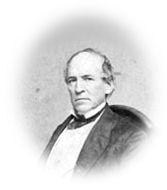
Fine day and much enjoyed by everybody. But little seems to be attended to except military matters. Soldiers marching, Drums beating and Bugles sounding all the time, and now and [sic] one hears the deep booming of a heavy Cannon from Fort Washington, or from the Navy Yard or perhaps from some vessel on the River. Saw the 12th NY Regt Parade, then went down to Willards. Saw A B Williams again. Saw Maj Anderson and many other officers. Found Chas & Sallie at the House.

______

The three diary manuscript volumes, Washington during the Civil War: The Diary of Horatio Nelson Taft, 1861-1865, are available online at The Library of  Congress.

May 9th, 1861.—We hear many rumors and the papers are filled with alarming paragraphs, just enough to keep us “on the anxious bench,” yet not enough to give much real information. We have been hearing hints of a blockade but last night the news reached us that the United States Government established on the 6th of May, a blockade of all Southern ports, beginning at Pensacola. This is bad but the South has so many bays and inlets along her miles and miles of sea-coast that it seems almost impossible to prevent the entrance of vessels that wish to come in. The Southern Confederacy needs everything you can mention in the way of weapons and munitions of war; neither have we manufactories, where these can be made. Nearly every day some new company is organized and the need for arms grows greater all the time. Cousin Bettie Bradford has been at school in New York and now she is in a great hurry to get home before it is too late. Cousin Johnnie has gone on for her but nothing has been heard from them as yet and the family are feeling anxious.

MAY 9th. — The Examiner still fires shot and shell at Gov. Letcher and the dominant majority in the Convention, on account of recent appointments. It is furious over the selection of Mr. Baldwin, recently a leading Union man, for inspector-general; and seems to apprehend bad results from thrusting Union men forward in the coming struggle. The Enquirer is moderate, and kind to Gov. Letcher, whose nomination and subsequent course were so long the theme of bitter denunciation. It is politic. The Whig now goes into the secession movement with all its might. Mr. Mosely has resumed the helm; and he was, I believe, a secessionist many years ago. The Dispatch, not long since neutral and conservative, throws all its powers, with its large circulation, into the cause. So we have perfect unanimity in the press. Per contra, the New York Herald has turned about and leap-frogged over the head of the Tribune into the front ranks of the Republicans. No doubt, when we win the day, the Herald will leap back again.

May 9th.—Virginia Commissioners here. Mr. Staples and Mr. Edmonston came to see me. They say Virginia “has no grievance; she comes out on a point of honor; could she stand by and see her sovereign sister States invaded?”

Sumter Anderson has been offered a Kentucky regiment. Can they raise a regiment in Kentucky against us? In Kentucky, our sister State?

Suddenly General Beauregard and his aide (the last left him of the galaxy who surrounded him in Charleston), John Manning, have gone—Heaven knows where, but out on a war-path certainly. Governor Manning called himself “the last rose of summer left blooming alone” of that fancy staff. A new fight will gather them again.

Ben McCulloch, the Texas Ranger, is here, and Mr. Ward,¹ my “Gutta Percha” friend’s colleague from Texas. Senator Ward in appearance is the exact opposite of Senator Hemphill. The latter, with the face of an old man, has the hair of a boy of twenty. Mr. Ward is fresh and fair, with blue eyes and a boyish face, but his head is white as snow. Whether he turned it white in a single night or by slower process I do not know, but it is strangely out of keeping with his clear young eye. He is thin, and has a queer stooping figure.

This story he told me of his own experience. On a Western steamer there was a great crowd and no unoccupied berth, or sleeping place of any sort whatsoever in the gentlemen’s cabin—saloon, I think they called it. He had taken a stateroom, 110, but he could not eject the people who had already seized it and were asleep in it. Neither could the Captain. It would have been a case of revolver or “‘leven inch Bowie-knife.”

Near the ladies’ saloon the steward took pity on him. “This man,” said he, “is 110, and I can find no place for him, poor fellow.” There was a peep out of bright eyes: “I say, steward, have you a man 110 years old out there ? Let us see him. He must be a natural curiosity.” “We are overcrowded,” was the answer, “and we can’t find a place for him to sleep.” “Poor old soul; bring him in here. We will take care of him.”

” Stoop and totter,” sniggered the steward to No. 110, “and go in.”

” Ah,” said Mr. Ward, “how those houris patted and pitied me and hustled me about and gave me the best berth! I tried not to look; I knew it was wrong, but I looked. I saw them undoing their back hair and was lost in amazement at the collapse when the huge hoop-skirts fell off, unheeded on the cabin floor.”

One beauty who was disporting herself near his curtain suddenly caught his eye. She stooped and gathered up her belongings as she said: “I say, stewardess, your old hundred and ten is a humbug. His eyes are too blue for anything,” and she fled as he shut himself in, nearly frightened to death. I forget how it ended. There was so much laughing at his story I did not hear it all. So much for hoary locks and their reverence-inspiring power!

Russell, the wandering English newspaper correspondent, was telling how very odd some of our plantation habits were. He was staying at the house of an ex-Cabinet Minister, and Madame would stand on the back piazza and send her voice three fields off, calling a servant. Now that is not a Southern peculiarity. Our women are soft, and sweet, low-toned, indolent, graceful, quiescent. I dare say there are bawling, squalling, vulgar people everywhere.

______

¹ Matthias Ward was a native of Georgia, but had removed to Texas in 1836. He was twice a delegate to National Democratic Conventions, and in 1858 was appointed to fill a vacancy from Texas in the United States Senate, holding that office until 1860.

—At 8 o’clock this afternoon the steamer Maryland, with other transports, arrived at Baltimore with 1,800 troops from Perryville. They consist of five companies of the 3d Infantry, regulars, Major Shepherd, 420 men; one company of Sherman’s Battery of Light Artillery, with 6 pieces of cannon and 70 horses, under Major Sherman; and the 1st Regiment, ten companies, of Pennsylvania Artillery, Col. Patterson, armed with muskets, and numbering 800 men. They were landed at Locust Point, one of the termini of the Baltimore and Ohio Railroad, within half a mile of Fort McHenry, and there transferred on board of two trains of car; which departed immediately.

Two hundred men were left to take charge of the horses, provisions and baggage, and these were to be forwarded at a later hour. The Mayor and Police Commissioners, with two hundred police, crossed in a ferry-boat to Locust Point, and were present at the debarkation.

The Harriet Lane stood off the point with her ports open. The transfer to the cars was accomplished without much difficulty, and there was no excitement other than that which proceeded from the curiosity of the people to witness the proceedings.

The track from Locust Point skirts the lower part of the city, and joins the main stem near Camden Station.—N. Y. Tribune, May 10.

—The Richmond Whig says: “We beg to sanest to all Southern papers the propriety of omitting all mention of the movement of troops within our borders. A word to the wise.”

“The caution is a good one, and might well be extended to correspondents, both private and public, by telegraph and by mail. The caution is the more necessary, because of our large daily correspondence with the people of the North, with whom we are unfortunately at war.”—N. O. Picayune, May 10.

—The Confederate Congress passed an act authorizing the President of the Southern Confederacy to raise such a force for the war as he may deem expedient.—(Doc. 147.)

—The Palmetto Guard left Charleston, S. C., for Virginia. The company numbers eighty-five privates, and is commanded as follows:

Geo. B. Cuthbert, Captain; C. R. Holmes, First Lieutenant; T. S. Brownfield, Second Lieutenant; L. S. Webb, Third Lieutenant; Samuel Robinson, First Sergeant; J. E. Wright, Second Sergeant; G. M. Lalane, Third Ser-geant; H. D. Manahan, Fourth Sergeant; M. J. Darly, Fifth Sergeant; J. B. Boyd, First Corporal; J. E. Gaillard, Second Corporal; A. M. Brailsford, Third Corporal; DeSaussure Edwards, Fourth Corporal; J. E. Dutart, Fifth Corporal; E. W. Bellinger, Sixth Corporal; O. D. Mathews, Quartermaster; R. S. Miller, jr., Commissary.—Charleston Mercury, May 10.

—The Cumberland, Pawnee, Monticello, and Yankee are enforcing the blockade off Fortress Monroe. The Yankee pursued an armed schooner up York River, but after proceeding a short distance was fired upon from a concealed battery, and compelled to return.

The steamers Philadelphia, Baltimore, Powhattan, and Mount Vernon, of the Aquia Creek line, recently taken possession of by the Federal Government, are cruising on the Potomac, all heavily armed. Southern troops are concentrating in the vicinity of Norfolk. An Alabama regiment of 1,100 men, and eighty cadets of the same State, have arrived, and encamped in the vicinity of Fort Norfolk.

The Virginians have five batteries erected in Norfolk harbor; one on Craney Island; one at Sandy Point; one at the Hospital; one near Fort Norfolk, and one on the Bluffs three miles from the Hospital. —N. Y. Evening Post, May 11.

—J. Lawrence Keese, a private in the 8th Company of the 7th Regiment of New York, was accidentally shot at Washington. He was standing in front of his tent washing his hands, when a musket fell from a stack of arms within a few feet of him, and went off, the ball entering his side, passing through his lungs, and killing him almost instantly. He was a young man of fine talents, and greatly esteemed by his comrades.—N. Y. Commercial, May 10.

—Today was strictly observed as a fast-day at Wheeling, Va. Patriotic sermons were delivered in nine out of the twelve churches. The Methodist Church pulpit was decorated with the Stars and Stripes. Rev. Mr. Smith delivered an eloquent address. He said he would hold no fellowship with traitors. If there was a secessionist in his congregation he wanted him to leave. Other ministers prayed that the rebels might be subdued or wiped from the face of the earth.—N. Y. Herald, May 10.

—The steamship Africa arrived at New York from England, bringing the first news of the impression produced in Europe by the reduction of Fort Sumter. The earliest feeling was one of the profoundest gloom and discouragement, but subsequent reflection suggested a probability, eagerly accepted, that hostilities would terminate with the opening act; and that, startled by the shock of arms, the Government and the separated States would have fresh dispositions for an amicable arrangement The notion, founded on the fact that no lives had been lost, also became current; that the affair was merely a sham fight, arranged entirely to cover the evacuation from discredit, and save the reputation of Major Anderson. These ideas were indorsed generally by the journals, who, however, regarded the business as extremely enigmatic, and as needing further enlightenment before final judgment could be passed.— (Doc. 148.)

—Two companies of Southern volunteers from Baltimore, numbering sixty-five men, passed through Frederick, Md., on their way to Virginia. They were under the command of Capts. Wetmore and Price, and unarmed. They marched through the city protected by Gen. Shriver and the sheriff, and their appearance created deep excitement, but no outbreak. A company of about thirty-four volunteers left Frederick early this morning for Harper’s Ferry, under the command of Captain Bradley T. Johnson.—National Intelligencer, May 11.

—The First Regiment of Connecticut Volunteers left New Haven this morning for the seat of war.—N. Y. Tribune, May 10.