Following the American Civil War Sesquicentennial with day by day writings of the time, currently 1863.

Monday, May 23, 2011

Cairo, May 23, 1861.

Lots of men come through here with their backs blue and bloody from beatings; and nine in ten of them got their marks in Memphis. A man from St. Louis was in camp a few days since with one-half of his head shaved, one-half of a heavy beard taken off, two teeth knocked out and his lips all cut with blows from a club. This was done in Memphis the day before I saw him. My health continues excellent. Never felt so well, and think that care is all that is necessary to preserve my health as it is. I can’t think that this Illinois climate is mean enough to give a fellow the chills, after it has raised him as well as it has me.

I never enjoyed anything in the world as I do this life, and as for its spoiling me, you’ll see if I don’t come out a better man than when I went in.

We have commenced fortifying this Point. One company is detailed every day to work on this. It is said that it will cost three million. As for enlisting for three years, I can’t, or rather won’t say now. ‘Tis a sure thing that as long as this war continues I will not be satisfied at home, and if I would there will certainly be no business. There is no use trying to coax me now for I can’t tell until my three month’s are up. Then, if I feel as now, I shall certainly go in for the war. Our company gets compliments from all the newspaper correspondents.

The whole camp is aching to be ordered to Memphis. Bird’s Point is not occupied. We had a company there for one day but withdrew them.

I commenced this about 12 last night in the hospital, but I had so much to do and there were so infernal many bugs that I concluded to postpone it. We do have the richest assortment of bugs here imaginable, from the size of a pin-head up to big black fellows as large as bats. I was sitting up with an old schoolmate from Bloomington, whose company have gone up to Big Muddy and left him to the tender care of our surgeons. The poor devil would die in a week but for the care he gets from a dozen of us here that used to go to school with him. There are about 50 men in our regiment’s hospital, and save the few that go up to care for their friends unasked, the poor fellows have no attendance nights. I gave medicine to four beside my friend last night, two of whom are crazy with fever. One of the latter insisted on getting up all the time, and twice he got down stairs while I was attending the others. Not one of our company is there, thank heaven.

Yesterday our company with the whole 7th Regiment were at work on the fortifications. Wheeling dirt and mounting guns was the exercise. The guns we mounted are 36 pounders and weigh three and one-half tons each. Our regiment, except this company, are at the same work to-day. To-morrow the 9th works. General Prentiss paid us a very handsome compliment in saying that our company did more work than any two companies have yet done in the same time. You should see our hands. Mine are covered with blisters. You might as well be making up your mind to the fact that I am not coming home soon. There is but one thing in the way to prevent my going in for the war. That is the talk of cutting off the heads of all lieutenants over 25 years of age, and of all captains over 35. Now under that arrangement all three of our officers will lose their heads, and we know we cannot replace them with as good. This thing, though not certain yet, has created a great deal of excitement in camp, and if it goes into effect will smash our company completely. Our company is the best officered of any in camp. There are no two sides to that proposition.

You’ll see that your Canton company will not regret the selection of officers they have made. The companies here with inexperienced officers have worlds of trouble, and five captains and one lieutenant, though good men at home, have resigned at the wish of their companies. Four of these companies tried to get our first lieutenant for captain, but he won’t leave us. The thousand men who occupied Bird’s Point the other day are most all Germans; many of them “Turners,” and a very well drilled regiment. They will get their cannons from St. Louis next week. None of the men expect an attack here, but we know that General Prentiss thinks it at least possible, and from his actions we think he expects it. A family were in camp yesterday who were driven away from a place only 12 miles from here in Missouri, and left a son there with a bullet through his brains. It happened yesterday morning. We have had our uniforms about a week. Gray satinet pants and roundabout, with a very handsome blue cloth cap. Nine brass buttons up the jacket front and grey flannel shirts. We are obliged to wash dirty clothes the day we change and to black our shoes every evening, and polish our buttons for dress parade. Our company is the only one that does this though, and they call us dandies. We have done more work and better drilling though, than any of them, so we don’t mind it.
May 23d.—As the mail communication has been suspended between North and South, and the Express Companies are ordered not to carry letters, I sent off my packet of despatches to-day, by Mr. Ewell, of the house of Dennistoun & Co.; and resumed my excursions through New Orleans.

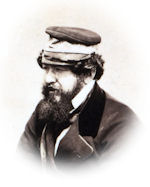
The young artist who is stopping at the St. Charles Hotel, came to me in great agitation to say his life was in danger, in consequence of his former connection with an abolition paper of New York, and that he had been threatened with death by a man with whom he had had a quarrel in Washington. Mr. Mure, to calm his apprehensions, offered to take him to the authorities of the town, who would, no doubt, protect him, as he was merely engaged in making sketches for an English periodical, but the young man declared he was in danger of assassination. He entreated Mr. Mure to give him despatches which would serve to protect him, on his way Northward; and the Consul, moved by his mental distress, promised that if he had any letters of an official character for Washington he would send them by him, in default of other opportunities.

I dined with Major Ranney, the president of one of the railways, with whom Mr. Ward was stopping. Among the company were Mr. Eustis, son-in-law of Mr. Slidell; Mr. Morse, the attorney-general of the State; Mr. Moise, a jew, supposed to have considerable influence with the governor, and a vehement politician; Messrs. Hunt, and others. The table was excellent, and the wines were worthy of the reputation which our host enjoys, in a city where Sallusts and Luculli are said to abound. One of the slave servants who waited at table, an intelligent yellow “boy,” was pointed out to me as a son of General Andrew Jackson.

We had a full account of the attack of the British troops on the city, and their repulse. Mr. Morse denied emphatically that there was any cotton bag fortification in front of the lines, where our troops were defeated; he asserted that there were only a few bales, I think seventy-five, used in the construction of one battery, and that they and some sugar hogsheads, constituted the sole defences of the American trench. Only one citizen applied to the state for compensation, on account of the cotton used by Jackson’s troops, and he owned the whole of the bales so appropriated.

None of the Southern gentlemen have the smallest apprehension of a servile insurrection. They use the universal formula “our negroes are the happiest, most contented, and most comfortable people on the face of the earth.” I admit I have been struck by well-clad and good-humored negroes in the streets, but they are in the minority; many look morose, ill-clad, and discontented. The patrols I know have been strengthened, and I heard a young lady the other night, say, “I shall not be a bit afraid to go back to the plantation, though mamma says the negroes are after mischief.”

THURSDAY 23

Nothing in particular going on today here. The War seems to assume greater proportions every day, and a contest seems to be inevitable soon. Troops ar[e] arriving all the time from the North and generaly going into camp. Chas and Saml are better today, have been there twice today; tonight with wife, staid an hour. Troops drilling and marching in every direction through the streets. Quite a crowd at Willards tonight. Got the “Times” and came home early.

______

The three diary manuscript volumes, Washington during the Civil War: The Diary of Horatio Nelson Taft, 1861-1865, are available online at The Library of  Congress.

CINCINNATI, May 23, 1861.

DEAR UNCLE:—I received yours of the 17th this morning, and am glad to know that your views as to finishing and furnishing the house correspond with our own. If I should not go away during the summer, I will, of course, visit you several times, and we can arrange all these matters. . . .

I suspect you do not like to commit yourself on my warlike designs. We have often observed, that on some questions, advice is never asked until one’s own purpose is fixed; so that the adviser is throwing away breath. Perhaps you think this is such a case, and perhaps you are right; but if the dispatches of this morning are correct, that the Government already has two hundred and twenty thousand men, and will accept no more, the question is settled.

It is raining again—disagreeable times for people in camp. I have not seen any Fremonters, but have written to Haynes¹ to come and see me, with any of the men.

Sincerely,

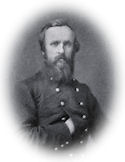
R.B. HAYES.

S. BIRCHARD.

_______

¹ W. E. Haynes. Later a colonel. Long a prominent citizen of Fremont. Member of Congress, etc.

MAY 23D.—To-day the President took the cars for Pensacola, where it had been said everything was in readiness for an assault on Fort Pickens. Military men said it could be taken, and Toombs, I think, said it ought to be taken. It would cost, perhaps, a thousand lives; but is it not the business of war to consume human life? Napoleon counted men as so much powder to be consumed; and he consumed millions in his career of conquest. But still he conquered, which he could not have done without the consumption of life. And is it not better to consume life rapidly, and attain results quickly, than to await events, when all history shows that a protracted war, of immobile armies, always engulfs more men in the grave from camp fevers than usually fall in battle during the most active operations in the field?

To-day I saw Col. Bartow, who has the bearing and eye of a gallant officer. He was attended by a young man named Lamar, of fine open countenance, whom he desired to have as his aid; but the regulations forbid any one acting in that capacity who was not a lieutenant; and Lamar not being old enough to have a commission, he said he would attend the colonel as a volunteer aid till he attained the prescribed age. I saw Ben McCulloch, also—an unassuming but elastic and brave man. He will make his mark. Also Capt. McIntosh, who goes to the West. I think I saw him in 1846, in Paris, at the table of Mr. King, our Minister; but I had no opportunity to ask him. He is all enthusiasm, and will rise with honor or fall with glory. And here I beheld for the first time Wade Hampton, resolved to abandon all the comforts of his great wealth, and encounter the privations of the tented field in behalf of his menaced country.

Arkansas and Tennessee, as I predicted, have followed the example of Virginia and North Carolina; and I see evidence daily in the mass of correspondence, that Missouri and Kentucky will follow in good time.

—A. H. Stephens arrived at Atlanta, Ga., on his return from Montgomery, and in response to a call of the citizens delivered a strong secession speech.—(Doc. 189.)

—Gen. Butler at Fortress Monroe, in a general order, announced the following staff: Capt. Grier Tallmadge, Assistant Quartermaster and Acting Assistant Adjutant-General, Capt.T. Bailey Myers; Acting Assistant Quartermaster, Capt. Peter Hagerty; and Second Lieut., George H. Butler; Major Richard S. Fay, Military Secretary.—N. Y. Commercial, May 31.

—The Philadelphia Evening Journal of today says: “We have it from good authority that there are, at this time, about five hundred Indians stationed at Harper’s Ferry, with the rebel, or traitor army. If this be the mode of warfare these blood-thirsty, scalping devils are to be brought into the fight, our friends in the South must not consider it all unkind if we accept the proffered services of the ten regiments of free negroes in Canada and the North, and send them down South. Our Governor refused to let one regiment of negroes pass through our State to go South to do battle, but if Indians are to be brought into the field by Jeff. Davis, the South may rely on it they will be met with a corresponding force of negroes, and they will increase their numbers as they pass through the country, by having the slaves join them.”

—The Advance Guard, Fifth Regiment, N. Y. Volunteers, Col. Duryea, embarked on board the steam transport Alabama, from New York, for Fortress Monroe.—(Doc. 190.)

—The Mississippi, which sailed from Boston, Mass., this forenoon, returned to that place and anchored off the Navy Yard. She had proceeded but a few miles down the harbor, when it was discovered that in repairing the engines, about two inches of the delivery pipe, through which the water from the condensers was freed out of the side of the ship, had been cut out, and in its place a joint of gum and canvas substituted, when it should have been a slip joint of iron or other metal. The defective part gave way, pouring a flood of water into the ship, when the engines were immediately stopped and the anchor thrown out. Temporary repairs were made so that she was enabled to return, but she lost a 6,000 lb. anchor by the parting of a cable. Michael Quinn of Virginia, late Chief Engineer in the Navy, superintended the repairs of the Mississippi. He recently resigned, returned to Virginia, and his name was stricken from the Navy roll.—N. Y. Tribune, May 24.

—The First and Second Regiments of the Ohio volunteers, numbering together eighteen hundred men, and under the command respectively of Colonels McCook and Wilson, reached Washington. It has been several weeks since they left home, having been in the mean time encamped in Pennsylvania—first at Lancaster, and afterwards near Philadelphia. They left the latter city early yesterday morning, on the railroad, coming by way of Baltimore.—(Doc. 194)

—An immense dry-dock was anchored at night in the Pensacola channel east of Fort Pickens by the rebels, who had intended, however, to anchor it elsewhere. Gen. Brown, in command at the fort, forbade its further removal. Its anchorage between Forts Pickens and McRae was for some time contemplated.—N. O. Delta, May 24.

—A battery of Whitworth guns, twelve-pounders, with ammunition and carriages complete, arrived in New York city, as a present to the Government from patriotic Americans abroad. The battery is consigned to Henry F. Spaulding, Samuel D. Babcock, and Henry A. Smythe, who have informed Secretary Cameron of its arrival, and that it is at the disposition of the Government. Each one of the guns bears the following inscription:

“From loyal Americans in Europe, to the United States Government, 1861.”

Mr. R. G. Moulton, an American at present residing in Manchester, deserves great credit for his energetic efforts in raising funds for the purchase of this battery.—N. Y. Times, May 24.

—One of the secession flags displayed from the head-quarters of the “Grays,” at Alexandria, Va., and within sight from Washington, was captured by two adventurous Union men—William McSpedon, of New York city, and Samuel Smith, of Queens County, N. Y.

—Gen. Patterson and staff arrived at Fort McHenry, Baltimore. Col. Vosburgh, late of the 71st N. Y. regiment, was buried in Greenwood Cemetery. —N. Y. Times, May 24.

—The Third Connecticut Regiment arrived at Washington. It numbers over eight hundred men, all well drilled, and is commanded by Colonel J. Arnold.—(Doc. 191.)

—The Alexandria (Va.) Sentinel of to-day, says: “The Washington Home Guard, Capt. Powell, took to-day 169 head of fine mutton, three miles above the chain bridge. They were appraised at $2.50 a head, and are impounded near this place. They had been purchased of some Virginia drover by the Georgetown butchers, and were to have been delivered by some party, who had undertaken to swim them across the river at so much a head. It has not been found out who it is in Virginia that is thus furnishing aid and comfort to her enemies. This company deserves great credit for the vigilance they have exercised in protecting the adjoining country from marauding bands of Lincoln’s soldiery, as also to prevent disloyal Virginians from furnishing supplies to the enemy.”

—Jefferson Davis issued instructions to privateers sailing under his letters of marque. —(Doc. 192.)

—Gen. Butler, desiring to know the precise lay of the land about Fortress Monroe, Va., concluded to pay a visit to the neighboring village of Hampton. Col. Phelps’s regiment of Vermonters were detailed for the reconnoissance, and took up the march across the dyke and bridge leading from the Fortress to the Hampton side of the bay. Observing the movement, the rebels rushed down to the bridge, and, with combustibles ready, prepared to set fire to it. At this the advance guard of the Vermonters took the double quick step, and before the fire had made much headway were down on the burning bridge and rebels. The latter fled precipitately, and the former was soon rescued from destruction. A field-piece, which the rebels had planted in the neighborhood, was unceremoniously pitched into the bay. Gen. Butler pushed on and completed the reconnoissance, to the infinite disgust of the rebels, and, probably, of John Tyler in particular, whose villa is not far distant. The ground for the permanent encampment was selected on the farm of Mr. Segor at the end of the bridge, and to-morrow will be the first permanent occupation of the soil of Virginia, made by Capt. Carr’s and Col. Phelps’s Regiments, who will go into encampment there.—N. Y. Tribune, May 27.

—The Wheeling(Va.) Intelligencer of today, says:—That the first belligerent issue between the “Union men” of Western Virginia and the “State troops “ recognizing the authority of the Southern Confederacy, has been joined at the town of Clarksburg, in the county of Harrison. Two companies of the Confederate military having marched into that place on the 20th instant, the court-house bell was rung as a signal for the assemblage of the two “Union military companies” of Clarksburg, under the command of Captains A. C. Moore and J. C. Vance, who demanded that the “Confederate forces” should surrender their arms and disband. After a brief parley the demand was complied with.