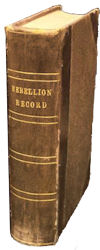
Following the American Civil War Sesquicentennial with day by day writings of the time, currently 1863.

Sunday, May 29, 2011

May 29th.—Dined in the evening with M. Aristide Milten-berger, where I met His Excellency Mr. Moore, the Governor of Louisiana, his military secretary, and a small party.

It is a strange country, indeed; one of the evils which afflicts the Louisianians, they say, is the preponderance and influence of South Carolinian Jews, and Jews generally, such as Moise, Mordecai, Josephs, and Judah Benjamin, and others. The subtlety and keenness of the Caucasian intellect give men a high place among a people who admire ability and dexterity, and are at the same time reckless of means and averse to labor. The Governor is supposed to be somewhat under the influence of the Hebrews, but he is a man quite competent to think and to act for himself—a plain, sincere ruler of a slave state, and an upholder of the patriarchal institute. After dinner we accompanied Madame Milten-berger (who affords in her own person a very complete refutation of the dogma that American women furnish no examples of the charms which surround their English sisters in the transit from the prime of life towards middle age), in a drive along the shell road to the lake and canal; the most remarkable object being a long wall lined with a glorious growth of orange trees: clouds of mosquitoes effectually interfered with an enjoyment of the drive.

May 29.—I cannot get over my disappointment—I am not to return home!—The wagon was engaged. E. W. had promised to accompany me; all things seemed ready; but yesterday a gentleman came up from the Seminary, reporting that the public roads are picketed far beyond our house, and that he had to cross fields, etc., to avoid an arrest, as he had no pass. I know that there are private roads which we could take, of which the enemy knows nothing; and even if they saw me, they surely would not forbid ingress and egress to a quiet elderly lady like myself. But Mr. thinks that I ought not to risk it. The fiat has gone forth, and I am obliged to submit. I hear that the house has been searched for arms, and that J’s old rifle has been filched from its corner. It was a wonderfully harmless rifle, having been innocent even of the blood of squirrels and hares for some time past. I wonder if they do suppose that we would leave good fire-arms in their reach when they are so much wanted in the Confederacy, or if it is a mere pretext for satisfying a little innocent curiosity for seeing the interior of Southern homes? Ah, how many Northerners—perhaps the very men who have come to despoil these homes, to kill our husbands, sons and brothers, to destroy our peace—have been partakers of the warmhearted hospitality so freely offered by our people! The parlours and dining-rooms now so ignominiously searched, how often have they been opened, and the best cheer which the houses could afford set forth for them! I do most earnestly hope that no Northern gentleman, above all, no Christian gentleman, will engage in this wicked war of invasion. It makes my blood boil when I remember that our private rooms, our chambers, our very sanctums, are thrown open to a ruthless soldiery. But let me not do them injustice. I believe that they took nothing but the rifle, and injured nothing but the sewing-machine. Perhaps they knew of the patriotic work of that same machine—how it had stitched up many a shirt and many a jacket for our brave boys, and therefore did it wrong. But this silent agent for our country’s weal shall not lie in ruins. When I get it again, it shall be repaired, and shall


“Stitch, stitch, stitch,

Band, and gusset, and seam,”

for the comfort of our men, and it shall work all the more vigorously for the wrongs it has suffered.

I am indulging myself in writing on and on, because I have so little occupation now, and I feel so anxious and restless about those so near and dear to us, who have gone forth to defend us. The loss of property will be as nothing if our boys are spared. I am willing to be poor, but let, oh, let our family circles be unbroken! But I may feel too much anxiety, even on this subject. Our children have gone forth in a just and righteous cause; into God’s hands let us consign them; they are doing their duty; to His will let us submit!

29th, Night.—Several of our friends from Alexandria have passed to-day. Many families who attempted to stay at home are escaping as best they may, finding that the liberty of the hoary-headed fathers of patriotic sons is at stake, and others are in peril for opinion’s sake. It is too provoking to think of such men as Dr. _____ and Dr. _____ being obliged to hide themselves in their houses, until their wives, by address and strategy, obtain passes to get them out of town! Now they go with large and helpless families, they know not whither. Many have passed whom I did not know. What is to become of us all?

Post image for A Letter to Seward from DNC Chairman August Belmont.

To The Hon. W. H. SEWARD,

Secretary of State, Washington, D. C.

New York, May 29, 1861

My Dear Sir,—I am extremely obliged to you for the very kind and flattering manner with which you speak of a letter of mine to Baron Rothschild, of which a copy had been handed to you by Mr. Weed.

The Baron is a very intimate friend of Lord John Russell, both representing the city of London in Parliament, and he is on equally friendly relations with Lord Palmerston.

I know that his personal views and sympathies have been, and are, still, with the North, and I have no doubt but what he will communicate my views to his ministerial friends.

As you have given a favorable consideration to my views on the unfriendly attitude assumed by the British Crown, I beg to hand you the inclosed copy of another letter which I wrote yesterday to Baron Rothschild on the proclamation of the Queen, and which I hope you will find leisure to peruse.

Post image for “Went to the 69th, Col Corcoran, opposite Georgetown. Extensive and strong ‘works’ going up there.”—Horatio Nelson Taft

WEDNESDAY 29

It has been a fine, cool, and airy day. Took a longer walk than I have for some time. Got a “pass” from Genl Mansfield and about 12 o’clock started with Mr Vansantvoord for Virginia over the Long Bridge. Visited the encampments of some 6000 men and their entrenchments. Was at “Arlington House,” “the Head Quarters” of Genl Sanford. Most delightful place, within fine view of the City. The NY 8th Regt are there. The 25th (Including the Albany Burgeses Corps[?]) are about one mile below or south, 3 miles from the River. Went to the 69th, Col Corcoran, opposite Georgetown. Extensive and strong “works” going up there. Crossed the Aqueduct (canal) to Georgetown, got Home about 6 o’c. Walked about 8 miles.

______

The three diary manuscript volumes, Washington during the Civil War: The Diary of Horatio Nelson Taft, 1861-1865, are available online at The Library of  Congress.

—A mass meeting of leading members of the Baptist Church was held at Brooklyn, N. Y., for the purpose of giving formal expression to their feelings, as a religious community in the present crisis, and to record their attachment to the Union, and their determination to uphold the efforts of the Federal Government, in behalf of the Constitution.—(Doc. 211.)

—The Brooklyn, Capt. Poore, entered the Mississippi River, below New Orleans, and sent out a number of boats, strongly manned with armed men, to board the ships lying on the bar, to acquaint them of the terms of the blockade. After some discussion, it was agreed that the ships on the bar should have fourteen days to go out. Capt. Poore also made a full survey and soundings of the river.—N. O. Delta, May 31.

—A statement of the Geographical arrangements of the army of the United States, corrected to date, is published.—(Doc. 212.)

—President Davis reached Richmond this morning, accompanied by his nephew, Mr. Joseph Davis, Col. Northrop, of the Confederate Army, and Col. Wigfall. Gov. Letcher and the Executive Council met and received the President at Petersburg. An immense assemblage welcomed his arrival at Richmond, with the most enthusiastic demonstrations of delight. The President, in a brief address, thanked the multitude for the hearty reception given him.—N. O. Delta, May 30.

—To-day the American flag was raised over the late residence of Lieutenant-General Scott, at Elizabethtown, N. J., in the presence of about five thousand people. When the flag was given to the breeze, the “Star-Spangled Banner” was sung, the vast concourse of people joining the chorus, producing a fine effect. Mayor Burnett presided, and speeches were made by William F. Day and Rev. Hobart Chetwood, which were received with great applause.—N. Y. Commercial, May 30.

—The correspondence in relation to the establishment of a department of nurses, and the acceptance of the services of Miss Dix, by the Secretary of War, is published.—(Doc. 213.)

—The New Orleans True Delta of this day contains the following:—”We have again and again received information of the motions and sentiments of vagabond free persons of color, upon whom it would be well that the police should keep an eye. These men are without ostensible means of earning a livelihood, and are, by many degrees, too familiar with our slave population, instilling into their minds sanguine notions of the ‘good time’ to be experienced in the event of Lincoln’s hoped-for success over the Southern people. The lake end of the Pontchartrain Railroad is infested with persons of this character, who exhibit a remarkable shrewdness in broaching their pestiferous hints and suggestions. The city also affords rendezvous, at which there are gathered knots of these vagabonds at unseasonable hours. Of course the localities are selected with a view to privacy and remoteness from the inquisitive eyes of the watchman. Careful espionage may bring to light the object of these nocturnal consultations.”

—The Twentieth, Twenty-first, and Twenty-fourth Regiments of Pennsylvania militia left Philadelphia for Chambersburg.—N. Y. Commercial, May 30.

—Colonel Mann’s Regiment of Pennsylvania militia, arrived at Easton, Pa., and went into camp.—(Doc. 214.)

—The American citizens in Paris favorable to the Union breakfasted together in the Hotel du Louvre. About one hundred and fifty attended, of whom one-third were ladies, including the wife of General Scott. Mr. Cowdin presided. Resolutions were adopted, pledging the meeting to maintain the Union under any circumstances. Mr. Dayton, the U. S. Minister, said that, since his arrival in France, be could detect no unfriendly feeling on the part of France to the United States, and certainly no French citizen would be found among the privateersmen. He expressed the conviction that the rebellion would be put down. Cassius M. Clay spoke at length, and was emphatic in his comments on the conduct of England in recognizing Southern belligerent rights. He declared that if ever the flag of England was associated with the black flag of the South, the Star-Spangled Banner of the United States and the tricolor of France would be seen together against her, for France had not forgotten St. Helena. Hon. Anson Burlingame spoke on the same topic. Col. Fremont was next called upon, and was received with enthusiasm. He made a quiet and moderate speech. He regretted the fanatical war, and felt confident it would end in the triumph of truth and justice. He had been called back to America, and would lose no time in responding. He was ready to give his best services to his country. Rev. Dr. McClintock followed. He said he did not attach any importance to the mutterings of the English press. The people of England had not yet spoken, and when they did speak, their voices would not be found on the side of piracy and slavery. Capt. Simons, of the U. S. Army, said he was on his way home, in obedience to the summons of Gen. Scott. Mr. Haldeman, Minister to Vienna, and Rev. Mr. Thayer, also spoke. All the speakers evinced not the slightest doubt of the final triumph of the North.— Galignani’s Messenger, May 30.

—The London News, of this date, contains a remarkable article on the “War in America.” —(Doc. 214½.)