Following the American Civil War Sesquicentennial with day by day writings of the time, currently 1863.

Friday, May 13, 2011

May 13th. I was busy making arrangements to get to Pensacola, and Fort Pickens, all day. The land journey was represented as being most tedious and exceedingly comfortless in all respects, through a waste of sand, in which we ran the chance of being smothered or lost. And then I had set my mind on seeing Fort Pickens as well as Pensacola, and it would be difficult, to say the least of it, to get across from an enemy’s camp to the Federal fortress, and then return again. The United States’ squadron blockaded the port of Pensacola, but I thought it likely they would permit me to run in to visit Fort Pickens, and that the Federals would allow me to sail thence across to General Bragg, as they might be assured I would not communicate any information of what I had seen in my character as neutral to any but the journal in Europe, which I represented, and in the interests of which I was bound to see and report all that I could as to the state of both parties. It was, at all events, worth while to make the attempt, and after a long search I heard of a schooner which was ready for the voyage at a reasonable rate, all things considered.

Mr. Forsyth asked if I had any objection to take with me three gentlemen of Mobile, who were anxious to be of the party, as they wanted to see their friends at Pensacola, where it was believed a “fight” was to come off immediately. Since I came South I have seen the daily announcement that “Braxton Bragg is ready,” and his present state of preparation must be beyond all conception. But here was a difficulty. I told Mr. Forsyth that I could not possibly assent to any persons coming with me who were not neutrals, or prepared to adhere to the obligations of neutrals. There was a suggestion that I should say these gentlemen were my friends, but as I had only seen two of them on board the steamer yesterday, I could not accede to that idea. “Then if you are asked if Mr. Ravesies is your friend, you will say he is not.” “Certainly.” “But surely you don’t wish to have Mr. Ravesies hanged?” “No, I do not, and I shall do nothing to cause him to be hanged; but if he meets that fate by his own act, I can’t help it. I will not allow him to accompany me under false pretences.”

At last it was agreed that Mr. Ravesies and his friends Mr. Bartre and Mr. Lynes, being in no way employed by or connected with the Confederate Government, should have a place in the little schooner which we had picked out at the quayside and hired for the occasion, and go on the voyage with the plain understanding that they were to accept all the consequences of being citizens of Mobile.

Mr. Forsyth, Mr. Ravesies, and a couple of gentlemen dined with me in the evening. After dinner, Mr. Forsyth, who, as mayor of the town, is the Executive of the Vigilance Committee, took a copy of Harper’s Illustrated Paper, which is a very poor imitation of the Illustrated London News, and called my attention to the announcement that Mr. Moses, their special artist, was travelling with me in the South, as well as to an engraving, which purported to be by Moses aforesaid. I could only say that I knew nothing of the young designer, except what he told me, and that he led me to believe he was furnishing sketches to the London News. As he was in the hotel, though he did not live with me, I sent for him, and the young gentleman, who was very pale and agitated on being shown the advertisement and sketch, declared that he had renounced all connection with Harper, that he was sketching for the Illustrated London News, and that the advertisement was contrary to fact, and utterly unknown to him; and so he was let go forth, and retired uneasily. After dinner I went to the Bienville Club. “Rule No. 1” is, “No gentleman shall be admitted in a state of intoxication.” The club very social, very small, and very hospitable.

Later paid my respects to Mrs. Forsyth, whom I found anxiously waiting for news of her young son, who had gone off to join the Confederate army. She told me that nearly all the ladies in Mobile are engaged in making cartridges, and in preparing lint or clothing for the army. Not the smallest fear is entertained of the swarming black population.

MONDAY, MAY 13, 1861.

Rather hot today. M. 80. RI Regt preparing to leave the Pat off and go into camp near Glenwood Cemetery. Six or eight of the Regts are now in camp. Nothing new now occuring from day to day in the office. We attend as usual in our rooms, and do what there is to do, but business is very light this month. Felt quite ill this morning, ate no breakfast, but am as well as usual tonight. Wife & Julia & Boys were at the Presidents to see a Review of the District Military. All the Regiments have a Dress Parade every evening about 6 o’clock. I saw the 12th tonight on F[ranklin]. Square.

______

The three diary manuscript volumes, Washington during the Civil War: The Diary of Horatio Nelson Taft, 1861-1865, are available online at The Library of  Congress.

Uncle Edward to Joseph Howland.

May 13, 1861.

My dear Joe: My eyes are so weak that I must use your Cousin Emily’s pen to express the surprise caused by the announcement in your letter that your sense of duty had obliged you to accept the adjutancy of a regiment.

Had the question been propounded to me, I should have replied that I did not think you possessed the physical endurance needed for such a post, nor the requisite knowledge of military law and tactics; also that you could be ten times more usefully employed in aiding the cause than by a personal devotion to the duties of an officer of the army. If there had been a deficiency of able men anxious to serve, then the duty might have been imperative to stand forward and offer personal services. There are, however, five men offering to each man required. All this I state, because you wish my candid opinion, though I am fully aware that now, having taken the step under your own sense of duty, it is perhaps well that you had not an opportunity of consulting me previous to your decision.

May God’s presence accompany you; and if during your absence I can be of any use to Eliza let her come to me as freely as to a father.

Your Cousin Emily joins with me in all love and desires to do anything in her power for you or Eliza.

Yours with sincere affection,

E. J. Woolsey.

HEADQUARTERS DEPARTMENT OF FLORIDA,
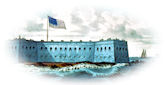
Fort Pickens, Pensacola, May 13, 1861.

Lieut. Col. E. D. TOWNSEND, Assistant Adjutant-General:

COLONEL: Since my last nothing of interest has occurred, and no demonstration of any kind been made by the enemy. He continues strengthening his batteries, but I cannot perceive that he has erected any new ones. The Florida and Alabama Railroad has been finished, and he has received some large guns and mortars ; but, so far as I can discover, he is rather making defensive than offensive preparations. My command has been unceasingly employed in unloading ships, storing provisions and stores, and in putting up works for the protection of the men and guns in the fort, and for bombarding the enemy without. The most important would ere this have been finished but for the want of sand bags, which is so important that I had to send an officer to Havana to purchase them or gunny-bags. Major Tower states that he made a requisition for 100,000, and sent it to Washington by Lieutenant Gilman in March, and no notice has yet been taken of it, although two steamers have since then arrived, by one of which (the Philadelphia) they might have been sent.

Having understood that there were three sea-coast 10-inch mortars at Tortugas, I have ordered two of them here. I am also in daily expectation of the schooner Perrin, which sailed from New York about the 17th of April. When she arrives we shall have, it is hoped, every article necessary for offensive operations, of many of the most essential of which we are now sadly deficient.

Great abuse of the flag of truce having in two or three instances occurred, I wrote General Bragg the letter marked A, and sent it by Captain Hartsuff, assistant adjutant-general. In the afternoon of the same day his aid, Captain Wood, accompanied by Captain Stevens, of the Engineers, came to the wharf, where I met them. He brought me a letter from General Bragg, addressed to me commanding Fort Pickens. I told Captain Wood that I was by order of my Government in command of the Department of Florida; as such I had addressed General Bragg, and that I could receive no official communication that did not recognize me as such. He carried back the letter, and I have since heard nothing on the subject. But no objectionable movements have since taken place. On the 7th two steamers appeared off the bar. They were brought to by the Powhatan and Brooklyn, and afterwards permitted by Captain Adams to return to Mobile. I inclose letters B, C, and D on this subject.

My sick-list is increasing, attributable, I think, to hard labor in a hot sun. None of the cases are very serious. I have lost two by death and two by desertion. I earnestly renew my application for a fast-sailing steamer or steam-tug of light draught of water. Two would be better than one. Their necessity can hardly be overestimated.

Since my last the mortar battery north of the fort has been finished and the mortars put in it, and I shall in a day or two have one for four 8-inch howitzers completed near the same place. I propose also commencing this week near the sea-beach, and to the east of these batteries and about six hundred yards from them, a battery for three 10-inch columbiads, and afterwards another for the same number of columbiads in a place yet to be selected. These finished, the guns and shells received, I hope to be able to give a good account of my command.

Company G, First Artillery (the old company), is so tainted with scurvy as to be of little or no service to me, and the disease increasing daily, I have on the certificate and recommendation of the senior assistant surgeon ordered them to Fort Hamilton (vide letter E). I have been induced to this by the long and distinguished services of this company at this place, by the report of the surgeon that a Northern climate was necessary to the recovery of their health, by the conviction that they would be of but little service to me, and by the fact that they can be sent to the North without any expense to the Government. I trust that my action will meet the approval of the General-in-Chief. I have attached the newly-joined men to Company A, First Artillery. I have directed Major French to send me by the first opportunity one of the companies now at Key West. I am amply strong to hold this fort against any force the enemy can bring against it, but not to prevent a lodgment on the island by a large force, which they can in one night throw on it, and I have therefore reluctantly ordered a company from Key West, where I think they are not strong enough; but this place is of the most pressing importance at present.

I have not received any orders or official communications, but see by the papers that affairs have materially changed since I received my instructions to act only on the defensive. Is it the intention of the Government that the same orders should govern me, or may I, if occasion offer, take the offensive?

I am, colonel, very respectfully, your obedient servant,

HARVEY BROWN,
Major, Second Artillery, Colonel Commanding.

[Inclosure A.]

HEADQUARTERS DEPARTMENT OF FLORIDA,
Fort Pickens, May 6, 1861.

Brig. Gen. BRAXTON BRAGG, Commanding Troops in Florida:

SIR: I respectfully call your attention to what I conceive an abuse of the rights and privileges of a flag of truce. This morning a steamer came to the wharf of this post with a flag, in which, besides the bearer, were a number of officers of your command and some citizens with spyglasses, the professed object of the flag being to bring a private letter from a lady to a subaltern officer of my command.

A steamer a few days since, also with officers of your command on board, visited one of the ships off this post, and in going and returning, instead of keeping in a direct line, coasted along the shore on both sides as close to this fort as she with safety could.

These both are, in my judgment, gross abuses of the flag, and I trust you will cause them to be immediately corrected. I observe and cause to be observed by my command strictly the laws of war in such cases, and expect a like observance on your part.

I am, sir, very respectfully, your obedient servant,

HARVEY BROWN,
Colonel, Commanding.

[Inclosure B.]

HEADQUARTERS DEPARTMENT OF FLORIDA,
Fort Pickens, May 8, 1861.

Capt. H. A. ADAMS, Commanding Naval Forces off Pensacola:

CAPTAIN: I deem it my duty to call your attention to the importance to the defense of this fort of excluding all steamers from the harbor. Their introduction would be of essential injury to us and benefit to the enemy, so that every possible precaution should, I think, be used to prevent it. I think that under no circumstances should a steamer or a vessel loaded with forage or provisions or articles contraband of war be permitted to enter. All those articles are for the consumption of the army of the enemy, and we, by permitting their introduction, are really feeding our enemies, and giving them the means of assailing us. We have information, which though not official, is authentic, that our steamers have been seized and appropriated by the enemy; that he has issued letters of marque, and is fitting out privateers, and that our officers have been taken prisoners, our property stolen, and that one of your own officers is now a prisoner in his hands. Under these circumstances, should not effective measures be taken to stop all vessels? I certainly think so. Permit me to suggest that the passage at the north of the island and the landing of the Perdido should be strictly watched, and that every possible exertion should be used to prevent the introduction of supplies of any and every kind.

I am, sir, very respectfully, your obedient servant,

HARVEY BROWN,
Colonel, Commanding.

[Inclosure C.]

U. S. FRIGATE SABINE,
Off Pensacola, May 8, 1861.

Col. HARVEY BROWN, U. S. Army, Fort Pickens:

COLONEL: I have given orders to the guard-vessels to allow no provisions to enter Pensacola Harbor. In the absence of all instructions with regard to the blockade, I do not know how to proceed towards foreign ships, which by the laws and customs of nations are usually allowed a certain time to come and go after the declaration of a blockade, nor towards those coasting vessels which exhibit a license from the U. S. Government. My doubts on this subject prevented me from making prizes of the two steamers detained last night, which had cargoes of provisions consigned to Judah & Le Baron. I have sent them back to Mobile. The President’s proclamation of blockade is dated April 19, and it is more than time some specific directions about it should have reached me here. Should I hear of any privateers, man-of-war, or letter of marque being at sea, under the secession flag, I intend to commence making captures immediately. But I shall be greatly embarrassed what to do with them, as I have no officers to put on board and carry them to a port of the United States for adjudication. Has any progress been made in the preparation of a battery to receive the Brooklyn’s 9-inch guns, if it should be thought advisable to land them? I am afraid the work of discharging the Philadelphia will go on but slowly, as the large boats of the Powhatan have been so much injured as to require extensive repairs, and those of the Brooklyn will be employed for a few days in ballasting the Supply.

Very respectfully, your obedient servant,

H. A. ADAMS,
Captain, Senior Officer Present.

[Inclosure D.]

HEADQUARTERS DEPARTMENT OF FLORIDA,
Fort Pickens, May 8, 1861.

Capt. H. A. ADAMS, Commanding Naval Forces off Pensacola.:

CAPTAIN: I wrote you this morning on the subject of allowing provisions to enter Pensacola Harbor, and am gratified that you have so far anticipated my wishes. I am not prepared to express a decided opinion as to the foreign vessels, but as the port has not been actually declared in a state of blockade I should suppose it to be expedient to let them pass unless they actually have on board articles contraband of war. I am, however, decidedly of opinion that no United States vessel, containing any article which will nourish or assist the enemy, should be permitted to enter, and most certainly no one, either American or secession, from a rebel State. I regret that you did not feel it to be your duty to detain the two steamers, they being in my opinion lawful prizes.

I have done nothing in relation to the batteries for the guns of the Brooklyn because I distinctly understood you to say that you could not possibly spare any guns from her. I may also say that other and more pressing work would have prevented my doing it, but that I will have an engineer detailed to lay out and superintend such a work whenever you may wish to commence it, presuming, as I do, that your officers will wish the whole to be a Navy work.

Is not the unloading of the Philadelphia and provisioning and supplying this work of very paramount importance to ballasting the Supply? I think that now, while the sea is smooth and the enemy quiet, nothing should take the boats off, and I most respectfully urge that the ballasting the Supply may be deferred until after the steamer is unloaded.

I am much obliged for the papers.

I am, captain, very respectfully, your obedient servant,

HARVEY BROWN,
Colonel, Commanding.

[ Inclosure E. ]

FORT PICKENS, FLA., May 9, 1861.

Capt. GEORGE L. HARTSUFF, Assistant Adjutant-General:

SIR: I have the honor of addressing you for the purpose of calling the attention of the colonel in command of the department to the condition of the men of Company G, First Artillery, stationed at this post. Said company has been for the last three years stationed in this vicinity, and for the last four months confined to the limits of this post. During the latter period it has been almost altogether deprived of fruits and vegetables, and during the whole of the three years but very scantily supplied therewith. Whilst occupying this fort the men and officers of the company have been taxed to their utmost capacity by physical labor and incessant watching night and day against attacks from the enemy. A number of cases of scurvy have already appeared among the men, some of them of considerable severity, and there is great reason to fear the general prevalence of the disease among them. The approach of the hot season will tend to aggravate the disease. The supplies of anti-scorbutics in the commissary stores I trust will be sufficient to prevent the appearance of the disease among the men lately arrived from the North, but I do not believe in their efficacy to relieve the cases which have already appeared or to prevent the recurrence of new cases among the men of Company G, First Artillery. Were it in your power to do so, I  would suggest the advisability of ordering to the North the old soldiers of the company; but if it be not in the limits of your authority to do so, I respectfully recommend that that portion of the company which has been on duty here so long be ordered to Key West, in order that the men may avail themselves of the tropical fruits and vegetables to be procured at that place, and for the benefit otherwise to be derived from change of air.

I have the honor to be, sir, very respectfully, your obedient servant,

JOHN CAMPBELL,
Assistant Surgeon.
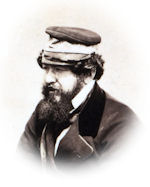
MAY 13th. ─ We traveled all night, and reached Wilmington, N. C., early in the morning. There I saw a Northern steamer which had been seized in retaliation for some of the seizures of the New Yorkers. And there was a considerable amount of ordnance and shot and shell on the bank of the river. The people everywhere on the road are for irremediable, eternal separation. Never were men more unanimous. And North Carolina has passed the ordinance, I understand, without a dissenting voice. Better still, it is not to be left to a useless vote of the people. The work is finished, and the State is out of the Union without contingency or qualification. I saw one man, though, at Goldsborough, who looked very much like a Yankee, and his enthusiasm seemed more simulated than real; and some of his words were equivocal. His name was Dibble.

To-day I saw rice and cotton growing, the latter only an inch or so high. The pine woods in some places have a desolate appearance; and whole forests are dead. I thought it was caused by the scarifications for turpentine; but was told by an intelligent traveler that the devastation was produced by an insect or worm that cut the inner bark.

The first part of South Carolina we touched was not inviting. Swamps, with cane, and cypress knees, and occasionally a plunging aligator met the vision. Here, I thought the Yankees, if they should carry the war into the far south, would fare worse than Napoleon’s army of invasion in Russia.

But railroads seldom run through the fairest and richest portions of the country. They must take the route where there is the least grading. We soon emerged, however, from the marshy district, and then beheld the vast cotton-fields, now mostly planted in corn. A good idea. And the grain crops look well. The corn, in one day, seems to have grown ten inches.

In the afternoon we were whisked into Georgia, and the face of the country, as well as the color of the soil, reminded me of some parts of France between Dieppe and Rouen. No doubt the grape could be profitably cultivated here. The corn seems to have grown a foot since morning.

May 13th.—We have been down from Montgomery on the boat to that God-forsaken landing, Portland, Ala. Found everybody drunk—that is, the three men who were there. At last secured a carriage to carry us to my brother-in-law’s house. Mr. Chesnut had to drive seven miles, pitch dark, over an unknown road. My heart was in my mouth, which last I did not open.

Next day a patriotic person informed us that, so great was the war fever only six men could be found in Dallas County. I whispered to Mr. Chesnut: “We found three of the lone ones hors de combat at Portland.” So much for the corps of reserves—alcoholized patriots.

Saw for the first time the demoralization produced by hopes of freedom. My mother’s butler (whom I taught to read, sitting on his knife-board) contrived to keep from speaking to us. He was as efficient as ever in his proper place, but he did not come behind the scenes as usual and have a friendly chat. Held himself aloof so grand and stately we had to send him a ” tip ” through his wife Hetty, mother’s maid, who, however, showed no signs of disaffection. She came to my bedside next morning with everything that was nice for breakfast. She had let me sleep till midday, and embraced me over and over again. I remarked: “What a capital cook they have here!” She curtsied to the ground. “I cooked every mouthful on that tray—as if I did not know what you liked to eat since you was a baby.”

—The Southern Baptist Convention, in session at Savannah, Ga., adopted a report of their committee on the state of the country, in which they hold “that the States once combined on this continent can no longer live together as one confederacy;” that the movement of Northern soldiers to sustain the Government is “an invasion designed to destroy whatever is dear in the heroic traditions of the South.” They tender to the government at Montgomery their sympathy and confidence, and recommend the churches of the South to observe the first and second days of June as days of fasting, humiliation, and prayer. This report borrows additional interest from the fact that it comes from the pen of Dr. Richard Fuller of Baltimore, who made himself conspicuous, three or four weeks ago, as a member of that committee of young Christians who waited upon Mr. Lincoln to request that the Government of the United States would reconsider its order for the troops needed at Washington to come through Maryland.—(Doc. 159.)

—A Union meeting was held in Martinsburgh, Berkeley county, Va. The gathering was large, and the greatest enthusiasm prevailed. Strong resolutions were adopted, and a protest entered against the warlike attitude which Virginia had assumed in opposition to the General Government. Eastern Virginia is not, as has been represented, unanimous for secession.—Newark (N. J.) Advertiser, May 22.

—Six hundred troops from Georgia and Alabama arrived at Pensacola, the advance guard of 2,000 ordered there by General Bragg.—Mobile Advertiser, May 15.

—A portion of the Federal troops lately stationed at the Relay House on the Baltimore and Ohio Railroad, entered Baltimore. They arrived at the Camden station at seven and a half o’clock in the evening, disembarked in good order, and marched from the dépôt, piloted by Col. Hare and Capt. McConnell, down Lee street to Hanover, and thence to Montgomery, to Light, to Hamburgh, to Federal Hill, and, moving to the high ground surrounding the Observatory, stacked arms, and made preparations for rest.

The force was under command of Gen. Butler, and composed of a portion of the Boston Light Artillery, Major Cook; a strong detachment of the Sixth Massachusetts Regiment, Col. Jones; and about five hundred of the Eighth New York Regiment, Lient.-Col. Waltenburgh.

On the route to the Hill, the streets were thronged with people, who greeted the military with cheers at every step, the ladies at the windows and the doors joining in the applause by waving their handkerchiefs. Arrived at their destination—which was unknown to the troops until they reached the place—they began to bestow themselves as comfortably as possible in the absence of tents. Their operations were seriously interrupted by a soaking shower that completely deluged the place, but, having become accustomed to camp life, they seemed to pay little attention to it. At a late hour large fires were built, somewhat dispelling the gloom of the place, and rendering the atmosphere more comfortable. The forces will be largely reinforced, and additional force is expected, who will immediately take possession of the commanding heights around Baltimore. Public Schoolhouse No. 10, corner of Warren and William streets, was taken possession of by the troops for the purpose of storing away their baggage and other articles likely to be injured by being exposed to the weather.—Baltimore Clipper, May 14.

—Judge Giles, of Baltimore, having issued a writ of habeas corpus, directing the delivery of a soldier at Fort McHenry, Major Morris, the commander at that post, refused to obey the writ, and gave his reasons in a published letter.—N. Y. Evening Post, May 14.—(Doc. 160.)

—Early this morning the steamer Pawnee was moored off the city of Alexandria, Va., so that her guns and mortars command the town. She has several of James’s rifled cannon on board, which will throw grape, shell, hot shot or solid into any part of the town, and far beyond into the camp of an army that may be so imprudent as to pitch their tents in the suburbs of the city.—N. Y. Herald, May 14.

—The Virginia Union Convention assembled at Wheeling, and organized, with Dr. J. W. Moss in the chair.—Idem.

—Senator Bayard, of Delaware, issued an address to his constituents, called forth by the denunciations against him on his return from the South. He narrates the history of his journey, gives the motives which induced him to undertake it, and denies having been in consultation with the rebels in Montgomery. He proposes to rest on his past course, his general character, and his future life, and declares that he shall resign as soon as he is convinced that there is to be a war.—(Doc. 161.)

—Mrs. Sarah Sanford, a native of New Haven, Conn., and a graduate of the South Hadley Female Seminary, but for some time past an assistant teacher in a New Orleans Grammar School, was stripped naked and tarred and feathered in Lafayette Square, New Orleans, in the presence and amid the applause of an immense crowd of people. The assigned reason was abolition sentiments, expressed to her pupils, and by them repeated to their parents. Dr. Charles McQueen, recently from New Orleans, was an eye witness to the transaction.—Buffalo Express.