Following the American Civil War Sesquicentennial with day by day writings of the time, currently 1863.

Saturday, May 21, 2011

(May 21 – The following material is from the diary entry of May 20, which actually appears to have covered two days. This blog entry covers the second day.)

When I woke up at daylight, I found the vessel lying alongside a wharf with a railway train alongside, which is to take us to the city of New Orleans, six miles distant.

A village of restaurants or “restaurats,” as they are called here, and of bathing boxes has grown up around the terminus; all the names of the owners, the notices and sign-boards being French. Outside the settlement the railroad passes through a swamp, like an Indian jungle, through which the overflowings of the Mississippi creep in black currents. The spires of New Orleans rise above the underwood and semitropical vegetation of this swamp. Nearer to the city lies a marshy plain, in which flocks of cattle, up to the belly in the soft earth are floundering among the clumps of vegetation. The nearer approach to New Orleans by rail lies through a suburb of exceedingly broad lanes, lined on each side by rows of miserable mean one-storied houses, inhabited, if I am to judge from the specimens I saw, by a miserable and sickly population.

A great number of the men and women had evident traces of negro blood in their veins, and of the purer blooded whites many had the peculiar look of the fishy-fleshy population of the Levantine towns, and all were pale and lean. The railway terminus is marked by a dirty, barrack-like shed in the city. Selecting one of the numerous tumble-down hackney carriages which crowded the street outside the station, I, directed the man to drive me to the house of Mr. Mure, the British consul, who had been kind enough to invite me as his guest for the period of my stay in New Orleans.

The streets are badly paved, as those of most of the American cities, if not all that I have ever been in, but in other respects they are more worthy of a great city than are those of New York. There is an air thoroughly French about the people—cafes, restaurants, billiard-rooms abound, with oyster and lager-bier saloons interspersed. The shops are all magazins; the people in the streets are speaking French, particularly the negroes, who are going out shopping with their masters and mistresses, exceedingly well dressed, noisy, and not unhappy looking. The extent of the drive gave an imposing idea of the size of New Orleans—the richness of some of the shops, the vehicles in the streets and the multitude of well dressed people on the pavements, an impression of its wealth and the comfort of the inhabitants. The Confederate flag was flying from the public buildings and from many private houses. Military companies paraded through the streets, and a large proportion of men were in uniform.

In the day I drove through the city, delivered letters of introduction, paid visits, and examined the shops and the public places; but there is such a whirl of secession and politics surrounding one it is impossible to discern much of the outer world.

Whatever may be the number of the unionists or of the non-secessionists, a pressure too potent to be resisted has been directed by the popular party against the friends of the Federal government. The agent of Brown Brothers, of Liverpool and New York, has closed their office and is going away in consequence of the intimidation of the mob, or as the phrase is here, the “excitement of the citizens,” on hearing of the subscription made by the firm to the New York fund, after Sumter had been fired upon. Their agent in Mobile has been compelled to adopt the same course. Other houses follow their example, but as most business transactions are over for the season, the mercantile community hope the contest will be ended before the next season, by the recognition of Southern independence.

The streets are full of Turcos, Zouaves, Chasseurs; walls are covered with placards of volunteer companies; there are Pickwick rifles, La Fayette, Beauregard, MacMahon guards, Irish, German, Italian and Spanish and native volunteers, among whom the Meagher rifles, indignant with the gentleman from whom they took their name, because of his adhesion to the North, are going to rebaptize themselves and to seek glory under one more auspicious. In fact, New Orleans looks like a suburb of the camp at Chalons. Tailors are busy night and day making uniforms. I went into a shop with the consul for some shirts—the mistress and all her seamstresses were busy preparing flags as hard as the sewing machine could stitch them, and could attend to no business for the present. The Irish population, finding themselves unable to migrate Northwards, and being without work, have rushed to arms with enthusiasm to support Southern institutions, and Mr. John Mitchell and Mr. Meagher stand opposed to each other in hostile camps.
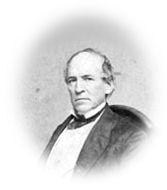
TUESDAY 21

Today the weather has been fine, quite still times in the office. Matters and business there are now assuming their usual channels, but applications for Patents have much fallen off of late. Went with Juliet up to the camp of the 7th NY Regt (“Camp Cameron”), a great crowd of spectators there. We went all round among the tents. After the Parade the soldiers had gymnastic exercises equal to a circus performance. Came back at dark, did not go down town.

______

The three diary manuscript volumes, Washington during the Civil War: The Diary of Horatio Nelson Taft, 1861-1865, are available online at The Library of  Congress.

Abby Howland Woolsey to the Sisters Abroad.

[Robert and his family and Hatty and Carry were still in Europe, but hurrying their return on account of the breaking out of the war.]

New York, May 21, 1861.

Dear Girls: We hope soon to have more particulars about your interview with Mrs. Browning, what she said, and “said he” and “said they.”

I hardly know what to tell you about home. I have been trying to think what questions about public affairs you are longing to have answered, the whys and wherefores of things, but am afraid I might hit on the very wrong ones. We cannot see into details ourselves; we live only on newspaper rumors, and the only peace of mind we get is by mentally consenting to leave everything in the hands of Scott, satisfied of his patriotism, wisdom and skill. The best statesmanship of the country is at work for its good; many knowing heads are contriving and planning; many brave hearts and steady hands are executing the will of government; the monied men, who have so much to save or lose, feel that their only hope of extrication is in the vindication of our laws and constitution; the military men know the true weakness of the South and predict its ultimate ruin; and above all and over all, as Mr. Prentiss preached to us on Sunday, “this continent belongs to Christ. He has a greater stake in it than any of us, who are here only for our little day, can have. If it should be destroyed, where on earth has God such another country so suited to His great providential designs? Be sure He will see to it that America is delivered out of all her troubles in His own time.”

We hear the bugle-call now constantly floating down the streets. It is used as a rallying sound in the field — as in Europe —by the French and the German volunteers, and by some of our own regiments, I think. Going down Broadway you pass a great many “headquarters” or recruiting offices, and the crossed bayonets at the door or the sentry marching up and down have a very foreign look. You should see Charley in his Home Guard martial array. It is a sight to strike awe into feeble sisters— a grey tight-fitting coat, with red cuffs and collar edged with white cord, and a red and grey cap trimmed with white braid.

From Eliza and Joe at Albany we hear as follows: Joe was summoned there to report for duty, as the regiment is quartered in barracks, along with others, four thousand troops in all. The regiment and officers were sworn into United States service last Wednesday, drawn up in a long line, and the sound of their cheers rolling down the field like thunder. Two men refused to swear from some cause or other, and a third, who had hesitated but finally stepped into the ranks, was cheered by his comrades till the tears ran down his cheeks.

They say they are “able to lick their heft in wild cats “ and are pronounced the finest regiment so far accepted—all six feet or more high and experienced riflemen. Joe is well, so far, and busy, and does not for a moment regret the step he has taken. The duties of adjutant are honorable and responsible ones, and purely military.

MAY 21st. — Being in the same room with the Secretary, and seen by all his visitors, I am necessarily making many new acquaintances; and quite a number recognize me by my books which they have read. Among this class is Mr. Benjamin, the Minister of Justice, who, to-day, informed me that he and Senator Bayard had been interested, at Washington, in my “Story of Disunion.” Mr. Benjamin is of course a Jew, of French lineage, born I believe in Louisiana, a lawyer and politician. His age may be sixty, and yet one might suppose him to be less than forty. His hair and eyes are black, his forehead capacious, his face round and as intellectual as one of that shape can be; and Mr. B. is certainly a man of intellect, education, and extensive reading, combined with natural abilities of a tolerably high order. Upon his lip there seems to bask an eternal smile; but if it be studied, it is not a smile — yet it bears no unpleasing aspect.

E. fancying at first that she ought to stay behind to care for “the stuff” when J. went to the war, sent cheerful bulletins to him of home matters.

Eliza Woolsey Howland to Joseph Howland at Albany.

Fishkill, May 21, 1861.

Everything goes on nicely. I have made the rounds this morning and the report is all satisfactory. Thomson has bought a very nice bay mare to take Dick’s place for $130, and a third pig, as there was too much food for the others. The men are all at work, the potatoes in and the corn will be finished tonight. Then the sodding and grading will be resumed. Mechie has bought dahlia poles and is now finishing the flower beds outside the greenhouse, which looks finely. A superb box of flowers came up this morning. . . . Everyone expresses the greatest interest in you and your movements. Moritz says the country wasn’t as “lonesome” all winter as it was the first few days of your absence. . . . I don’t doubt James will go with you, but I wouldn’t let him decide hastily. Thomson would go with you himself in a minute but for his family. . . . I have had a very busy morning and haven’t had a chance to miss you.

21st.—Mr. _____ has returned. Yesterday evening we rode to the parade-ground in Alexandria; it was a beautiful but sad sight. How many of those young, brave boys may be cut off, or maimed for life! I shudder to think of what a single battle may bring forth. The Federal vessel Pawnee now lies before the old town, with its guns pointing towards it. It is aggravating enough to see it; but the inhabitants move on as calmly as though it were a messenger of peace. It is said that an undefended, indefensible town like Alexandria will hardly be attacked. It seems to me strange that they do not go immediately to the Rappahannock, the York, or the James, and land at once in the heart of the State. I tremble lest they should make a direct attack upon Richmond. Should they go at once to City Point, and march thence to the city, I am afraid it could hardly be defended. Our people are busy in their preparations for defence; but time is necessary—every day is precious to us. Our President and military chiefs are doing all that men can do to forward preparations. My ear is constantly pained with the sound of cannon from the Navy-Yard at Washington, and to-day the drum has been beating furiously in our once loved metropolis. Dr. S. says there was a grand dress parade—brothers gleefully preparing to draw their brothers’ blood!

Day after to-morrow the vote of Virginia on secession will be taken, and I, who so dearly loved this Union, who from my cradle was taught to revere it, now most earnestly hope that the voice of Virginia may give no uncertain sound; that she may leave it with a shout. I am thankful that she did not take so important a step hastily, but that she set an example of patience and long-suffering, and made an earnest effort to maintain peace; but as all her efforts have been rejected with scorn, and she has been required to give her quota of men to fight and destroy her brethren of the South, I trust that she may now speak decidedly.

—Gen. Price, of the Missouri Militia, and Gen. Harney U. S. A., agreed upon a plan to maintain the public peace. Gen. Price pledged the whole power of the State officers to maintain order among the people of the State, and Gen. Harney declares that this object being assured, he can have no occasion as he has no wish, to make military movements, which might otherwise create excitement and jealousies which he most earnestly desires to avoid.—Ohio Statesman, May 22.

—This afternoon two companies, numbering 120 muskets, from the Philadelphia camp, composed of companies E and G under the command of Major McLane, went to Baltimore; proceeded to an unoccupied house near Green Mount Cemetery, and seized a large quantity of arms stored there, comprising 1,600 muskets, the boxes marked, “Virginia muskets,” and 84 boxes containing 4,000 pikes, the boxes marked, “From Denmeads.” The whole made twenty-six dray loads and were all taken to camp, and thence to Fort McHenry. The arms had been in the custody of the city authorities.—Idem.

—The Second Regiment of Tennessee Volunteers, numbering 952 men, arrived at Richmond, Va., and went into camp at the head of Main street.—(Doc. 182.)

—The ship General Parkhill of Liverpool, for Charleston, arrived at Philadelphia in charge of a prize crew of the Niagara. She was spoken off Cape Romain on the 12th, and ordered off. The next day she was captured in attempting to run the blockade. She is 600 tons with a general cargo, a large portion being salt. It is suspected that arms and munitions of war are concealed under the salt. She was commanded by Capt. Forbes, and had two secession flags fiying.—Philadelphia Press, May 21.

—Jefferson Davis approved the act, passed at the session of the Southern Congress, prohibiting Southerners owing moneys to Northern merchants from paying the same, and compelling payment instead into the treasury of the seceded States.—(Doc. 183.)

—A comprehensive and able article upon the present condition of affairs in the United States, is published in the Cologne Gazette.— (Doc. 184.)

—The Confederate Congress in session at Montgomery, Ala., adjourned to meet at Richmond, Va., July 20th.—N. Y. Herald, May 28.

—A letter from Roxabelle, N. C., says:— The Chowan Association, by a unanimous vote, cut off all intercourse with the Bible Union, and recommended those owing subscriptions to withhold the same, deprecating any further agency of the Bible Union among the churches —another fruit of the reckless fanaticism of the Northern agitators. Unwilling to bow down to the Jehovah revealed by Moses and preached by Paul, they seek anti-slavery God. Nor are they unmindful in their ardent devoirs to the almighty dollar. Thousands have gone into the Bible Union treasury, annually for years past; but the steam is now stopped.—N. Y. Express, May 24.

—The New School Presbyterian Assembly in session at Syracuse, N. Y., passed a series of resolutions upholding the Federal Government, the Constitution and laws.—Albany Journal, May 24.

—Gen. Sam Houston addressed the people of Independence, Texas, on the 10th of May last, on the occasion of a May festival. In the course of his remarks he took occasion to define his position in the present political crisis.—(Doc. 185.)