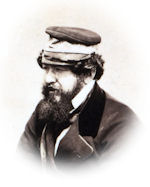
May 19th.—The heat out of doors was so great that I felt little tempted to stir out, but at 2 o’clock Mr. Magee drove me to a pretty place, called Spring Hill, where Mr. Stein, a German merchant of the city, has his country residence. The houses of Mobile merchants are scattered around the rising ground in that vicinity; they look like marble at a distance, but a nearer approach resolves them into painted wood. Stone is almost unknown on all this seaboard region. The worthy German was very hospitable, and I enjoyed a cool walk before dinner under the shade of his grapes, which formed pleasant walks in his garden. The Scuppernung grape, which grew in profusion—a native of North Carolina — has a remarkable appearance. The stalk, which is smooth, and covered with a close grained grey bark, has not the character of a vine, but grows straight and stiff like the branch of a tree, and is crowded with delicious grapes. Cherokee plum and rose trees, and magnificent magnolias, clustered round his house, and beneath their shadow I listened to the worthy German comparing the Fatherland to his adopted country, and now and then letting out the secret love of his heart for the old place. He, like all of the better classes in the South, has the utmost dread of universal suffrage, and would restrict the franchise largely to-morrow if he could.
Thursday, May 19, 2011
SUNDAY, MAY 19, 1861.
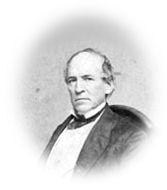
Cool today, fire in Parlor in the morning. Went with Juliet to the camp of the 12th Regt in the morning and heard Rev Mathew Hale Smith (the Chaplin of the Regt) deliver an eloquent discourse to the soldiers. Got to church in time from there and heard Doct Smith, a good many soldiers in the house. Lieut [Millward?] of the 12th called in the evening. He lives in NY, an Englishman by birth. Went down onto the Ave at 6 o’ck and saw the Mich Regt parade. Their Band of Music is very fine. Back before dark, Juliet was with me.

______
The three diary manuscript volumes, Washington during the Civil War: The Diary of Horatio Nelson Taft, 1861-1865, are available online at The Library of Congress.
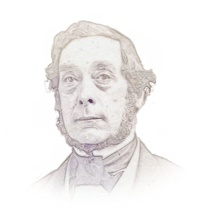
MAY 19th. — The Secretary of War sent for me this morning, and said he required more assistance in his correspondence, then increasing daily; but the act of Congress limiting salaries would prevent him from offering me an adequate compensation. He could only name some ten or twelve hundred dollars. I told him my great desire was employment, and facilities to preserve interesting facts for future publication. I was installed at once, with Major Tyler, in the Secretary’s own office. It was my duty to open and read the letters, noting briefly their contents on the back. The Secretary would then indicate in pencil marks the answers to be written, which the major and I prepared. These were signed by the Secretary, copied in another room, and mailed. I was happy in the discharge of these duties, and worked assiduously day and night.
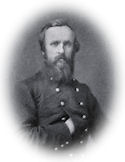
May 19, 1861.—We find a good deal of difficulty in getting new companies or regiments accepted for the war, but we shall persevere.
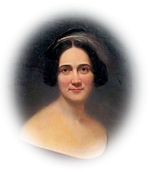
May 19th.—Mrs. Fitzpatrick says Mr. Davis is too gloomy for her. He says we must prepare for a long war and unmerciful reverses at first, because they are readier for war and so much stronger numerically. Men and money count so in war. “As they do everywhere else,” said I, doubting her accurate account of Mr. Davis’s spoken words, though she tried to give them faithfully. We need patience and persistence. There is enough and to spare of pluck and dash among us, the do-and-dare style.
I drove out with Mrs. Davis. She finds playing Mrs. President of this small confederacy slow work, after leaving friends such as Mrs. Emory and Mrs. Joe Johnston¹ in Washington. I do not blame her. The wrench has been awful with us all, but we don’t mean to be turned into pillars of salt.
Mr. Mallory came for us to go to Mrs. Toombs’s reception. Mr. Chesnut would not go, and I decided to remain with him. This proved a wise decision. First Mr. Hunter² came. came. In college they called him from his initials, R. M. T., ” Run Mad Tom ” Hunter. Just now I think he is the sanest, if not the wisest, man in our new-born Confederacy. I remember when I first met him. He sat next to me at some state dinner in Washington. Mr. Clay had taken me in to dinner, but seemed quite satisfied that my “other side” should take me off his hands.
Mr. Hunter did not know me, nor I him. I suppose he inquired, or looked at my card, lying on the table, as I looked at his. At any rate, we began a conversation which lasted steadily through the whole thing from soup to dessert. Mr. Hunter, though in evening dress, presented a rather tumbled-up appearance. His waistcoat wanted pulling down, and his hair wanted brushing. He delivered unconsciously that day a lecture on English literature which, if printed, I still think would be a valuable addition to that literature. Since then, I have always looked forward to a talk with the Senator from Virginia with undisguised pleasure. Next came Mr. Miles and Mr. Jameson, of South Carolina. The latter was President of our Secession Convention; also has written a life of Du Guesclin that is not so bad. So my unexpected reception was of the most charming. Judge Frost came a little later. They all remained until the return of the crowd from Mrs. Toombs’s.
These men are not sanguine—I can’t say, without hope, exactly. They are agreed in one thing: it is worth while to try a while, if only to get away from New England. Captain Ingraham was here, too. He is South Carolina to the tips of his fingers; yet he has it dyed in the wool—it is part of his nature—to believe the United States Navy can whip anything in the world. All of these little inconsistencies and contrarieties make the times very exciting. One never knows what tack any one of them will take at the next word.

______
¹ Mrs. Johnston was Lydia McLane, a daughter of Louis McLane, United States Senator from Delaware from 1827 to 1829, and afterward Minister to England. In 1831 he became Secretary of the Treasury and in 1833 Secretary of State. General Joseph E. Johnston was graduated from West Point in 1829 and had served in the Black Hawk, Seminole, and Mexican Wars. He resigned his commission in the United States Army on April 22,1861.
² Mr. Hunter was a Virginian. He had long served in Congress, was twice speaker of the House, and in 1844 was elected a United States Senator, serving until 1861. He supported slavery and became active in the secession movement. At the Charleston Convention in 1860, he received the next highest vote to Stephen A. Douglas for President.
—Shots were exchanged between the U. S. Steamers Freeborn and Monticello, and a rebel battery at Sewell’s Point north of Elizabeth River, Virginia.—(Doc. 177.)
—Two schooners with secession troops on board were taken by U. S. steamer Freeborn, in the Potomac, 10 miles below Fort Washington.—N. Y. World, May 21.
—The rebels at Harper’s Ferry, Md., were reinforced from the south. Two thousand troops arrived from Mississippi and two regiments from Alabama.—N. Y. Herald, May 21.
—A meeting of the New York Bible Society was held, in reference to supplying the Bible to all soldiers, who go to fight for the Federal Government. Wm. Allen Butler presided, and speeches were made by the president, Dr. Tyng, Dr. Hitchcock, and others.—(Doc. 178.)
—A body of 1,000 Virginians and South Carolinians from Harper’s Ferry took a position on the Virginia side of the Potomac, opposite Williamsport, a town about seven miles from Hagerstown, Md. They there were in a situation to command the ferry at that spot.—Phila. Press, May 21.


