Following the American Civil War Sesquicentennial with day by day writings of the time, currently 1863.

May 2011

Note from Mrs. Professor Smith.

My dear Mrs. Howland: I thank you very much for the beautiful flowers, which are a great delight to us all, and I thank you especially for thinking of our pleasure when your heart must have been so full. I could hardly be reconciled at first to Mr. Howland’s going, but now I am glad that such a man should go. Surely the cause is worthy of the best and noblest, and he will have the same Protector there as at home, and the constant loving prayers of many hearts will be like a shield of defence.

MAY 16th. —Met John Tyler, Jr., to-day, who, with his native cordiality, proffered his services with zeal and earnestness. He introduced me at once to Hon. L. P. Walker, Secretary of War, and insisted upon presenting me to the President the next day. Major Tyler had recently been commissioned in the army, but is now detailed to assist the Secretary of War in his correspondence. The major is favorably known in the South as the author of several Southern essays of much power that have been published in a Review, signed “Python.”

The principal hotel is the Exchange, as in Richmond; the entrance to the bar, reading-room, etc. is by a flight of stairs from the street to the second story, with stores underneath. Here there is an incessant influx of strangers coming from all directions on business with the new government. But the prevalent belief is that the government itself will soon travel to Richmond. The buildings here will be insufficient in magnitude for the transaction of the rapidly increasing business.

May 16.—To-day I am alone. Mr. _____ has gone to Richmond to the Convention, and so have the Bishop and Dr. S. I have promised to spend my nights with Mrs. J. All is quiet around us. Federal troops quartered in Baltimore. Poor Maryland! The North has its heel upon her, and how it grinds her! I pray that we may have peaceful secession.

—A letter upon the Virginia election was written by Senator Mason of that State, in which he says, that “the ordinance of secession” (not yet voted upon by the people of Virginia) “annulled the Constitution and laws of the United States within that State, and absolved the citizens of Virginia from all obligation and obedience to them;” and that if it be now rejected by the people, Virginia must “change sides,” and “turn her arms against her Southern sisters.” Moreover, that ordinance brought into Virginia several thousand soldiers of the Confederate army, and thus the faith of Virginia is pledged to it, for if it be rejected, their soldiers will merely have been entrapped. —(Doc. 170.)

—The Montgomery (Ala.) Advertiser, of today, says that the various accounts about hundreds of letters of marque having been granted by the War Department of the Southern Confederacy, and that thousands of applications are already on file, is a gross error. Applications for that business are made to the collectors of the different ports, and not to the department at Montgomery, where none have been received. A number of applications have been made to the collectors of New Orleans, Mobile, and other Southern ports.

—General Butler was serenaded at the National Hotel in Washington, and in response made a happy speech upon the war, and the position of Massachusetts in it.—(Doc. 171.)

—Upon the opening of the U. S. Circuit Court at Boston, Judge Sprague charged the Grand Jury upon the crime of piracy.—(Doc. 172.)

—The Second Regiment of Maine volunteer militia passed through New York, on their way to the seat of war. Previous to their departure the natives of Maine, resident in the city, presented the regiment with an American flag; the presentation being made at the City Hall, in the presence of thousands of enthusiastic spectators.—(Doc. 173.)

—A correspondence between Gov. Andrews of Mass., and Gen. Benjamin F. Butler, relative to the proposed suppression by the latter of a slave insurrection, is published.—(Doc. 174.)

—Brigadier-Generals Butler and McClellan were appointed Major-Generals.—N. Y. News, May 17.

—Secretary Seward declares it treason to accept from the government of a Southern State the proffered price of vessels previously seized. —(Doc. 174½)

May 15.—Busy every moment of time packing up, that our furniture may be safely put away in case of a sudden removal. The parlor furniture has been rolled into the Laboratory, and covered, to keep it from injury; the books are packed up; the pictures put away with care; house linen locked up, and all other things made as secure as possible. We do not hope to remove many things, but to prevent their ruin. We are constantly told that a large army would do great injury if quartered near us; therefore we want to put things out of the reach of the soldiers, for I have no idea that officers would allow them to break locks, or that they would allow our furniture to be interfered with. We have a most unsettled feeling—with carpets up, curtains down, and the rooms without furniture; but a constant excitement, and expectation of we know not what, supplants all other feelings. Nothing but nature is pleasant, and that is so beautiful! The first roses of the season are just appearing, and the peonies are splendid; but the horrors of war, with which we are so seriously threatened, prevent the enjoyment of any thing. I feel so much for the Southerners of Maryland; I am afraid they are doomed to persecution, but it does seem so absurd in Maryland and Kentucky to talk of armed neutrality in the present state of the country! Let States, like individuals, be independent—be something or nothing. I believe that the very best people of both States are with us, but are held back by stern necessity. Oh that they could burst the bonds that bind them, and speak and act like freemen! The Lord reigneth; to Him only can we turn, and humbly pray that He may see fit to say to the troubled waves, “Peace, be still!” We sit at our windows, and see the bosom of our own Potomac covered with the sails of vessels employed by the enemies of our peace. I often wish myself far away, that I, at least, might not see these things. The newspapers are filled with the boastings of the North, and yet I cannot feel alarmed. My woman’s heart does not quail, even though they come, as they so loudly threaten, as an avalanche to overwhelm us. Such is my abiding faith in the justice of our cause, that I have no shadow of doubt of our success.

WEDNESDAY 15

This has been a fine airy day. The RI Regt is a[l]most gone from the Pat office. Troops are coming into the City every day. It is so common now to see Regts march through the streets that it is hardly known where they come from by the crowd. Went to hear the music at the Prests this evening. The R.I. Band played, quite a crowd there. Lord Lyon quite prominent. 4000 troops were marching on the Ave when we came away. Went into all the Hotels tonight. Not much excitement, but there is “something in the wind.” Genl Butler will be heard from soon.

______

The three diary manuscript volumes, Washington during the Civil War: The Diary of Horatio Nelson Taft, 1861-1865, are available online at The Library of  Congress.

MAY 15th. —From my window at the top of the house, I see corn in silk and tassel. Three days ago the corn I saw was not three inches high. And blackberries are in season. Strawberries and peas are gone.

This city is mostly situated in a bottom on the Alabama River.

Being fatigued I did not visit the departments to-day, but employed myself in securing lodgings at a boarding-house. Here I met, the first time, with my friend Dr. W. T. Sawyer, of Hollow Square, Alabama. A skillful surgeon and Christian gentleman, his mission on earth seems to be one of pure beneficence. He had known me before we met, it appears; and I must say he did me many kind offices.

In the afternoon I walked to the capitol, a fine structure with massive columns, on a beautiful elevation, where I delivered several letters to the Virginia delegation in Congress. They were exceedingly kind to me, and proffered their services very freely.

image

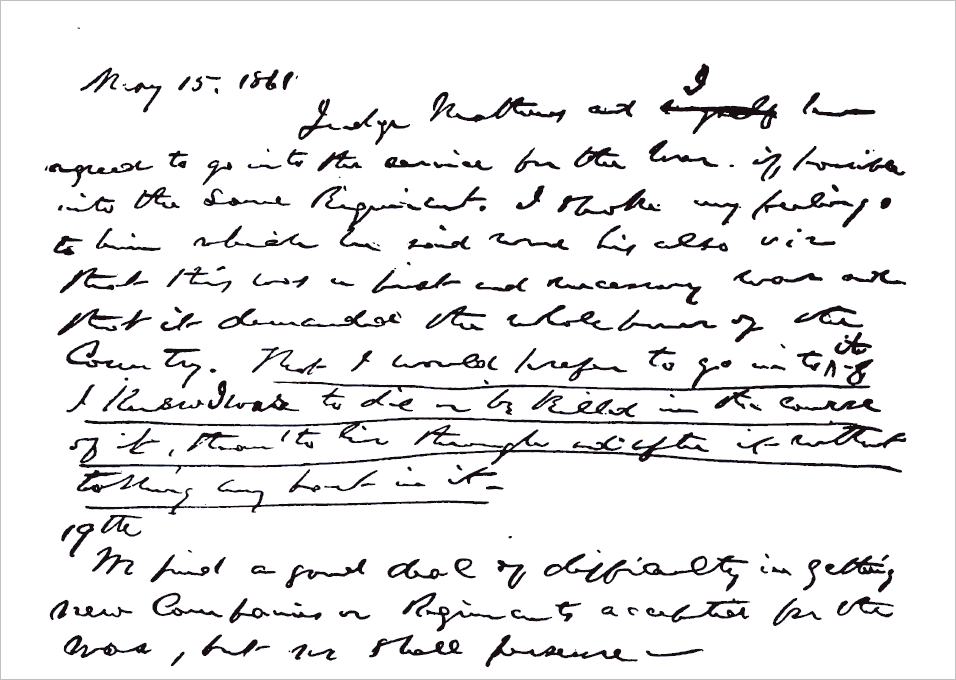
The last diary page of Rutherford B. Hayes before he entered the Union Army for the War.

May 15, 1861.—Judge Matthews and I have agreed to go into the service for the war,—if possible into the same regiment. I spoke my feelings to him, which he said were his also, viz., that this was a just and necessary war and that it demanded the whole power of the country; that I would prefer to go into it if I knew I was to die or be killed in the course of it, than to live through and after it without taking any part in it.

MAY 15, 1861.

Colonel Blenker And Gentlemen Of  The First Regiment Of Rifles,— I have the honor to present this stand of colors to your regiment. It is the flag which for three-quarters of a century has been hailed in every quarter of the inhabited globe as the emblem of Constitutional liberty, and the beacon of hope to the oppressed of all nations.

In rushing with generous ardor to the rescue of our flag, you have given to your fellow-citizens a most gratifying proof of the patriotism and the devotion of our German population to the land of their adoption and choice. A large number of you have fled from oppression and tyranny in the Old World, after having in vain shed your blood for the liberties of your country on many a hardfought battle-field in Hungary and Germany.

You have found on these hospitable shores protection, freedom, and loving hearts, and in offering now the sacrifice of your lives on the altar of your adopted country you pay a debt of gratitude for the blessings vouchsafed to you under our liberal institutions.

Our most fervent prayers follow you to the path of duty and honor which you have chosen. May the Almighty, who has thus far showered His choicest blessings upon our cherished Union, protect her brave defenders. May He watch over you in the hour of danger, and may He grant you to return in safety to your homes and firesides after every star in this bright constellation shall have been restored, to abide with its sisters in union and peace to the end of time.

From Mother.

May 15, 1861.

My dear Eliza: Thank you and Joe for your letters received this morning. I was hoping to see you here today, and on reading these letters telling of Joe’s sudden departure, and thinking of you as all alone at your house, I at once concluded to go up, Charley and I, by the three o’clock train. I was all packed up to start when your telegram was brought in. I felt relieved to get it, because I was going off in a little uncertainty as to whether we might not possibly pass you on the road, on your way to us. I hope you will come, and Joe too, if he can. He must now I suppose obey orders—a somewhat new position for him! Should the regiment be ordered to Washington, perhaps you might feel like going on there for a while, at least, But remember, my dear child, your home is with us still, for as long as you choose. —Indeed, I think you had better come to us altogether—at any rate we must manage to keep an eye over you, and all of us must look on the bright side and hope for the best. How comforting to fall back at such times to that invisible arm which is ever ready for our support and which, I trust, is leading in all this movement. Charley waits for the letter, and I will only add my tender love to you both. Many thanks to Joe for his letters.

Your loving Mother