Following the American Civil War Sesquicentennial with day by day writings of the time, currently 1863.

July 2011

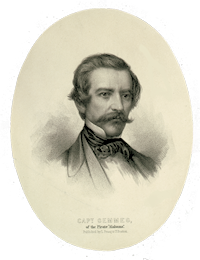
Semmes, Raphael—Advices were received at New York, that the privateer Sumter arrived at Cienfuegos, Cuba, on the 6th of July, carrying in as prizes the brigs Cuba, Machias, Naiad, Albert Adams, Ben Dunning, and the barks West Wind, and Louisa Kilham. She also fell in with the ship Golden Rocket off the Isle of Pines, which was set fire to and burned, after taking off the officers and crew.

Captain Semmes., of the Sumter, sent an officer ashore with a letter to the Governor of the town, who telegraphed to the Captain General at Havana for instructions. The steamer left the next day, having received a supply of coal and water. All the prizes were taken a short distance from the shore.—Philaphia Press, July 15.

—The rebel forces under General Robert S. Garnett, formerly a Major in the United States Army, while retreating from Laurel Hill, Va., to St. George, were overtaken to-day by Gen. Morris, with the Fourteenth Ohio and the Seventh and Ninth Indiana Regiments. When within eight miles of St. George, at a place called Carrick’s Ford, the rebels made a stand, a brisk fight ensued, and they were completely routed and scattered by the troops of General Morris. While General Garnett was attempting to rally his men he was struck through the spine by a rifle ball, and fell dead on the road. The rebels fled up the Horseshoe Valley, Gen. Hill following in hot pursuit. Forty loads of provisions, all their horses, wagons, and guns fell into the hands of the victors.— (Doc. 88.)

—The Third Wisconsin Regiment, commanded by Colonel Hamilton, arrived at Buffalo this afternoon, and, after taking refreshments proceeded to Elmira, where they received arms.— N. Y. World, July 15.

—A report of the results of three reconnoissances made on the Fairfax road, on the Richmond road, and on the Mount Vernon road, all starting from Alexandria, Va., was today made to Col. Miles, commanding the 5th Division of Troops, Department of Northeastern Virginia, by Col. Thomas A. Davies, commanding the 2d Brigade, of the 5th Division. The reconnoissances were all successful.— (Doc. 91.)

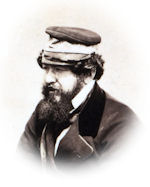
Post image for William Howard Russell’s Diary: The Northern army as reported and as it is.—General M’Clellan.

July 13th.—I have had a long day’s ride through the camps of the various regiments across the Potomac, and at this side of it, which the weather did not render very agreeable to myself or the poor hack that I had hired for the day, till my American Quartermaine gets me a decent mount. I wished to see with my own eyes what is the real condition of the army which the North have sent down to the Potomac, to undertake such a vast task as the conquest of the South. The Northern papers describe it as a magnificent force, complete in all respects, well-disciplined, well-clad, provided with fine artillery, and with every requirement to make it effective for all military operations in the field.

In one word, then, they are grossly and utterly ignorant of what an army is or should be. In the first place, there are not, I should think, 30,000 men of all sorts available for the campaign. The papers estimate it at any number from 50,000 to 100,000, giving the preference to 75,000. In the next place, their artillery is miserably deficient; they have not, I should think, more than five complete batteries, or six batteries, including scratch guns, and these are of different calibres, badly horsed, miserably equipped, and provided with the worst set of gunners and drivers which I, who have seen the Turkish field-guns, ever beheld. They have no cavalry, only a few scarecrow-men, who would dissolve partnership with their steeds at the first serious combined movement, mounted in high saddles, on wretched mouthless screws, and some few regulars from the frontiers, who may be good for Indians, but who would go over like ninepins at a charge from Punjaubee irregulars. Their transport is tolerably good, but inadequate; they have no carriage for reserve ammunition; the commissariat drivers are civilians, under little or no control; the officers are unsoldierly-looking men; the camps are dirty to excess; the men are dressed in all sorts of uniforms; and from what I hear, I doubt if any of these regiments have ever performed a brigade evolution together, or if any of the officers know what it is to deploy a brigade from column into line. They are mostly three months’ men, whose time is nearly up. They were rejoicing to-day over the fact that it was so, and that they had kept the enemy from Washington “without a fight.” And it is with this rabblement that the North propose not only to subdue the South, but according to some of their papers, to humiliate Great Britain, and conquer Canada afterwards.

I am opposed to national boasting, but I do firmly believe that 10,000 British regulars, or 12,000 French, with a proper establishment of artillery and cavalry, would not only entirely repulse this army with the greatest ease, under competent commanders, but that they could attack them and march into Washington over them or with them whenever they pleased. Not that Frenchman or Englishman is perfection, but that the American of this army knows nothing of discipline, and what is more, cares less for it.

Major-General M’Clellan—I beg his pardon for styling him Brigadier—has really been successful. By a very well-conducted and rather rapid march, he was enabled to bring superior forces to bear on some raw levies under General Garnett (who came over with me in the steamer), which fled after a few shots, and were utterly routed, when their gallant commander fell, in an abortive attempt to rally them by the banks of the Cheat river. In this great battle” M’Clellan’s loss is less than 30 killed and wounded, and the Confederates loss is less than 100. But the dispersion of such guerilla bands has the most useful effect among the people of the district; and M’Clellan has done good service, especially as his little victory will lead to the discomfiture of all the Secessionists in the valley of the Keanawha, and in the valley of Western Virginia. I left Washington this afternoon, with the Sanitary Commissioners, for Baltimore, in order to visit the Federal camps at Fortress Monroe, to which we proceeded down the Chesapeake the same night.

SATURDAY 13

A cool rainy day, woolen clothes comfortable. In the office all day as usual, a crowd of soldiers in the office every day. Troops are pushing over the River now rapidly, and a crisis appears to be approaching. We have just been looking at the signal lights at the camps over the river and answered at the Camps back of the City. It is the Calcium light apparently, and very brilliant. Saw the Dress parade of the 27th. Capt Adams came home and took tea with us. I sent the “Lyons boys” a basket of onions this evening to eat with their bacon, they were much pleased with the present. The “boys” are all well.

______

The three diary manuscript volumes, Washington during the Civil War: The Diary of Horatio Nelson Taft, 1861-1865, are available online at The Library of  Congress.

JULY 13TH.—The Secretary made peace yesterday between the general and the colonel, or a duel might have transpired.

To-day the colonel carried into the Secretary a number of applications for commissions as surgeons. Among the applicants were some of the colonel’s friends. He returned soon after in a rage, slamming the door after him, and then throwing down the papers violently on the floor. He picked them up the next moment, however, and sitting down beside me, became instantaneously as gentle as a dove. He said the men of science were thrust aside to give way to quacks; but, laughing, he remarked that the quacks would do well enough for the wounded——. Our men would have too much sense to submit to their malpractice.

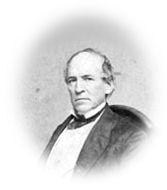
Post image for “Yesterday, as we left the cars, we had a glimpse of war. It was the saddest sight: the memory of it is hard to shake off—sick soldiers, not wounded ones.”— Mary Chesnut’s Diary.”

RICHMOND, Va., July 13, 1861.—Now we feel safe and comfortable. We can not be flanked. Mr. Preston met us at Warrenton. Mr. Chesnut doubtless had too many spies to receive from Washington, galloping in with the exact numbers of the enemy done up in their back hair.

Wade Hampton is here; Doctor Nott also—Nott and Glyddon known to fame. Everybody is here, en route for the army, or staying for the meeting of Congress.

Lamar is out on crutches. His father-in-law, once known only as the humorist Longstreet,¹ author of Georgia Scenes, now a staid Methodist, who has outgrown the follies of his youth, bore him off to-day. They say Judge Longstreet has lost the keen sense of fun that illuminated his life in days of yore. Mrs. Lamar and her daughter were here.

The President met us cordially, but he laughed at our sudden retreat, with baggage lost, etc. He tried to keep us from going; said it was a dangerous experiment. Dare say he knows more about the situation of things than he chooses to tell us.

To-day in the drawing-room, saw a vivandière in the flesh. She was in the uniform of her regiment, but wore Turkish pantaloons. She frisked about in her hat and feathers; did not uncover her head as a man would have done; played the piano; and sang war-songs. She had no drum, but she gave us rataplan. She was followed at every step by a mob of admiring soldiers and boys.

Yesterday, as we left the cars, we had a glimpse of war. It was the saddest sight: the memory of it is hard to shake off—sick soldiers, not wounded ones. There were quite two hundred (they said) lying about as best they might on the platform. Robert Barnwell² was there doing all he could. Their pale, ghastly faces! So here is one of the horrors of war we had not reckoned on. There were many good men and women with Robert Barnwell, rendering all the service possible in the circumstances.

Just now I happened to look up and saw Mr. Chesnut with a smile on his face watching me from the passageway. I flew across the room, and as I got half-way saw Mrs. Davis touch him on the shoulder. She said he was to go at once into Mr. Davis’s room, where General Lee and General Cooper were. After he left us, Mrs. Davis told me General Beauregard had sent Mr. Chesnut here on some army business.

______

¹ Augustus Baldwin Longstreet had great distinction in the South as a lawyer, clergyman, teacher, journalist, and author, and was successively president of five different colleges. His Georgia Scenes, a series of humorous papers, enjoyed great popularity for many years.

² Rev. Robert Barnwell, nephew of Hon. Robert Barnwell, established in Richmond a hospital for South Carolinians.

—John B. Clark, member of the House of Representatives from Missouri, was expelled from that body, having been found in arms against the United States Government, and in active part with the rebels under Governor Jackson, in the late battle of Booneville, Missouri.

—Joseph Holt addressed the citizens of Louisville, Ky., this day. His speech was a triumph for the Government of the Union. He called forth in expressive outbursts the popular consciousness that the Government of the United States, which has so long protected and blessed all its citizens, is now itself in need of protection and blessing from them; and in this hour of its peril calls for, and has the right to call for, the earnest and absolute support of all who still profess allegiance to it. An eminently distinguished Kentuckian, an old and highly honored resident of Louisville, an illustrious patriot, faithful to his country and to his oath amidst untold embarrassments, Joseph Holt was listened to by the vast gathering of his Kentucky friends with the profoundest respect and the most rapturous approval; and the more emphatic and unqualified the orator’s declarations of devotion to the Union and the Government, and the stronger his appeals for Kentucky to do her whole duty and contribute her whole strength to the Administration in its heroic struggle to save the Government and restore the Union, the louder and longer was the universal applause.—National Intelligencer, July 20.—(Doc. 90.)

—General Polk issued a general order from his head-quarters, at Memphis, Tenn., to-day on the occasion of assuming the command of the Mississippi division of the rebel army. He says that “justice will triumph, and an earnest of this triumph is already beheld in the mighty uprising of the whole Southern heart.”— (Doc. 95.)

FRIDAY, JULY 12, 1861.

A pleasant cool day and apparently much enjoyed by all. A great many soldiers moveing, some just coming into the City, some going into camp back of the City, and some marching for Virginia. The Union Regt Col Slocum, Ny Y [sic] 27th Regt Volunteers, came in last night and occupy the camp on Franklin Square. The Lyons Co, Capt A D Adams, is along; the men all look well. Went with Julia to the RI Camp. It was the finest drill and parade I ever saw. Secy of War was there. There were two Regts or about 2200 men.

______

The three diary manuscript volumes, Washington during the Civil War: The Diary of Horatio Nelson Taft, 1861-1865, are available online at The Library of  Congress.

Post image for William Howard Russell’s Diary: Rumours about M’Clellan

July 12th.—There are rumours that the Federals, under Brigadier M’Clellan, who have advanced into Western Virginia, have gained some successes; but so far it seems to have no larger dimensions than the onward raid of one clan against another in the Highlands. And whence do rumours come? From Government departments, which, like so many Danaes in the clerks’ rooms, receive the visits of the auriferous Jupiters of the press, who condense themselves into purveyors of smashes, slings, baskets of champagne, and dinners. M’Clellan is, however, considered a very steady and respectable professional soldier. A friend of his told me to-day one of the most serious complaints the Central Illinois Company had against him was that, during the Italian war, he seemed to forget their business; and that he was busied with maps stretched out on the floor, whereupon he, superincumbent, penned out the points of battle and strategy when he ought to have been attending to passenger trains and traffic. That which was flat blasphemy in a railway office may be amazingly approved in the field.

Post image for Rebel War Clerk’s Diary

JULY 12TH.—The colonel’s temper is as variable as an April day—now all smiles and sunshine, but by-and-by a cloud takes all away. He becomes impatient with a long-winded story, told by some business applicant—and storms whenever any one asks him if the Secretary is in.

To-day, for the first time, I detected a smile on the lip of Col. Myers, the Quartermaster-General, as he passed through the office. A moment after, Gen. Walker, of Georgia, came in, and addressed the colonel thus

“Is the Secretary in?”

Col. (with a stare). I don’t know.

Gen. W. (returning the stare). Could you not ascertain for me? I have important business with him; and am here by appointment.

Col. B. You can ascertain for yourself. I am not his door-keeper. There is his door.

Gen. W. (after a moment’s reflection). I asked you a civil question in a courteous manner, and have not deserved this harshness, and will not submit to it.

Col. B. It is not courteous to presume I am acting in the capacity of a messenger or door-keeper.

Just then the Secretary appeared at the door, having heard the loud language, and Gen. W. immediately entered his office.

Afterward the colonel fumed and fretted like an angry volcano. He disliked Col. Myers, and believed he had sent the general in under prompting to annoy him about the Secretary, whom he (Myers) really hated.

—Last night, after the battle at Rich Mountain, Colonel Pegram, who was in command, withdrew from the fort near Beverly, leaving behind six guns, a largo number of horses,wagons, and camp equipage.—(Doc. 85.)

—J. P. Benjamin, Attorney-General of the Confederate States of America, issued a circular of instruction to Marshals in relation to prisoners of war, and persons captured at sea, as follows:—

1. All persons captured at sea and placed in custody of the Marshals, are at once to be confined in such manner as to prevent their obtaining any information which could be made useful to the enemy.

2. All persons captured on board of vessels (whether armed or unarmed) employed in the public service of the United States, are to be considered as prisoners of war. All persons employed in the service of the enemy, are to be considered as prisoners of war even when captured on unarmed vessels not employed in the public service of the enemy.

Persons captured on private unarmed vessels, and not employed in the public service of the enemy, are not prisoners of war.

3. As soon as the Marshal shall have received into custody persons captured at sea, he shall make out a list of their names, rank, and position, and submit one copy thereof to the judge of the court, and another to the captors or their proctor, for the purpose of designating such as are to be detained as witnesses.

4. After separating those who are to be detained in confinement as witnesses, the Marshal will at once deliver to the commander of the nearest military post all the prisoners of war; and will transport to the frontier and place beyond the limits of the Confederacy all such alien enemies as are not prisoners of war. —Baltimore American, July 22.

—This evening a detachment of three companies of Colonel Woodruffs Second Kentucky Regiment attacked six hundred rebels between Mad River and Barboursville, on the Kanawha River, Western Virginia, completely routing them. Ten or twelve rebels were killed and a number wounded. The Kentuckians had one killed.—(Doc. 85.)

—To-day the ladies of Martinsburg, Virginia, presented to the Second Wisconsin Regiment a beautiful National ensign. Coming as it does from the people of a State which has been declared out of the Union by her constituted authorities, the regiment received the donation with peculiar sensations of pleasure. The flag was presented with the following remarks :

Soldiers of the Wisconsin Regiment:—We have met this bright and beautiful morning to present to you this emblem of our national glory as a token of our high regard for you and our cause; we welcome you into our midst bearing the flag of our glorious country, trusting in God; this flag has protected the oppressed of all lands, who have sought its shelter, and so long as this flag shall wave the oppressed shall be free. Believing from what you have already accomplished, it will never be disgraced in your hands you will accept this token from the ladies of Martinsburg, Berkeley County, Virginia.—Baltimore American, July 23.

—The Senate of the United States passed the bill, which had previously passed the House, to provide for the collection of duties in such ports as are situated within States, or parts of a State refusing obedience to the ordinary revenue laws of the nation.

In such cases it is ordered by this new act that the Surveyors at the several ports shall be subject to all the obligations and provided with all the subordinate officers of Collectors, and that all the general provisions of law regulating trade and commerce shall apply to such ports in the same manner as they do to ports of entry established by the laws now in force.

The President is also authorized to direct that the custom-house for any district in which the collection of the customs in the ordinary way is obstructed, may be established in any secure place within such district, or on shipboard near the coast. Provision is also made for enforcing the regulations of Congress under this head. In cases where these extraordinary means maybe found unavailing for the purpose of protecting the public revenue, the President is authorized, by proclamation, to close such ports of entry; and any ship undertaking to disregard such proclamation is rendered liable to forfeiture.

Another section of the bill directs that all commercial intercourse between other portions of the Union and States, or parts of States, declared to be in insurrection, according to the terms of the act of 1795, shall cease and be unlawful so long as such condition of hostility exists.—National Intelligencer, July 13.

—The Thirty-sixth Regiment N. Y. S. V., commanded by Colonel Charles S. Innes, departed from Riker’s Island, direct for Washington.—N. Y. Times, July 13.

—In the House of Representatives at Washington, Mr. Vallandigham, of Ohio, offered a preamble and resolution, declaring vacant the seats of such members as have accepted commands in the militia of their several States, which occasioned a lively passage of words between various representatives, when the matter was tabled by ninety-two votes to fifty-one.

—Colonel Pegram, the commander of the rebel forces, near Beverly, Virginia, surrendered to General McClellan. This morning he sent a messenger to the Federal camp at Huttonsville, Va., stating that he, with six hundred men, would surrender as prisoners of war. They were nearly starved, and as Gen. Garnett was flying from Laurel Hill, to which point he was flying, he had no chance to escape. Gen. McClellan required an unconditional surrender. To this Col. Pegram was obliged to submit, and, with his whole force, was disarmed and marched into Beverly. Lieut.-Col. Cantwell, with a part of the Ohio Fourth Regiment, received their arms and took them in charge. His army was composed of the flower of Eastern Virginia, and contained among its curiosities a Professor in Hampden Sidney College, with a company of his students. Col. Pegram is a West Point graduate, a brave man, and has only left the United States array within a few months. Gen. Garnett, who is now flying with his whole force of six thousand men, is also a graduate of West Point, and was the commandant there a few years ago.—(Doc. 87.)
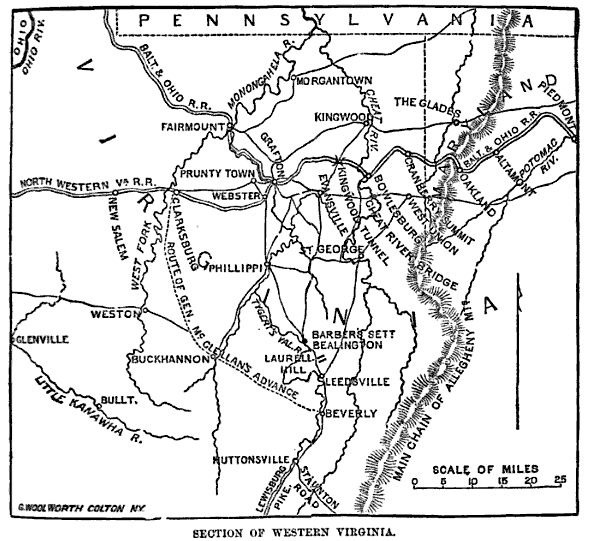
section of West Virginia, July 12, 1861

—The Galveston (Texas) Civilian, of to-day, contains the following:—”The San Antonio Ledger has late advices from New Mexico. Brigadier-General F. B. Stanton has arrived and organized two regiments for Lincoln’s service. The first regiment is commanded by Ceran St. Train, Colonel. The Second Regiment is commanded by Miguel Pino, Colonel, and Manuel Chara, Lieutenant-Colonel. The Fifth and Seventh Regular Infantry have orders to march to the States. So we may look for trouble in New Mexico.”