Following the American Civil War Sesquicentennial with day by day writings of the time, currently 1863.

July 2011

JULY 11TH.—The colonel tried his hand to-day at dictating answers to certain letters. Together we pitched upon the proper replies, which, after being marked with his pencil, I elaborated with the pen. These were first approved by the Secretary, then signed by the Chief of the Bureau, and copied by Mr. Scott.

To-day the colonel essayed a flight with his own plumage. I followed his dictation substantially in the answers. But the moment the Secretary’s eyes rested upon them, they were promptly reversed. The Secretary himself, suspecting how it was, indeed he saw the colonel’s pencil marks, brought them to me, while a humorous smile played upon his usually not very expressive lip. When the colonel came in, and beheld what had been done, he groaned, and requested me to write the proper answers. From that day he ceased to have anything more to do with the correspondence than to sign his name to the letters I prepared for him. He remarked to-day that if he was to have nothing to do, he would do nothing.

THURSDAY 11

This has been a cool delightful day with a little rain just before night, just enough to again prevent our proposed visit to the R.I. Camp. I went out and saw the Regt of Col Small parade, it is from Penn. More Removals in the Office today, one Examr (Reed)[?] and three or four Clerks. Rumors of fighting West and also of the Retreat of the Rebels from Fairfax Court House. We shall know tomorrow. More troops come every day, and go into camp back of us.

______

The three diary manuscript volumes, Washington during the Civil War: The Diary of Horatio Nelson Taft, 1861-1865, are available online at The Library of  Congress.

CAMP CHASE, July 11, 1861.

DEAR UNCLE:—I am now almost at home. Lucy is at Platt’s with Birch and Webb. Dr. Joe came yesterday bringing Webb with him. We shall have the boys out here a good deal. It is a good place for them. Birch was infinitely disgusted to meet me without my uniform on.

I have my horse here and ride him all about the camp and parade ground. Although young, he is sensible to the last. I shall probably not need Ned, Jr. A horse must canter or lope well to be of any account in a camp. The colonel and Matthews have both been disappointed in theirs. Matthews sent his back home yesterday. My sorrel cost one hundred dollars. He is called the cheapest and one of the best horses in camp. . . .

Sincerely,

R. B. HAYES.

S. BIRCHARD.

As soon as possible we called on Miss Dorothea Dix, who had, by a general order, been recognized in the following words:

“Be it known to all whom it may concern that the free services of Miss D. L. Dix are accepted by the War Department, and that she will give at all times all necessary aid in organizing military hospitals and by supplying nurses; and she is authorized to receive and disburse supplies from individuals or associations, etc., etc.

Given under the seal of the War Department, April 23, 1861. (Signed.)

Simon Cameron, Secretary.

——

Georgeanna writes:

Miss Dix received us kindly and gave us a good deal of information about the hospitals, and this morning we went out to the Georgetown Hospital to see for ourselves. We were delighted with all the arrangements. Everything was clean and comfortable. We shall go again and take papers and magazines.

Post image for William Howard Russell’s Diary: Newspaper criticism on Lord Lyons.

July 11th.—The diplomatic circle is so totus teres atque rotundus, that few particles of dirt stick on its periphery from the road over which it travels. The radii are worked from different centres, often far apart, and the tires and naves often fly out in wide divergence; but for all social purposes is a circle, and a very pleasant one. When one sees M. de Stoeckle speaking to M. Mercier, or joining in with Baron Gerolt and M. de Lisboa, it is safer to infer that a little social re-union is at hand for a pleasant civilised discussion of ordinary topics, some music, a rubber, and a dinner, than to resolve with the New York Correspondent, “that there is reason to believe that a diplomatic movement of no ordinary significance is on foot, and that the ministers of Russia, France, and Prussia have concerted a plan of action with the representative of Brazil, which must lead to extraordinary complications, in view of the temporary embarrassments which distract our beloved country. The Minister of England has held aloof from these reunions for a sinister purpose no doubt, and we have not failed to discover that the emissary of Austria, and the representative of Guatemala have abstained from taking part in these significant demonstrations. We tell the haughty nobleman who represents Queen Victoria, on whose son we so lately lavished the most liberal manifestations of our good will, to beware. The motives of the Court of Vienna, and of the republic of Guatemala, in ordering their representatives not to join in the reunion which we observed at three o’clock to-day, at the corner of Seventeenth Street and One, are perfectly transparent; but we call on Mr. Seward instantly to demand of Lord Lyons a full and ample explanation of his conduct on the occasion, or the transmission of his papers. There is no harm in adding, that we have every reason to think our good ally of Russia, and the minister of the astute monarch, who is only watching an opportunity of leading a Franco-American army to the Tower of London and Dublin Castle, have already moved their respective Governments to act in the premises.”

That paragraph, with a good heading, would sell several thousands of the “New York Stabber” tomorrow.

Post image for Mary Chesnut’s Diary.—”Mary Hammy saw lights glancing about among the trees, and we all heard guns. So we sat up. “

July 11th.—We did hear cannon to-day. The woman who slandered Mrs. Davis’s republican court, of which we are honorable members, by saying they—well, were not young; that they wore gaudy colors, and dressed badly—I took an inventory to-day as to her charms. She is darkly, deeply, beautifully freckled; she wears a wig which is kept in place by a tiara of mock jewels; she has the fattest of arms and wears black bead bracelets.

The one who is under a cloud, shadowed as a Yankee spy, has confirmed our worst suspicions. She exhibited unholy joy, as she reported seven hundred sick soldiers in the hospital at Culpeper, and that Beauregard had sent a flag of truce to Washington.

What a night we had! Maria had seen suspicious persons hovering about all day, and Mrs. Preston a ladder which could easily be placed so as to reach our rooms. Mary Hammy saw lights glancing about among the trees, and we all heard guns. So we sat up. Consequently, I am writing in bed to-day. A letter from my husband saying, in particular: “Our orders are to move on,” the date, July 10th. “Here we are still and no more prospect of movement now than when I last wrote to you. It is true, however, that the enemy is advancing slowly in our front, and we are preparing to receive him. He comes in great force, being more than three times our number.”

The spy, so-called, gave us a parting shot: said Beauregard had arrested her brother in order that he might take a fine horse which the aforesaid brother was riding. Why? Beauregard, at a moment’s notice, could have any horse in South Carolina, or Louisiana, for that matter. This man was arrested and sent to Richmond, and “will be acquitted as they always are,” said Brewster. “They send them first to Richmond to see and hear everything there; then they acquit them, and send them out of the country by way of Norfolk to see everything there. But, after all, what does it matter? They have no need for spies: our newspapers keep no secrets hid. The thoughts of our hearts are all revealed. Everything with us is open and aboveboard.

“At Bethel the Yankees fired too high. Every daily paper is jeering them about it yet. They’ll fire low enough next time, but no newspaper man will be there to get the benefit of their improved practise, alas!”

—Alexander H. Stephens delivered an elaborate speech at Augusta, Georgia, defending the cause of secession and pointing out the way to the success of the southern rebellion.— (Doc. 83.)

—This morning a young man presented himself at the quarters of one of the Pennsylvania Regiments, near Shuter’s Hill, opposite Washington, dressed in a suit of blue navy flannel, surmounted with a lieutenant’s epaulettes, and introduced himself as “Lieut. Smith of Company A, 6th Massachusetts Regiment.” Not being suspected at the time, he was allowed to inspect the works at Fort Ellsworth, and to witness the departure of the Zouaves toward Fairfax. Not until he had safely returned to Washington and been carried by the cars some miles on the road to Baltimore, was it discovered that a secessionist had been in camp.—N. Y. Tribune, July 13.

—The companies sent to the relief of Col. Smith, at Monroe, Missouri, returned to Hannibal this evening, and report the road unobstructed between Hannibal and Monroe. On arriving at the latter place, they formed a junction with Col. Smith’s force, which was intrenched in the Academy buildings. The rebels, 1,200 strong, were grouped over the prairie, out of reach of Col. Smith’s rifles. They had two pieces of artillery, which were brought to bear, but the distance was so great that the balls were almost spent before reaching the lines. Col. Smith’s artillery was of longer range, and did considerable execution. The fight lasted until dusk, and the last shot from the Federal side dismounted one of the rebels’ guns. Just at that moment Governor Wood, of Illinois, fell on their rear with the cavalry sent from Quincy and completely routed them, taking seventy-five prisoners, one gun, and a large number of horses. About twenty or thirty rebels were killed. Not one of the Unionists was killed, although several were severely wounded. General Tom Harris, the rebel leader, escaped.—Chicago Tribune, July 12.

—The New-Orleans Delta, of this day, says that further persistence of the Confederate States in the endeavor to obtain the recognition of our nationality is useless. It also says that the British Ministry have not the courage nor the inclination to apply to the Confederate States the rules which they have uniformly applied to other nations. It adds: “Too much importance has been assigned to the idea that France and England would break the blockade to get Southern products.” The editor, therefore, proposes a recall of the Southern Commissioners, and to refuse the recognition of resident Consuls of all the Powers which will not recognize similar officers of the Confederate States abroad.

—The rebels at New Orleans, La., have taken a powerful tug-boat, covered her with railroad iron, and put her machinery below the waterline. They have also built a new boat completely of iron, very sharp, with a sharp point below the waterline, intended to run down the Federal vessels of war. The latter will be commanded by Capt. Seward Porter, formerly of Portland, Maine.—National Intelligencer, July 16.

—The Charleston Mercury of this day publishes the following:—The Sixteenth Regiment S. C. M., comprising eight beat companies, were on the Green yesterday for inspection (?). A more ridiculous farce could not possibly have been enacted than that gone through with yesterday—that is, if regarded in a military point of view. If six hundred citizens, drawn up in two ranks, without arms or equipments, ununiformed, and ignorant of the first principles of a soldier’s duty, can be called a regiment, this was a regiment.

We forego further comment, only remarking, that what is a farce now, to be enjoyed by idle juveniles, may be at no distant day a tragedy over which the State will mourn.

—At St. Louis, Mo., about 400 men belonging to Col. McNeil’s regiment, a reserve corps, visited the State Journal office early this morning, removing the type, paper, etc. They then read an order from Gen. Lyon prohibiting the further publication of that sheet.

Col. McNeil published a proclamation to the people of Missouri, stating that the suppression of the State Journal was in consequence of its giving aid and comfort to those in active rebellion against the authority of the United States Government, encouraging the people to take up arms against that authority, to commit acts of violence and oppression against loyal citizens, and by the fabrication of false reports respecting the United States troops, inciting disaffected citizens to the commission of overt acts of treason, with a view of entirely subverting the Federal authority in the State.—N. Y. World, July 16.

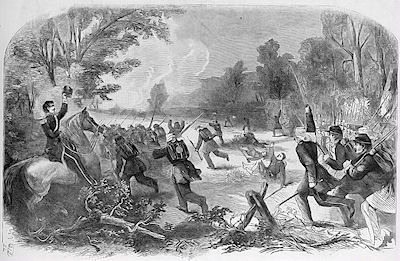
—A Battle was fought this afternoon at Rich Mountain,1 about two miles east of Roaring Run, Va. where the rebels, numbering about two thousand, under command of Col. Pegram, were strongly intrenched.
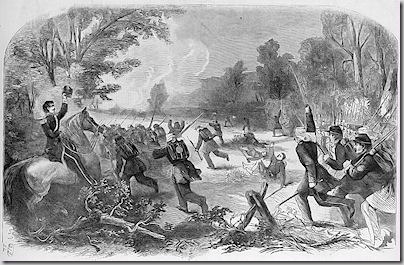
Battle_of_Rich_MountainAbout 3 o’clock this morning Gen. McClellan ordered four regiments—the Eighth, Tenth, Thirteenth Indiana, and Nineteenth Ohio Regiments, under the command of Gen. Rosecrans —to proceed along the line of the hills southeast of the enemy’s intrenched camp on the Beverly road, where it crosses Rich Mountain, two miles east of the enemy’s position, with orders to advance along the Beverly road and attack the east side of the work—Gen. McClellan being prepared to assault the west side as soon as the firing should announce the commencement of the attack. The capture of a courier, who mistook the road through the enemy’s camp for the route of the Federal troops, placed the enemy in possession of intelligence of the movement.

The rebels, about 2,500 strong, with heavy earthwork batteries, were intrenched on the western slopes of the Rich Mountain, about twenty-five miles east from Buckhannon, and two miles west from Beverly, which is on the east side of the mountain. They had selected the forks of the Roaring Creek, which empties after a northerly course into the Tygart’s Valley River, a branch of the Monongahela. The creek crosses the road in two places, about a mile apart.

The morning was cool and bracing, and the Federal troops were in capital spirits. Gen. Rosecrans ordered the brigade to cut a path through a thick growth of mountain pine trees and heavy undergrowth of brush for nearly nine miles, which occupied about ten hours, resting at noon.

Late in the afternoon Gen. Rosecrans came on the rear of the rebels, and, after a desperate fight of an hour and a half, completely routed them, driving them in the utmost disorder into the woods, and capturing all their guns, wagons, and camp equipage, or, as Gen. McClellan says, “all they had.” They also took several prisoners, many officers among them. Sixty of the rebels were killed and a large number wounded. Of the Union troops twenty were killed and forty wounded. Gen. McClellan had his guns mounted to command the rebels’ position, but he found that the gallantry of Rosecrans spared him the trouble of going into action. He is now moving on Beverly, and the advance command of Gen. Rosecrans are within three miles of that place.—(Doc. 84.)

_____

1 Rich Mountain is a gap in the Laurel Hill Range where the Staunton and Weston turnpike crosses it between Buckhannon and Beverly, and about four or miles out of the latter place. It is about as far from Laurel Hill proper, (that is, where the Beverly and Fairmount pike crosses it, and where the enemy is intrenched,) as Beverly is: some 15 or 16 miles. It is also about 25 miles  from Buckhannon.— Wheeling Intelligencer.
Post image for William Howard Russell’s Diary: Silencing the Press and Telegraph.—A Loan Bill.—Interview with Mr. Cameron.

July 10th.—To-day was spent in a lengthy excursion along the front of the camp in Virginia, round by the chain bridge which crosses the Potomac about four miles from Washington.

The Government have been coerced, as they say, by the safety of the Republic, to destroy the liberty of the press, which is guaranteed by the Constitution, and this is not the first instance in which the Constitution of the United States will be made nominis umbra. The telegraph, according to General Scott’s order, confirmed by the Minister of War, Simon Cameron, is to convey no despatches respecting military movements not permitted by the General; and today the newspaper correspondents have agreed to yield obedience to the order, reserving to themselves a certain freedom of detail in writing their despatches, and relying on the Government to publish the official accounts of all battles very speedily. They will break this agreement if they can, and the Government will not observe their part of the bargain. The freedom of the press, as I take it, does not include the right to publish news hostile to the cause of the country in which it is published; neither can it involve any obligation, on the part of Government to publish despatches which may be injurious to the party they represent. There is a wide distinction between the publication of news which is known to the enemy as soon as to the friends of the transmitters, and the utmost freedom of expression concerning the acts of the Government or the conduct of past events; but it will be difficult to establish any rule to limit or extend the boundaries to which discussion can go without mischief, and in effect the only solution of the difficulty in a free country seems to be to grant the press free licence, in consideration of the enormous aid it affords in warning the people of their danger, in animating them with the news of their successes, and in sustaining the Government in their efforts to conduct the war.

The most important event to-day is the passage of the Loan Bill, which authorises Mr. Chase to borrow, in the next year, a sum of £50,000,000, on coupons, with interest at 7 per cent, and irredeemable for twenty years—the interest being guaranteed on a pledge of the Customs duties. I just got into the House in time to hear Mr. Vallandigham, who is an ultra-democrat, and very nearly a secessionist, conclude a well-delivered argumentative address. He is a tall, slight man, of a bilious temperament, with light flashing eyes, dark hair and complexion, and considerable oratorical power. “Deem me ef I wouldn’t just ride that Vallandiggaim on a reay-al,” quoth a citizen to his friend, as the speaker sat down, amid a few feeble expressions of assent. Mr. Chase has also obtained the consent of the Lower House to his bill for closing the Southern ports by the decree of the President, but I hear some more substantial measures are in contemplation for that purpose. Whilst the House is finding the money the Government are preparing to spend it, and they have obtained the approval of the Senate to the enrolment of half a million of men, and the expenditure of one hundred millions of dollars to carry on the war.

I called on Mr. Cameron, the Secretary of War. The small brick house of two stories, with long passages, in which the American Mars prepares his bolts, was, no doubt, large enough for the 20,000 men who constituted the armed force on land of the great Republic, but it is not sufficient to contain a tithe of the contractors who haunt its precincts, fill all the lobbies and crowd into every room. With some risk to coattails, I squeezed through iron-masters, gun-makers, clothiers, shoemakers, inventors, bakers, and all that, genus which fattens on the desolation caused by an army in the field, and was introduced to Mr. Cameron’s room, where he was seated at a desk surrounded by people, who were also grouped round two gentlemen as clerks in the same small room. “I tell you, General Cameron, that the way in which the loyal men of Missouri have been treated is a disgrace to this Government,” shouted out a big, black, burly man—” I tell you so, sir.” “Well, General,” responded Mr. Cameron, quietly, “so you have several times. Will you, once for all, condescend to particulars?” “Yes, sir; you and the Government have disregarded our appeals. You have left us to fight our own battles. You have not sent us a cent…” “There, General, I interrupt you. You say we have sent you no money,” said Mr. Cameron, very quietly. “Mr. Jones will be good enough to ask Mr. Smith to step in here.” Before Mr. Smith came in, however, the General, possibly thinking some member of the press was present, rolled his eyes in a Nicotian frenzy, and perorated: “The people of the State of Missouri, sir, will power-out every drop of the blood which only flows to warm patriotic hearts in defence of the great Union, which offers freedom to the enslaved of mankind, and a home to persecuted progress, and a few-ture to civil-zation. We demand, General Cameron, in the neame of the great Western State …” Here Mr. Smith came in, and Mr. Cameron said, “I want you to tell me what disbursements, if any, have been sent by this department to the State of Missouri.” Mr. Smith was quick at figures, and up in his accounts, for he drew out a little memorandum book, and replied (of course, I can’t tell the exact sum), ” General, there has been sent, as by vouchers, to Missouri, since the beginning of the levies, six hundred and seventy thousand dollars and twenty-three cents.” “The General looked crestfallen, but he was equal to the occasion, “These sums may have been sent, sir, but they have not been received. I declare in the face of …” “Mr. Smith will show you the vouchers, General, and you can then take any steps needful against the parties who have misappropriated them.”

“That is only a small specimen of what we have to go through with our people,” said the Minister, as the General went off with a lofty toss of his head, and then gave me a pleasant sketch of the nature of the applications and interviews which take up the time and clog the movements of an American statesman. “These State organisations give us a great deal of trouble.” I could fully understand that they did so. The immediate business that I had with Mr. Cameron—he is rarely called General now that he is Minister of War— was to ask him to give me authority to draw rations at cost price, in case the army took the field before I could make arrangements, and he seemed very well disposed to accede; “but I must think about it, for I shall have all our papers down upon me if I grant you any facility which they do not get themselves.” After I left the War Department, I took a walk to Mr. Seward’s, who was out. In passing by President’s Square, I saw a respectably-dressed man up in one of the trees, cutting off pieces of the bark, which his friends beneath caught up eagerly. I could not help stopping to ask what was the object of the proceeding. “Why, sir, this is the tree Dan Sickles shot Mr. ____ under. I think it’s quite a remarkable spot.”

WEDNESDAY 10

This has been a fine day but rather hot for the marching troops. Some Regts have gone over the River and some have arrived from the North. A move towards the rebels is now makeing, and a battle or a race is now impending. My impression is the Rebels will run. Myself and Julia had intended to go over to the RI Camp, but there came on another rain (a copious one) and prevented us. There has been nothing like a “dry time” yet this season. Staid in the House reading &c.

______

The three diary manuscript volumes, Washington during the Civil War: The Diary of Horatio Nelson Taft, 1861-1865, are available online at The Library of  Congress.

JULY 10TH.—There are indications of military operations on a large scale on the Potomac. We have intelligence that McDowell is making preparations to advance against our forces at Manassas. Gen. Johnston is expected to be there in time; and for that purpose is manœuvring Gen. Patterson out of the way. Our men have caps now—and will be found in readiness. They have short-commons under the Commissary Department; but even with empty stomachs, they can beat the Yankees at the ordeal of dying. Fighting is a sport our men always have an appetite for.