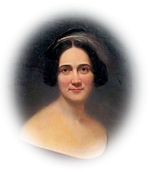
March 10th.—Mrs. Childs was here to-night (Mary Anderson, from Statesburg), with several children. She is lovely. Her hair is piled up on the top of her head oddly. Fashions from France still creep into Texas across Mexican borders. Mrs. Childs is fresh from Texas. Her husband is an artillery officer, or was. They will be glad to promote him here. Mrs. Childs had the sweetest Southern voice, absolute music. But then, she has all of the high spirit of those sweet-voiced Carolina women, too.
Then Mr. Browne came in with his fine English accent, so pleasant to the ear. He tells us that Washington society is not reconciled to the Yankee régime. Mrs. Lincoln means to economize. She at once informed the major-domo that they were poor and hoped to save twelve thousand dollars every year from their salary of twenty thousand. Mr. Browne said Mr. Buchanan’s farewell was far more imposing than Lincoln’s inauguration.
The people were so amusing, so full of Western stories.
Dr. Boykin behaved strangely. All day he had been gaily driving about with us, and never was man in finer spirits. To-night, in this brilliant company, he sat dead still as if in a trance. Once, he waked somewhat—when a high public functionary came in with a present for me, a miniature gondola, “A perfect Venetian specimen,” he assured me again and again. In an undertone Dr. Boykin muttered: “That fellow has been drinking.” “Why do you think so?” “Because he has told you exactly the same thing four times.” Wonderful! Some of these great statesmen always tell me the same thing—and have been telling me the same thing ever since we came here.
A man came in and some one said in an undertone, “The age of chivalry is not past, O ye Americans!” “What do you mean?” “That man was once nominated by President Buchanan for a foreign mission, but some Senator stood up and read a paper printed by this man abusive of a woman, and signed by his name in full. After that the Senate would have none of him; his chance was gone forever.”
SUNDAY 10
Rather a cold day but no frost, a cold wind. Went to Trinity Ch (Dr Butlers.) this morning with my old friend S Patrick. Bro C R, Maj Sol [Bulkley?] & Juliet also there. In afternoon, all went to Dr Smiths ch, heard a Mr Fish from Paris (France). He is trying to raise funds for the Protestant cause in France. He did not speak very good English but was still very interesting and could be easily understood by close attention. Was in at Willards with Bro in the Evening. Wife has been writing to Hariet Brownson. C R & self talking of Wmstown Characters.

______
The three diary manuscript volumes, Washington during the Civil War: The Diary of Horatio Nelson Taft, 1861-1865, are available online at The Library of Congress.
March 10, 1861.—The excitement in this house has risen to fever heat during the past week. The four gentlemen have each a different plan for saving the country, and now that the bridal bouquets have faded, the three ladies have again turned to public affairs; Lincoln’s inauguration and the story of the disguise in which he traveled to Washington is a never-ending source of gossip. The family board being the common forum, each gentleman as he appears first unloads his pockets of papers from all the Southern States, and then his overflowing heart to his eager female listeners, who in turn relate, inquire, sympathize, or cheer. If I dare express a doubt that the path to victory will be a flowery one, eyes flash, cheeks burn, and tongues clatter, till all are checked up suddenly by a warning rap for “Order, order!” from the amiable lady presiding. Thus we swallow politics with every meal. We take a mouthful and read a telegram, one eye on table, the other on the paper. One must be made of cool stuff to keep calm and collected. I say but little. There is one great comfort; this war fever has banished small talk. The black servants move about quietly, never seeming to notice that this is all about them.
“How can you speak so plainly before them?” I say.
“Why, what matter? They know that we shall keep the whip-handle.”

______
Note: To protect Mrs. Miller’s job as a teacher in New Orleans, the diary was published anonymously, edited by G. W. Cable, names were changed and initials were often used instead of full names — and even the initials differed from the real person’s initials.