Following the American Civil War Sesquicentennial with day by day writings of the time, currently 1863.

Friday, March 25, 2011

March 25th.—I had an invitation to meet several members of the New York press association at breakfast. Among the company were—Mr. Bayard Taylor, with whose extensive notes of travel his countrymen are familiar — a kind of enlarged Inglis, full of the genial spirit which makes travelling in company so agreeable, but he has come back as travellers generally do, satisfied there is no country like his own—Prince Leeboo loved his own isle the best after all—Mr. Raymond, of the “New York Times” (formerly Lieutenant-Governor of the State); Mr. Olmsted, the indefatigable, able, and earnest writer, whom to describe simply as an Abolitionist would be to confound with ignorant if zealous, unphilosophical, and impracticable men; Mr. Dana, of the “Tribune;” Mr. Hurlbert, of the “Times;” the Editor of the “Courier des Etats Unis;” Mr. Young, of the “Albion,” which is the only English journal published in the States; and others. There was a good deal of pleasant conversation, though every one differed with his neighbor, as a matter of course, as soon as he touched on politics. There was talk de omnibus rebus et quibusdam aliis, such as Heenan and Sayers, Secession and Sumter, the press, politicians, New York life, and so on. The first topic occupied a larger place than it was entitled to, because in all likelihood the sporting editor of one of the papers who was present expressed, perhaps, some justifiable feeling in reference to the refusal of the belt to the American. All admitted the courage and great endurance of his antagonist, but seemed convinced that Heenan, if not the better man, was at least the victor in that particular contest. It would be strange to see the great tendency of Americans to institute comparisons with ancient and recognized standards, if it were not that they are adopting the natural mode of judging of their own capabilities. The nation is like a growing lad who is constantly testing his powers in competition with his elders. He is in his youth and nonage, and he is calling down the lanes and alleys to all comers to look at his muscle, to run against or to fight him. It is a sign of youth, not a proof of weakness, though it does offend the old hands and vex the veterans.

Then one finds that Great Britain is often treated very much as an old Peninsula man may be by a set of young soldiers at a club. He is no doubt a very gallant fellow, and has done very fine things in his day, and he is listened to with respectful endurance, but there is a secret belief that he will never do anything very great again.

One of the gentlemen present said that England might dispute the right of the United States Government to blockade the ports of her own States, to which she was entitled to access under treaty, and might urge that such a blockade was not justifiable; but then, it was argued, that the President could open and shut ports as he pleased; and that he might close the Southern ports by a proclamation in the nature of an Order of Council. It was taken for granted that Great Britain would only act on sordid motives, but that the well known affection of France for the United States is to check the selfishness of her rival, and prevent a speedy recognition.

After our pleasant breakfast came that necessity for activity which makes such meals disguised as mere light morning repasts take their revenge. I had to pack up, and I am bound to say the moral aid afforded me by the waiter, who stood with a sympathizing expression of face, and looked on as I wrestled with boots, books, and great coats, was of a most comprehensive character. At last I conquered, and at six o’clock p.m. I left the Clarendon, and was conveyed over the roughest and most execrable pavements through several miles of unsympathetic, gloomy, dirty streets, and crowded thoroughfares, over jaw-wrenching street-railway tracks, to a large wooden shed covered with inscriptions respecting routes and destinations on the bank of the river, which as far as the eye could see, was bordered by similar establishments, where my baggage was deposited in the mud. There were no porters, none of the recognized and established aides to locomotion to which we are accustomed in Europe, but a number of amateurs divided the spoil, and carried it into the offices, whilst I was directed to struggle for my ticket in another little wooden box, from which I presently received the necessary document, full of the dreadful warnings and conditions, which railway companies inflict on the public in all free countries.

The whole of my luggage, except a large bag, was taken charge of by a man at the New York side of the ferry, who “checked it through” to the capital—giving me a slip of brass with a number corresponding with a brass ticket for each piece. When the boat arrived at the stage at the other side of the Hudson, in my innocence I called for a porter to take my bag. The passengers were moving out of the capacious ferry-boat in a steady stream, and the steam throat and bell of the engine were going whilst I was looking for my porter; but at last a gentleman passing, said, “I guess y’ill remain here a considerable time before y’ill get any one to come for that bag of yours;” and taking the hint, I just got off in time to stumble into a long box on wheels, with a double row of most uncomfortable seats, and a passage down the middle, where I found a place beside Mr. Sanford, the newly-appointed United States Minister to Belgium, who was kind enough to take me under his charge to Washington.

The night was closing in very fast as the train started, but such glimpses as I had of the continuous line of pretty-looking villages of wooden houses, two stories high, painted white, each with its Corinthian portico, gave a most favorable impression of the comfort and prosperity of the people. The rail passed through the main street of most of these hamlets and villages, and the bell of the engine was tolled to warn the inhabitants, who drew up on the side walks, and let us go by. Soon the white houses faded away into faint blurred marks on the black ground of the landscape, or twinkled with starlike lights, and there was nothing more to see. The passengers were crowded as close as they could pack, and as there was an immense iron stove in the centre of the car, the heat and stuffiness became most trying, although I had been undergoing the ordeal of the stove-heated New York houses for nearly a week. Once a minute, at least, the door at either end of the carriage was opened, and then closed with a sharp crashing noise, that jarred the nerves, and effectually prevented sleep. It generally was done by a man whose sole object seemed to be to walk up the centre of the carriage in order to go out of the opposite door —occasionally it was the work of the newspaper boy, with a sheaf of journals and trashy illustrated papers under his arm. Now and then it was the conductor; but the periodical visitor was a young gentleman with a chain and rings, who bore a tray before him, and solicited orders for “gum drops,” and “lemon drops,” which, with tobacco, apples, and cakes, were consumed in great quantities by the passengers.

At 10 o’clock, P.M., we crossed the river by a ferry boat to Philadelphia, and drove through the streets, stopping for supper a few moments at the La Pierre Hotel. To judge from the vast extent of the streets, of small, low, yet snug-looking houses, through which we passed, Philadelphia must contain in comfort the largest number of small householders of any city in the world. At the other terminus of the rail, to which we drove in a carriage, we procured for a small sum, a dollar I think, berths in a sleeping car, an American institution of considerable merit. Unfortunately a party of prizefighters had a mind to make themselves comfortable, and the result was anything but conducive to sleep. They had plenty of whiskey, and were full of song and fight, nor was it possible to escape their urgent solicitations “to take a drink,” by feigning the soundest sleep. One of these, a big man, with a broken nose, a mellow eye, and a very large display of rings, jewels, chains and pins, was in very high spirits, and informed us he was “Going to Washington to get a foreign mission from Bill Seward. He wouldn’t take Paris, as he didn’t care much about French or Frenchmen; but he’d just like to show John Bull how to do it; or he’d take Japan if they were very pressing.” Another told us he was “Going to the bosom of Uncle Abe” (meaning the President)—”that he knew him well in Kentucky years ago, and a high toned gentleman he was.” Any attempts to persuade them to retire to rest made by the conductors were treated with sovereign contempt, but at last whiskey asserted its supremacy, and having established the point that they “would not sleep unless they pleased,” they slept and snored.
MONDAY 25

This has been a delightful day, bright & warm. Have been very busy in the office, doing the work of two Desks or the Clerical duties of the room in addition to my own from the removal of our assist. Went down to the “National.” Saw Carl Shurz the famous Dutch Orator. And also met my old friend P Dorsheimer who is now State Treasurer of NY. He is after the N York Naval office. Got the NY papers & read them. Bed at 11.

______

The three diary manuscript volumes, Washington during the Civil War: The Diary of Horatio Nelson Taft, 1861-1865, are available online at The Library of  Congress.

FORT SUMTER, S.C., March 25, 1861.
(Received A. G. O., March 28.)

Col. L. THOMAS, Adjutant-General U. S A.:

COLONEL: I have the honor to report that everything is quiet around us, and that we do not see any work being prosecuted except that at the new battery at Fort Johnson. They are practicing this morning with shells from the columbiads at Fort Moultrie and from a mortar battery between Nos. 9 and 10.

I inclose herewith a report of the condition of our fort. It will be seen that a great deal of work has been done since we came in. We are now about finishing the closing of the openings in the gorge–a measure first suggested by Captain Doubleday.

I have not noted the different operations we have been engaged in from time to time, as I did not deem them of sufficient importance to require it.

I am, colonel, very respectfully, your obedient servant,

ROBERT ANDERSON,

Major, First Artillery, Commanding.

[Inclosure.]

FORT SUMTER, S.C., March 24, 1861.

Maj. ROBERT ANDERSON, First Artillery, Commanding:

SIR: In accordance with verbal instructions given by you, we have the honor to submit the following report upon the condition of Fort Sumter when occupied December 26, 1860, the measures taken to put it in a state of defense, and its present condition:

Condition of the work December 26, 1860.

The barbette tier was ready for its armament: Three 24-pounders were mounted at the left and three more were ready to be mounted at the right gorge angle.

Fort Sumter, Charleston Harbor, March 25, 1861

The second tier of arches was not ready for its guns. The embrasures were not yet placed, and forty-one openings, eight feet square, were left in the scarp wall for this purpose. Those on the flanks (20) were closed only with a sheathing of 1-inch boards; the remainder, on the faces (21), were either entirely open or closed with three courses of brick dry-laid, or, as on the left face, With two courses laid in mortar; some few were only half closed. One 32-pounder was mounted, for experimental purposes, on the right flank.

First tier.–Eleven 32-pounders were mounted on the left face. Guns could be mounted throughout. The forty-one embrasures were closed with the ordinary 6-inch wooden shutters, secured with a wooden brace and rope lashing. Two small posterns in the gorge angles were closed, each with two doors, the outer hooked, the inner barred. The soldiers’ quarters were unfinished, and as those portions that were tenable were occupied by workmen, the transferred garrison was placed in the officers’ quarters, which were completed.

The parade was crowded with temporary wooden buildings (6), used as shops and storehouses, with a large amount of flagging, lumber, sand, shell, and brick, and with the ordnance, consisting of sixty-six guns with their carriages and 5,600 shot and shell. The communications through these incumbrances were very difficult.

The main postern was closed by two gates, each of two 4-inch leaves, secured with wooden cross-bars; they were loopholed and were weak and insecure.

On the gorge seven loopholed doors were closed with 5-inch wooden shutters; twelve magazine ventilators with wooden shutters at the throat; fifty-one loopholed windows were not closed. The esplanade and wharf were much incumbered with flagging, sand, and brick, and by two apparatuses, twelve feet high and attached to the scarp wall, for hoisting boats.

The garrison transferred from Fort Moultrie consisted of seven officers, seventy-six enlisted men, and forty-five women and children. There were three officers, one enlisted man, two hundred and five laborers, and one woman at Fort Sumter. One hundred and fifty of the laborers were discharged within a few days, and the women and children were shipped to New York early in February, 1861, leaving at this date a garrison consisting of ten officers, seventy-five enlisted men, and fifty-five laborers. There has been and is an ample supply of water and a sufficiency of fuel, principally in the shape of lumber, flooring, and gun carriages.

Immediately after the transfer of the garrison to this place, and your assuming command, instructions were given to limit the defense to the barbette and first tier, closing all openings in that tier, except three or four at each angle, where guns were to be mounted, and all openings in the second tier, permanently and securely. The first labors were directed to mounting the proposed armament, and to closing these openings, after which such defenses were prepared as the situation of the garrison suggested, until this date, when the condition of the work is as follows:

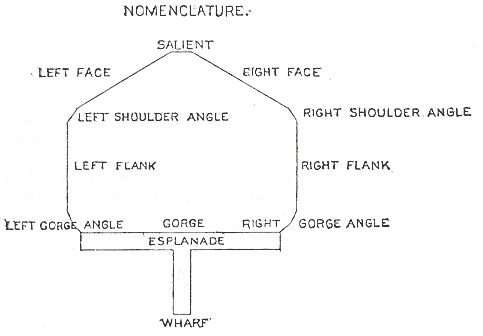
Barbette tier.–The armament is fully described in the accompanying figure. It consists, in all, of twenty-seven guns, one of which, a 42-pounder, is mounted at the left shoulder angle on a casemate carriage placed on the chassis of a 10-inch columbiad, and a 24-pounder at the left gorge angle is so arranged and the parapet so cut away that it can be depressed to 18o and fired upon the end of the wharf. Several machicoulis galleries of 1 1/2-inch plank (five lined with 1/2-inch iron plate) are placed on the parapet, one on the center of each face and flank, and three on the gorge, over and commanding the main postern; 225 shells, mostly 8-inch, are arranged as grenades, to be rolled off the parapet and exploded by means of a lanyard of proper length. Thunder-barrels are placed at each angle and over the main gate; fragments of stone, brick, &c., along the breast-height for missiles; twenty-three flights of steps lead to the parapet; ammunition in limber-boxes is placed convenient for instant use, and grape, canister, shot, and shell in abundance at each gun. Some five hundred cartridge bags have been made. The powder is well stored in the first-story magazine in the left gorge angle.

Second tier.–The 32-pounder on the right flank is dismounted; the forty-one 8-foot square openings are securely closed by a 3-foot brick wall, laid in cement, and backed in twenty-seven by two feet of sand, kept in place by a sheathing of boards or by barrels, in eight by two feet of flagging-stones, laid dry, and in six by dry brick, or re-enforced only by piles of finishing-stuff and flooring-boards.

First tier.–The armament consists of twenty-seven guns, and is fully described in the plan adjoined. There are eighteen guns ready for instant service, sixteen of the embrasures in front of which are closed with the original 6-inch wooden shutter, and also with an inner 6-inch shutter fitting close to the throat, and through the center of which a link from the outer shutter passes; an iron key tightens both firmly together. Two are closed by iron shutters of 1/2-inch iron plate; all are further secured by a 10-foot brace abutting against the gun run “from battery.” Where guns are mounted (9), but not required for immediate use, the embrasures (9) are closed temporarily, in addition to the outer shutter, by stone flagging, notched to fit the throat and laid flat, or by brick laid in mortar. There are fourteen embrasures, behind which guns are not mounted, of which eight, on the flanks, are closed by an 18-inch brick wall laid in mortar against the outer shutter; one by the dry-stone flagging, and the remainder (five) on the right face, by an entire embrasure filling of brick and stone laid in mortar.

The doors of the two posterns on the flanks are strengthened by 3-foot brick walls laid in mortar against the outer doors.

On the parade four 8-inch and one 10-inch columbiads are mounted as mortars (see preceding plan), and point to Morris Island and Charleston. All the temporary buildings and the lumber have been removed for fuel, the flagging turned on edge against the quarters or in the ends of the casemates, the shell spread on the walks, the sand and brick used, with a stone revetment, for splinter-proof traverses about the guns and in front of the hospital. The lantern has been removed from the light-house and placed on a platform in the center. The entire parade is clear.

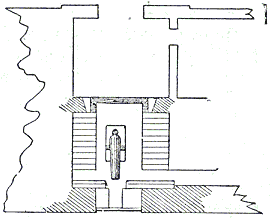
Main postern.–A stone and brick wall laid in cement is built against the outer gate to within four feet of the lintel. It is three feet six inches thick and six feet high. Through it is a manhole one foot eleven inches wide. An 8-inch sea-coast howitzer on a casemate-top carriage only looks through the manhole. In the door above the wall are four loopholes, reached by steps. One leaf of the gate is firmly bolted shut; the other can be opened or securely shut, and through it and corresponding with the manhole in the wall is a manhole closed by a door.

Fort Sumter, Charleston Harbor, March 25, 1861

The outside of the gate and inside of the small door are covered with ½-inch iron. The inner door is fastened with a wooden cross-bar, and has a manhole closed by a door; there are four loopholes in it, and two in the cross wall to which it is hung. Material is at hand with which to close the outer door permanently. The walls of the stairways leading   to the second floor are closed with 1½-inch plank, and openings over the postern are arranged for throwing grenades.

Fort Sumter, Charleston Harbor, March 25, 1861

The gorge.–In the second story the thirty-four windows and six magazine ventilators are protected by placing in each two wrought-iron embrasure jams, eight inches thick and three feet six inches long, permitting of musketry fire over them. In the first story the seven doors are closed with a 5-inch wooden shutter, against which, outside, is built a 9-inch brick wall, laid in cement, and outside this a pintle stone, 8 feet by 2 feet 2 inches by 1 foot 3 inches, with pieces of flagging, fastened in with wooden wedges and melted lead; the six magazine ventilators by large stones and lead against the wall and shutter; and fifteen windows are closed by the pintle stone and flagging, fastened with the wedges and lead. In all these openings the filling is placed against the offset at the throat, by which a solid wall, two feet thick and well secured in the rear, has been obtained.

On the esplanade two 8-inch sea-coast howitzers are mounted on casemate carriages only, one each side of the main gate, to sweep the gorge and the approaches to it. The stone &c., has been removed, leaving only a row along the edge to prevent grenades rolling off. Two fougasses, of 12 feet diameter, charged with 50 pounds of powder, are placed against the foot of the scarp wall, one in the center of each half gorge.

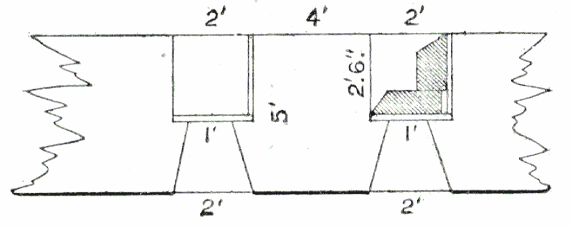
Two mines, charged with 25 pounds of powder, are sunk in the wharf 40 feet apart. A wooden fence, 8 feet high, at each end of the esplanade, extends from the scarp to low water. The stones of the enrockment in front of embrasures to be opened are removed. A deep cut in the enrockment on the left flank obstructs communication.

Respectfully submitted.

G. W. SNYDER,

First Lieutenant of Engineers, U. S. Army.

T. SEYMOUR,

Brevet Captain and First Lieutenant, First Artillery.

[Indorsement.]

FORT SUMTER, S.C., March 25, 1861.

Report exhibiting the work done at Fort Sumter since its occupation by the present garrison, and its condition at this date. Confidentially communicated for the information of the War Department.

ROBERT ANDERSON,

Major, First Artillery, Commanding.

HEADQUARTERS
PROVISIONAL FORCES,

Charleston, S.C.,
March
25, 1861.

Brig. Gen. S. COOPER, Adjutant-General C. S. Army:

SIR: I have the honor to acknowledge the receipt of your two letters dated, respectively, the 20th and 21st instants, the former extending the limits of my command, &c.; the latter in relation to the recruiting service in Baltimore; also, a telegram from the Secretary of War in relation to the recruits. The instructions contained therein will be complied with. I will not leave this city until after the evacuation of Fort Sumter. Sixty-four recruits arrived here from Baltimore, under the charge of Mr. R. E. Haslett, on Saturday, the 23d instant, and were sent to Castle Pinckney. They will be enlisted to-day. Captain Childs and Lieutenants O’Brien and Robertson have been assigned to duty with them. The quartermaster-general of the State of South Carolina has kindly offered to furnish them with the necessary rations, clothing, &c., to be settled for hereafter. It would, perhaps, be economical to prescribe the uniform for the Regular Army as early as practicable. Mr. Haslett informs me that a bounty was promised these men, but does not know the amount–thinks about $25 or $30. I have, therefore, to request that you notify me what amount will be paid, and under what regulations, that I may cause the same to be noted on their muster and pay rolls. I am just informed that Lamon, special messenger from Washington, has arrived, and is now conferring with the governor.

I am sir, very respectfully, your obedient servant,

G. T. BEAUREGARD,

Brigadier-General, Commanding.

EXECUTIVE DEPARTMENT,
State of South Carolina, March 25, 1861.

[General BEAUREGARD?]:

MY DEAR SIR: I sent Lamon to Major Anderson, and all right. Will see you as soon as I can. I told him we would agree to evacuation upon any honorable and reasonable terms, but would not suffer any war vessel to come up to the fort, and everything must be conducted respectably, and in no arrogant or wanton manner towards us. He says Spencer will come out in a few days, certain.

Truly,

F. W. PICKENS.

—Colonel Lamon, a Government messenger, had an interview at Charleston with Governor Pickens and General Beauregard.—Times, March 26.

—The rumors from Charleston are very conflicting concerning the evacuation of Fort Sumter. One report states that Major Anderson is strengthening his position; another, that he has received orders to evacuate the fort and report himself for duty at Newport barracks, and that the officers are packing their goods in expectation of immediate departure. The truth of the matter will probably be known in a day or two.—Evening Post.