Following the American Civil War Sesquicentennial with day by day writings of the time, currently 1863.

Friday, March 11, 2011

March 11th.—In full conclave to-night, the drawingroom crowded with Judges, Governors, Senators, Generals, Congressmen. They were exalting John C. Calhoun’s hospitality. He allowed everybody to stay all night who chose to stop at his house. An ill-mannered person, on one occasion, refused to attend family prayers. Mr. Calhoun said to the servant, “Saddle that man’s horse and let him go.” From the traveler Calhoun would take no excuse for the “Deity offended.” I believe in Mr. Calhoun’s hospitality, but not in his family prayers. Mr. Calhoun’s piety was of the most philosophical type, from all accounts.¹

The latest news is counted good news; that is, the last man who left Washington tells us that Seward is in the ascendency. He is thought to be the friend of peace. The man did say, however, that “that serpent Seward is in the ascendency just now.”

Harriet Lane has eleven suitors. One is described as likely to win, or he would be likely to win, except that he is too heavily weighted. He has been married before and goes about with children and two mothers. There are limits beyond which! Two mothers-in-law!

Mr. Ledyard spoke to Mrs. Lincoln in behalf of a doorkeeper who almost felt he had a vested right, having been there since Jackson’s time; but met with the same answer; she had brought her own girl and must economize. Mr. Ledyard thought the twenty thousand (and little enough it is) was given to the President of these United States to enable him to live in proper style, and to maintain an establishment of such dignity as befits the head of a great nation. It is an infamy to economize with the public money and to put it into one’s private purse. Mrs. Browne was walking with me when we were airing our indignation against Mrs. Lincoln and her shabby economy. The Herald says three only of the élite Washington families attended the Inauguration Ball.

The Judge has just come in and said: “Last night, after Dr. Boykin left on the cars, there came a telegram that his little daughter, Amanda, had died suddenly.” In some way he must have known it beforehand. He changed so suddenly yesterday, and seemed so careworn and unhappy. He believes in clairvoyance, magnetism, and all that. Certainly, there was some terrible foreboding of this kind on his part.

____

¹John C. Calhoun had died in March, 1850.
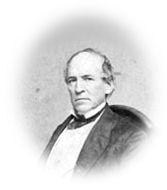
MONDAY, MARCH 11, 1861.

It has been a pleasant cool day, comfortable out door with an overcoat on. A great many people in the office today. Office seekers are hanging on here in great numbers. Went after 3 o’clck with Bro C R & Maj [Bulkley?] to the Navy Yard through the shops and on board the US War Steamer Pensacola. Maj B came home and dined with us. We then went down to Willards. Bro & myself called at Cramers, and then went back to Willards. Senator Wigfall was there with a crowd round him but not boisterous.

______

The three diary manuscript volumes, Washington during the Civil War: The Diary of Horatio Nelson Taft, 1861-1865, are available online at The Library of  Congress.

HDQRS.
PROVISIONAL ARMY
CONFEDERATE STATES,
Charleston, S.C.,
March
11, 1861.

.

.

Hon. L. P. WALKER, Secretary of War, Montgomery, Ala. :

“I desire to state that should my application to be appointed in the Regular service, instead of the Provisional one, occasion any embarrassment to the President, I desire it to remain unnoticed; and, moreover, should he at any time consider it necessary for the good of the service or safety of the country to send here an officer of more experience than myself, I hope he will do so without hesitation, as I care more for the success of our arms and of our cause than for the honor of being in command here, and I would serve under the orders of such a commanding officer with the same zeal and activity as at present.

SIR: I have taken the earliest opportunity my present duties would permit (yesterday) to make a thorough reconnaissance of the country south of this city to the Stono River and its mouth, to determine what works are required to prevent an enemy from approaching in that direction, either to throw re-enforcements during the night into Fort Sumter, through the Stono River, Folly River, or Light-house Inlet, and their numerous and intricate branches (see Bache’s maps of Charleston Harbor and adjacent coast and country), or to attack Charleston. I have selected the sites and ordered the construction of some field works that will, I think, effectually guard those channels of approach; but we must have time and means to complete them. With good assistants (chiefs of Engineers and Ordnance) this could probably be done in about eight or ten days; but Major Whiting and Captain Boggs (two most reliable and efficient officers) have been recalled to Savannah by the governor of Georgia, and I am again left to my own resources. Their absence fills me with care and grief, for other very important matters demand my attention; in fact, a great deal in the way of organization remains still to be attended to. I find a great deal of zeal and energy around me, but little professional knowledge and experience. I earnestly request the immediate return of the two officers just named, or that two others, of equal ability, if they can be procured, be sent me. Probably Capt. G. W. Smith, of New York, and Captain Gorgas might be induced to come, if a positive rank could be offered to them. Should an enemy succeed in effecting a landing on the Stono River (a very navigable stream), or anywhere else in that direction, I will take a position with all my disposable forces in a very advantageous location I have selected,  a little in advance of the Savannah road bridge, leading into Charleston, covering, at the same time, the bridge with a tete-de-pont. From thence I will oppose to the last his direct attack, or take him in flank and rear, to cut off his communication, if practicable.

With regard to my letter of the 12th, referring to my present commission in the Confederate service, I desire to state that should my application to be appointed in the Regular service, instead of the Provisional one, occasion any embarrassment to the President, I desire it to remain unnoticed; and, moreover, should he at any time consider it necessary for the good of the service or safety of the country to send here an officer of more experience than myself, I hope he will do so without hesitation, as I care more for the success of our arms and of our cause than for the honor of being in command here, and I would serve under the orders of such a commanding officer with the same zeal and activity as at present.

I remain, sir, very respectfully, your obedient servant,

G. T. BEAUREGARD,

Brigadier-General, Commanding.

P. S.–Your letter of the 9th instant has just been received. Its remarks are answered in the above letter.

G. T. B.

ORDERS,

No. 1

PENSACOLA, FLA.,
March 11, 1861.

I. In compliance with Special Orders No. 1 from the War Department, Confederate States of America, dated at Montgomery, Ala., March 7, 1861, Brigadier-General Bragg assumes the command of all troops in the service of said States in the vicinity of Pensacola. His headquarters will be at Fort Barrancas.

BRAXTON BRAGG,

Brigadier-General, Commanding.

WASHINGTON, March 11, 1861.

General BEAUREGARD,
Commanding Army Confederate States, Charleston, S.C.:

Believed here that Anderson will be ordered to evacuate Sumter in five days. Was certainly informally agreed on in Cabinet Saturday night. May have been done as ruse to throw you off your guard and enable them to re-enforce.

LOUIS T. WIGFALL.

WASHINGTON, March 11, 1861.

His Excellency JEFFERSON DAVIS,
Montgomery, Ala.:

It is believed here in Black Republican circles that Anderson will be ordered to vacate Fort Sumter in five days. An informal conclusion to this effect was arrived at Saturday night in Cabinet. Anderson telegraphed, it is said, that he had no fuel and but fifteen days’ provisions.

LOUIS T. WIGFALL.