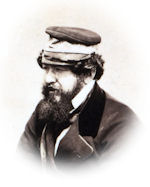
March 22d.—A snow-storm worthy of Moscow or Riga flew through New York all day, depositing more food for the mud. I paid a visit to Mr. Horace Greeley, and had a long conversation with him. He expressed great pleasure at the intelligence that I was going to visit the Southern States. “Be sure you examine the slave-pens. They will be afraid to refuse you, and you can tell the truth.” As the capital and the South form the chief attractions at present, I am preparing to escape from “the divine calm ” and snows of New York. I was recommended to visit many places before I left New York, principally hospitals and prisons. Sing-Sing, the state penitentiary, is “claimed,” as the Americans say, to be the first “institution” of its kind in the world. Time presses, however, and Sing-Sing is a long way off. I am told a system of torture prevails there for hardened or obdurate offenders—torture by dropping cold water on them, torture by thumbscrews, and the like—rather opposed to the views of prison philanthropists in modern days.
Tuesday, March 22, 2011
FRIDAY 22
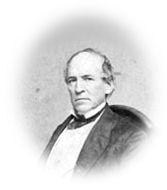
A cold wind till near night, but a fine evening & bright moon. The Heads begin to drop in our office. Three assistant exmrs have been removed today, others will probably follow. Called with Juliet at Doct Everitts after dinner, then went on to the Ave alone and round the Hotels. They are pretty well crowded yet with anxious faces. Levee at the Prests tonight, crowds were moving that way on the Ave. Came home before 9, and read “Williams on heat” till 11, read last night till after 12 o’clock.

______
The three diary manuscript volumes, Washington during the Civil War: The Diary of Horatio Nelson Taft, 1861-1865, are available online at The Library of Congress.

Fort SUMTER, S.C., March 22, 1861.
General Jos. G. TOTTEN,
Chief Engineer U. S. Army, Washington., D.C.:
GENERAL: Everything appears to be quiet this morning in the batteries around us. Night before last the South Carolinians put down again the buoy that had been taken up a few nights before from its position, about half a mile to the east of this fort. It appears, however, that it was not replaced in the former position, but placed upon the opposite side of the channel.
Last night a special messenger, Mr. Fox, arrived from Washington, and came down to the fort under the escort of Captain Hartstene, formerly of the United States Navy. After a confidential interview with Major Anderson, he left immediately for Washington.
With respect to this fort, I have filled all the loophole openings on the first tier with solid stone. All the openings are now closed, with the exception of five near the ends of the gorge, which had been partially filled with a 9-inch brick wall. I am now completing the filling of these with lead concrete.
I am also building traverses in front of the hospital, which is on the first floor of the quarters, and in front of the ordnance storeroom, to shield them from shells from Fort Moultrie.
Very respectfully, your obedient servant,
J. G. FOSTER,
Captain, Engineers.
—Governor Pettus, of Mississippi, in accordance with the order of the President of the Confederate States, issued a proclamation calling upon the organized military of the State for fifteen hundred infantry.—Georgia Republic, March 25.
—Dr. Fox, of the United States navy, a special messenger from the Government to Major Anderson, reached Charleston and visited Fort Sumter by permission, in company with Captain Hartstein.
“Intercepted despatches”—by which we are to understand “stolen letters”—subsequently disclosed to the authorities in Charleston, it is said, that Mr. Fox employed this opportunity to devise and concert with Major Anderson a plan to supply the fort by force; and that this plan was adopted by the United States Government.—Times, March 28 and April 18.
—A meeting was held at Frankfort, Ala., at which the following resolutions, among others of a similar character, were passed:
Resolved, That we approve the course pursued by our delegates, Messrs. Watkins and Steele, in convention at Montgomery, in not signing the so-called secession ordinance.
That secession is inexpedient and unnecessary, and we are opposed to it in any form, and the more so since a majority of the slave States have refused to go out, either by what is called “southern cooperation,” or “precipitate secession;” and that the refusal to submit the so-called secession ordinance to the decision of the people is an outrage upon our right and liberty, and manifests a spirit of assumption, unfairness, and dictatorship.
Resolved, That our congressional nominee, if elected, is to represent us in the United States Congress, and not in the Congress of this so-called “Southern Confederacy.”—Tuscumbia North Alabamian.
—The Montgomery Mail protests against the word stripes: “We protest against the word ‘stripes,’ as applied to the broad bars of the flag of our confederacy. The word is quite appropriate as applied to the Yankee ensign or a barber’s pole; but it does not correctly describe the red and white divisions of the flag of the Confederate States. The word is bars—we have removed from under the stripes.”— World, April 2.


