Following the American Civil War Sesquicentennial with day by day writings of the time, currently 1863.

Thursday, March 17, 2011

Sunday, 17th March.—The first thing I saw this morning, after a vision of a waiter pretending to brush my clothes with a feeble twitch composed of fine fibre had vanished, was a procession of men, forty or fifty perhaps, preceded by a small band (by no excess of compliment can I say, of music), trudging through the cold and slush two and two: they wore shamrocks, or the best resemblance thereto which the American soil can produce, in their hats, and green silk sashes emblazoned with crownless harp upon their coats, but it needed not these insignia to tell they were Irishmen, and their solemn mien indicated that they were going to mass. It was agreeable to see them so well clad and respectable looking, though occasional hats seemed as if they had just recovered from severe contusions, and others had the picturesque irregularity of outline now and then observable in the old country. The aspect of the street was irregular, and its abnormal look was increased by the air of the passers-by, who at that hour were domestics — very finely dressed negroes, Irish, or German. The coloured ladies made most elaborate toilettes, and as they held up their broad crinolines over the mud looked not unlike double-stemmed mushrooms. “They’re concayted poor craythures them niggirs, male and faymale,” was the remark of the waiter as he saw me watching them. “There seem to be no sparrows in the streets,” said I. “Sparrashe exclaimed; “and then how did you think a little baste of a sparra could fly across the ochean?” I felt rather ashamed of myself.

And so down-stairs where there was a table d’hdte room, with great long tables covered with cloths, plates, and breakfast apparatus, and a smaller room inside, to which I was directed by one of the white-jacketted waiters. Breakfast over, visitors began to drop in. At the “office” of the hotel, as it is styled, there is a tray of blank cards and a big pencil, whereby the cardless man who is visiting is enabled to send you his name and title. There is a comfortable “reception room,” in which he can remain and read the papers, if you are engaged, so that there is little chance of your ultimately escaping him. And, indeed, not one of those who came had any but most hospitable intents.

Out of doors the weather was not tempting. The snow lay in irregular layers and discoloured mounds along the streets, and the gutters gorged with “snow-bree” flooded the broken pavement. But after a time the crowds began to issue from the churches, and it was announced as the necessity of the day, that we were to walk up and down the Fifth Avenue and look at each other. This is the west-end of London—its Belgravia and Grosvenoria represented in one long street, with offshoots of inferior dignity at right angles to it. Some of the houses are handsome, but the greater number have a compressed, squeezed-up aspect, which arises from the compulsory narrowness of frontage in proportion to the height of the building, and all of them are bright and new, as if they were just finished to order,—a most astonishing proof of the rapid development of the city. As the hall door is made an important feature in the residence, the front parlour is generally a narrow, lanky apartment, struggling for existence between the hall and the partition of the next house. The outer door, which is always provided with fine carved panels and mouldings, is of some rich varnished wood, and looks much better than our painted doors. It is generously thrown open so as to show an inner door with curtains and plate glass. The windows, which are double on account of the climate, are frequently of plate glass also. Some of the doors are on the same level as the street, with a basement story beneath; others are approached by flights of steps, the basement for servants having the entrance below the steps, and this, I believe, is the old Dutch fashion, and the name of “stoop” is still retained for it. No liveried servants are to be seen about the streets, the doorways, or the area-steps. Black faces in gaudy caps, or an unmistakable “Biddy” in crinoline are their substitutes. The chief charm of the street was the living ornature which moved up and down the trottoirs. The costumes of Paris, adapted to the severity of this wintry weather, were draped round pretty, graceful figures which, if wanting somewhat in that rounded fulness of the Medicean Venus, or in height, were svelte and well poised. The French boot has been driven off the field by the Balmoral, better suited to the snow; and one must at once admit— all prejudices notwithstanding—that the American woman is not only well shod and well gloved, but that she has no reason to fear comparisons in foot or hand with any daughter of Eve, except, perhaps, the Hindoo.

The great and most frequent fault of the stranger in any land is that of generalizing from a few facts. Every one must feel there are “pretty days” and “ugly days” in the world, and that his experience on the one would lead him to conclusions very different from that to which he would arrive on the other. Today I am quite satisfied that if the American women are deficient in stature and in that which makes us say, “There is a fine woman,” they are easy, well formed, and full of grace and prettiness. Admitting a certain pallor—which the Russians, by the bye, were wont to admire so much that they took vinegar to produce it— the face is not only pretty, but sometimes of extraordinary beauty, the features fine, delicate, well defined. Ruby lips, indeed, are seldom to be seen, but now and then the flashing of snowy-white evenly-set ivory teeth dispels the delusion that the Americans are—though the excellence of their dentists be granted—naturally ill provided with what they take so much pains, by eating bon-bons and confectionery, to deprive of their purity and colour.

My friend R——, with whom I was walking, knew every one in the Fifth Avenue, and we worked our way through a succession of small talk nearly as far as the end of the street which runs out among divers places in the State of New York, through a débris of unfinished conceptions in masonry. The abrupt transition of the city into the country is not unfavourable to an idea that the Fifth Avenue might have been transported from some great workshop, where it had been built to order by a despot, and dropped among the Red men: indeed, the immense growth of New York in this direction, although far inferior to that of many parts of London, is remarkable as the work of eighteen or twenty years, and is rendered more conspicuous by being developed in this elongated street, and its contingents. I was introduced to many persons to-day, and was only once or twice asked how I liked New York; perhaps I anticipated the question by expressing my high opinion of the Fifth Avenue. Those to whom I spoke had generally something to say in reference to the troubled condition of the country, but it was principally of a self-complacent nature. “I suppose, sir, you are rather surprised, coming from Europe, to find us so quiet here in New York: we are a peculiar people, and you don’t understand us in Europe.”

In the afternoon I called on Mr. Bancroft, formerly minister to England, whose work on America must be rather rudely interrupted by this crisis. Anything with an “ex” to it in America is of little weight—ex-presidents are nobodies, though they have had the advantage, during their four years’ tenure of office, of being prayed for as long as they live. So it is of ex-ministers, whom nobody prays for at all. Mr. Bancroft conversed for some time on the aspect of affairs, but he appeared to be unable to arrive at any settled conclusion, except that the republic, though in danger, was the most stable and beneficial form of government in the world, and that as a Government it had no power to coerce the people of the South or to save itself from the danger. I was indeed astonished to hear from him and others so much philosophical abstract reasoning as to the right of seceding, or, what is next to it, the want of any power in the Government to prevent it.

Returning home in order to dress for dinner, I got into a street-railway-car, a long low omnibus drawn by horses over a strada ferrata in the middle of the street. It was filled with people of all classes, and at every crossing some one or other rang the bell, and the driver stopped to let out or to take in passengers, whereby the unoffending traveller became possessed of much snow-droppings and mud on boots and clothing. I found that by far a greater inconvenience caused by these street-railways was the destruction of all comfort or rapidity in ordinary carriages.

I dined with a New York banker, who gave such a dinner as bankers generally give all over the world. He is a man still young, very kindly, hospitable, well informed, with a most charming household—an American by theory, an Englishman in instincts and tastes —educated in Europe, and sprung from British stock. Considering the enormous interests he has at stake, I was astonished to perceive how calmly he spoke of the impending troubles. His friends, all men of position in New York society, had the same dilettante tone, and were as little anxious for the future, or excited by the present, as a party of savans chronicling the movements of a ” magnetic storm.”

On going back to the hotel, I heard that Judge Daly and some gentlemen had called to request that I would dine with the Friendly Society of St. Patrick to-morrow at Astor House. In what is called “the bar,” I met several gentlemen, one of whom said, “the majority of the people of New York, and all the respectable people, were disgusted at the election of such a fellow as Lincoln to be President, and would back the Southern States, if it came to a split.”
SUNDAY, MARCH 17, 1861.

It threatened rain all day but none fell. Holly has been rather sick today, sore throat, cold, &c. Julia D[itt]o. Neither went to church. Uncle C R and the rest of us all went to Doct. Smiths in the morning. Bro & myself went over to the Island to hear Mason Noble in the afternoon. Bro thinks of starting home tomorrow, must try and keep him a little longer. He seems very near to me as a Brother. We have concluded not to send Juliet back to Elmira this term. Holly has considerable fever tonight and we feel somewhat anxious about him. I sleep with him tonight.

______

The three diary manuscript volumes, Washington during the Civil War: The Diary of Horatio Nelson Taft, 1861-1865, are available online at The Library of  Congress.

CINCINNATI, March 17, 1861.

DEAR UNCLE:—I received yours of the 13th yesterday. I shall not come out for three or four weeks, perhaps not so soon. It is not yet possible to guess how the [city] election will go, but the chances are decidedly against our side. The Democrats and Know-nothings have united and will nominate their ticket this week. If they nominate men tolerably acceptable to both wings of the fusion, they will succeed beyond all question. Their majority at the last election over the Republicans was nearly three thousand. We can’t beat this. Our chance is that there will be some slip or mistake which will upset the union. I shall go under with the rest, but expect to run ahead of the ticket. Of course, I prefer not to be beaten, but I have got out of the office the best there is in it for me. I shall get me an office alone, and start anew—a much pleasanter condition of things than the one I left with Corwine.

Yes, giving up Fort Sumter is vexing. It hurts our little election, too; but I would give up the prospect of office, if it would save the fort, with the greatest pleasure.

Elinor Mead¹ leaves us on Tuesday to return home the last of the week. She has enjoyed her visit, I think. Mother is very well again; is able to go out, to shop and to church. Little Ruddy (our brag boy now) has been sick, but is getting nearly well. The other boys count largely on going to Fremont this summer.

Sincerely,

R. B. HAYES.

S. BIRCHARD.

_______

¹A cousin from Vermont; later to become the wife of William Dean Howells, who that winter was a newspaper correspondent at Columbus.

FORT SUMTER, S. C., March 17, 1861.

General Jos. G. TOTTEN,
Chief Engineer U. S. Army, Washington, D. C.:

GENERAL: The unusual activity observed and reported yesterday morning in the surrounding batteries was due to preparations for receiving some distinguished person who visited them in the afternoon.

It is supposed that this was Vice-President Stephens, of the so-called Southern Confederacy. Three rounds were fired from all the batteries on Morris Island, except No. 1, apparently as much for practice as for saluting, for most of the guns not pointed in this direction were shotted. This firing enabled me to detect the positions and approximate calibers of the guns in these batteries.

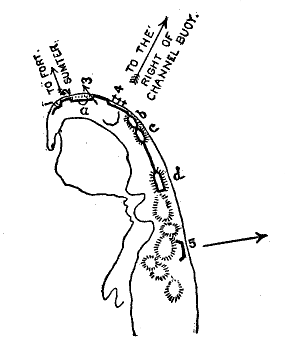
imageThe marginal sketch represents this roughly:

No. 1. Battery of sand and palmetto logs, four 24-pounders.

No. 2. Iron-clad battery, three guns, 42-pounders or 8-inch columbiads.

No. 3. Battery of sand and palmetto logs, three guns, 24-pounders or 32-pounders.

No. 4. Battery of sand and palmetto logs, with one 8-inch columbiad or 8-inch sea-coast howitzer.

No. 5. Star of the West battery, five guns, 24-pounders or 32-pounders.

a is a large magazine; b, c, d are defenses of the character of redoubts on top of three sand hills.

There were two guns at each round fired from the light-house battery. Three or four more guns were landed yesterday with barbette carriages, and most of them (in fact, all that are removed from the landing which is in front of battery No. 1, where there is deep water close in shore) were carried around upon the channel side. One, at least, was placed in battery No. 4, making four guns in that battery at present.

These guns with barbette carriages came from Castle Pinckney, nearly the whole of the upper tier of which is being removed for this purpose. None of the guns from Fort Moultrie bearing upon this fort or the channel have been removed. No work is being done on the batteries looking towards us. All preparations are directed to strengthening the channel batteries very much, and to covering the present batteries in the rear, which was before open.

No work of any magnitude is being done on Cummings Point to-day (Sunday). On James Island the work on the covered way connecting the flank of the line of intrenchments and the mortar battery is being continued.

The weather is pleasant, although there are indications of a storm brewing.

I have the honor to be, very respectfully, your obedient servant,

J. G. FOSTER,

Captain of Engineers.

1861. March 17. —A long and interesting telegram by the America. The Inauguration on the 4th had gone off without disturbance of any kind, in the presence of some thirty thousand persons. Mr. Lincoln’s address was both firm and mild,—firm against the constitutionality of secession, mild in assurances and language. Nothing in the telegram about convening the new Congress, nor about the new Tariff bill, though he noticed the passage of Corwin’s resolution to amend the Constitution by expressly prohibiting Congress from meddling with slavery in the States, and approved it.

March 17th, 1861.—Brother Amos has been a member of the Governor’s Guards for a long time; that is, ever since the company was organized last October and he did not tell us until tonight that the Guards volunteered two weeks ago. Sister Mag was wild with grief at first but Mother tried to comfort her by insisting that there would be no fighting—just talk of war and reconciliation would follow. Brother Junius came in to supper and he told us he and Dr. Gardner and several others were raising a company in this county, to be called the Dixie Yoemen. Richmond Gardner, Captain; Joel Blake, 1st Lieutenant; Junius Taylor, 2nd Lieutenant; Jimmie Conner, 3rd Lieutenant. These men must think there will be war or they would not be preparing for it. This is extremely exciting.

U. S. STEAMER BROOKLYN,
Pensacola Harbor, Fla., March 17, 1861.

Col. L. THOMAS,  Assistant Adjutant-General:

SIR: On the 24th of last January I left Fort Monroe, Va., with sealed orders from the headquarters of the Army, which assigned me to the command of the forts in this harbor. On my arrival at this station I met a telegraphic dispatch from the Secretary of War which instructed the commander of the Brooklyn not to land my company for the present. A few days since I requested a copy of the post return from Lieutenant Slemmer in order to make a monthly return of the whole command. He declines furnishing me with it, as he holds that the telegraphic dispatch superseded my orders, and of course deprived me of the right to command. I do not so construe the dispatch, nor can I consider it as binding upon me, as I have never received a copy of it, nor is it in any way directed to me. I can hardly imagine that the Department could intend that I should be superseded by an officer junior to myself both in grade and rank, and that it would have at least informed me directly of the fact if such had been its intention.

I need not point out to you how important in the present critical state of affairs it is to have a perfect unity of command. Should anything occur that may render it necessary that my company should be landed, it is necessary that some previous arrangements should be made for its  reception and distribution of the whole command. It is unnecessary for me to state that such arrangements cannot be made by Lieutenant Slemmer, nor can I for one moment consent to his dispensing of either myself or my command. Besides which, until Lieutenant Slemmer declined sending me the return, I had no idea that he disputed my right to command, and I had made arrangements with Captain Adams, commanding the naval forces on this station, to land a force of marines and sailors, which, with my company and the troops now in the fort, will raise the command to five hundred men. This force, in my opinion, will be sufficient to hold Fort Pickens against any force that may attempt to carry it by escalade. There is, however, a great deficiency both of ammunition and supplies for so large a command. The medical supplies are very limited. There are no bunks either for the hospital nor for the men. The casemates are open, and have only brick floors. At present the men are in the officers’ quarters, but these will be required for the officers, and would besides be entirely inadequate to accommodate so large a command. To expose the men to sleep on the damp brick exposed as they would be to the inclemency of the weather, would soon place most of them on the sick-report.

It is important that requisitions should be made for medicines and quartermaster’s supplies of lumber, bunks, and clothing for the command. I directed the attending surgeon and the acting assistant quartermaster to make the necessary requisitions, but whether they have done so or not I cannot say, as they have not been submitted to me.

I think that the above statement will satisfy you as to the importance of placing things upon such a footing as may settle at once the right to command. I have not deemed it judicious to take the course with Lieutenant Slemmer which I should have taken at any other time, but I think I have said sufficient to satisfy you that it is important that all ambiguity as to my right to command should be at once removed. I therefore ask that instructions may at once be given for me to at once take up my residence within the fort, which the authorities now seem to think is contrary to the agreement entered into.

I deem it important that the commissary and quartermaster’s department at this post should be supplied with money, as it is impossible to obtain supplies without it.

Some batteries have been erected by the seceders between the navy-yard and Fort Barrancas, on the shore. These may offer a very serious obstacle to the ships-of-war entering the harbor. The troops, however, I think can be safely landed on Santa Rosa Island, and enter the fort without encountering any serious impediment. May I request that you will give your early attention to the above case, and let me know your decision?

Yours, &c.,

I. VOGDES,
Captain, First Artillery.