U. S. STEAMER BROOKLYN, March 21, 1861.
[General SCOTT:]
GENERAL: I wrote to you a few days since asking you to decide the subject of command on this station. Since then Lieutenant Gilman has arrived. I hope, however, that you will give my communication a careful consideration, and will see the necessity of establishing a unity of command on the station. As I mentioned in my communication, it is indispensable that there should be a perfect understanding between the troops and the naval forces, and the positions to be occupied beforehand be fully determined upon. How this can be done when the troops will have to land only when the fort is attacked I am unable to see. It cannot be done unless Lieutenant Slemmer is to be allowed to give me orders and to assign me a position, and to that I never will submit. I will endeavor to perform my duty, I trust, on all occasions, but I never will submit to be commanded, directly or indirectly, by my junior. Moreover, when I enter the fort I become its commander, and will be held responsible for its defense. This will be, probably, when the enemy is already before its walls, and when I must, of course, be ignorant of the disposition which Lieutenant Slemmer has made for its defense. How am I to be held accountable for its defense when I have not the command until the last moment? I trust, general, that you will see at once the false position in which I am placed, and at once relieve me from it. If not, I enter my protest against being in any way held accountable for what may take place.
Until within a few days the naval and military forces have been supplied with fresh provisions from Warrington and Pensacola, but General Bragg has issued an order prohibiting any supplies being furnished to us, and prohibits the citizens communicating with us, except by special permission.
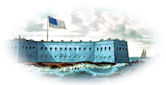
The conditions of the agreement entered into by the late Government and Major Chase and Senator Mallory give every advantage to the seceders, yet some of them deny the right of those two gentlemen to make it. They are not required to give any notice of its abrogation, and may attack the fort without a moment’s notice, and under the most favorable circumstances it will be impossible to send any assistance to the fort from the ships in less time than three hours. Should there be the least panic among the troops within the fort it would probably be taken. There are about forty guns mounted, and the garrison is about one man to a gun. They could only make a single discharge, and would not probably be able to reload the guns. Should those on any of the fronts be discharged too soon, that front would be left without any defense. Moreover, the garrison is kept constantly harassed, and is almost every night obliged to be under arms, from fear of attack. With the present garrison, my company, and one hundred marines, which we could obtain from the fleet, I think it would be perfectly secure from assault.
Our means of communication with the Government are very uncertain. We do not feel certain that our communications have reached the Department, nor do we know whether the Department’s messenger to us may not have been intercepted. Of course, we do not know how we are expected to act. I would suggest that a small steamer should ply between here and Havana, so as to communicate with the mail steamer from New York at that port. The supplies at the fort are getting low, and those of the naval forces are still lower. These last have not ten days’ supply.
The Brooklyn leaves to-morrow for Key West or Havana in order to obtain a supply. Should she not succeed, the naval forces will have to be withdrawn. The Brooklyn has by far the most efficient battery of any of the ships on the station, and is besides probably the only vessel that could take up a position to effectively cover our landing. It is much to be regretted that she should be withdrawn at this juncture. My company is to be transferred to the frigate Sabine.
Major Tower, of the Engineers, arrived on the 19th, but under the existing arrangement cannot reside within the fort. Even was he there not having any force to labor, he could not do much. I have endeavored to lay before you a true statement of the disadvantageous position in which we are placed, and I trust that so far as it can be done it will be remedied. Whatever may be done, I trust that we will be soldiers enough to do all that lies in our power to uphold the honor of our country’s flag, and prevent its forts from being seized by those in rebellion against its authority.
Yours, truly,
I. VOGDES,
Captain, First Artillery.