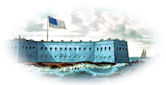
March 20th.—The papers are still full of Sumter and Pickens. The reports that they are or are not to be relieved are stated and contradicted in each paper without any regard to individual consistency. The “Tribune” has an article on my speech at the St. Patrick’s dinner, to which it is pleased to assign reasons and motives which the speaker, at all events, never had in making it.
Received several begging letters, some of them apparently with only too much of the stamp of reality about their tales of disappointment, distress, and suffering. In the afternoon went down Broadway, which was crowded, notwithstanding the piles of blackened snow by the kerbstones, and the sloughs of mud, and half frozen pools at the crossings. Visited several large stores or shops — some rival the best establishments in Paris or London in richness and in value, and far exceed them in size and splendour of exterior. Some on Broadway, built of marble, or of fine cut stone, cost from £6000 to £8000 a year in mere rent. Here, from the base to the fourth or fifth story, are piled collections of all the world can produce, often in excess of all possible requirements of the country; indeed I was told that the United States have always imported more goods than they could pay for. Jewellers’ shops are not numerous, but there are two in Broadway which have splendid collections of jewels, and of workmanship in gold and silver, displayed to the greatest advantage in fine apartments decorated with black marble, statuary, and plate-glass.
New York has certainly all the air of a “nouveau riche.” There is about it an utter absence of any appearance of a grandfather—one does not see even such evidences of eccentric taste as are afforded in Paris and London, by the existence of shops where the old families of a country cast off their “exuviae” which are sought by the new, that they may persuade the world they are old; there is no curiosity shop, not to speak of a Wardour Street, and such efforts as are made to supply the deficiency reveal an enormous amount of ignorance or of bad taste. The new arts, however, flourish; the plague of photography has spread through all the corners of the city, and the shop-windows glare with flagrant displays of the most tawdry art. In some of the large booksellers’ shops—Appleton’s for example—are striking proofs of the activity of the American press, if not of the vigour and originality of the American intellect. I passed down long rows of shelves laden with the works of European authors, for the most part, oh shame! stolen and translated into American type without the smallest compunction or scruple, and without the least intention of ever yielding the most pitiful deodand to the authors. Mr. Appleton sells no less than one million and a half of Webster’s spelling books a year; his tables are covered with a flood of pamphlets, some for, others against coercion; some for, others opposed to slavery,—but when I asked for a single solid, substantial work on the present difficulty, I was told there was not one published worth a cent. With such men as Audubon and Wilson in natural history, Prescott and Motley in history, Washington Irving and Cooper in fiction, Longfellow and Edgar Poe in poetry, even Bryant and the respectabilities in rhyme, and Emerson as essayist, there is no reason why New York should be a paltry imitation of Leipsig, without the good faith of Tauchnitz.
I dined with a litterateur well known in England to many people a year or two ago—sprightly, loquacious, and well informed, if neither witty nor profound — now a Southern man with Southern proclivities, as Americans say; once a Southern man with such strong anti-slavery convictions, that his expression of them in an English quarterly had secured him the hostility of his own people—one of the emanations of American literary life for which their own country finds no fitting receiver. As the best proof of his sincerity, he has just now abandoned his connection with one of the New York papers on the republican side, because he believed that the course of the journal was dictated by anti-Southern fanaticism. He is, in fact, persuaded that there will be a civil war, and that the South will have much of the right on its side in the contest. At his rooms were Mons. B——, Dr. Gwin, a Californian ex-senator, Mr. Barlow, and several of the leading men of a certain clique in New York. The Americans complain, or assert, that we do not understand them, and I confess the reproach, or statement, was felt to be well founded by myself at all events, when I heard it declared and admitted that “if Mons. Belmont had not gone to the Charleston Convention, the present crisis would never have occurred.”