Following the American Civil War Sesquicentennial with day by day writings of the time, currently 1863.

April 2011

U. S. TROOP-SHIP ATLANTIC,
Havana, April 25, 1861.

Brig. Gen. J. G. TOTTEN,
Chief of Engineers, Washington:

GENERAL: In obedience to orders from the President of the United States, I accompanied as engineer the expedition of Colonel Brown, fitted out in New York, and sailing under secret and confidential orders to attempt to re-enforce Fort Pickens.

I left Washington on the afternoon of the 3d April, having been engaged from the 31st March in preparation for the expedition.

The Secretary of State having assured me that any arrangement I might make for the preservation and control of the public works under my charge in Washington during my absence would be approved by the Executive, I appointed Capt. J. N. Macomb, Topographical Engineers and my brother-in-law, my attorney to sign checks, draw requisitions, and do all other acts necessary for the control of these public works until my return.

Arrived in New York, I devoted myself, in concert with the commander of the expedition, Col. Harvey Brown, Colonel Keyes, military secretary, and others, to the fitting out of the vessels necessary to convey the troops, horses, artillery, ordnance, and stores to Santa Rosa.

By the request of the President I sailed in the first transport ready, the Atlantic steamer, formerly of the Collins line, with instructions to remain with Colonel Brown until he was established in Fort Pickens, and then to return to my duties in Washington.

We had on board five companies of artillery and infantry, two of which were light artillery, Barry’s and Hunt’s. Captain Barry’s company carried their horses with them, 73 in number. Captain Hunt’s company, having lost their horses by the treachery of General Twiggs in Texas, were dismounted.

Such artillery as could be hastily collected, such part of the stores and supplies for six months for 1,000 men, purchased in New York, as could be embarked by the evening of the 6th April, were placed on board and the vessel hauled into the stream after sunset on that date.

She continued taking in stores during the night and sailed on the morning of the 7th instant. While of many articles large supplies were put on board, not less than fifty days’ rations of any single article of subsistence accompanied us, and we carried with us thirty days’ forage for the horses.

The dock was left covered with stores, shovels, sand bags, forage, subsistence, ammunition, and artillery, to follow with steamer Illinois, to sail on the evening of the 8th.

These two vessels it was believed would carry supplies for 1,000 men for six months.

The uncertainty of the Government as to the condition of Fort Pickens, and as to the very orders and instructions under which the squadron off that fortress was acting, led to apprehensions lest the place might be taken before relief could reach it.

A landing in boats from the mainland on a stormy night was perfectly practicable in spite of the utmost efforts of a fleet anchored outside and off the bar to prevent it. Such a landing in force taking possession of the low flank embrasures by men armed with revolvers would be likely to sweep in a few minutes over the ramparts of Fort Pickens, defended by only forty soldiers and forty ordinary men from the navy-yard, a force which did not allow one man to be kept at each flanking gun.

Believing that a ship of war could be got ready for sea and reach Pensacola before any expedition in force, I advised the sending of such a ship under a young and energetic commander, with orders to enter the harbor without stopping, and, once in, to prevent any boat expedition from the main to Santa Rosa.

Capt. David D. Porter readily undertook this dangerous duty, and, proceeding to New York, succeeded in fitting out the Powhatan, and sailed on the 6th for his destination.

Unfortunately, or rather fortunately, as the result will show, the Powhatan had been put out of commission at Brooklyn and stripped of her crew and stores on the 1st April, only two and a half hours before the telegram from the President, ordering her instant preparation for sea reached the commander of the navy-yard at that place. She was got ready for sea, however, by working night and day, and sailed on the 6th, about twelve hours before the Atlantic.

Off Hatteras, on Monday, 8th, the Atlantic ran into a heavy northeast gale, which increased to such a degree that, in order to save the horses on the forward deck, it became necessary to heave the ship to under steam and keep her head to sea for over thirty-six hours. When the gale abated we found ourselves 100 miles out of our course, 138 miles east-southeast from Hatteras.

With all speed possible under the circumstances we made our way to Key West, where, anchoring off the harbor and allowing no other communication with the shore, Colonel Brown, the ordnance officer, Lieutenant Balch, and myself landed by boat at Fort Taylor.

Here, calling the United States judge, Mr. Marvin, the newly-appointed collector and marshal, and the commanding officer of the fort, Major French, to meet Colonel Brown at the fort, the orders and instructions of the President were communicated to these gentlemen, and the commission of marshal for Mr. H. Clapp, intrusted to me for this purpose by the Secretary of State, was delivered to Judge Marvin.

Several secession flags floated from buildings in view of the fort and upon the court-house of the town.

The President’s orders to the authorities at Key West were to tolerate the exercise of no officer in authority inconsistent with the laws and Constitution of the United States, to support the civil authority of the United States by force of arms if necessary, to protect the citizens in their lawful occupations, and in case rebellion or insurrection actually broke out to suspend the writ of habeas corpus, and remove from the vicinity of the fortresses of Key West and Tortugas all dangerous or suspected persons.

Having by restowing much of our cargo made room for some additions, Colonel Brown here drew from Fort Taylor a battery of 12-pounder howitzers and 6-pounder guns, three 10-inch siege mortars for which shells had been embarked at New York, and a supply of ammunition for the field pieces; these, being placed upon a scow, were towed out to the Atlantic anchorage by the Crusader, Captain Craven, and put upon her decks during the night.

Early the next morning, 14th April, we proceeded to the Tortugas, where proper instructions were left with Major Arnold, commanding the place. Four mountain howitzers, with prairie carriages, light and suitable either for the sands of Santa Rosa or for the service upon the covered ways of Fort Pickens, with supplies of fixed ammunition, spherical case and canister, were taken on board.

Twenty carpenters and one overseer, engaged in Washington, had followed me to New York and were already on board the Atlantic.

To assist in the manual labor of disembarking the immense stores, to be landed on an open sea beach exposed to the broad Gulf of Mexico, Colonel Brown, under the ample powers conferred on him by the President, directed Lieutenant Morton, Engineers, to send with the expedition one overseer and twenty of the hired negroes at Fort Jefferson, and skillful with the oar and the rope. By some mistake twenty-one of the negroes embarked, and they proved hardy, willing, and cheerful laborers during the disembarkation.

Lieutenants Reese and McFarland, Engineers, here joined the expedition.

To assist in landing artillery, the attempt was made to tow a scow from Fort Jefferson to Pensacola, but it broke from its fastenings before we left the harbor. It has since been recovered at the fort.

Leaving the harbor of Tortugas after dark on the 14th, forcing our way through a heavy head sea caused by a severe norther, losing all the horse-stalls on the port bow of the steamer, washed away by the sea, though fortunately without destroying any of the horses, we reached the anchorage of the squadron off Pensacola bar at 6 p.m. of the 16th instant. It must then have been known in Pensacola, though concealed from the fort and from those afloat, that Fort Sumter had, after bombardment, surrendered on the 13th.

Communicating with Captain Adams, commanding the squadron, and exhibiting his instructions from the President, Colonel Brown called upon him for boats to make a landing immediately after dark.

The Atlantic proceeded at dark, towing the boats to anchor near the shore, and, while waiting for the boats to come alongside, the signal for attack, two rockets from the fort, was made by Captain Vogdes.

Captain Vogdes, with his company and 110 marines, had landed on the night of the 12th. The orders of General Scott to him to land, received some days before, had not been executed, because unrevoked instructions to Captain Adams from the Secretary of the Navy and the Secretary of War contradicted them. Captain Adams had therefore declined landing the troops until Lieutenant Slemmer officially informed him that he apprehended an attack.

From the signs visible on the mainland and from information received by him, Lieutenant Slemmer on the 12th, being convinced that an attack was imminent, called upon Captain Adams to land the troops and it was done that night.

Major Tower, Engineers, thought that this landing and very stormy weather had deferred the attack. But commotion on shore and movements visible from the fort led them to believe that an attack would be made immediately after the arrival of the Atlantic, and therefore the signal was sent up.

The ditches of the Barrancas were lighted up and much hurrahing was heard.

While the boats were collecting on the Atlantic, Colonel Brown and his staff, taking a boat of the frigate Sabine, under Lieutenant Belknap, of that vessel, pulled into the mouth of the harbor, and we landed on the beach between Forts McRee and Pickens. Passing many sentinels and patrols, we entered Fort Pickens by the north gate, and were gladly welcomed by Captain Vogdes and his officers, who assured us that five thousand men might be expected on shore in a short time.

I returned in the Sabine’s boat to direct the landing of all the men who could be got ashore during the night.

On our way to the Atlantic we met the fleet of boats, and which landed as intended, and put our two hundred men into the fort within a few hours after our arrival.

The night passed off quietly, and the next morning early all the rest of the command, with the exception of the carpenters and laborers and Captain Barry’s artillery company, retained to attend to their horses, were landed on the beach and marched into the fort.

I landed that morning, with Captain Barry and a covering party of men, about five miles from Fort Pickens and reconnoitered the island, determined upon a suitable place for landing the horses and for an intrenched camp out of range of the heaviest artillery on the mainland, and at a point beyond which a boat canal may easily be cut across the island.

During the day and night of the 17th and the morning of the 18th the horses were got ashore. One was drowned alongside by some mismanagement., one got loose, swam twice around the ship before he was caught., and died from exhaustion after landing, and one, turned head over heels by the surf, broke his neck. Four had died and been thrown overboard in the boisterous passage, so that seven out of seventy-three were lost. The rest landed safely, and were at once set to work to haul into the fort the immense stores brought with the expedition.

On the morning of the 17th, while engaged in landing the horses, the Powhatan, which we had passed without seeing her during the voyage, hove in sight. A note from Colonel Brown advised me that in his opinion her entrance into the harbor at that time would bring on a collision, which it was very important to defer until our stores, guns, and ammunition were disposed of.

As the enemy did not seem inclined yet to molest us; as with 600 troops in the fort and three war steamers anchored close inshore there was no danger of a successful attempt at a landing by the enemy, it was evident that it was important to prevent a collision, and her entrance would have uselessly exposed a gallant officer and a devoted crew to extreme dangers.

The circumstances had changed since Captain Porter’s orders had been issued by the President. Knowing the imperative nature of these orders and the character of him who bore them, I feared that it would not be possible to arrest his course; but requesting the commander of the Wyandotte, on board of which I fortunately found myself at the time I received Colonel Brown’s letter, to get under way and place his vessel across the path of the Powhatan, making signal that I wished to speak with him, I succeeded at length, in spite of his changes of course and his disregard of our signals, in stopping this vessel, which steered direct for the perilous channel on which frowned the guns of McRee, Barrancas, and many newly-constructed batteries.

I handed to Captain Porter Colonel Brown’s letter, indorsed upon it my hearty concurrence in its advice, which, under his authority from the Executive, had the force of an order from the President himself, and brought the Powhatan to anchor near the Atlantic, in position to sweep with her guns the landing place and its communications.

The Brooklyn shortly afterwards anchored east of the Atlantic, and the Wyandotte took up position near her.

The landing of so many tons of stores was laborious and tedious. Whenever the surf would permit, it was carried on by the boats of the several vessels, Powhatan, Brooklyn, Wyandotte, Sabine, and St. Louis. The most useful boats engaged were the paddle-box boats of the Powhatan. One of them, armed with a Dahlgren boat howitzer, was kept ready to protect the stores and men on the beach from the guard-boats of the enemy, which would occasionally approach the narrow island from the bay opposite. None of them, however, interrupted the landing.

On the night of the 19th-20th the Illinois arrived bringing Brooks’ and Allen’s companies and 100 recruits and some sixteen stragglers from the companies embarked on the Atlantic. She brought in all 295 men and officers and a full cargo of stores.

On the 23d, having landed all the cargo of the Atlantic, having seen Colonel Brown established in Fort Pickens, I proceeded to sea in the Atlantic to leave dispatches and get coal at Key West, to return her to New York and myself to return to Washington.

The naval store of coal at Key West is small and the Mohawk was about to take her place at the dock to coal and proceed to Fort Pickens to relieve the Wyandotte, almost worn out, having been over one hundred days under steam without opportunity for repair.

The only merchant on the island who had coal for sale, Mr. Tift, sympathizing with those who are in array against his country, refused to sell coal to a steamer in Government employ, and the Atlantic was forced to come to this port as the quickest way of obtaining coal for the voyage to New York.

The seizure of the Star of the West, the issue of letters of marque and reprisal, and the proclamation of the President were not then known to us.

Large requisitions for ordnance and ordnance stores have been made by Colonel Brown. They should be forwarded with all possible dispatch.

The principal batteries constructed against Fort Pickens are beyond the range of the siege 10-inch mortars at that place, and heavy sea-coast 10-inch mortars are much needed. A battery of rifled guns is also wanted.

The distance of the hostile batteries is so great that I think, therefore, though annoying, will do little damage. Rifled 42-pounders will enable the garrison to dismount the 10-inch columbiads which arm the battery west of the light-house, and which are the most formidable opposed to them.

Sea-coast mortars placed in battery outside the fort, but protected by its fire, will cover the whole ground occupied by hostile batteries, and will draw off much of the fire intended for Fort Pickens.

I advised Colonel Brown to place the greater part of his men in an intrenched camp outside. He has now, including marines and 21 mechanics, nearly 1,000 men in the fort.

A favorable spot for camping is found about four miles from the west end of the island. It is beyond the range of the 13-inch sea-coast mortar at the navy-yard. It is overlooked, as is the whole narrow island between it and the fort, by the guns of the steamer–9 and 11 inch guns. A good road can be made between this intrenched camp and the fort, perfectly protected by sand ridges forming natural epaulements from all horizontal fire for nine-tenths of the distance. A boat channel can be easily cut through the island just above it, and this may enlarge to a navigable inlet. Here the men and horses would be healthy, safe from annoyance and from fire.

The fort itself, it appears to me, should be treated like the batteries in front of besieging parallels. Men enough to work the guns in use and to protect it against a sudden dart should be kept in it, and none others exposed to fire.

Thus treated, so long as the United States maintains a naval supremacy off Pensacola, it appears to me that Fort Pickens can be held with little loss of life.

As Fort Sumter, I learned at Key West, has been bombarded and taken, I presume that the farce of peace so long kept up at Pensacola while planting batteries against the United States will soon terminate, and that the entrance of troops, provisions, munitions, and ordnance, by steam and sail, under the guns of our squadron and of our fortress, to be turned against both whenever convenient to do s% will be stopped.

The enemy did not seem to be ready to commence hostilities. They stopped the papers on the night of our arrival, 16th, and of the next mail they allowed, I understand, only two letters to come off to the squadron, both from Southern States. They informed the garrison that Fort Sumter had surrendered without bloodshed; that General Scott had resigned; that Virginia had seceded; that Pennsylvania troops passing through Baltimore to the defense of Washington had been robbed of 8,000 stand of arms, &c., but they continued to work the naval foundery night and day, Sundays included, casting, as was reported, solid shot for their 10-inch and other guns, and they moved artillery from Fort McRee to other positions in preparation for hostilities.

Fort Pickens, Fort Taylor, and Fort Jefferson need much to put them beyond all hazard from the attack of a naval power. Upon these wants I shall have the honor of making a detailed report.

Orders were given by Colonel Brown, as commanding the new Military Department of Florida, for the fortification of the Tortugas Keys, so in connection with vessels of the Navy moved in proper positions, to command the whole anchorage. At present a fleet could enter that harbor and find secure anchorage without exposing a single ship to the fire of Fort Jefferson.

Orders were also given to the commander at Key West and to the Engineer officer, Captain Hunt, to prepare plans for intrenchments to prevent a hostile landing on the island of Key West.

Fort Taylor, with a brick and concrete scarp exposed toward the island, from which it is only 300 yards distant, cannot resist a landing, and is no better fitted to withstand bombardment than Fort Sumter. The burning woodwork of its barracks would soon drive out its garrison.

I add an approximate estimate of the United States forces on and about Santa Rosa Island, said to be opposed by about 5,000 to 7,000 men on the mainland. The army on the mainland, however, is probably increased by detachments set at liberty by the taking of Fort Sumter, unless, as is more probable, their armies are both intended for action against Washington City:
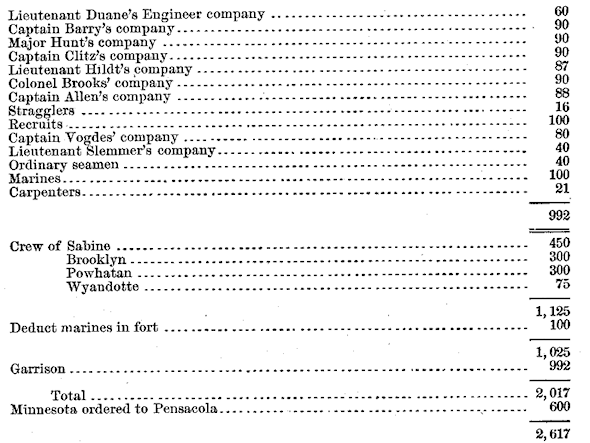
The Mohawk, at Key West, is ordered up to relieve the Wyandotte; and the St. Louis is at Key West, believed to be under orders for the Tortugas. Crusader is here to return to Key West in a day or two.

The expedition is under great obligations to the sailors of the fleet, who were ready and untiring in the severe labor of landing horses, ordnance, and stores of all kinds upon the sea beach, exposed at times to a heavy surf, which killed one horse and bilged several boats.

Lieutenants Brown, of the Powhatan, and Lewis, of the Sabine, remained on board the Atlantic for several days, directing the boats and seamen, and were of the greatest assistance to us.

Captain Gray, commanding this steamer, the Atlantic, deserves the thanks of the Government. None could exceed him in efforts for the success of the expedition and for the well-being and comfort of all on board. Night and day he and his crew worked at their posts embarking or disembarking men and stores. His skillful seamanship carried the vessel with the loss of only four horses through a most severe gale which lasted for thirty-six hours, and his watchfulness narrowly saved her from collision with a large vessel at night and during the height of the storm.

I have the honor to be, general, your obedient servant,

M. C. MEIGS,
Captain of Engineers.
—Colonel Van Dorn of the State troops of Texas captured four hundred and fifty United States troops at Saluria.—(Doc. 98.)

—Fort Smith, Arkansas, taken possession of by the State troops. About 12 o’clock at night a volunteer force of nearly three hundred men, under the command of Col. Solon Borland, landed at the wharf, when the post was formally surrendered by Capt. A. Montgomery to Gen. E Burgvein, Adjutant-General of the State, who placed Col. Borland in charge. About an hoar before their arrival Capt. Sturgis left with his command, consisting of two cavalry companies. He took away the horses belonging to his command, and such supplies as he could transport. He is falling back on Fort Washita.

Capt. Montgomery and Major Gatlin were taken prisoners, and afterward released on parole. The Confederate flag was raised on the fort at 12 o’clock, amid the firing of cannon and the cheers of the people. After the review three cheers were given for the Arkansas citizen soldiery, three cheers for Jeff. Davis, and three cheers for Gov. H. M. Rector. The stock and property taken possession of is estimated to be of the value of $300,000.—N. Y. Tribune, April 26.

—The Steam Transport Empire City, from Texas, arrived at New York, having on board the Third Regiment of Infantry and the Second Regiment of Cavalry, U. S. A., numbering six hundred men.—N. Y. Herald, April 26.

—An enthusiastic meeting of the British residents of the city was held at New York. Speeches were made by S. M. Saunders, (the President,) Colonel Shepherd, Rev. H. N. Hudson, C. C. Leigh, and others.—Idem.

—A deputation of twenty Indians, headed by White Cloud, in behalf of the Sioux and Chippeways, arrived in New York. They tender to the United States, in behalf of themselves and 800 other warriors, their services against rebellion. Having heard that the Cherokees had sided with the rebels, they could not remain neutral, and, with a promptness worthy of imitation in high quarters, have come to offer their services in defense of the Government. They ask to be armed and led.

White Cloud is the interpreter of the Sioux, and is a man of intelligence and true patriotic ardor. He visited the Quartermaster’s Department to-day, and addressed the soldiers being inspected there. He says, the men on the way are all good warriors, ranging from 18 to 40 years of age.—N. Y. Tribune, April 26.

—George Law addressed a letter to the President of the United States, demanding of Government the opening of lines of communication between Washington and the North.—(Doc. 99.)

—Governor Yates, in a special message to the Legislature of that State, gives the reasons that induced the armed occupation of Cairo city. He says, “That the transfer of part of the volunteer forces of this State to the city of Cairo was made in compliance with an order of the War Department, directing a force to be stationed at Cairo. Simultaneously with the receipt of the order, reliable information reached me of the existence of a conspiracy by disaffected persons in other states to seize upon Cairo and the southern portion of the Illinois Central Railroad, and cut off communication with the interior of the State. It was my desire that the honor of this service should have been given to the patriotic citizens of the counties in the immediate vicinity. But as these were not at that time organized and armed for patriotic duty, and the necessity for speedy action was imperative, the requisition was filled from companies previously tendered from other portions of the State.”—N. Y. Evening Post, April 29.

—The Gulf City Guards, of Mobile, Ala., Capt. Hartwell, left that place for Virginia. The Register says:—This is a fine and gallant company, of the flower of Mobile. Verily has Mobile contributed 400 of her best and most chivalrous youth in the four companies that have gone North, and yet the demand for marching orders has not abated in the least. Companies are offering their services and others are forming. Mobile has 4,500 fighting men. We have about 1,000 in the field, and the balance are ready to march. About 5 o’clock, the Guards moved from the armory, and marched up Royal to Dauphin, and down Dauphin to the steamer Selma, on board of which boat they took passage to Montgomery. —N. O. Picayune, April 28.

—General Harney, on his way to Washington, was arrested by the Virginia authorities at Harper’s Ferry. He left Wheeling, Va., for the purpose of reporting himself at headquarters at Washington. Before the train reached Harper’s Ferry it was stopped, and a number of troops mounted the platforms; whilst the train was moving slowly on, the troops passed through the cars, and the General being pointed out, he was immediately taken into custody.—N. Y. Times, April, 28.

—The Illinois troops struck a great blow at the secessionists of Missouri. Acting under orders from the President of the United States, an expedition of Illinois volunteers visited St. Loris, advanced upon the Federal Arsenal at that place, and brought away immense stores of artillery, ammunition, and small arms, which had been stored at that post by the Government.

The amount of Federal property thus secured from the hands of the Secessionists of Missouri is of great value. Among the articles recovered were 21,000 stand of small arms and a park of artillery. There was no fighting. The Illinois boys declare, in true Western style, that the “Secessionists are euchred.”—(Doc. 100.)

—At New Orleans, the steamship Cahawba was seized by Capt. Shivers, of the Caddo Rifles. Arranging his plans, selecting four of his men, and taking them armed in cabs, he proceeded to the foot of St. Joseph street, where the Cahawba was lying. Arriving there, the men jumped out of the cabs, formed in line, and Capt. Shivers, accompanied by Judge Price, boarded the steamer. The deck watch asked what was wanted. Captain Shivers replied he wanted to see the officer in command of the Cahawba. The watchman proceeded to the first mate’s room and announced the presence of a gentleman on board, who wanted to see him.

The mate came on deck, and Capt. Shivers politely told him to surrender the ship. The mate stated that the captain of the Cahawba was not on board, and therefore he had nothing to say. Capt. Shivers then ordered his men on board, put a guard fore and aft, and elsewhere, thus taking possession.—N. O. Delta, April 25.

The Cahawba was released soon after her seizure, by order of Gov. Moore, who had received orders from the Confederate Government prohibiting any obstruction to commerce in Southern ports—N. Y. Herald, April 27.

—The second detachment of Rhode Island troops passed through New York on their way to Annapolis, Md. The officers of the detachment are:—Lieutenant-Colonel commanding, J. T. Pitman; Major, Joe. W. Bolsch; Lieutenants, Carl C. Harris, Eddy, Luther; Lieutenant Colonel, Charles C. H. Day; Surgeon, M. McKnight.

The troops are subdivided as follows:—First Light Infantry, Mechanics’ Rifles, Westerly Rifles, Newport Artillery; Wesley Rifles; Providence Artillery, Cadets of Providence, East Greenwich detachment, and Pawtucket detachment. The troops are well armed, each company having eight of Burnside’s self-breech-loading rules. Their countenances are expressive of strong determination, and a glance at the texture of their hands will show plainly that they have come from the mechanical and hard working classes of Rhode Island. The women of Rhode Island are not behindhand in offering their services for their country. The volunteers bring along with them two very prepossessing young women, named Martha Francis and Katey Brownell, both of Providence, who propose to act as “daughters of the regiment,” after the French plan.

As a proof of the patriotic spirit which animates the citizens of Rhode Island, it may be mentioned that a man named William Dean, who lost one arm in the Mexican war, is now a volunteer in this corps, being willing to lose another limb in defence of the honor of his country. The noble fellow carries his musket slung behind his back, but it is said when the hour comes for bloodier action he can use it with as good effect and expertness as if in possession of his natural appendages. The regiment also carries a flag which was borne through all the terrors of the Revolution. The uniform of the Regiment is light and comfortable; it consists of a blue flannel blouse, gray pants, aid the army regulation hat.—N. Y. Herald.

—At Annapolis, Md., the grounds of the Naval Academy are now a military camp. Gen. Butler in command. The railroad between Annapolis and Washington is guarded with his troops. The track, which was destroyed by the rebels, has been relaid, and communication between the two cities is open. Gen. Butler has taken possession of the heights opposite Annapolis, and commanding that city.

The Maryland Legislature met to-day at Frederick. Gen. Butler says that if it passes an ordinance of secession, he will arrest the entire body!N. Y. Times, April 27.

—The New York Seventh Regiment arrived at Washington, marched up Pennsylvania avenue to the President’s house, and thence to the War Department. They were warmly applauded and hailed with great joy.—(Doc. 101).

—Governor Letcher of Virginia issued a proclamation, with accompanying documents, announcing the transfer of that State to the government of the Southern Confederacy, in advance of any expression of opinion by the People on the ordinance of secession passed on the 17th of April.—(Doc. 102.)

—A great Union meeting was held at Castleton, Vt. Over ten thousand persons were present. Speeches were made by P. W. Hyde, O. M. Willard, Willard Child, and others. Great enthusiasm prevailed. Forty-one men enrolled themselves as members of a volunteer company. The officers of the company are as follows: Captain, James Hope; First Lieutenant, John Howe; Second Lieutenant, Henry D. Noble.—N. Y. Times, April 27.

—Senator Douglas was publicly received by the Illinois Legislature, and made a patriotic speech, urging immediate action in support of the Government.—Chicago Tribune, April 26.

April 24th.—In the morning we found ourselves in chopping little sea-way for which the “Nina” was particularly unsuited, laden as she was with provisions and produce. Eyes and glasses anxiously straining seawards for any trace of the blockading vessels. Every sail scrutinized, but no ‘stars and stripes’ visible.

Our captain—a good specimen of one of the inland-water navigators, shrewd, intelligent, and active—told me a good deal about the country. He laughed at the fears of the whites as regards the climate. “Why, here am I,” said he,” going up the river, and down the river all times of the year, and at times of day and night when they reckon the air is most deadly, and I’ve done so for years without any bad effects. The planters whose houses I pass all run away in May, and go off to Europe, or to the piney wood, or to the springs, or they think they’d all die. There’s Captain Buck, who lives above here,—he comes from the State of Maine. He had only a thousand dollars to begin with, but he sets to work and gets land on the Macamaw River at twenty cents an acre. It was death to go nigh it, but it was first-rate rice land, and Captain Buck is now worth a million of dollars. He lives on his estate all the year round, and is as healthy a man as ever you seen.”

To such historiettes my planting friends turn a deaf ear. ” I tell you what,” said Pringle, “just to show you what kind our climate is. I had an excellent overseer once, who would insist on staying near the river, and wouldn’t go away. He fought against it for more than five-and-twenty years, but he went down with fever at last.” As the overseer was more than thirty years of age when he came to the estate, he had not been cut off so very suddenly. I thought of the quack’s advertisement of the “bad leg of sixty years standing.” The captain says the negroes on the river plantations are very well off. He can buy enough of pork from the slaves on one plantation to last his ship’s crew for the whole winter. The money goes to them, as the hogs are their own. One of the stewards on board had bought himself and his family out of bondage with his earnings. The State in general, however, does not approve of such practices.

At three o’clock p.m., ran into Charleston harbor, and landed soon afterwards.

I saw General Beauregard in the evening; he was very lively and in good spirits, though he admitted he was rather surprised by the spirit displayed in the North. “A good deal of it is got up, however,” he said “and belongs to that washy sort of enthusiasm which is promoted by their lecturing and spouting.” Beauregard is very proud of his personal strength, which for his slight frame is said to be very extraordinary, and he seemed to insist on it that the Southern men had more physical strength, owing to their mode of life and their education, than their Northern “brethren.” In the evening held a sort of tabaks consilium in the hotel, where a number of officers—Manning, Lucas Chesnut, Calhoun, &c.—discoursed of the affairs of the nation. All my friends, except Trescot, I think were elated at the prospect of hostilities with the North, and overjoyed that a South Carolinian regiment had already set out for the frontiers of Virginia.

WEDNESDAY 24

Another warm day with some rain in the afternoon. The day has passed off much as yesterday. No troops from the North. No mails since Friday, and in fact no news at all from the North. It is thought that there are troops enough here now for the safety of the City, as matters now look. But large bodies of Virginians have gathered near Alexandria and also north of us, and a decent may be made upon us anytime, but we are geting used to strange things now. I am alone in the room at the office now and have to do all the writing. Charley dined with us today.

______

The three diary manuscript volumes, Washington during the Civil War: The Diary of Horatio Nelson Taft, 1861-1865, are available online at The Library of  Congress.

Wednesday morning, 24th. Reveille at daybreak, when we fell in and stood under arms for half an hour, when, finding everything quiet, and no enemy in sight, we broke ranks and prepared breakfast. Authentic reports came in early that the railroad between this place and the junction has been destroyed, and all the bridges burnt. We have orders to march immediately after breakfast, but cannot do so until transportation for officers’ baggage, ammunition, etc., has been found; the quartermaster is at work, and has many varieties of wagons already engaged, drawn by mules, oxen, cows, and horses. The camp is still abundantly supplied by the colored folks with eatables, and we have filled our haversacks with boiled eggs, corn bread, and home-made pies.

The following statement in Hayes’s handwriting, evidently prepared about this time, shows what plans the citizens of Cincinnati were making to defend the city against possible attack from Kentucky.

To be ready on the day that Kentucky secedes to take possession of the hills on the Kentucky side which command Cincinnati, or the approaches to it, and prepare to hold them against any force.

a. Regiments ready to cross on short notice with arms; ammunition, provisions, tools, etc., for entrenching; cannon, boats, and all essentials.

b. Cut off telegraphic communication south from Covington and Newport.

c. Also railroad communication.

d. Take all boats; fortify all hills, etc.

e. The prevention of raids to rob banks, etc.

Spies to Frankfort with passwords for dispatches, etc.

RALEIGH, April 24, 1861.

Hon. L. P. WALKER

You shall have from one to ten thousand volunteers in a few days, with arms, and I wish them to go as State troops. Many of our men will enlist in Confederate Army. Will have a regiment ready in four days. Funds will be required for transportation, as I cannot lawfully draw on the State treasury for this purpose. I am anxious to send at least three regiments. Our legislature will meet in few days. I will not await, however.

JOHN W. ELLIS.

April 24.—Martial music is heard everywhere, day and night, and all the trappings and paraphernalia of war’s decorations are in great demand. The ladies are sewing everywhere, even in the churches. But the gay uniforms we see to-day will change their hue before the advent of another year. All history shows that fighting is not only the most perilous pursuit in the world, but the hardest and the roughest work one can engage in. And many a young man bred in luxury, will be killed by exposure in the night air, lying on the damp ground, before meeting the enemy. But the same thing may be said of the Northmen. And the arbitrament of war, and war’s desolation, is a foregone conclusion. How much better it would have been if the North had permitted the South to depart in peace! With political separation, there might still have remained commercial union. But they would not.

—A remarkable feature in the present war excitement is the alacrity with which citizens of foreign birth or origin, and even those who are not naturalized at all, are hastening to the defence of the Government and the national flag. There is hardly a foreign country represented in the North, the children whereof are not organizing regiments and tendering their services to the Government. —N. Y. Herald, April 27.

—Rumors of an attack on Fort Pickens continue to receive credence in some quarters.

—The Portsmouth (Va.) Transcript of the 23d April says:—”Despatches received last night give important and glorious news. Fort Pickens was taken by the South. The loss on our side is said to be heavy. One despatch states the loss on the side of the South at 2,500 men; but the victory is ours.”

Immediately after the above, the Baltimore Sun says that it is enabled to state “on the authority of a private despatch, received in this city last night, that the report of the battle is incorrect.”

—The Twenty-fifth Regiment of N. Y. State Militia, from Albany, with a party of regulars and one hundred and seventy-five men of the Seventh New York Regiment left New York for the seat of war— N. Y. Tribune, April 25.

—A volunteer company was organized at Sag Harbor, and $3,000 subscribed by the citizens for the benefit of the families of the volunteers.—Idem, April 26.

—Daniel Fish, gunmaker, of the city of New York, was arrested and handed over to the custody of the United States Marshal on a charge of treason, and misprision of treason, in having sent off large quantities of arms for the use of the Southern traitors. The correspondence and bills of lading found in his possession abundantly sustain the charge. A man calling himself Dr. Sabo, was also arrested, and is now in the bands of the United States authorities for recruiting men for the Southern navy. The papers which he used for the purpose were headed “United States of America,” and purported to be authorized by the United States Collector and Naval Officer of Charleston. As there are no such officers at that port acting in behalf of the United States of America, it is evident that the intention was to enlist men under a false pretence, and, after getting them to Charleston, impress them into the service of the C. S. A.—N. Y. Tribune, April 25.

—Messrs. Hotchkiss & Sons, of Sharon, Connecticut, offered the Governor of their State a bronze rifled cannon, (16-pounder,) and all of their patent projectiles which can be fired from it during the war. Gov. Buckingham has accepted the gift. They also offered to produce additional rifled cannon and projectiles at cost—Idem.

—Beriah Magoffin, Governor of Kentucky, issued a proclamation calling upon the State to place herself in a state of defence; and convening the Legislature on the 6th day of May, to take such action as may be necessary for the general welfare.—(Doc. 94.)

—The Navy Department at Washington signified its approbation of the loyalty, spirit, and good conduct of William Conway, an aged seaman, doing duty as Quartermaster in the Warrington Navy Yard, Florida, at the time of its surrender, in promptly and indignantly refusing to obey, when ordered by Lieutenant F. B. Renshaw to haul down the national flag.—National Intelligencer, May 3.

—There was an immense Union meting at Detroit, Michigan. General Cass presided and delivered a short but effective speech.—(Doc. 95.)

—Two thousand federal troops are stationed at Cairo, Illinois. Of these, says the Charleston Courier of the 30th April, “fully three hundred are supposed to be negroes, and the remainder have been picked up from the gutters of Chicago, and among the Dutch. A force of one thousand firm-hearted Southern men would drive them from the place, if the attack was properly made.”

—The members of the Brown High School at Newburyport, Mass., raised the American flag near their school building in the presence of a large concourse of citizens. Patriotic speeches were made by Caleb Cushing and others.—(Doc. 96.)

—John Letcher, governor of Virginia, issued a proclamation authorizing the release of all private vessels and property seized by the State except the steamships Jamestown and Yorktown; advising the people to return to their usual avocations, promising them protection, and appealing to them “not to interfere with peaceable, unoffending citizens who preserve the peace and conform to our laws.”—(Doc. 97.)

April 23.—Several prominent citizens telegraphed President Davis to-day to hasten to Virginia with as many troops as he can catch up, assuring him that his army will grow like a snow-ball as it progresses. I have no doubt it would. I think it would swell to 50,000 before reaching Washington, and that the people on the route would supply the quartermaster’s stores, and improvise an adequate commissariat. I believe he could drive the Abolitionists out of Washington even yet, if he would make a bold dash, and that there would be a universal uprising in all the border States this side of the Susquehanna. But he does not respond. Virginia was too late moving, and North Carolina, Tennessee, Arkansas, Kentucky, and Missouri have not seceded yet — though all of them will soon follow Virginia. Besides, the vote on the ratification in this State is to take place a month hence. It would be an infringement of State rights, and would be construed as an invasion of Virginia! Could the Union men in the Convention, after being forced to pass the ordinance, have dealt a more fatal blow to their country? But that is not all. The governor is appointing his Union partisans to military positions. Nevertheless, as time rolls on, and eternal separation is pronounced by the events that must be developed, they may prove true to the best interests of their native land.

Every hour there are fresh arrivals of organized companies from the country, tendering their services to the governor; and nearly all the young men in the city are drilling. The cadets of the Military Institute are rendering good service now, and Professor Jackson is truly a benefactor. I hope he will take the field himself; and if he does, I predict for him a successful career.