Following the American Civil War Sesquicentennial with day by day writings of the time, currently 1863.

March 2011

HEADQUARTERS FORT TAYLOR, FLA.,
March 27, 1861.

T. A. M. CRAVEN,

Lieutenant, Commanding U. S. Steamer Crusader, Harbor of Key West:

SIR: In reference to our conversation this morning and the letter shown by you to myself, and with the desire that we may act together should an occasion occur, I deem it advisable to state that this fort is fully garrisoned with veteran soldiers, and I believe it is entirely within my power to control this island and to prevent a lodgment thereon by any hostile force whatsoever; further, that I intend to treat any attempt to do so as an overt act of war, to be met at its initiation. I have no specific instructions from the War Department, but the course of my duty is clear, and I mean to follow it.

I am, sir, very respectfully, your most obedient servant,

WM. H. FRENCH,
Brevet Major, First Artillery, Commanding.

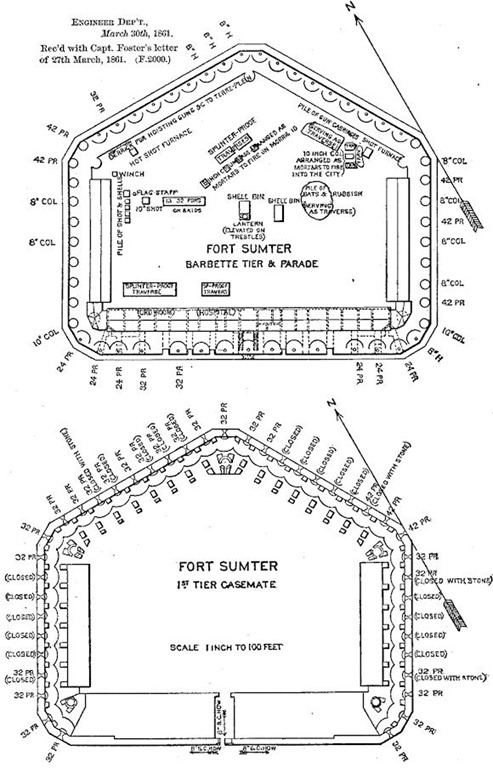
Official drawings from War of the Rebellion: a Compilation of the Official Records of the Union and Confederate Armies

(click on image to view larger version of drawing)

Sketches of Fort Sumter, March, 1861

There is no specific entry in the book for March 26th.  However, since there is a clear demarcation of arrival at Washington, the entry for the 25th is split at this point for publication in this blog.–MpG 1/23/2011

March 26th.–At six A.M., we were roused up by the arrival of the train at Washington, having crossed great rivers and traversed cities without knowing it during the night. I looked out and saw a vast mass of white marble towering above us on the left, stretching out in colonnaded porticoes, and long flanks of windowed masonry, and surmounted by an unfinished cupola, from which scaffold and cranes raised their black arms. This was the Capitol. To the right was a cleared space of mud, sand, and fields studded with wooden sheds and huts, beyond which, again, could be seen rudimentary streets of small red brick houses, and some church-spires above them.

Emerging from the station, we found a vociferous crowd of blacks, who were the hackney-coachmen of the place; but Mr. Sanford had his carriage in waiting, and drove me straight to Willard’s Hotel where he consigned me to the landlord at the bar. Our route lay through Pennsylvania avenue—a street of much breadth and length, lined with ælanthus trees, each in a white-washed wooden sentry box, and by most irregularly-built houses in all kinds of material, from deal plank to marble—of all heights, and every sort of trade. Few shop-windows were open, and the principal population consisted of blacks, who were moving about on domestic affairs. At one end of the long vista there is the Capitol; and at the other, the Treasury buildings—a fine block in marble, with the usual American classical colonnades.

Close to these rises the great pile of Willard’s Hotel, now occupied by applicants for office, and by the members of the newly-assembled Congress. It is a quadrangular mass of rooms, six stories high, and some hundred yards square; and it probably contains at this moment more scheming, plotting, planning heads, more aching and joyful hearts, that any building of the same size ever held in the world. I was ushered into a bed-room which had just been vacated by some candidate—whether he succeeded or not I cannot tell, but if his testimonials spoke truth, he ought to have been selected at once for the highest office. The room was littered with printed copies of letters testifying that J. Smith, of Hartford, Conn., was about the ablest, honestest, cleverest, and best man the writers ever knew. Up and down the long passages doors were opening and shutting for men with papers bulging out of their pockets, who hurried as if for their life in and out, and the building almost shook with the tread of the candidature, which did not always in its present aspect justify the correctness of the original appellation.

It was a remarkable sight, and difficult to understand unless seen. From California, Texas, from the Indian Reserves, and the Mormon territory, from Nebraska, as from the remotest borders of Minniesota, from every portion of the vast territories of the Union, except from the Seceded States, the triumphant republicans had winged their way to the prey.

There were crowds in the hall through which one could scarce make his way — the writing-room was crowded, and the rustle of pens rose to a little breeze —the smoking-room, the bar, the barbers, the reception-room, the ladies’ drawing-room—all were crowded. At present not less than 2,500 people dine in the public room every day. On the kitchen floor there is a vast apartment, a hall without carpets or any furniture but plain chairs and tables, which are ranged in close rows, at which flocks of people are feeding, or discoursing, or from which they are flying away. The servants never cease shoving the chairs to and fro with a harsh screeching noise over the floor, so that one can scarce hear his neighbor speak. If he did, he would probably hear as I did, at this very hotel, a man order breakfast, “Black tea and toast, scrambled eggs, fresh spring shad, wild pigeon, pigs’ feet, two robins on toast, oysters,” and a quantity of breads and cakes of various denominations. The waste consequent on such orders is enormous — and the ability required to conduct these enormous establishments successfully is expressed by the common phrase in the States, “Brown is a clever man, but he can’t manage an hotel.” The tumult, the miscellaneous nature of the company — my friends the prize-fighters are already in possession of the doorway—the heated, muggy rooms, not to speak of the great abominableness of the passages and halls, despite a most liberal provision of spittoons, conduce to render these institutions by no means agreeable to a European. Late in the day I succeeded in obtaining a sitting-room with a small bed-room attached, which made me somewhat more independent and comfortable—but you must pay highly for any departure from the routine life of the natives. Ladies enjoy a handsome drawing-room, with piano, sofas, and easy chairs, all to themselves.

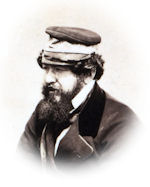
I dined at Mr. Sanford’s, where I was introduced to Mr. Seward, Secretary of State; Mr. Truman Smith, an ex-senator, much respected among the Republican party; Mr. Anthony, a senator of the United States, a journalist, a very intelligent looking man, with an Israelitish cast of face; Colonel Foster of the Illinois railway, of reputation in the States as a geologist; and one or two more gentlemen. Mr. Seward is a slight, middle-sized man, of feeble build, with the stoop contracted from sedentary habits and application to the desk, and has a peculiar attitude when seated, which immediately attracts attention. A well-formed and large head is placed on a long, slender neck, and projects over the chest in an argumentative kind of way, as if the keen eyes were seeking for an adversary; the mouth is remarkably flexible, large but well formed, the nose prominent and aquiline, the eyes secret, but penetrating, and lively with humor of some kind twinkling about them; the brow bold and broad, but not remarkably elevated; the white hair silvery and fine—a subtle, quick man, rejoicing in power, given to perorate and to oracular utterances, fond of badinage, bursting with the importance of state mysteries, and with the dignity of directing the foreign policy of the greatest country—as all Americans think—in the world. After dinner he told some stories of the pressure on the President for place, which very much amused the guests who knew the men, and talked freely and pleasantly of many things —stating, however, few facts positively. In reference to an assertion in a New York paper, that orders had been given to evacuate Sumter, “That” he said, “is a plain lie—no such orders have been given. We will give up nothing we have—abandon nothing that has been entrusted to us. If people would only read these statements by the light of the President’s inaugural, they would not be deceived.” He wanted no extra session of Congress. History tells us that kings who call extra parliaments lose their heads,” and he informed the company he had impressed the President with his historical parallels.

All through this conversation his tone was that of a man very sanguine, and with a supreme contempt for those who thought there was anything serious in secession. “Why,” said he, “I myself, my brothers, and sisters, have been all secessionists — we seceded from home when we were young, but we all went back to it sooner or later. These States will all come back in the same way.” I doubt if he was ever in the South; but he affirmed that the state of living and of society there was something like that in the State of New York sixty or seventy years ago. In the North all was life, enterprise, industry, mechanical skill. In the South there was dependence on black labor, and an idle extravagance which was mistaken for elegant luxury—tumble-down old hackney-coaches, such as had not been seen north of the Potomac for half a century, harness never cleaned, ungroomed horses, worked at the mill one day and sent to town the next, badly furnished houses, bad cookery, imperfect education. No parallel could be drawn between them and the Northern States at all. “You are all very angry,” he said, “about the Morrill tariff. You must, however, let us be best judges of our own affairs. If we judge rightly, you have no right to complain; if we judge wrongly, we shall soon be taught by the results, and shall correct our error. It is evident that if the Morrill tariff fulfils expectations, and raises a revenue, British manufacturers suffer nothing, and we suffer nothing, for the revenue is raised here, and trade is not injured. If the tariff fails to create a revenue, we shall be driven to modify or repeal it.”

The company addressed him as “Governor,” which led to Mr. Seward’s mentioning that when he was in England he was induced to put his name down with that prefix in a hotel book, and caused a discussion among the waiters as to whether he was the “Governor” of a prison or of a public company. I hope the great people of England treated Mr. Seward with the attention due to his position, as he would assuredly feel and resent very much any slight on the part of those in high places. From what he said, however, I infer that he was satisfied with the reception he had met in London. Like most Americans who can afford it, he has been up the Nile. The weird old stream has great fascinations for the people of the Mississippi —as far at least as the first cataract.

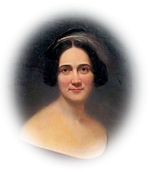
CHARLESTON, S. C, March 26, 1861—I have just just come from Mulberry, where the snow was a foot deep—winter at last after months of apparently May or June weather. Even the climate, like everything else, is upside down. But after that den of dirt and horror, Montgomery Hall, how white the sheets looked, luxurious bed linen once more, delicious fresh cream with my coffee! I breakfasted in bed.

Dueling was rife in Camden. William M. Shannon challenged Leitner. Kochelle Blair was Shannon’s second and Artemus Goodwyn was Leitner’s. My husband was riding hard all day to stop the foolish people. Mr. Chesnut finally arranged the difficulty. There was a court of honor and no duel. Mr. Leitner had struck Mr. Shannon at a negro trial. That’s the way the row began. Everybody knows of it. We suggested that Judge Withers should arrest the belligerents. Dr. Boykin and Joe Kershaw¹ aided Mr. Chesnut to put an end to the useless risk of life.

John Chesnut is a pretty soft-hearted slave-owner. He had two negroes arrested for selling whisky to his people on his plantation, and buying stolen corn from them. The culprits in jail sent for him. He found them (this snowy weather) lying in the cold on a bare floor, and he thought that punishment enough; they having had weeks of it. But they were not satisfied to be allowed to evade justice and slip away. They begged of him (and got) five dollars to buy shoes to run away in. I said: “Why, this is flat compounding a felony.” And Johnny put his hands in the armholes of his waistcoat and stalked majestically before me, saying, “Woman, what do you know about law?”

Mrs. Reynolds stopped the carriage one day to tell me Kitty Boykin was to be married to Savage Heyward. He has only ten children already. These people take the old Hebrew pride in the number of children they have. This is the true colonizing spirit. There is no danger of crowding here and inhabitants are wanted. Old Colonel Chesnut² said one day: “Wife, you must feel that you have not been useless in your day and generation. You have now twenty-seven great-grandchildren.”

____

¹ Joseph B. Kershaw, a native of Camden, S. C, who became famous in connection with “The Kershaw Brigade” and its brilliant record at Bull Run, Fredericksburg, Chickamauga, Spottsylvania, and elsewhere throughout the war.

²Colonel Chesnut, the author’s father-in-law, was born about 1760. He was a prominent South Carolina planter and a public-spirited man. The family had originally settled in Virginia, where the farm had been overrun by the French and Indians at the time of Braddock’s campaign, the head of the family being killed at Fort Duquesne. Colonel Chesnut, of Mulberry, had been educated at Princeton, and his wife was a Philadelphia woman. In the final chapter of this Diary, the author gives a charming sketch of Colonel Chesnut.

TUESDAY, MARCH 26, 1861.

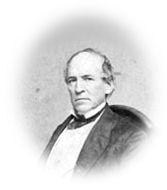
Another warm pleasant day with some wind, rained some last night. At work hard in the office and very much fatigued tonight. Julia called for me from her school after calling upon Mr Alexander of the Seed Room and geting some garden & flower seeds. I did not go down to the Ave this evening. Took a walk with Julia up 14th St after taking short nap on the sofa. Read the days news in the “Star,” heard the boys read some. Their mother thrumed the Piano some. I have noded some, am off to bed at 1/2 past 9.

______

The three diary manuscript volumes, Washington during the Civil War: The Diary of Horatio Nelson Taft, 1861-1865, are available online at The Library of  Congress.

FORT SUMTER, S.C., March 26, 1861.
(Received A. G. O., March 29.)

Col. L. THOMAS, Adjutant-General U. S. Army:

“I inclose herewith a correspondence between the South Carolina officials and myself in reference to some points to which attention was called some time since.”

COLONEL: I have the honor to report that quite a large party is busy this morning on what is probably a bomb-proof in rear of the large work near Fort Johnson. They have extended and heightened several of the works on Morris Island, particularly No. 1 of Captain Seymour’s sketches.

We are constructing splinter-proofs on the parade, and closing the opening in the gorge wall. I have the honor to mention that Mr. Lamon, from Washington City, visited me yesterday.

I am, colonel, very respectfully, your obedient servant,

ROBERT ANDERSON,

Major, First Artillery, Commanding.

P. S.–I inclose herewith a correspondence between the South Carolina officials and myself in reference to some points to which attention was called some time since. Expecting a reply to my last communication, I have delayed sending these letters off, but now do so, as no rejoinder will probably be made.

Respectfully,

R. A.

[Inclosure No. 1.]

FORT SUMTER, S.C., March 13, 1861.

His Excellency Gov. F. W. PICKENS:

SIR: I have the honor herewith respectfully to inclose, for the consideration of your excellency, a note received yesterday by the clerk of Captain Foster from the beef contractor, which appears to show an interference with your excellency’s orders.

I am confident in the event of your excellency having made any change in your instructions in reference to my supplies I would have been promptly notified thereof. A similar interference may have prevented my receiving some boxes of solidified milk, which have been several days in the city to my address and which cannot have been detained on account of freight, as it was prepaid. This certainly would not, in the eyes of the transportation agent, come under the head of contraband of war or prohibited articles. It may be as well for me to mention here a few points which have not received that attention to which I think they are entitled.

About six weeks ago I sent, under cover to Col. L. M. Hatch, quartermaster-general, a note from Sergeant Renehan, of this command, to his brother-in-law, asking him to send from Fort Moultrie his private property, which was already packed up, and I respectfully asked Colonel Hatch if he would be pleased to give it his attention. No reply has been received to my communication, nor have the articles been sent.

About a month since instructions were given by the honorable Secretary of War that Captain Foster’s private property on Sullivan’s Island, as well as some public papers in the office in Charleston, should be sent down. Neither the property nor the papers have yet been received here.

Early in January I sent some officers to Fort Moultrie for certain private property left there. They were received in so different a manner from the civility and courtesy that characterized the manner of Colonel De Saussure that I have not ventured to make another attempt to obtain possession of it, and I am thus cut off from regimental books (not public property) and office papers, valuable to us, and merely interesting to others.

Some of the officers of this command have been put to considerable inconvenience and discomfort by the detention in the city of their hired servant, who left the post with a permit from the honorable Secretary of War. His detention after the discovery that the correspondence, at first characterized as a “very improper one,” proved to be “nothing more than what might have been expected between any silly persons in their situations,” is unwarranted. I attached no importance to this matter from the first, and so remarked to a gentleman who came down to see me in reference to it. No one, not even an owner of a slave, would have a right, under such circumstances, to prevent his return, and it was undoubtedly called for in this case by common civility and courtesy as the officers have no opportunity of replacing him.

In regard to packages arriving from time to time, through the express or otherwise, if it is necessary to trouble your excellency for special permits whenever articles of such mirror importance as condiments, &c., are to be sent down to us, it is questionable with me whether it would not be better for us to do without them altogether, and to send instructions to the various express companies not to receive any packages destined for my command.

With sentiments of high consideration and regard,

I am, very respectfully, your excellency’s obedient servant,

ROBERT ANDERSON,

Major, U. S. Army, Commanding.

[Inclosure No. 2.]

EXECUTIVE OFFICE, DEPARTMENT OF WAR,
Charleston, S. C., March 15, 1861.

Maj. ROBERT ANDERSON:

SIR: I am instructed by his excellency the governor to inform you that he is unwilling to modify his original permission that you should receive from the markets in this city such supplies of fresh meat and vegetables as you might indicate. A proper investigation will be instituted to inquire what obstacle has been interposed to the execution of the orders given on the subject.

I will inquire why Lieutenant-Colonel Hatch has not sent the private property of Sergeant Renehan which was left at Fort Moultrie.

With respect to the furniture left by Captain Foster in the house occupied by him before he left Sullivan’s Island, and the papers, &c., left in his office in this city, I reply that Captain Simonton was requested to separate the furniture claimed by Captain Foster from his own, and send it to Fort Sumter through the quartermaster-general. This has been delayed, I believe, chiefly on account of some reclamations on the part of Captain Simonton for injuries done to his own furniture during the time the house was occupied by Captain Foster, and for rent. I have been informed that the matter has been attended to by Captain Simonton within the past few days, and I will take steps to have Captain Foster’s property sent to him without delay. As to the papers, Mr. Legaré, who was indicated by Captain Foster as a proper person to carry out his wishes, reported to me that he had collected and sent the papers, &c., to Captain Foster.

With respect to the property which you failed to recover from Fort Moultrie, I am informed by Lieutenant-Colonel Ripley that he sent word to you that if you would transmit an inventory of any articles of property left by you he would endeavor to collect and send them to you, but that he received no reply to his offer.

As to the servant referred to in your letter, it is proper that I should say that I am unwilling to discuss any question of right or courtesy growing out of the case beyond the unquestionable privilege of a slave owner to permit or not, at his own pleasure, the return of his slave to a hostile fort; but, as you have put a different interpretation on the language employed by me in my letters on the subject than I designed, I desire to state what I did mean: “The very improper correspondence” between the slaves to which I alluded had reference to the slaves alone, as information was given by the woman to the boy of operations in this city which were not proper to be communicated to any one in your garrison, and the reply of the boy clearly showed that his temper and principles had not been improved by a residence in Fort Sumter. The other words of mine, which you quote–“nothing more than what might have been expected between silly persons in their situation”–were meant as kind expressions on my part, to disabuse the minds of Dr. Crawford and other officers at the fort of any unfavorable impression upon me of a complicity on their part with the improper correspondence of idle negroes.

I am, sir, respectfully, yours,

D. F. JAMISON.

[Inclosure No. 3.]

FORT SUMTER, S. C., March 17, 1861.

Hon. D. F. JAMISON, Executive Office, Department of War:

SIR: I have the honor to acknowledge the receipt of your communication of the 15th instant in reply to mine of the 13th to his excellency the governor.

I hasten to ask you to refer to my letter to his excellency, and you will see that I did not solicit any modification of his original permission about receiving supplies of fresh meat and vegetables. I am satisfied with the existing arrangement, and only called attention to a reported interference of it. I thank you for your promise in reference to the property of Captain Foster.

Lieutenant-Colonel Ripley did kindly offer to attend to collecting any “private property” left on the island by the officers, and I thanked him for having done so.

The property alluded to in my note is not, strictly speaking, private, but belongs to the regiment or post, and therefore was not, in my opinion, embraced in his offer. My object in mentioning this matter was to call attention to it, in order that such directions might be given regarding it as might be deemed proper.

I beg leave to assure you that I had no desire to discuss the question of right or of courtesy in reference to the treatment my officers received in the failure to return the hired boy, and my remarks were intended to apply to the professed owner of the boy, who, neglecting his duty as owner or master for months, had permitted the boy to hire himself out, every one supposing him to be free, and now, at a time when the exercise of his “undoubted right” puts gentlemen here to a serious inconvenience, for the first time asserts his rights of ownership.

His excellency mentions in his letter to me, received yesterday, that the boy is a slave, and, of course, that ends the matter. In justice to myself I must state that I did not intentionally place a forced construction on your words. The day your first letter was received about the boy a gentlemen came down to see me about the “improper correspondence,” which he was told had reference to the negroes joining us in the event of a collision. He remarked to his informants, as he told me, that he thought it a foolish story, advised them to say nothing about it, and said that he was certain, at all events, that I had no idea of anything of the kind, and came down to tell me of the rumor.

I regret exceedingly that your letter contains the remark it does in reference to the effect of a residence at Fort Sumter on the boy’s “temper and principles,” and I am satisfied that, upon further consideration, you will regret it.

I am, sir, respectfully, yours, &c.,

ROBERT ANDERSON,

Major, U. S. Army, Commanding.

HDQRS. PROVISIONAL ARMY CONFEDERATE STATES,

Charleston, S.C., March 26, 1861.

Hon. L. P. WALKER,

Secretary of War, Montgomery, Ala.:

SIR: The Department letter of the 21st has been received, and I inclose you herewith the copy of the letter I have thought proper to address to Maj. Robert Anderson, with whom I am personally well acquainted. His answer will be communicated to the Department as soon as received, and I have no doubt it will be satisfactory. Mr. Lamon left here last night, saying that Major Anderson and command would soon be withdrawn from Fort Sumter in a satisfactory manner. I am, however, progressing with my offensive and defensive batteries, which will all be finished and armed to-morrow night or the day after. I find great difficulty, for want of an ordnance officer, in properly organizing the armament, &c., of said batteries. I have this day had assigned to me for that duty Lieutenant Rutledge, South Carolina Navy, who I hope will be of assistance to me in that department.

As already telegraphed, Capt. W. H. Stevens, of the Engineers, is not at present required here. He might be usefully employed at Savannah if not wanted elsewhere, or I may soon have need of him for the defenses of the sea coast of South Carolina, which I may have to order hereafter.

Four of the Drummond lights ordered for this harbor have this day arrived, with the required instructions, a copy of which is herewith inclosed. No operator could be sent with them. I have procured the welcome and generous services of Professor Gibbes, of Charleston College, for the purpose of instructing a proper person here in their use. I have no doubt that Professor Riddle, of New Orleans, postmaster, would be happy to give his assistance in a like manner for the six sent there, two of which might be sent to Pensacola or some other harbor. With four here we shall have enough now.

I remain, sir, very respectfully, your obedient servant,

G. T. BEAUREGARD,

Brigadier-General, Commanding.

March 25th.—I had an invitation to meet several members of the New York press association at breakfast. Among the company were—Mr. Bayard Taylor, with whose extensive notes of travel his countrymen are familiar — a kind of enlarged Inglis, full of the genial spirit which makes travelling in company so agreeable, but he has come back as travellers generally do, satisfied there is no country like his own—Prince Leeboo loved his own isle the best after all—Mr. Raymond, of the “New York Times” (formerly Lieutenant-Governor of the State); Mr. Olmsted, the indefatigable, able, and earnest writer, whom to describe simply as an Abolitionist would be to confound with ignorant if zealous, unphilosophical, and impracticable men; Mr. Dana, of the “Tribune;” Mr. Hurlbert, of the “Times;” the Editor of the “Courier des Etats Unis;” Mr. Young, of the “Albion,” which is the only English journal published in the States; and others. There was a good deal of pleasant conversation, though every one differed with his neighbor, as a matter of course, as soon as he touched on politics. There was talk de omnibus rebus et quibusdam aliis, such as Heenan and Sayers, Secession and Sumter, the press, politicians, New York life, and so on. The first topic occupied a larger place than it was entitled to, because in all likelihood the sporting editor of one of the papers who was present expressed, perhaps, some justifiable feeling in reference to the refusal of the belt to the American. All admitted the courage and great endurance of his antagonist, but seemed convinced that Heenan, if not the better man, was at least the victor in that particular contest. It would be strange to see the great tendency of Americans to institute comparisons with ancient and recognized standards, if it were not that they are adopting the natural mode of judging of their own capabilities. The nation is like a growing lad who is constantly testing his powers in competition with his elders. He is in his youth and nonage, and he is calling down the lanes and alleys to all comers to look at his muscle, to run against or to fight him. It is a sign of youth, not a proof of weakness, though it does offend the old hands and vex the veterans.

Then one finds that Great Britain is often treated very much as an old Peninsula man may be by a set of young soldiers at a club. He is no doubt a very gallant fellow, and has done very fine things in his day, and he is listened to with respectful endurance, but there is a secret belief that he will never do anything very great again.

One of the gentlemen present said that England might dispute the right of the United States Government to blockade the ports of her own States, to which she was entitled to access under treaty, and might urge that such a blockade was not justifiable; but then, it was argued, that the President could open and shut ports as he pleased; and that he might close the Southern ports by a proclamation in the nature of an Order of Council. It was taken for granted that Great Britain would only act on sordid motives, but that the well known affection of France for the United States is to check the selfishness of her rival, and prevent a speedy recognition.

After our pleasant breakfast came that necessity for activity which makes such meals disguised as mere light morning repasts take their revenge. I had to pack up, and I am bound to say the moral aid afforded me by the waiter, who stood with a sympathizing expression of face, and looked on as I wrestled with boots, books, and great coats, was of a most comprehensive character. At last I conquered, and at six o’clock p.m. I left the Clarendon, and was conveyed over the roughest and most execrable pavements through several miles of unsympathetic, gloomy, dirty streets, and crowded thoroughfares, over jaw-wrenching street-railway tracks, to a large wooden shed covered with inscriptions respecting routes and destinations on the bank of the river, which as far as the eye could see, was bordered by similar establishments, where my baggage was deposited in the mud. There were no porters, none of the recognized and established aides to locomotion to which we are accustomed in Europe, but a number of amateurs divided the spoil, and carried it into the offices, whilst I was directed to struggle for my ticket in another little wooden box, from which I presently received the necessary document, full of the dreadful warnings and conditions, which railway companies inflict on the public in all free countries.

The whole of my luggage, except a large bag, was taken charge of by a man at the New York side of the ferry, who “checked it through” to the capital—giving me a slip of brass with a number corresponding with a brass ticket for each piece. When the boat arrived at the stage at the other side of the Hudson, in my innocence I called for a porter to take my bag. The passengers were moving out of the capacious ferry-boat in a steady stream, and the steam throat and bell of the engine were going whilst I was looking for my porter; but at last a gentleman passing, said, “I guess y’ill remain here a considerable time before y’ill get any one to come for that bag of yours;” and taking the hint, I just got off in time to stumble into a long box on wheels, with a double row of most uncomfortable seats, and a passage down the middle, where I found a place beside Mr. Sanford, the newly-appointed United States Minister to Belgium, who was kind enough to take me under his charge to Washington.

The night was closing in very fast as the train started, but such glimpses as I had of the continuous line of pretty-looking villages of wooden houses, two stories high, painted white, each with its Corinthian portico, gave a most favorable impression of the comfort and prosperity of the people. The rail passed through the main street of most of these hamlets and villages, and the bell of the engine was tolled to warn the inhabitants, who drew up on the side walks, and let us go by. Soon the white houses faded away into faint blurred marks on the black ground of the landscape, or twinkled with starlike lights, and there was nothing more to see. The passengers were crowded as close as they could pack, and as there was an immense iron stove in the centre of the car, the heat and stuffiness became most trying, although I had been undergoing the ordeal of the stove-heated New York houses for nearly a week. Once a minute, at least, the door at either end of the carriage was opened, and then closed with a sharp crashing noise, that jarred the nerves, and effectually prevented sleep. It generally was done by a man whose sole object seemed to be to walk up the centre of the carriage in order to go out of the opposite door —occasionally it was the work of the newspaper boy, with a sheaf of journals and trashy illustrated papers under his arm. Now and then it was the conductor; but the periodical visitor was a young gentleman with a chain and rings, who bore a tray before him, and solicited orders for “gum drops,” and “lemon drops,” which, with tobacco, apples, and cakes, were consumed in great quantities by the passengers.

At 10 o’clock, P.M., we crossed the river by a ferry boat to Philadelphia, and drove through the streets, stopping for supper a few moments at the La Pierre Hotel. To judge from the vast extent of the streets, of small, low, yet snug-looking houses, through which we passed, Philadelphia must contain in comfort the largest number of small householders of any city in the world. At the other terminus of the rail, to which we drove in a carriage, we procured for a small sum, a dollar I think, berths in a sleeping car, an American institution of considerable merit. Unfortunately a party of prizefighters had a mind to make themselves comfortable, and the result was anything but conducive to sleep. They had plenty of whiskey, and were full of song and fight, nor was it possible to escape their urgent solicitations “to take a drink,” by feigning the soundest sleep. One of these, a big man, with a broken nose, a mellow eye, and a very large display of rings, jewels, chains and pins, was in very high spirits, and informed us he was “Going to Washington to get a foreign mission from Bill Seward. He wouldn’t take Paris, as he didn’t care much about French or Frenchmen; but he’d just like to show John Bull how to do it; or he’d take Japan if they were very pressing.” Another told us he was “Going to the bosom of Uncle Abe” (meaning the President)—”that he knew him well in Kentucky years ago, and a high toned gentleman he was.” Any attempts to persuade them to retire to rest made by the conductors were treated with sovereign contempt, but at last whiskey asserted its supremacy, and having established the point that they “would not sleep unless they pleased,” they slept and snored.

MONDAY 25

This has been a delightful day, bright & warm. Have been very busy in the office, doing the work of two Desks or the Clerical duties of the room in addition to my own from the removal of our assist. Went down to the “National.” Saw Carl Shurz the famous Dutch Orator. And also met my old friend P Dorsheimer who is now State Treasurer of NY. He is after the N York Naval office. Got the NY papers & read them. Bed at 11.

______

The three diary manuscript volumes, Washington during the Civil War: The Diary of Horatio Nelson Taft, 1861-1865, are available online at The Library of  Congress.

FORT SUMTER, S.C., March 25, 1861.
(Received A. G. O., March 28.)

Col. L. THOMAS, Adjutant-General U. S A.:

COLONEL: I have the honor to report that everything is quiet around us, and that we do not see any work being prosecuted except that at the new battery at Fort Johnson. They are practicing this morning with shells from the columbiads at Fort Moultrie and from a mortar battery between Nos. 9 and 10.

I inclose herewith a report of the condition of our fort. It will be seen that a great deal of work has been done since we came in. We are now about finishing the closing of the openings in the gorge–a measure first suggested by Captain Doubleday.

I have not noted the different operations we have been engaged in from time to time, as I did not deem them of sufficient importance to require it.

I am, colonel, very respectfully, your obedient servant,

ROBERT ANDERSON,

Major, First Artillery, Commanding.

[Inclosure.]

FORT SUMTER, S.C., March 24, 1861.

Maj. ROBERT ANDERSON, First Artillery, Commanding:

SIR: In accordance with verbal instructions given by you, we have the honor to submit the following report upon the condition of Fort Sumter when occupied December 26, 1860, the measures taken to put it in a state of defense, and its present condition:

Condition of the work December 26, 1860.

The barbette tier was ready for its armament: Three 24-pounders were mounted at the left and three more were ready to be mounted at the right gorge angle.
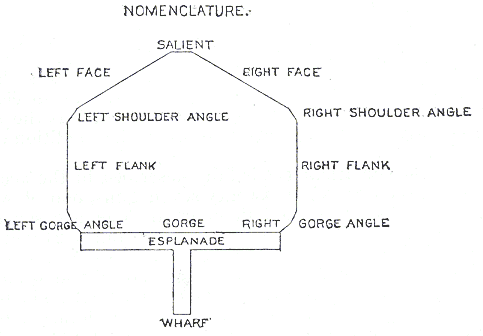
Fort Sumter, Charleston Harbor, March 25, 1861

The second tier of arches was not ready for its guns. The embrasures were not yet placed, and forty-one openings, eight feet square, were left in the scarp wall for this purpose. Those on the flanks (20) were closed only with a sheathing of 1-inch boards; the remainder, on the faces (21), were either entirely open or closed with three courses of brick dry-laid, or, as on the left face, With two courses laid in mortar; some few were only half closed. One 32-pounder was mounted, for experimental purposes, on the right flank.

First tier.–Eleven 32-pounders were mounted on the left face. Guns could be mounted throughout. The forty-one embrasures were closed with the ordinary 6-inch wooden shutters, secured with a wooden brace and rope lashing. Two small posterns in the gorge angles were closed, each with two doors, the outer hooked, the inner barred. The soldiers’ quarters were unfinished, and as those portions that were tenable were occupied by workmen, the transferred garrison was placed in the officers’ quarters, which were completed.

The parade was crowded with temporary wooden buildings (6), used as shops and storehouses, with a large amount of flagging, lumber, sand, shell, and brick, and with the ordnance, consisting of sixty-six guns with their carriages and 5,600 shot and shell. The communications through these incumbrances were very difficult.

The main postern was closed by two gates, each of two 4-inch leaves, secured with wooden cross-bars; they were loopholed and were weak and insecure.

On the gorge seven loopholed doors were closed with 5-inch wooden shutters; twelve magazine ventilators with wooden shutters at the throat; fifty-one loopholed windows were not closed. The esplanade and wharf were much incumbered with flagging, sand, and brick, and by two apparatuses, twelve feet high and attached to the scarp wall, for hoisting boats.

The garrison transferred from Fort Moultrie consisted of seven officers, seventy-six enlisted men, and forty-five women and children. There were three officers, one enlisted man, two hundred and five laborers, and one woman at Fort Sumter. One hundred and fifty of the laborers were discharged within a few days, and the women and children were shipped to New York early in February, 1861, leaving at this date a garrison consisting of ten officers, seventy-five enlisted men, and fifty-five laborers. There has been and is an ample supply of water and a sufficiency of fuel, principally in the shape of lumber, flooring, and gun carriages.

Immediately after the transfer of the garrison to this place, and your assuming command, instructions were given to limit the defense to the barbette and first tier, closing all openings in that tier, except three or four at each angle, where guns were to be mounted, and all openings in the second tier, permanently and securely. The first labors were directed to mounting the proposed armament, and to closing these openings, after which such defenses were prepared as the situation of the garrison suggested, until this date, when the condition of the work is as follows:

Barbette tier.–The armament is fully described in the accompanying figure. It consists, in all, of twenty-seven guns, one of which, a 42-pounder, is mounted at the left shoulder angle on a casemate carriage placed on the chassis of a 10-inch columbiad, and a 24-pounder at the left gorge angle is so arranged and the parapet so cut away that it can be depressed to 18o and fired upon the end of the wharf. Several machicoulis galleries of 1 1/2-inch plank (five lined with 1/2-inch iron plate) are placed on the parapet, one on the center of each face and flank, and three on the gorge, over and commanding the main postern; 225 shells, mostly 8-inch, are arranged as grenades, to be rolled off the parapet and exploded by means of a lanyard of proper length. Thunder-barrels are placed at each angle and over the main gate; fragments of stone, brick, &c., along the breast-height for missiles; twenty-three flights of steps lead to the parapet; ammunition in limber-boxes is placed convenient for instant use, and grape, canister, shot, and shell in abundance at each gun. Some five hundred cartridge bags have been made. The powder is well stored in the first-story magazine in the left gorge angle.

Second tier.–The 32-pounder on the right flank is dismounted; the forty-one 8-foot square openings are securely closed by a 3-foot brick wall, laid in cement, and backed in twenty-seven by two feet of sand, kept in place by a sheathing of boards or by barrels, in eight by two feet of flagging-stones, laid dry, and in six by dry brick, or re-enforced only by piles of finishing-stuff and flooring-boards.

First tier.–The armament consists of twenty-seven guns, and is fully described in the plan adjoined. There are eighteen guns ready for instant service, sixteen of the embrasures in front of which are closed with the original 6-inch wooden shutter, and also with an inner 6-inch shutter fitting close to the throat, and through the center of which a link from the outer shutter passes; an iron key tightens both firmly together. Two are closed by iron shutters of 1/2-inch iron plate; all are further secured by a 10-foot brace abutting against the gun run “from battery.” Where guns are mounted (9), but not required for immediate use, the embrasures (9) are closed temporarily, in addition to the outer shutter, by stone flagging, notched to fit the throat and laid flat, or by brick laid in mortar. There are fourteen embrasures, behind which guns are not mounted, of which eight, on the flanks, are closed by an 18-inch brick wall laid in mortar against the outer shutter; one by the dry-stone flagging, and the remainder (five) on the right face, by an entire embrasure filling of brick and stone laid in mortar.

The doors of the two posterns on the flanks are strengthened by 3-foot brick walls laid in mortar against the outer doors.

On the parade four 8-inch and one 10-inch columbiads are mounted as mortars (see preceding plan), and point to Morris Island and Charleston. All the temporary buildings and the lumber have been removed for fuel, the flagging turned on edge against the quarters or in the ends of the casemates, the shell spread on the walks, the sand and brick used, with a stone revetment, for splinter-proof traverses about the guns and in front of the hospital. The lantern has been removed from the light-house and placed on a platform in the center. The entire parade is clear.

Main postern.–A stone and brick wall laid in cement is built against the outer gate to within four feet of the lintel. It is three feet six inches thick and six feet high. Through it is a manhole one foot eleven inches wide. An 8-inch sea-coast howitzer on a casemate-top carriage only looks through the manhole. In the door above the wall are four loopholes, reached by steps. One leaf of the gate is firmly bolted shut; the other can be opened or securely shut, and through it and corresponding with the manhole in the wall is a manhole closed by a door.
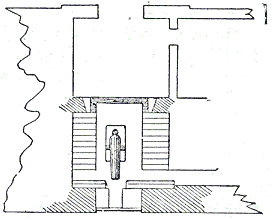
Fort Sumter, Charleston Harbor, March 25, 1861

The outside of the gate and inside of the small door are covered with ½-inch iron. The inner door is fastened with a wooden cross-bar, and has a manhole closed by a door; there are four loopholes in it, and two in the cross wall to which it is hung. Material is at hand with which to close the outer door permanently. The walls of the stairways leading   to the second floor are closed with 1½-inch plank, and openings over the postern are arranged for throwing grenades.
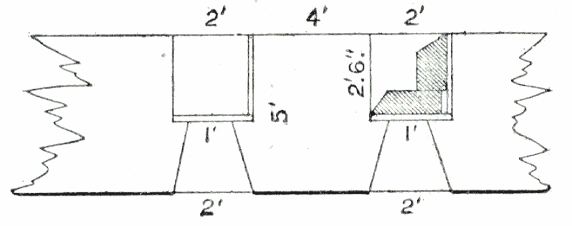
Fort Sumter, Charleston Harbor, March 25, 1861

The gorge.–In the second story the thirty-four windows and six magazine ventilators are protected by placing in each two wrought-iron embrasure jams, eight inches thick and three feet six inches long, permitting of musketry fire over them. In the first story the seven doors are closed with a 5-inch wooden shutter, against which, outside, is built a 9-inch brick wall, laid in cement, and outside this a pintle stone, 8 feet by 2 feet 2 inches by 1 foot 3 inches, with pieces of flagging, fastened in with wooden wedges and melted lead; the six magazine ventilators by large stones and lead against the wall and shutter; and fifteen windows are closed by the pintle stone and flagging, fastened with the wedges and lead. In all these openings the filling is placed against the offset at the throat, by which a solid wall, two feet thick and well secured in the rear, has been obtained.

On the esplanade two 8-inch sea-coast howitzers are mounted on casemate carriages only, one each side of the main gate, to sweep the gorge and the approaches to it. The stone &c., has been removed, leaving only a row along the edge to prevent grenades rolling off. Two fougasses, of 12 feet diameter, charged with 50 pounds of powder, are placed against the foot of the scarp wall, one in the center of each half gorge.

Two mines, charged with 25 pounds of powder, are sunk in the wharf 40 feet apart. A wooden fence, 8 feet high, at each end of the esplanade, extends from the scarp to low water. The stones of the enrockment in front of embrasures to be opened are removed. A deep cut in the enrockment on the left flank obstructs communication.

Respectfully submitted.

G. W. SNYDER,

First Lieutenant of Engineers, U. S. Army.

T. SEYMOUR,

Brevet Captain and First Lieutenant, First Artillery.

[Indorsement.]

FORT SUMTER, S.C., March 25, 1861.

Report exhibiting the work done at Fort Sumter since its occupation by the present garrison, and its condition at this date. Confidentially communicated for the information of the War Department.

ROBERT ANDERSON,

Major, First Artillery, Commanding.