Following the American Civil War Sesquicentennial with day by day writings of the time, currently 1863.

March 2011

HEADQUARTERS
PROVISIONAL FORCES,

Charleston, S.C.,
March
25, 1861.

Brig. Gen. S. COOPER, Adjutant-General C. S. Army:

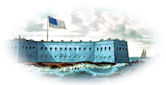
SIR: I have the honor to acknowledge the receipt of your two letters dated, respectively, the 20th and 21st instants, the former extending the limits of my command, &c.; the latter in relation to the recruiting service in Baltimore; also, a telegram from the Secretary of War in relation to the recruits. The instructions contained therein will be complied with. I will not leave this city until after the evacuation of Fort Sumter. Sixty-four recruits arrived here from Baltimore, under the charge of Mr. R. E. Haslett, on Saturday, the 23d instant, and were sent to Castle Pinckney. They will be enlisted to-day. Captain Childs and Lieutenants O’Brien and Robertson have been assigned to duty with them. The quartermaster-general of the State of South Carolina has kindly offered to furnish them with the necessary rations, clothing, &c., to be settled for hereafter. It would, perhaps, be economical to prescribe the uniform for the Regular Army as early as practicable. Mr. Haslett informs me that a bounty was promised these men, but does not know the amount–thinks about $25 or $30. I have, therefore, to request that you notify me what amount will be paid, and under what regulations, that I may cause the same to be noted on their muster and pay rolls. I am just informed that Lamon, special messenger from Washington, has arrived, and is now conferring with the governor.

I am sir, very respectfully, your obedient servant,

G. T. BEAUREGARD,

Brigadier-General, Commanding.

EXECUTIVE DEPARTMENT,
State of South Carolina, March 25, 1861.

[General BEAUREGARD?]:

MY DEAR SIR: I sent Lamon to Major Anderson, and all right. Will see you as soon as I can. I told him we would agree to evacuation upon any honorable and reasonable terms, but would not suffer any war vessel to come up to the fort, and everything must be conducted respectably, and in no arrogant or wanton manner towards us. He says Spencer will come out in a few days, certain.

Truly,

F. W. PICKENS.

—Colonel Lamon, a Government messenger, had an interview at Charleston with Governor Pickens and General Beauregard.—Times, March 26.

—The rumors from Charleston are very conflicting concerning the evacuation of Fort Sumter. One report states that Major Anderson is strengthening his position; another, that he has received orders to evacuate the fort and report himself for duty at Newport barracks, and that the officers are packing their goods in expectation of immediate departure. The truth of the matter will probably be known in a day or two.—Evening Post.

SUNDAY 24

We have had a “march Wind” today in good earnest, with plenty of dust. I did not go to church in the morning. The Family went. I am not a great admirer of Doct Smiths Sermons. I wrote letters part of the day, one to S Patrick, one to Wm Van Camp, and one to Frank. In the evening I called with Holly at Mr Cramers and had a pleasant chat with them. Did not get home till near 10 o’clock, read awhile and went to bed about 11 o’clock.

______

The three diary manuscript volumes, Washington during the Civil War: The Diary of Horatio Nelson Taft, 1861-1865, are available online at The Library of  Congress.

Headquarters, State Of South Carolina,

March 24, 1861.

General Beauregard:

My Dear General: I have read the papers and your note to Major Anderson. As to the inventory suggested, of all public property, would it not be well to wait his propositions first? Because, if we propose an inventory, it will imply that our Government is to be responsible for the amount in any future settlement, whereas, considering that the United States forces inaugurated a state of hostilities, approaching a state of war (by the removal from Moultrie, by leaving the carriages, spiking the guns, and cutting down the flagstaff, and left the fort in actual flames, which would have reached the magazine if I had not taken possession and stopped the progress), then the attempt to throw re-enforcements in and the whole course of the Government and command here, has forfeited all claim for future accountability for armament and public property in this fort now; besides, the expenses they have forced us to, in order to ward off the conquest and subjugation intended by their occupation of Sumter, all cancel the obligation to account. If Anderson should offer or desire to have an inventory, then I will agree to it with pleasure, or any reasonable request, so as to get them out without difficulty. But I would, when they retire, sign the inventory with a protest against the Government being finally responsible, unless it might be expedient to do so in a full settlement. I have no idea that Anderson has as yet any authority to agree to your propositions in any shape, because I do not think the Government has yet empowered him. I merely throw out these suggestions for the present, and have no objections to your sending a letter somewhat like yours, if you think the time has now arrived.

With great regard, yours, very truly,

F. W. PICKENS.

(Source: The War of the Rebellion: v. 1-53 [serial no. 1-111] Formal reports, both Union and Confederate, of the first seizures of United States property in the southern states, and of all military operations in the field, with the correspondence, orders and returns relating specially thereto. 1880-98.)

March 23rd.—It is announced positively that the authorities in Pensacola and Charleston have refused to allow any further supplies to be sent to Fort Pickens, the United States fleet in the Gulf, and to Fort Sumter. Everywhere the Southern leaders are forcing on a solution with decision and energy, whilst the Government appears to be helplessly drifting with the current of events, having neither bow nor stern, neither keel nor deck, neither rudder, compass, sails, or steam. Mr. Seward has declined to receive or hold any intercourse with the three gentlemen called Southern Commissioners, who repaired to Washington accredited by the Government and Congress of the Seceding States now sitting at Montgomery, so that there is no channel of mediation or means of adjustment left open. I hear, indeed, that Government is secretly preparing what force it can to strengthen the garrison at Pickens, and to reinforce Sumter at any hazard; but that its want of men, ships, and money compels it to temporize, lest the Southern authorities should forestall their designs by a vigorous attack on the enfeebled forts.

There is, in reality, very little done by New York to support or encourage the Government in any decided policy, and the journals are more engaged now in abusing each other, and in small party aggressive warfare, than in the performance of the duties of a patriotic press, whose mission at such a time is beyond all question the resignation of little differences for the sake of the whole country, and an entire devotion to its safety, honour, and integrity. But the New York people must have their intellectual drams every morning, and it matters little what the course of Government may be, so long as the aristocratic democrat can be amused by ridicule of the Great Rail Splitter, or a vivid portraiture of Mr. Horace Greeley’s old coat, hat, breeches, and umbrella. The coarsest personalities are read with gusto, and attacks of a kind which would not have been admitted into the “Age” or “Satirist” in their worst days, form the staple leading articles of one or two of the most largely circulated journals in the city. “Slang” in its worst Americanised form is freely used in sensation headings and leaders, and a class of advertisements which are not allowed to appear in respectable English papers, have possession of columns of the principal newspapers, few, indeed, excluding them. It is strange, too, to see in journals which profess to represent the civilization and intelligence of the most enlightened and highly educated people on the face of the earth, advertisements of sorcerers, wizards, and fortune-tellers by the score—”wonderful clairvoyants” “the seventh child of a seventh child,” “mesmeristic necromancers,” and the like, who can tell your thoughts as soon as you enter the room, can secure the affections you prize, give lucky numbers in lotteries, and make everybody’s fortunes but their own. Then there are the most impudent quack programmes—very doubtful “personals” addressed to “the young lady with black hair and blue eyes, who got out of the omnibus at the corner of 7th Street”—appeals by “a lady about to be confined” to any respectable person who is desirous of adopting a child:” all rather curious reading for a stranger, or for a family.

It is not to be expected, of course, that New York is a very pure city, for more than London or Paris it is the sewer of nations. It is a city of luxury also—French and Italian cooks and milliners, German and Italian musicians, high prices, extravagant tastes and dressing, money readily made, a life in hotels, barrooms, heavy gambling, sporting, and prize-fighting flourish here, and combine to lower the standard of the bourgeoisie at all events. Where wealth is the sole aristocracy, there is great danger of mistaking excess and profusion for elegance and good taste. To-day as I was going down Broadway, some dozen or more of the most over-dressed men I ever saw were pointed out to me as “sports;that is, men who lived by gambling-houses and betting on races; and the class is so numerous that it has its own influence, particularly at elections, when the power of a hard-hitting prizefighter with a following makes itself unmistakably felt. Young America essays to look like martial France in mufti, but the hat and the coat suited to the Colonel of Carabiniers en retraite do not at all become the thin, tall, rather long-faced gentlemen one sees lounging about Broadway. It is true, indeed, the type, though not French, is not English. The characteristics of the American are straight hair, keen, bright, penetrating eyes, and want of color in the cheeks.

SATURDAY, MARCH 23, 1861.

Warm comfortable day today with indications of rain towards night. Nothing of note occured in the office. No Comr yet. A great many removals in the Pension Office, and a clamorous crowd ready to fill vacancies. The City is yet quite full of strangers. Despairing applicants for office are telegraphing to their friends to come & help them. Was in at Willards & Kirkwoods, bought a cravat at Berglings and the papers at [French & Richsteins?], and came home about 9 o’ck, read till 11.

______

The three diary manuscript volumes, Washington during the Civil War: The Diary of Horatio Nelson Taft, 1861-1865, are available online at The Library of  Congress.

WAR DEPARTMENT, A. G. O.,
Montgomery, Ala., March 23, 1861.

Brig. Gen. BRAXTON-BRAGG,
Commanding Pensacola Harbor:

SIR: The Secretary of War wishes to be informed, at your earliest convenience, whether any reconnaissance or examination of the country in your rear toward Perdido Bay, and along the Gulf coast, has been made. Having in view the transport of supplies from Mobile to Pensacola, it is of eminent importance to know whether the long transit between Blakely and the latter point can in any way be avoided. You are therefore requested to transmit any information which you may have on the subject, and to ascertain, if possible, whether communication by water, portage, and land carriage can be made between Bonsecours Bay, Perdido Bay, and Pensacola Harbor, and, if so, the least depth of water and the length of portage it would be necessary to make.

I am, very respectfully, your obedient servant,

S. COOPER,

Adjutant-General.

March 22d.—A snow-storm worthy of Moscow or Riga flew through New York all day, depositing more food for the mud. I paid a visit to Mr. Horace Greeley, and had a long conversation with him. He expressed great pleasure at the intelligence that I was going to visit the Southern States. “Be sure you examine the slave-pens. They will be afraid to refuse you, and you can tell the truth.” As the capital and the South form the chief attractions at present, I am preparing to escape from “the divine calm ” and snows of New York. I was recommended to visit many places before I left New York, principally hospitals and prisons. Sing-Sing, the state penitentiary, is “claimed,” as the Americans say, to be the first “institution” of its kind in the world. Time presses, however, and Sing-Sing is a long way off. I am told a system of torture prevails there for hardened or obdurate offenders—torture by dropping cold water on them, torture by thumbscrews, and the like—rather opposed to the views of prison philanthropists in modern days.

FRIDAY 22

A cold wind till near night, but a fine evening & bright moon. The Heads begin to drop in our office. Three assistant exmrs have been removed today, others will probably follow. Called with Juliet at Doct Everitts after dinner, then went on to the Ave alone and round the Hotels. They are pretty well crowded yet with anxious faces. Levee at the Prests tonight, crowds were moving that way on the Ave. Came home before 9, and read “Williams on heat” till 11, read last night till after 12 o’clock.

______

The three diary manuscript volumes, Washington during the Civil War: The Diary of Horatio Nelson Taft, 1861-1865, are available online at The Library of  Congress.