Following the American Civil War Sesquicentennial with day by day writings of the time, currently 1863.

March 2011

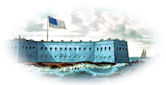
Fort SUMTER, S.C., March 22, 1861.

General Jos. G. TOTTEN,
Chief Engineer U. S. Army, Washington., D.C.:

GENERAL: Everything appears to be quiet this morning in the batteries around us. Night before last the South Carolinians put down  again the buoy that had been taken up a few nights before from its  position, about half a mile to the east of this fort. It appears, however, that it was not replaced in the former position, but placed upon  the opposite side of the channel.

Last night a special messenger, Mr. Fox, arrived from Washington,  and came down to the fort under the escort of Captain Hartstene, formerly of the United States Navy. After a confidential interview with  Major Anderson, he left immediately for Washington.

With respect to this fort, I have filled all the loophole openings on  the first tier with solid stone. All the openings are now closed, with  the exception of five near the ends of the gorge, which had been partially filled with a 9-inch brick wall. I am now completing the filling  of these with lead concrete.

I am also building traverses in front of the hospital, which is on the  first floor of the quarters, and in front of the ordnance storeroom, to  shield them from shells from Fort Moultrie.

Very respectfully, your obedient servant,

J. G. FOSTER,

Captain, Engineers.

—Governor Pettus, of Mississippi, in accordance with the order of the President of the Confederate States, issued a proclamation calling upon the organized military of the State for fifteen hundred infantry.—Georgia Republic, March 25.

—Dr. Fox, of the United States navy, a special messenger from the Government to Major Anderson, reached Charleston and visited Fort Sumter by permission, in company with Captain Hartstein.

“Intercepted despatches”—by which we are to understand “stolen letters”—subsequently disclosed to the authorities in Charleston, it is said, that Mr. Fox employed this opportunity to devise and concert with Major Anderson a plan to supply the fort by force; and that this plan was adopted by the United States Government.—Times, March 28 and April 18.

—A meeting was held at Frankfort, Ala., at which the following resolutions, among others of a similar character, were passed:

Resolved, That we approve the course pursued by our delegates, Messrs. Watkins and Steele, in convention at Montgomery, in not signing the so-called secession ordinance.

That secession is inexpedient and unnecessary, and we are opposed to it in any form, and the more so since a majority of the slave States have refused to go out, either by what is called “southern cooperation,” or “precipitate secession;” and that the refusal to submit the so-called secession ordinance to the decision of the people is an outrage upon our right and liberty, and manifests a spirit of assumption, unfairness, and dictatorship.

Resolved, That our congressional nominee, if elected, is to represent us in the United States Congress, and not in the Congress of this so-called “Southern Confederacy.”—Tuscumbia North Alabamian.

—The Montgomery Mail protests against the word stripes: “We protest against the word ‘stripes,’ as applied to the broad bars of the flag of our confederacy. The word is quite appropriate as applied to the Yankee ensign or a barber’s pole; but it does not correctly describe the red and white divisions of the flag of the Confederate States. The word is bars—we have removed from under the stripes.”— World, April 2.

U. S. STEAMER BROOKLYN, March 21, 1861.

[General SCOTT:]

GENERAL: I wrote to you a few days since asking you to decide the subject of command on this station. Since then Lieutenant Gilman has arrived. I hope, however, that you will give my communication a careful consideration, and will see the necessity of establishing a unity of command on the station. As I mentioned in my communication, it is indispensable that there should be a perfect understanding between the troops and the naval forces, and the positions to be occupied beforehand be fully determined upon. How this can be done when the troops will have to land only when the fort is attacked I am unable to see. It cannot be done unless Lieutenant Slemmer is to be allowed to give me orders and to assign me a position, and to that I never will submit. I will endeavor to perform my duty, I trust, on all occasions, but I never will submit to be commanded, directly or indirectly, by my junior. Moreover, when I enter the fort I become its commander, and will be held responsible for its defense. This will be, probably, when the enemy is already before its walls, and when I must, of course, be ignorant of the disposition which Lieutenant Slemmer has made for its defense. How am I to be held accountable for its defense when I have not the command until the last moment? I trust, general, that you will see at once the false position in which I am placed, and at once relieve me from it. If not, I enter my protest against being in any way held accountable for what may take place.

Until within a few days the naval and military forces have been supplied with fresh provisions from Warrington and Pensacola, but General Bragg has issued an order prohibiting any supplies being furnished to us, and prohibits the citizens communicating with us, except by special permission.

The conditions of the agreement entered into by the late Government and Major Chase and Senator Mallory give every advantage to the seceders, yet some of them deny the right of those two gentlemen to make it. They are not required to give any notice of its abrogation, and may attack the fort without a moment’s notice, and under the most favorable circumstances it will be impossible to send any assistance to the fort from the ships in less time than three hours. Should there be the least panic among the troops within the fort it would probably be taken. There are about forty guns mounted, and the garrison is about one man to a gun. They could only make a single discharge, and would not probably be able to reload the guns. Should those on any of the fronts be discharged too soon, that front would be left without any defense. Moreover, the garrison is kept constantly harassed, and is almost every night obliged to be under arms, from fear of attack. With the present garrison, my company, and one hundred marines, which we could obtain from the fleet, I think it would be perfectly secure from assault.

Our means of communication with the Government are very uncertain. We do not feel certain that our communications have reached the Department, nor do we know whether the Department’s messenger to us may not have been intercepted. Of course, we do not know how we are expected to act. I would suggest that a small steamer should ply between here and Havana, so as to communicate with the mail steamer from New York at that port. The supplies at the fort are getting low, and those of the naval forces are still lower. These last have not ten days’ supply.

The Brooklyn leaves to-morrow for Key West or Havana in order to obtain a supply. Should she not succeed, the naval forces will have to be withdrawn. The Brooklyn has by far the most efficient battery of any of the ships on the station, and is besides probably the only vessel that could take up a position to effectively cover our landing. It is much to be regretted that she should be withdrawn at this juncture. My company is to be transferred to the frigate Sabine.

Major Tower, of the Engineers, arrived on the 19th, but under the existing arrangement cannot reside within the fort. Even was he there not having any force to labor, he could not do much. I have endeavored to lay before you a true statement of the disadvantageous position in which we are placed, and I trust that so far as it can be done it will be remedied. Whatever may be done, I trust that we will be soldiers enough to do all that lies in our power to uphold the honor of our country’s flag, and prevent its forts from being seized by those in rebellion against its authority.

Yours, truly,

I. VOGDES,
Captain, First Artillery.

THURSDAY 21

It has been a cold windy day. It snowed some last night, and we are now having about as much Winter as we have had. The indications are now that Fort Sumpter will be evacuated and perhaps the other Forts in the seceded states, and that there will be no War. But in my opinion a peaceable separation will ultimately be brought about (probably with all the Slave States) and two confederacys be formed. Went with Julia (after calling on our neighbor Mr Douglass with my wife) to the Raven Club at Prof Whitakers, heard Doct Chesney discuss the Character of Queen Elizabeth.

______

The three diary manuscript volumes, Washington during the Civil War: The Diary of Horatio Nelson Taft, 1861-1865, are available online at The Library of  Congress.

WAR DEPARTMENT! C. S. A.,
Montgomery, March 21, 1861.

Hon. L. T. WIGFALL, Washington, D.C.:

MY DEAR SIR: I have just received your letter of the 17th instant. Orders were given to General Beauregard, at Charleston, to detail an officer for the special service at Baltimore, and I am only just informed that the officer appointed is still in Charleston. A person will be sent from this place to-night to perform that duty, with instructions to report to you if in Baltimore, and in your absence to William T. Walters, 68 Exchange Place, Baltimore. It will be much cheaper to ship the men as steerage passengers than by rail, and he will be so instructed unless you have special reasons for a contrary course.

Although it would be most agreeable to all of us to have you here, it occurs to me that you could render more efficient service by remaining in Baltimore until our recruiting depot is fully and successfully established as an institution. Captain Pender, the officer to be sent from here to inspect and superintend the shipment of the men, is directed to place himself under your orders, and will remain in Baltimore for some weeks. Such money as he may require within the scope of his business you will arrange for him to have.

I regret to say that I have no authority to receive the Washington company in the manner proposed. I have no other idea than war, and we hope soon to be ready for any emergency.

Very truly,

L. P. WALKER.

—A. H. Stephens, Vice-President of the “Confederate States” of the South, delivered a speech at Savannah, Ga. It is intended to be a vindication of the new features in the constitution, which has been adopted for their government.—(Doc. 48.)

MOBILE, March 21, 1861.

Hon. L. P. WALKER:

The sloop Isabella, laden with stores mostly for officers of the United States Navy at Pensacola, was seized last night by the acting mayor, and at the request of General Bragg.

W. J. HARDEE,

Colonel First Regiment Infantry.

MONTGOMERY, March 21, 1861.

Hon. L. T. WIGFALL, Washington:

Officer leaves to-night with letter for you and full instructions. Did not know until half hour ago that Haskell had not gone. If men can’t wait ship them at once, and write Beauregard the vessel they are in, so that he may be ready to enlist on arrival.

L. P. WALKER.

WASHINGTON, March 21, 1861.

Hon. L. P. WALKER:

Large number of men in Baltimore. Cannot be kept together there much longer. Nothing heard of or from Haskell. What shall I do? Answer immediately.

LOUIS T. WIGFALL.

March 20th.—The papers are still full of Sumter and Pickens. The reports that they are or are not to be relieved are stated and contradicted in each paper without any regard to individual consistency. The “Tribune” has an article on my speech at the St. Patrick’s dinner, to which it is pleased to assign reasons and motives which the speaker, at all events, never had in making it.

Received several begging letters, some of them apparently with only too much of the stamp of reality about their tales of disappointment, distress, and suffering. In the afternoon went down Broadway, which was crowded, notwithstanding the piles of blackened snow by the kerbstones, and the sloughs of mud, and half frozen pools at the crossings. Visited several large stores or shops — some rival the best establishments in Paris or London in richness and in value, and far exceed them in size and splendour of exterior. Some on Broadway, built of marble, or of fine cut stone, cost from £6000 to £8000 a year in mere rent. Here, from the base to the fourth or fifth story, are piled collections of all the world can produce, often in excess of all possible requirements of the country; indeed I was told that the United States have always imported more goods than they could pay for. Jewellers’ shops are not numerous, but there are two in Broadway which have splendid collections of jewels, and of workmanship in gold and silver, displayed to the greatest advantage in fine apartments decorated with black marble, statuary, and plate-glass.

New York has certainly all the air of a “nouveau riche.” There is about it an utter absence of any appearance of a grandfather—one does not see even such evidences of eccentric taste as are afforded in Paris and London, by the existence of shops where the old families of a country cast off their “exuviae” which are sought by the new, that they may persuade the world they are old; there is no curiosity shop, not to speak of a Wardour Street, and such efforts as are made to supply the deficiency reveal an enormous amount of ignorance or of bad taste. The new arts, however, flourish; the plague of photography has spread through all the corners of the city, and the shop-windows glare with flagrant displays of the most tawdry art. In some of the large booksellers’ shops—Appleton’s for example—are striking proofs of the activity of the American press, if not of the vigour and originality of the American intellect. I passed down long rows of shelves laden with the works of European authors, for the most part, oh shame! stolen and translated into American type without the smallest compunction or scruple, and without the least intention of ever yielding the most pitiful deodand to the authors. Mr. Appleton sells no less than one million and a half of Webster’s spelling books a year; his tables are covered with a flood of pamphlets, some for, others against coercion; some for, others opposed to slavery,—but when I asked for a single solid, substantial work on the present difficulty, I was told there was not one published worth a cent. With such men as Audubon and Wilson in natural history, Prescott and Motley in history, Washington Irving and Cooper in fiction, Longfellow and Edgar Poe in poetry, even Bryant and the respectabilities in rhyme, and Emerson as essayist, there is no reason why New York should be a paltry imitation of Leipsig, without the good faith of Tauchnitz.

I dined with a litterateur well known in England to many people a year or two ago—sprightly, loquacious, and well informed, if neither witty nor profound — now a Southern man with Southern proclivities, as Americans say; once a Southern man with such strong anti-slavery convictions, that his expression of them in an English quarterly had secured him the hostility of his own people—one of the emanations of American literary life for which their own country finds no fitting receiver. As the best proof of his sincerity, he has just now abandoned his connection with one of the New York papers on the republican side, because he believed that the course of the journal was dictated by anti-Southern fanaticism. He is, in fact, persuaded that there will be a civil war, and that the South will have much of the right on its side in the contest. At his rooms were Mons. B——, Dr. Gwin, a Californian ex-senator, Mr. Barlow, and several of the leading men of a certain clique in New York. The Americans complain, or assert, that we do not understand them, and I confess the reproach, or statement, was felt to be well founded by myself at all events, when I heard it declared and admitted that “if Mons. Belmont had not gone to the Charleston Convention, the present crisis would never have occurred.”