Following the American Civil War Sesquicentennial with day by day writings of the time, currently 1863.

Sunday, August 7, 2011

WEDNESDAY 7

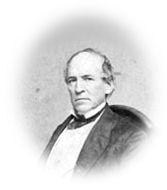
Heat still oppressive. M. 92, but a good air. Was on the Ave awhile this morning, soldiers not as plenty there as formerly. They are now kept in their quarters. The “Patrol” “nabs” them anywhere, officers and all, when found without a “pass.” Congress adjourned yesterday. I have spent most of the day at home doing some small jobs, looking over my drawings &c. The Lincoln boys were here again today. My three boys are now fited out in the Zuave uniform.

______

The three diary manuscript volumes, Washington during the Civil War: The Diary of Horatio Nelson Taft, 1861-1865, are available online at The Library of  Congress.

August 7th.—In the evening I went to Mr. Seward^s, who gave a reception in honour of Prince Napoleon. The Minister’s rooms were crowded and intensely hot. Lord Lyons and most of the diplomatic circle were present. The Prince wore his Order of the Bath, and bore the onslaughts of politicians, male and female, with much good humour. The contrast between the uniforms of the officers of the United States army and navy and those of the French in the Prince’s suit, by no means redounded to the credit of the military tailoring of the Americans. The Prince, to whom I was presented by Mr. Seward, asked me particularly about the roads from Alexandria to Fairfax Courthouse, and from there to Centreville and Manassas. I told him I had not got quite as far as the latter place, at which he laughed. He inquired with much interest about General Beauregard, whether he spoke good French, if he seemed a man of capacity, or was the creation of an accident and of circumstances. He has been to Mount Vernon, and is struck with the air of neglect around the place. Two of his horses dropped dead from the heat on the journey, and the Prince, who was perspiring profusely in the crowded room, asked me whether the climate was not as bad as midsummer in India. His manner was perfectly easy, but he gave no encouragement to bores, nor did he court popularity by unusual affability, and he moved off long before the guests were tired of looking at him. On returning to my rooms a German gentleman named Bing—who went out with the Federal army from Washington, was taken prisoner at Bull’s Run, and carried to Richmond—came to visit me, but his account of what he saw in the dark and mysterious South was not lucid or interesting.


25 Cooper Union, N. Y., August 7th, 1861.

My dear Miss Woolsey: Dr. Blackwell, at our last board meeting, read a very interesting letter from you, giving details about the hospitals. We should be very much obliged if you would be willing to write us a few incidents in regard to hospital supplies. Any little personal anecdote relative to the pleasure caused by the receipt of these delicacies and stores, any message from a wounded soldier, would go farther to interest our country contributors, than any figure-statements of what has been, and is to be, done. . . .

The response made to our appeals is grand, and it is a privilege to know and feel the noble spirit that animates the women of the loyal states. We have contributions not only from our own states, but from Conn., New Jersey, Massachusetts and Michigan. Within the last fortnight our receipts have amounted to over 7000 different articles of clothing and 860 of edibles. . . .

Our letters from the Sanitary Commission say that the hospitals near Washington are now well supplied.

August 7, Wednesday.—Another bright, warm day. With Adjutant Fisher pistol shooting this A. M. Tolerably good firing. Last night a picket shot through the hand; said he fired twice at his assailant; doubted. Supposed to be an accidental wounding. Letters from Ohio.

Centreville, August 7, 1861.

I have received from Gen. Jackson the appointment to act as his aid, and wish you to send my uniform coat and pants by Rollin, Kahle or some one of our men, whichever comes first. Switzer is just leaving, and I have not time to write more.

AUGUST 7TH.—Saw Col. Pendleton to-day, but it was not the first time. I have seen him in the pulpit, and heard him preach good sermons. He is an Episcopal minister. He it was that plowed such destruction through the ranks of the invaders at Manassas. At first the battery did no execution; perceiving this, he sighted the guns himself and fixed the range. Then exclaiming, “Fire, boys! and may God have mercy on their guilty souls!” he beheld the lanes made through the regiments of the enemy. Since then be has been made a colonel, and will some day be a general; for he was a fellow-cadet at West Point with the President and Bishop Polk.

A tremendous excitement! The New York Herald has been received, containing a pretty accurate list of our military forces in the different camps of the Confederate States, with names and grades of the general officers. The Secretary told me that if he had required such a list, a more correct one could not have been furnished him. Who is the traitor? Is he in the Adjutant-General’s office? Many suppose so; and some accuse Gen. Cooper, simply because he is a Northern man by birth. But the same information might be supplied by the Quartermaster’s or Commissary-General’s office; and perhaps by the Ordnance Bureau; for all these must necessarily be in communication with the different organizations in the field. Congress was about to order an investigation; but it is understood the department suggested that the matter could be best searched into by the Executive. For my part, I have no doubt there are many Federal spies in the departments. Too many clerks were imported from Washington. And yet I doubt if any one in a subordinate position, without assistance from higher authority, could have prepared the list published in the Herald

Post image for A Diary of American Events.–August 7, 1861

August 7. — John C. Breckinridge was serenaded at a hotel in Baltimore, and in response essayed to address those assembled in the street, but was compelled to desist by the uproar of the crowd, who shouted for the “Union,” “Crittenden,” “Scott,” etc. — Baltimore American, August 9.

— Gen. Magruder, C. S. A., with a force of 7,000 men, including 200 cavalry and eight pieces of artillery, viz., three Parrott guns, four howitzers, and one rifled cannon, took up a position on Back River, three miles from Hampton, Virginia. The intention was to draw out the national forces, attack Camp Hamilton or Newport News if practicable, and at least to destroy Hampton, so as to prevent its use by the U. S. troops for winter-quarters. Gen. Butler at once repaired to Hampton Bridge, where he remained until 11 o’clock P. M. Col. Weber erected a barricade near the Hampton end of the bridge, and placed a strong guard at various points near.

A few minutes past midnight, Gen. Magruder, with about 500 Confederates—some of them belonging in Hampton—entered the town, and immediately fired the buildings with torches. A greater part of the five hundred houses were built of wood, and no rain having fallen lately, the strong south wind soon produced a terrible conflagration. There were perhaps twenty white people and double that number of negroes remaining in the town from inability to move, some of whose houses were fired without waking the inmates. They gave Gary Jones and his wife, both of them aged and infirm, but fifteen minutes to remove a few articles of furniture to the garden. Several of the whites and also of the negroes were hurried away to be pressed into the Confederate service. Mr. Scofleld, a merchant, took refuge in a swamp above the town. Two negroes were drowned while attempting to cross the creek. A company of rebels attempted to force the passage of the bridge, but were repulsed with a loss of three killed and six wounded. They then withdrew. The fire raged all night and entirely destroyed the town.—(Doc. 168.)

—The Ohio Democratic State Convention met at Columbus to-day and nominated H. J. Jewett for Governor and John Scott Harrison for Lieutenant-Governor. A series of resolutions were adopted. The third recommends the legislatures of the States to call a National Convention for settling the present difficulties and restoring and preserving the Union. The sixth resolution condemns the President’s late attempt to suspend the writ of habeas corpus. —National Intelligencer, August 10.

—The United States gun boat Flag arrived at Fort Mifflin, on the Delaware River, this morning with thirty-six rebel prisoners, taken from the rebel war vessel, Petrel, formerly the revenue cutter Aiken, seized at Charleston last winter. The Aiken fired at the St. Lawrence, off Charleston, mistaking her for a merchant vessel, when the St. Lawrence returned a broadside, sinking the rebel. Five of the crew were lost, and the rest rescued and placed on board the Flag.—Philadelphia Press, August 8.

—Isham G. Harris, Governor of Tennessee, appeals to the people of that State “to raise, organize, and thoroughly prepare a reserve force of thirty thousand volunteers.”—(Doc. 169.)

——-

Late addition to Volume 3:


August 7.—In the C. S. Congress, a bill was reported favorably from the Military Committee to increase the military force of the Confederacy to the extent of four hundred thousand men.—Richmond Enquirer, August 9.