Following the American Civil War Sesquicentennial with day by day writings of the time, currently 1863.

Friday, August 12, 2011

Astoria, August 12th.

Dear Girls: If mother and the remaining three kept to the programme, they all left for Lenox on Saturday and are at last settled in their summer quarters, much to my relief. So long as they would not come to us, I think it was highly necessary for them to go somewhere, as the city grew hotter and smellier and more unbearable every day.

Knowing what New York is at this season, and inferring what Washington must be, I am sure you will consider my proposition reasonable when I beg that you will come on and freshen up a little here at Astoria “by the side of a river so clear.” . . . When you come Robert will sail you up to Riker’s Island, in order to make you feel more at home, where the Anderson Zouaves are encamped. We went up there the other day with some illustrated papers sent by Jane to the men, and were enthusiastically received by a company of bathers, who swam round the boat for whatever we had to offer, and whom we left seated on the rocks reading Frank Leslie, with not so much as a button or an epaulette on by way of dress.

MONDAY 12

Went down to the Pat office this morning and saw the Comr, could get nothing definite from him in reference to my restoration to the office. Business there is still dull. Few soldiers are seen in the streets now and none without a “pass.” The 27th Regt have rcd orders to cross the River into Virginia and go into Camp. Troops are accumulating here and also at Mannasses Junction. Another collision must soon take place, it will be a life struggle with both parties. Doct Barnes to Bkfst & tea.

______

The three diary manuscript volumes, Washington during the Civil War: The Diary of Horatio Nelson Taft, 1861-1865, are available online at The Library of  Congress.

August 12. Monday.—Showery all day. Sent to Clarksburg H. T. Martin. He will probably be sent to Columbus for safe keeping. I gave him a letter to my brother-in-law to insure him attention there in case he should need. It is impossible to avoid mistakes in these cases. Union men may make charges merely to gratify personal animosity, knowing that in the nature of things a full investigation is impossible.

During Monday night a squad of the Tenth Regiment returned from the Buckhannon road with the body of one of the wild men of the mountains found in this country. He followed their regiment, shooting at them from the hills. They took him in the Bulltown region. He wore neither hat nor shoes, was of gigantic size—weighing two hundred and thirty pounds; had long hooked toes, fitted to climb—a very monster. They probably killed him after taking him prisoner in cold blood—perhaps after a sort of trial. They say he was attempting to escape.

_______

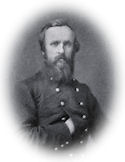
WESTON, VIRGINIA, August 12, 1861.

DEAR UNCLE:—We are still getting on nicely. We have a good deal more excitement now than usual. Wagon and cattle trains and small parties are fired on by guerrillas from the hills on two of the roads leading from here. Dr. Joe has about eight or ten in charge who have been wounded in this way. Two only have been killed. None in our regiment. The men all laugh at “squirrel guns” and the wounds they make. Several would have been killed if shot in the same part by the conical balls of our military guns. The “deadly rifle” of olden times shoots too small a bullet, and is too short in its range; but as Cassio says, it is often “sufficient.” We send out parties who bring in prisoners— sometimes the right men, sometimes not. All this keeps up a stir. In a week or two we shall get up a regular system of scouring the country to get rid of these rascals. The Union men here hate and fear them more than our men.

The threatened invasion by Lee from eastern Virginia hangs fire. They will hardly venture in, unless they come in a few days, as we are daily getting stronger. I hope you are still getting better.

Good-bye,

R. B. HAYES.

S. BIRCHARD.

AUGUST 12TH.—There is trouble with Mr. Tochman, who was authorized to raise a regiment or so of foreigners in Louisiana. These troops were called (by whom?) the Polish Brigade, though, perhaps, not one hundred Polanders were on the muster-rolls; Major Tochman being styled General Tochman by “everybody,” he has intimated to the President his expectation of being commissioned a brigadier. The President, on his part, has promptly and emphatically, as is sometimes his wont, declared his purpose to give him no such commission. He never, for a moment, thought of making him more than a colonel. To this the major demurs, and furnishes a voluminous correspondence to prove that his claims for the position of brigadier-general had been recognized by the Secretary of War.

On returning from my ride next morning, I took up the Baltimore paper, and saw a paragraph announcing the death of an English officer at the station; it was the poor fellow whom I saw sitting at General Mansfield’s steps yesterday. The consul was absent on a short tour rendered necessary by the failure of his health consequent on the discharge of his duties. Finding the Legation were anxious to see due care taken of the poor fellow’s remains, I left for Baltimore at a quarter to three o’clock, and proceeded to inquire into the circumstances connected with his death. He had been struck down at the station by some cerebral attack, brought on by the heat and excitement; had been carried to the police station and placed upon a bench, from which he had fallen with his head downwards, and was found in that position, with life quite extinct, by a casual visitor. My astonishment may be conceived when I learned that not only had the Coroner’s inquest sat and returned its verdict, but that the man had absolutely been buried the same morning, and so my mission was over, and I could only report what had occurred to Washington. Little value indeed has human life in this new world, to which the old gives vital power so lavishly, that it is regarded as almost worthless. I have seen more “fuss” made over an old woman killed by a cab in London than there is over half a dozen deaths with suspicion of murder attached in New Orleans or New York.

12th.—Sixteen of my sick have so far recovered that I sent them to-day to join their regiment at Kalorama Heights, near Washington. I have quite recovered from my attack, which was rubeolous fever. I had been so much mixed up with measles that, notwithstanding I had passed through the disease in childhood, the system in some degree yielded to its contagious influence, and I have had all the symptoms of measles, except the eruption. I have termed this rubeoloid, or rubeolous fever. It is common in camp.

12th.—Still nothing from the army. We go on here quietly and happily—as happily as the state of the country will allow. The household peaceful and pleasant. The ladies—all of us collect in one room—work, while one reads some pleasant book. We are mercifully dealt with, and I hope we are grateful for such blessings.

The Northern papers tell us that General Patterson has withdrawn from the Northern army. The reason thereof is not mentioned; but we shrewdly suspect that the powers at Washington are not entirely satisfied that he was so completely foiled by General Johnston. General Johnston was fighting the battle of Manassas before General P. knew that he had left the Valley. The rumour that he had gone to join McDowell was unfounded. For many days there was no intercourse between the section occupied by the Federal army and that occupied by ours; pickets were placed on every road, to prevent any one from passing towards General P. Gentlemen who had come to Winchester and Berryville on business for a few hours, were not allowed to return home for days. So how could the poor man know what was going on? We only fear that his place may be supplied by one more vigilant. General Scott, too, has been almost superseded by General McClellan, who seems just now to be the idol of the North. The Philadelphia papers give a glowing description of his reception in that city. It was his luck, for it seems to me, with his disciplined and large command, it required no skill to overcome and kill the gallant General Garnett at Rich Mountain. For this he is feted and caressed, lionized and heroized to the greatest degree. I only hope that, like McDowell and Patterson, he may disappoint their expectations.

August 12.—Charles J. Faulkner, late U. S. Minister to France, was arrested in Washington by the Provost Marshal. The order for his arrest was issued from the War Department. A heavy detachment of infantry accompanied the Marshal to guard against any disturbance that the arrest might prompt. Mr. Faulkner acknowledged the authority, and signified his readiness to accompany the officer. He was taken to the jail, where the other prisoners of war are confined. Mr. Faulkner occupies a lower floor of the jail, and has a ward adjoining that of Dr. Fleming, of Virginia, who is also a prisoner and a man of wealth and influence. When first arrested, he was somewhat excited, but he shortly recovered himself, and during the afternoon conversed freely with one of the officers on the condition of France. When asked how the rebellion was regarded there, he answered, “France, sir, deeply regrets it.” He also stated that he had his passes all ready, and intended to leave for his home in Virginia today. In his conversation he carefully avoids expressing any opinion as to the political condition of the country. The charges upon which the arrest is based, are his successful efforts to procure arms in Europe for the use of the rebels, and the fact that he was going home to assume command of a regiment of rebels who had elected him colonel.—N. Y. Times, August 13.

—Abraham Lincoln, President of the United States, in accordance with a resolution of Congress, issued a proclamation, appointing a day of public fasting and prayer, to be observed by the people of the United States with religious solemnities and the offering of fervent supplications to Almighty God for the safety and welfare of the country, His blessings on the national arms, and a speedy restoration of peace.—(Doc. 178.)

—At one o’clock this afternoon, the office of the Democrat, a secession sheet published at Bangor, Me., was visited by a large number of people. During an alarm of fire, a crowd entered the office, cleared it of every thing it contained, and burned the contents in the street. Mr. Emery, the editor of the paper, escaped unharmed. A man who made some demonstrations in opposition to the acts of the mob, was badly used, but was finally rescued and put in jail.

—Judge Catron, of the United States Supreme Court, was expelled from Nashville, Tenn., by a Vigilance Committee, for his refusal to resign his office under the United States Government.—Baltimore American, August 14.

—Gen. Wool was ordered to the command of the Southeastern District of Virginia, headquarters at Fortress Monroe.—The Eleventh Regiment of New York Volunteers (First Fire Zouaves) left Washington for New York.—Troy Times, August 13.

—Twenty-two released prisoners of war arrived at Fortress Monroe from Norfolk, Va., under a flag of truce. They comprise the following persons:—Surgeons, Edward T. Taylor, First New Jersey; Jacob A. Stewart, First Minnesota; Eugene Peugnet, Seventy-first Now York; Foster Swift, Eighth New York; S. O. Thunkins, Fourth Maine; B. F. Buckstone, Fifth Maine; Wm. H. Allen, Second Maine; Jas. M. Lewis, Second Wisconsin; Gustavus Winston, New York Eighth; Chas. DeGraw, do.; _____ Normal, Seventy-ninth New York. These surgeons remained at Sudley Church and the stone building after the battle, attending the wounded, and were taken prisoners. They remained, some at Bull Run and others at Manassas Junction, attending upon the wounded for two weeks after the battle, and then were sent to Richmond. Finally they were released on parole and sent within the national lines, via Norfolk They have been courteously and kindly treated by the military authorities of the “Confederate ” States, and give the most unqualified denial to all stories of the killing or ill-treatment of the wounded. Mrs. Curtis, of New York, who went out a day or two after the battle and was taken prisoner, is also released.—(Doc. 179.)

Ben. McCulloch, in a general order, congratulated “the army under his command” upon the victory at Wilson’s Creek, and hoped that “the laurels they had gained” would “not be tarnished by a single outrage.” He also issued a proclamation to the people of Missouri, calling upon them to act either for the North or the South.—(Doc. 180.)