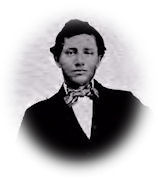
Monday, 19th—I helped haul and stack hay this forenoon, and in the afternoon went to Inland with the other boys who enlisted yesterday, to see about going to Camp McClellan, at Davenport.
Friday, August 19, 2011
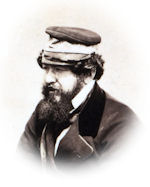
Next day (19th) the rain fell incessantly. The mail was brought in by a little negro boy on horseback, and I was warned by my letters that an immediate advance of McClellan’s troops was probable. This is an old story. “Battle expected to-morrow” has been a heading in the papers for the last fortnight. In the afternoon I was driven over a part of the estate in a close carriage, through the windows of which, however, I caught glimpses of a beautiful country, wooded gloriously, and soft, sylvan, and well-cultivated as the best parts of Hampshire and Gloucestershire, the rolling lands of which latter county, indeed, it much resembled in its large fields, heavy with crops of tobacco and corn. The weather was too unfavourable to admit of a close inspection of the fields; but I visited one or two tobacco houses, where the fragrant Maryland was lying in masses on the ground, or hanging from the rafters, or filled the heavy hogsheads with compressed smoke.
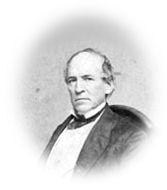
MONDAY 19
This will pass for a rainy day and a disagreable one. I was at Genl Porters office (Provost Marshall), a great crowd there after “passes” to Virginia. The Court Marshall was sitting in the same building. I saw four of the mutineers of the NY 79th who were awaiting their trial. They were hand cuffed. Went to the P.O. and was awhile at the Pat office. Rumors of the “rebels” crossing the River into Maryland. Hard fighting expected soon near the City. Called upon Mr Reynolds to sell him my furniture, think of sending the family north soon.

______
The three diary manuscript volumes, Washington during the Civil War: The Diary of Horatio Nelson Taft, 1861-1865, are available online at The Library of Congress.
Government hospitals were multiplying in Washington, Georgetown, and Alexandria. As regiments were ordered forward extemporized camp hospitals were broken up, and patients were sent back to these large general ones in the rear.
By this time J. H. had ordered his horses and carriage sent on from Fishkill for our use and we were constantly driving about, seeing where the need was in camps and hospitals and supplying wants. In order to make our way to the many outlying hospitals about Washington and also to visit Joe’s camp over the river, it was necessary for us to be provided with passes—not always an easy thing to procure. General Scott, however, came to the rescue and gave the following comprehensive one which was “good daily” during the rest of our stay in Washington:—
The Commission on its side was always glad to have our report and responded promptly to all our suggestions.
By this time J. H. had ordered his horses and carriage sent on from Fishkill for our use and we were constantly driving about, seeing where the need was in camps and hospitals and supplying wants. In order to make our way to the many outlying hospitals about Washington and also to visit Joe’s camp over the river, it was necessary for us to be provided with passes—not always an easy thing to procure. General Scott, however, came to the rescue and gave the following comprehensive one which was “good daily” during the rest of our stay in Washington:—
Headquarters of the Army,
Washington, Aug. 19, 1861.
Mrs. Joseph Howland (wife of the Adjutant of the New York 16th Regt.), sister Miss G. M. Woolsey, and man-servant (Stanislas Moritz) will be permitted to pass the Bridges to Alexandria (and return) and are commended to the courtesy of the troops.
Good daily.
Winfield Scott.
By command:
H. VAN RENSSELAER,
Col. and Aid de Camp.
The Commission on its side was always glad to have our report and responded promptly to all our suggestions.
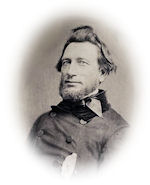
19th.—To-day came from Baltimore and joined my regiment at Meridian Hill, where I find the whole country a vast city of camps.
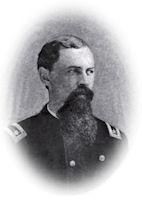
Cairo, August 19, 1861.
The boys are writing to-day for some butter and things from home. The expense by express from Peoria is not worth speaking of and the other boys have things sent them often. We have made up our minds to lying here six weeks longer at least, and conclude that time will pass better with a few home extras to grace our table.
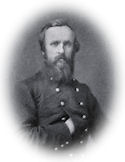
August 19. Monday.—No more rumors. A tolerably pretty day. At 12 M. [midnight] got orders to quietly strike tents and with three days’ rations and the minimum amount of baggage move to Buckhannon. Two companies, Captain Drake’s and Captain Zimmerman’s, had just returned from a scouting expedition to Walkersville, etc. No rest yet. After a world of confusion, aggravated by an incompetent quartermaster, we got off at daylight.
AUGUST 19TH.—The Secretary has gone to Orange C. H., to see Col. Jones, of the 4th Alabama, wounded at Manassas, and now in a dying condition.
Meeting with Mr. Benjamin this morning, near the Secretary’s door, I asked him if he did not think some one should act as Secretary during Mr. Walker’s absence. He replied quickly, and with interest, in the affirmative. There was much pressing business every hour; and it was uncertain when the Secretary would return. I asked him if he would not speak to the President on the subject. He assented; but, hesitating a moment, said he thought it would be better for me to see him. I reminded him of my uniform reluctance to approach the Chief Executive, and he smiled. He then urged me to go to the presidential mansion, and in his, Mr. B.’s name, request the President to appoint a Secretary ad interim. I did so, for the President was in the city that day, and fast recovering from his recent attack of ague.
Arrived at the mansion in Clay Street, I asked the servant if I could see the President. He did not know me, and asked my name, saying the President had not yet left his chamber. I wrote my business on a card with a pencil, not omitting to use the name of Mr. Benjamin, and sent it up. A moment after the President came down, shook hands with me, and, in his quick and rather pettish manner, said “send me the order.” I retired immediately, and finding Mr. Benjamin still in the hall of the department, informed him of my success. Then, in conformity with his suggestion, I repaired to Adjutant-General Cooper, who wrote the order that A. T. Bledsoe discharge the duties of Secretary of War during the absence of Mr. Walker. This I sent by a messenger to the President, who signed it.
Then I informed Col. Bledsoe of what had been done, and he proceeded without delay to the Secretary’s office. It was not long before I perceived the part Mr. Benjamin and I had acted was likely to breed a storm; for several of the employees, supposed to be in the confidence of Mr. Walker, designated the proceeding as an “outrage;” and some went so far as to intimate that Mr. Benjamin’s motive was to have some of his partisans appointed to lucrative places in the army during the absence of the Secretary. I know not how that was; but I am sure I had no thought but for the public service. The Secretary ad in. made but few appointments this time, and performed the functions quietly and with all the dignity of which he was capable.
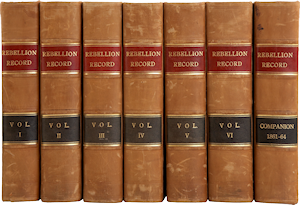
August 19.—The bill admitting Missouri into the Southern Confederacy, on certain conditions, was passed by the “Confederate” Congress. The conditions are, that Missouri shall duly ratify the Constitution of the Southern Confederacy, through her legally constituted authority, which authority is declared to be the government of Gov. Jackson, who was lately deposed. President Davis is also authorized to muster into the Confederate service, in Missouri, such troops as may volunteer to serve in the Southern army. The bill likewise empowers the President of the Confederate States, at his discretion, at any time prior to the admission of said State as a member of the Confederacy, to perfect and proclaim an alliance, offensive and defensive, with the said government, limited to the period of the existing war between the Confederacy and the United States, the said treaty or alliance to be in force from the date thereof, and until the same shall be disaffirmed or rejected by this Congress.—National Intelligencer, September 5.
—The Republican, published at Savannah, Ga., has the following, in reference to the defences of that city: “In response to numerous inquiries propounded through the press of the interior, we would simply say that within a week from to-day no Federal fleet will be able to enter a harbor or inlet, or effect a landing of troops on the coast of Georgia. Month after month elapsed and the State, with all the boasting of its chief executive officer, and with over a million in his hands for the purpose, did absolutely nothing for our protection. The Confederate authorities, to whom the matter has been turned over, have recently been industriously at work, and the fortifications along the coast are nearly completed.”
—E. W. Hinman, of New York, respectfully submitted the following proposition to President Lincoln:—”Whereas the commercial and mercantile interests of our country are being destroyed, it is proposed by numerous masters and owners of vessels, which may be deemed acceptable on the part of the Government of the United States, to aid and assist in capturing any steamer or other craft which may be found on the ocean, sailing under the Confederate or rebellion flag of the seceded States, or which may be found acting under a privateer commission issued by the Government under Jefferson Davis as its President. Therefore the undersigned, in behalf of Captain George Walen and others, -would respectfully make application to your Excellency, as President of the United States, to issue an order to the undersigned to capture and take such vessels for a bounty to be paid by the Government, under such stipulations and conditions as may be deemed advisable, with a view to protect our commerce and mercantile interests of such of our citizens as may be considered loyal and patriotic, in behalf of the Government of the United States, who are desirous of the maintenance of the Constitution, the Union, and the laws of our country.”
—To-day two hundred and forty fugitives from East Tennessee, men driven from their homes, were fed in the Seminary yard in Danville, Ky. Some of them were elderly men and some young, and all had been compelled to abandon their families, and were ill-clad, almost barefoot, weary, and hungry. The whole of the two hundred and forty fugitives enlisted in the United States service at Camp Dick Robinson, in Kentucky.—Louisville Journal.
—The office of the Sentinel at Easton, Pa., was destroyed by a crowd of Unionists.—Phila. Press, August 20.
—The town of Commerce, Mo., forty miles from Cairo, Ill., which was taken by a battery planted by the secessionists, was retaken by five hundred troops sent down from Cape Girardeau by order of Gen. Fremont. The rebels made no stand with their battery on the approach of the National troops. Their number was about one hundred and fifty infantry and one hundred and fifty cavalry.—Boston Transcript, August 21.
—Tnis day the Department of State, at Washington, gave notice that “no person will be allowed to go abroad from a port of the United States without a passport either from this Department or countersigned by though Secretary of State; nor will any person be allowed to land in the United States without a Passport from a Minister or Consul of the United States, or, if a foreigner, from his own Government, countersigned by such Minister or Consul. This regulation, however, is not to take effect in regard to persons coming from abroad until a reasonable time shall have elapsed for it to become known in the country from which they may proceed.
—At Philadelphia, Pa., Pierce Butler was arrested this afternoon by the United States marshal at the order of the Secretary of War and taken to New York. The arrest was caused by intercepted letters from him giving information to the Confederates.—National Intelligencer, August 21.
—In Haverhill, Mass., this evening, Ambrose L. Kimball, editor of the Essex County Democrat, was forcibly taken from his house by an excited mob, and, refusing information, was covered with a coat of tar and feathers, and ridden on a rail through the town. Subsequently, under threats of violence, Mr. K. promised to keep his pen dry in aid of rebellion, and was liberated. The town authorities and many good citizens unsuccessfully attempted to quell the mob. Mr. Kimball, after suffering the abuse and indignity of the mob for a long time, made the following affirmation on his knees: “I am sorry that I have published what I have, and I promise that I will never again write or publish articles against the North and in favor of secession, so help me God.” After this he was conducted to his home.—N. Y. Herald, August 21.
—A Battle took place to-night at Charleston, Mo., between the National forces, about two hundred and fifty strong, consisting of the Twenty-second Illinois Regiment, under command of Col. Dougherty, accompanied by Lieut.Col. Ransom, of the Eleventh Illinois Regiment. The rebel force was estimated at six to seven hundred men, and commanded by Col. Hunter, of Jeff. Thompson’s army. The National force was victorious, completely routing the rebels, killing forty and taking seventeen prisoners. The National loss was one killed, viz.: Wm. P. Sharp, of Company A. Among the wounded were Col. Dougherty, slightly; Lieut.-Col. Ransom, shot in the shoulder, not serious; Capt. Johnson, Company A, shot in the leg; George A. Perry, slightly wounded in the arm. Capt. Noleman, with fifty mounted men, left Bird’s Point at about six o’clock this evening for Charleston, to join the forces under Col. Dougherty, but failed to form a junction with them. They met a party of rebels about one hundred strong and gave them battle, killing two and taking thirty-three prisoners, also capturing thirty-five horses, without the loss of a man.—(Doc. 195.)
—The Jeffersonian newspaper office in West Chester, Pa., was quietly visited by a crowd and cleaned out.—There was no disturbance; most of the residents of the place were ignorant of what was going on until the work was effected.—Ohio Statesman, August 21.
—William Henry Odenheimer, Bishop of New Jersey, issued a pastoral letter to the clergy and laity of his diocese, appointing the service to be used on the fast day recommended by the President of the United States.—(Doc. 196.)
—Brigadier-general Hurlburt issued an order directing the authorities of Palmyra, Mo., to deliver up the marauders who fired upon the train of the St. Joseph and Hannibal Railroad on the evening of the 16th inst. In case of a refusal to comply, he signified his intention of levying contributions upon the county to the amount of ten thousand dollars, and upon the city of five thousand dollars.—(Doc. 197.)


