Thursday, 22d—Received orders this morning to get ready for review. At 1 o’clock in the afternoon we marched down into town and through the streets for a while and then back to camp. General Baker, Adjutant General of Iowa, is in charge of the camp. Our camp was named for General McClellan in the East.
Monday, August 22, 2011
[August] 22. Thursday.—At our nice camp. P. M. rained and blew violently. In the midst of it we got orders from General Rosecrans to prepare to march to Beverly. “Early” in the morning would do. Slept in my wet boots. Wrote home and to mother and Uncle.
_______
BUCKHANNON, August 22, 1861.
DEAR JIM:—I have written hastily to Mr. Warren. I hope he will not be so much disturbed after he reflects on matters. Have you had a formal application before the governor for a place? It should be done by yourself or by a friend in person. I suppose examination may be required. If so, attend to it. Dr. Joe is well. We are expecting an enemy soon.
Sincerely,
R. B. HAYES.
DR. JAMES D. WEBB.
_______
BUCKHANNON, VIRGINIA, August 22, 1861.
DEAREST:—It is a cold, rainy, dismal night. We are all preparing for an early march. I have made up a large bundle of duds—all good of course—which must be left here, to be got possibly some day but not probably. All are cut down to regulation baggage. Many trunks will stop here. A tailor sits on one end of my cot sewing fixings. All is confusion. The men are singing jolly tunes. Our colonel takes his half regiment, the left wing, and half of McCook’s Germans, and we push off for the supposed point of the enemy’s approach. We shall stop and camp at Beverly a while, and then move as circumstances require.
How are the dear boys ? Will Scott writes me that he goes into the Kentucky Union regiments.
Good-bye, darling. Joe wishes to write and wants my pen.
Affectionately,
R. B. HAYES.
MRS. HAYES.
THURSDAY 22
Another rainy day. Went down to the Provost Marshalls Office, great crowd there for passes across the River. Saw Capt Fowler and Capt [Huron?] there (of the 12 Regt). Sent a line to the President by H N Jr — requesting a private interview. Will see him in the morning 1/2 past 8 o’clock. Was at home most of the day, but at the Pat office awhile. The 3rd Regt of the Regular Army is now on Franklin Square.

______
The three diary manuscript volumes, Washington during the Civil War: The Diary of Horatio Nelson Taft, 1861-1865, are available online at The Library of Congress.
22nd.—I do not know but that I have the blues to-day. However that may be, it is sad to contemplate the selfishness of our officers. When I witness the political manœuvreing here, the conducting affairs for political effect at home, I am almost inclined to believe our war a humbug, and our Government a failure. I must not talk this, but I must not forget it.
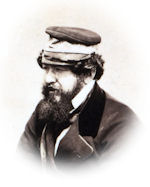
August 22nd.—
“The little dogs and all,
Tray, Blanche, and Sweetheart,
See they bark at me.”
The North have recovered their wind, and their pipers are blowing with might and main. The time given them to breathe after Bull Run has certainly been accompanied with a greater development of lung and power of blowing than could have been expected. The volunteer army which dispersed and returned home to receive the Io Pæans of the North, has been replaced by better and more numerous levies, which have the strong finger and thumb of General McClellan on their windpipe, and find it is not quite so easy as it was to do as they pleased. The North, besides, has received supplies of money, and is using its great resources, by land and sea, to some purpose, and as they wax fat they kick.
A general officer said to me, “Of course you will never remain, when once all the press are down upon you. I would not take a million dollars and be in your place.” “But is what I’ve written untrue?” “God bless you! do you know in this country if you can get enough of people to start a lie about any man, he would be ruined, if the Evangelists came forward to swear the story was false. There are thousands of people who this moment believe that McDowell, who never tasted anything stronger than a water melon in all his life, was helplessly drunk at Bull’s Run. Mind what I say; they’ll run you into a mud hole as sure as you live.” I was not much impressed with the danger of my position further than that I knew there would be a certain amount of risk from the rowdyism and vanity of what even the Americans admit to be the lower orders, for which I had been prepared from the moment I had despatched my letter; but I confess I was not by any means disposed to think that the leaders of public opinion would seek the small gratification of revenge, and the petty popularity of pandering to the passions of the mob, by creating a popular cry against me. I am not aware that any foreigner ever visited the United States who was injudicious enough to write one single word derogatory to their claims to be the first of created beings, who was not assailed with the most viperous malignity and rancour. The man who says he has detected a single spot on the face of their sun should prepare his winding sheet.
The New York Times, I find, states “that the terrible epistle has been read with quite as much avidity as an average President’s message. We scarcely exaggerate the fact when we say, the first and foremost thought on the minds of a very large portion of our people after the repulse at Bull’s Run was, what will Russell say?” and then they repeat some of the absurd sayings attributed to me, who declared openly from the very first that I had not seen the battle at all, to the effect “that I had never seen such fighting in all my life, and that nothing at Alma or Inkerman was equal to it.” An analysis of the letter follows, in which it is admitted that “with perfect candour I purported to give an account of what I saw, and not of the action which I did not see,” and the writer, who is, if I mistake not, the Hon. Mr. Raymond, of the New York Times, like myself a witness of the facts I describe, quotes a passage in which I say, “There was no flight of troops, no retreat of an army, no reason for all this precipitation,” and then declares “that my letter gives a very spirited and perfectly just description of the panic which impelled and accompanied the troops from Centreville to Washington. He does not, for he cannot, in the least exaggerate its horrible disorder, or the disgraceful behaviour of the incompetent officers by whom it was aided, instead of being checked. He saw nothing whatever of the fighting, and therefore says nothing whatever of its quality. He gives a clear, fair, perfectly just and accurate, as it is a spirited and graphic account of the extraordinary scenes which passed under his observation. Discreditable as those scenes were to our army, we have nothing in connection with them whereof to accuse the reporter; he has done justice alike to himself, his subject, and the country.”
Ne nobis blandiar, I may add, that at least I desired to do so, and I can prove from Northern papers that if their accounts were true, I certainly much “extenuated and nought set down in malice”—nevertheless, Philip drunk is very different from Philip sober, frightened, and running away, and the man who attempts to justify his version to the inebriated polycephalous monarch is sure to meet such treatment as inebriated despots generally award to their censors.
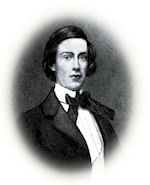
Camp Causten, Aug. 22d, 1861.
My dear Cousin Lou:
What a pleasant thing it is to live, and how I do enjoy it here on the banks of the Potomac. I do not believe God ever made a more beautiful land than this. How I would fight for it if I believed it threatened by an unscrupulous foe! Cousin Lou, I used to think the “booty and beauty” allusion a sort of poor joke, too sorry even for ridicule, but I now see it as the cunning work of the far-sighted master who knew his people.
By-the-way do you know we are now encamped on the Kosciusko farm, and near by the house still stands where the patriot lived? I was walking in a cornfield today, and spied the silk drooping from one of the ears, dyed a deep red. I plucked it, and send it now to you in memory of Kosciusko, or if you like it better, in memory of Cousin Will. Bother! I was getting sentimental, when a gust of wind tore up the tent pins and blew out the candle. One has great experiences in camp. The other night I was softly slumbering, dreaming of Dolly Ann or of cutting a Secessionist’s throat, or something agreeable at any rate, when I heard a sound like that of mighty waters — I felt the waves washing over me — then followed a chilly sensation. I awoke. The stars were above me and by my side lay a sea of canvas — “in short,” as Mr. Micawber would say, my tent was blown down. Another night my tent was pitched on the side of a steep hill. I wrapped myself in my blanket, braced my feet against the tent-pole and fell asleep. In the night my knees relaxed, and no longer prevented by the prop, I slid quietly downward, awaking in the morning at a good night’s march from the point at which I first lay down to rest.
Much obliged for the information you send me regarding that youngest son of the Earl of Montrose, who came to America and graduated at Yale College. I always knew I was of noble degree, and have felt my blood preeminently Scotch since the first time I heard Aunt Caroline singing “Where, and oh where is my Highland Laddie gone?” I look too, admiringly upon the queenly Julia, and I say, “Nay, nay, but there’s no churl’s blood there.” In beatific vision the sisters five file past me; then comes long lanky Sylvester Vegetable Graham, leanest of men, with a bag of oatmeal, and I say to myself, “Verily my blood is very Scotch.”
Give my best love to that wee mite of a little lady who is to have the delightful honor of taking charge of my wooden leg when I return from the wars a garrulous one-legged old soldier. Imagine me, Cousin Lou, tripping it at my own wedding not on the light fantastic, but on timber toes. Now let us consider the matter, Cousin Lou. Shall the leg be a real timber one though, or shall a compromise be made with Nature, and one of the flexible Anglesea pattern be chosen?
Alas, alas! All day long we have heard guns firing in the distance. Some poor fellows must have fallen, though we get no intelligence of movements made. We are left out of the question. There is a great battle soon to take place, but I fear the 79th is too much crippled to make a great show. We numbered once a thousand gallant hearts — we number now 700 men capable for action; to such a pass we have been reduced by death and what is worse, by desertion. Officers have deserted, and the men have followed the base example. I have seen enough to convince me that this is no war for foreigners. It is our war, and let us cheerfully bear the burden ourselves. The South sends its best blood to fight for a phantom, but we, in the North, send our scum and filth to fight for a reality. It is not thus we are to gain the victory. I would have all our Northern youth not talk, but act — not deem their lives so precious as their honor. Have you read the names of those who resigned their commissions after the Battle of Manassas? The names of over 250 cowards. Life is sweet to all, but have they no trust in God that they fear the bitterness of death? Love to all friends in Enfield. I must say good-night.
Au-Revoir,
Will.
I did not serve as a private but in the capacity of Lieut. at Bull Run.
AUGUST 22D. —”Immediate” is still there; but the Secretary has not yet been to the council board, though yesterday was cabinet day. Yet the President sends Capt. Josselyn regularly with the papers referred to the Secretary. These are always given to me, and after they are “briefed,” delivered to the Secretary. Among these I see some pretty sharp pencil marks. Among the rest, the whole batch of Tochman papers being returned unread, with the injunction that “when papers of such volume are sent to him for perusal, it is the business of the Secretary to see that a brief abstract of their contents accompany them.”
August 22.—At Philadelphia, Pa., on the arrival of the New York train this morning, Marshal Milward and his officers examined all the bundles of papers, and seized every copy of the New York Daily News. The sale of this paper was totally suppressed in that city. Marshal Milward also seized all the bundles of the Daily News at the express offices for the West and South, including over one thousand copies for Louisville, and nearly five hundred copies for Baltimore, Washington, Alexandria, and Annapolis.—National Intelligencer, August 23.
The First regiment of Pennsylvania Cavalry, under the command of Colonel Max Friedman, passed through Baltimore, Md., on the way to Washington. The regiment is composed of ten full companies, having an aggregate of nine hundred and fifty men, of whom a large portion have seen service. They were accompanied by twenty trumpeters and buglers. The men, with the exception of fifty, were uniformed alike in a dark blue cloth jacket and pantaloons, with yellow trimmings, and a high felt hat. The horses of the command had previously been sent on to Washington, where the men will receive such arms as may be requisite.— Baltimore American, August 23.
—The Stark County Democrat, a secession sheet, published in Canton, Ohio, was entirely destroyed by some volunteers of that place.— Buffalo Courier, August 24.
—Edwin D. Morgan, Governor of New York, issued a proclamation, urging all good and loyal citizens to use all means in their power to sustain the credit of the State and of the National Government, as well as furnish an ample response to the late call of the President for men to crush the rebellion.—(Doc. 1.)
—The following order was promulgated from Washington, and virtually suppressed the Day Book: and the Daily News of New York:
“Post Office Department, August 22, 1861.
“Sir: The Postmaster-General directs that from and after your receipt of this letter, none of the newspapers published in New York City, which were lately presented by the Grand Jury as dangerous, from their disloyalty, shall be forwarded in the mails.
“I am, respectfully, jour obedient servant,
“T. B. Trott, Chief Clerk.
“To the Postmaster of New York City.”
—Sixty-four of the leading Democrats in Vallandigham’s district, Montgomery County, Ohio, issued a circular against the “despotic and traitorous course of the Vallandigham clique.” They say: “It is the mission of the Democratic party to give strength and vigor and efficiency to the Constitution and Government when they are attacked by rebels and traitors. In the language of the lamented Douglas, ‘No man can be a true Democrat without being at the same time a loyal patriot; and there are but two positions to assume: we must either be for or against our Government —either patriots or traitors.'” They pledge themselves “to unite with all loyal citizens in the defence of the nation, and in rebuking the unpatriotic action of said convention, and of the Dayton Empire, and in supporting for office in the county of Montgomery men, irrespective of party, who are loyal to the Government by a vigorous prosecution of this war, and who in no contingency are in favor of secession.”— N. Y. Evening Post, August. 22.
—The steamer Samuel Orr, an Evansville and Paducah mail packet, was seized at Paducah, Ky., and taken up the Tennessee River. The officers and crew left her, and went to Cairo, Ill., in skiffs. Her cargo was valued at twenty thousand dollars.—Baltimore American, August 24.
—In Philadelphia, Pa., the U. S. marshal, Milward, proceeded to the office of the Christian Observer, in Fourth street below Chestnut, and took all the type, paper, and other appurtenances of the place. He also closed up the office, and warned the persons conducting the Observer that, on any attempt to revive the publication, they would be dealt with according to law. The indignation of the people against this sheet was rapidly culminating down to the time of its stoppage, and it was to have been torn out on Saturday night next—a matter of which the authorities were cognizant.—Philadelphia Press, August 28.


