Following the American Civil War Sesquicentennial with day by day writings of the time, currently 1863.

August 2011

The Briars, August 10.—Nothing new from the army. All seems quiet; no startling rumours within the past week. The family somewhat scattered: M. P. has gone to the “Hot Springs,” J. to Capon Springs, both in quest of health; E. P. and E. M. are at “Long Branch” (Mr. H. N’s) on a visit to a young friend.

J. P. has just called, having resigned his commission in the United States Navy, and received one in the Confederate; he is on his way to Richmond for orders. He tells me that my dear W. B. P. has come in from Kentucky, with the first Kentucky Regiment, which is stationed near Centreville. It is right he should come; and I am glad he has, though it is another source of painful anxiety to me.

10th.—The poisoned soldier is very sick to-day, but I have hopes of his recovery. In a city where we have received so much kindness and attention as in Baltimore, it is painful to have to suspect anyone of so devilish an act as that of poisoning a man.

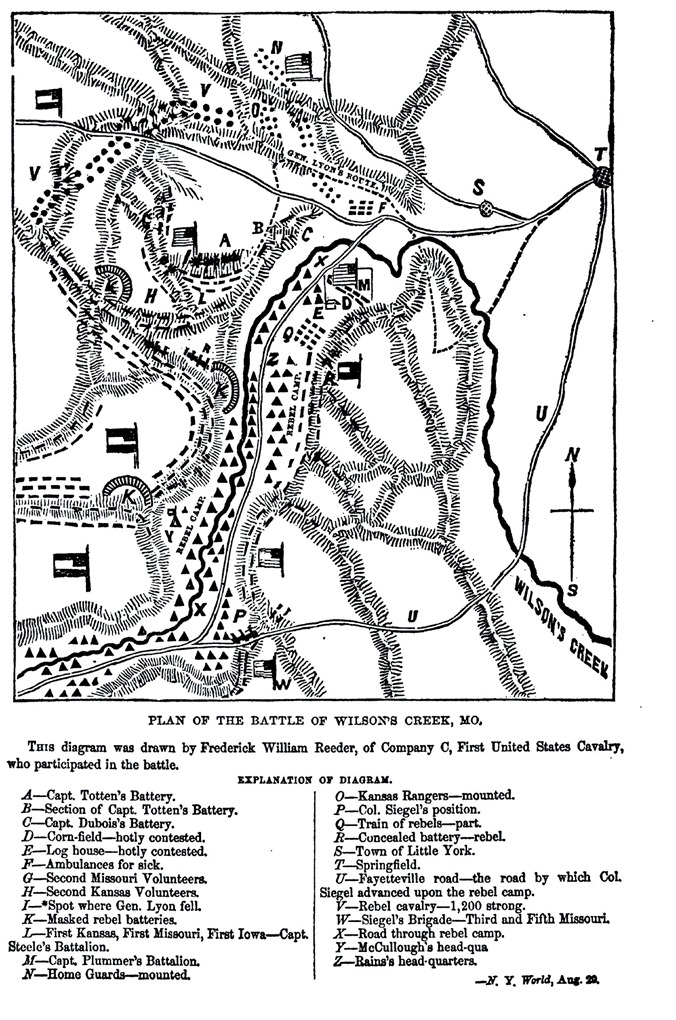
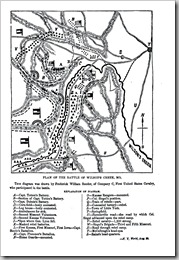
Wilson's Creek, August 10, 1861

Click map to
view full size

August 10.—Gen Lyon’s column marched until 2 A. M., when it was halted for two hours. Capt. Gilbert’s regulars were thrown out as skirmishers at 4 A. M., and the column moved forward. At 5 o’clock the enemy’s pickets were driven in, and soon after the army came in sight of the rebels’ position. McCulloch’s camp extended in a valley along Wilson’s Creek for three miles, and followed the bends of the streams to the north at its western extremity, and to the south at the eastern. Siegel’s attack was to be made at the latter point, and Lyon moved, therefore, upon the western and northern extremity, down the head of the valley. Blair’s First Missouri Regiment at about 6 o’clock drove a full regiment of infantry from a ridge at the end of the encampment, and at the same time Totten’s battery threw some shells among the enemy’s tents. Blair’s regiment moved forward up a second ridge, upon which they encountered a Louisiana regiment. Here they were reinforced, and finally gained the summit, driving the rebels before them. Two companies of regulars were at this time sent across the creek eastwardly to engage a rebel force in that direction, but were compelled to retire; when Lieut. Dubois opened his battery from the second ridge won, and threw a number of shells which exploded with great effect, and completely routed this body. Blair’s regiment was now withdrawn, and the Iowa First ordered to take its place, and the Kansas regiments to support the Iowa First. An attempt to charge with his cavalry was next made by McCulloch, but the charge was entirely broken by the fire of Totten’s battery. Both batteries were soon in position, and the battle resolved itself into the enemy’s attempt to dislodge them, and regain the ridges from which he had been driven. In this attempt he was repeatedly foiled. At about nine o’clock, as the enemy came on again, Gen. Lyon, who had received three wounds, put himself at the head of the Iowa First to lead a charge with the bayonet, when he received a rifle ball in though breast and fell dead. His fall, however, was not generally known. Major Sturgis assumed the command, and the battle went on.—Mean time, Gen. Siegel made his attack upon McCulloch’s right, drove the rebels for half a mile from their position and took possession of that extremity of their camp; but his advance was broken by the fire of a full regiment that he had permitted to approach in the belief that it was a reinforcement from Gen. Lyon. Unable to rally Salomon’s regiment, he was driven back with the loss of five guns. About noon, the enemy’s tents and his whole baggage train were destroyed by fire, supposed to have been his own act The fight still continued in front, and the last advance of the enemy, made at one P. M., was driven back by the whole national force in the field. Immediately after, Major Sturgis ordered a movement toward Springfield, and the whole force fell back in good order. McCulloch made no pursuit. The national loss was 800 in killed and wounded. Though the rebel loss is not known, it is thought to have been very large, as the national artillery fire was remarkably accurate.—(Doc. 175.)

—The Spanish Minister announced to the Secretary of State at Washington, that the seven American vessels captured by the pirate Sumter and carried into Cienfuegos, had been discharged by order of the Spanish Government.— Washington Republican, August 11.

—To-day Lieutenant Budd, commanding the Reamer Resolute, cleared out one of the rebel depots on the Potomac. It has been known for some time that the Herring Creek on the Maryland side, and Machodock Creek opposite on the Virginia side, were the dcpot for Maryland recruits to the rebel army in Virginia. The Resolute having approached within 300 yards of the shore of the creek, was fired on with musketry. A boat was immediately lowered, and Lieut. Budd with twelve men landed. The rebels fled at their approach and were pursued for a mile, but made their escape. Two muskets and a knapsack which they .threw away in flight were picked up. Upon returning to the house abundant evidence that it had been a rebel rendezvous, and papers containing important information, were found. The buildings were destroyed, and ten contrabands found on the premises were brought away.

After leaving the creek, Lieut. Budd learned from the negroes that there were 800 of the rebels concentrated at the Hague, about five miles back from the river, and that their ferryboat was about three-quarters of a mile up the creek. Meeting the schooner Dana, he took her gun and crew upon the Resolute, and placing the negroes in charge of two men of the Dana, he went up the creek and captured a large boat capable of carrying 25 or 80 men, but saw nothing of the rebels.

—The prize schooner Geo. V. Baker, of Galveston, and her confederate crew of four men in irons, were carried under the guns of Fortress Monroe. The schooner was captured by one of the United States blockading fleet off Galveston, Texas, and sent to New York with the United States crew on board. She was captured yesterday off Cape Hatteras by the rebel privateer York, who put four of her own men on board. Meanwhile the York was seen by the United States gunboat Union, who gave chase and burnt the privateer, but not until the crow had beached her and escaped. The Union then recaptured the Baker, and her crew.

—Isham G. Harris issued an order to the clerks of the county courts of Tennessee, requesting them to search the residences of the people for arms of every description, and to forward such arms to the military authorities at Nashville, Memphis, or Knoxville.—(Doc. 175½.)

—Between the hours of six and seven this evening eighty mounted men, led by Capt. White and a refugee named Talbot, attacked a smaller number of Home Guards at Potosi, Missouri, and were repulsed with a loss of two killed and three wounded. One man of the Home Guards was killed.—St. Louis Democrat, August 12.

—Prof. La Mountain made two successful balloon ascensions at Fortress Monroe, having attained an altitude of three thousand feet. He found the encampment of the Confederate forces to be about three miles beyond Newmarket Bridge, Va. There were no traces of the rebels near Hampton. A considerable force is also encamped on the east side of James River, some eight miles above Newport News. The two cannon mounted at Sewall’s Point toward Old Point, he thinks, are only large fieldpieces. There are, perhaps, one thousand Confederates at Sewall’s Point.—N. Y. Times, August 13.

—The Western Virginia State Convention, in a series of resolutions, declared itself “unalterably opposed to any compromise with the rebels.”—(Doc. 176.)

—The Helena (Arkansas) Shield, of this day, contains the following:—From the Hon. C. W. Adams of this county, who arrived at home a few days since from the northern part of this State, we learn that on last Monday week thirteen hundred Indian warriors—Southern allies —crossed the Arkansas River near Fort Smith, en route for McCulloch’s camp. These Indians are armed with rifle, butcher knife, and tomahawk, and had their faces painted, one half red, and the other black. We also learn that a regiment of mounted Texans likewise crossed the Arkansas at or near Fort Smith, for the same destination.

——-

Late addition to Volume 3:


August 10.—The narrative of Doctor Blaisdell, a physician lately resident in Macon, Ga., was published, in which he pronounced the whole story of Jeff. Davis having taken command in person at Manassas during the fight, a pure fiction.—Cincinnati Gazette.
FRIDAY 9

This day has not been so hot, rather cloudy and rain tonight. I was on the Ave and at the Pat office, got a Hack and brot home my Books and papers from the office. Nothing new stirring in the City. Do[c]t Vanslyck was here today and Capt Adams gave us a Call. I finished of[f] my model and did not do much else today about the House. The boys have been playing soldier in their tent opposite the House — keeping guard &c.

______

The three diary manuscript volumes, Washington during the Civil War: The Diary of Horatio Nelson Taft, 1861-1865, are available online at The Library of  Congress.

9th.—What a wonderful effect the hardships of camp life, with the troubles and cares which they entail on a surgeon, have had on my health. For many years I have been dyspeptic. Now I can eat what I please, and go without sleep almost entirely, and suffer no inconvenience. Last night, at 11 o’clock, after having ate a piece of hard salt beef for my supper, I “cared for” a pint of rich ice cream, and feel no inconvenience from it to-day. This would kill an ordinary civil man. I have to work very hard, but feel it a great comfort to work amongst the sick without suffering from fatigue, as I have been accustomed to.

Having received an order this morning from Gen. Dix to put all my sick into general hospital, and finding them bitterly opposed, I visited Fort McHenry, saw Gen. D., and prevailed on him to rescind the order.

I was highly gratified with what I saw at Fort McHenry. It, being the first equipped fort I ever saw, was an object of much interest; its numerous cannon, large enough for a small soldier to sleep in, pointing in all directions overlooking Baltimore and guarding all the approaches to it. No matter from what direction you come, you find these monster guns looking right in your face. Low down behind the walls lie almost innumerable ugly bull-dog-looking mortars, not over two and a half feet long, loaded with a 20 to 40-pound shells filling them to the very muzzle, and ready to be vomited forth at the first approach of trouble. There, too, is the great Dahlgren, stretching its long black neck away beyond the embrasures, as if looking for an object into which to pour its monster shot and shell, or its shower of grape and cannister. Its howitzers are there, and its great Columbiads, into some of which I was strongly tempted to crawl and take a nap, but a sudden recollection of the history of Jonah reminded me that its stomach, too, might sicken, and that I might awake in a trip across the mighty deep on the wings of the wind. I didn’t go in. The bright little brass 6, 8, and 10 pounders, on the greater number of which Napoleon said God always smiled in battles, were conspicuous amongst these great leviathans, and above all, the newly invented rifle cannon, ready to demolish ships or houses at two to five miles distance.

Have lost no man yet from sickness, but I have one who, I fear, will not recover. He is supposed to he poisoned by a glass of lemonade, bought of a man suspected of being a rebel.

I have succeeded, by selling a half barrel of flour, and by the approval of a small requisition made on the commissary, in getting provisions of all kinds to make my little detachment comfortable.

AUGUST 9TH.—Gen. Magruder commands on the Peninsula. President Tyler had a villa near Hampton, which the Yankees despoiled in a barbarous manner. They cut his carpets, defaced the pictures, broke the statues, and made kindling wood of the piano, sofas, etc.

August 9, Friday.—The colonel is out of humor with Lieutenant Rice for letting men on guard go to their tents to sleep and scolds him severely in the presence of his men. A little less grumbling and more instruction would improve the regiment faster. The men are disconcerted whenever the colonel approaches; they expect to be pitched into about something. A good man, but impatient and fault-finding; in short, he is out of health, nervous system out of order. Would he had sound health, and all would go well. He gives no instruction either in drill or other military duties but fritters away his time on little details which properly belong to clerks and inferior officers.— Begun to rain at noon, refreshing rather.

Our men returning from Sutton report our right wing under Lieutenant-Colonel Matthews gone on to Summersville. Also that a party in ambush fired on two companies of Colonel Lytle’s regiment, killing one and wounding four. This sort of murder must be stopped. The colonel is busy issuing passes to citizens, the patrol or picquets having been ordered to stop all persons travelling on the roads without passes. This must be a great annoyance to the inhabitants. Is there enough benefit to be gained for all the hate we shall stir up by it?

The mother of our adjutant at Camp Chase seeing a boy walking up and down on his sentinel’s beat took pity on him, sent him out a glass of wine and a piece of cake with a stool to sit on while he ate and drank. She told him not to keep walking so, to sit down and rest! She also advised him to resign!

More rumors of the approach of Lee with fifteen thousand men to attack our forces at Buchanan [Buckhannon]. Lieutenant Reichenbach with his party of twenty men marched yesterday twenty-eight miles and today, by noon, fifteen miles.

Joe Holt¹ makes the best war speeches of any man in the land. It always braces my nerves and stirs my heart when I read them. At Camp Joe Holt, near Louisville, he said: “Since the sword flamed over the portals of Paradise until now, it has been drawn in no holier cause than that in which you are engaged.”

_______

CAMP NEAR WESTON, VIRGINIA, August 9, 1861.

Friday Afternoon.

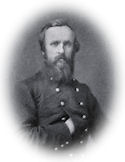
DEAREST:—I have just read your letter postmarked the 5th at Kingston. Right pleased with you. Very happy to get your good letter. It has been bright, warm (hot) weather since Sunday, but today at noon a fine rain began to fall, and this afternoon I was loafing about in the tents, hard up for occupation. Lying alone in my tent, your letter came in with one from Uncle written Sunday. Wasn’t it so lucky? I’ve nothing to tell you, I believe. Dr. Joe is well—perfectly—again; busy changing his hospital from the court-house and jail to a secession church which doesn’t run now. The colonel is busy giving passes to citizens wishing to travel roads guarded by our picquets.

Colonel Matthews under Colonel Tyler has gone to Summersville about seventy miles south of this. They are looking for Wise. In the meantime we have rumors that General Lee is marching over the mountains to push the Union forces in this region out of the State, and to seize the stores so abundantly gathered hereabouts. We have no means of knowing the truth here; if there is anything in it, we shall be called to Buchanan [Buckhannon], sixteen miles east, where the first attack is expected. There is a little more activity among the enemy in this quarter since these rumors became rife. Our party from the south, returning today, report that an attack was made up the road on two companies of Colonel Lytle’s men by a party in ambush, who fired one volley and ran off into the hills. One man killed and four wounded. Captain Gaines (our prosecutor) called to see me last night. His company is detached from his regiment, guarding a party putting up telegraph wires. Mr. Schooley returned from Cincinnati with late news last night. He says, it [was] so lonely he really wished to get back to camp. I am sorry to have Colonel Matthews and the right wing gone, but except that we are doing nicely. Colonel Scammon is in better health and things go on very smoothly.

The soldiers fare very well here, and stand in little need of sympathy, but when I have an opportunity to smooth matters for them, I try to do it, always remembering how you would wish it done. What a good heart you have, darling. I shall try to be as good as you would like me to be.

Young Jewett got safely home. He is likely to have a long and serious time getting well, but will probably be very slightly, if at all, crippled. Colonel Ammen is at Clarksburg. If we have any force sent against us, we shall be with him; otherwise, not at present.

I am glad you are visiting at Aunt Margaret’s this hot weather. Do you recollect when we were up [the] Saguenay a year ago at this time? Here Colonel Scammon came in full of pleasant gossip, feeling happy with letters from his wife and daughters. No more chance to write in time for tonight’s mail. Continue to address me at Clarksburg until I direct otherwise. Love to all at Elmwood. Kiss the boys all around.

Affectionately,

R. B. HAYES.

MRS. HAYES.

_______

¹Joseph Holt, born in Breckinridge County, Kentucky, January 6, 1807; died in Washington, August 1, 1894. Famous as a jurist and an orator. He was Postmaster-General in Buchanan’s Cabinet for a time and in 1860, when John B. Flood resigned, he became Secretary of War. He was a vigorous Union man, urging his fellow Kentuckians “to fly to the rescue of their country before it is everlastingly too late.” In September, 1862, President Lincoln appointed him Judge-Advocate General of the army, in which capacity he served long with great distinction.

Post image for A Diary of American Events.–August 9, 1861

August 9.—President Lincoln to-day made the following appointments of brigadier-generals for the volunteer force: Colonels Blenker and Slocum, of the volunteers, and Major Wadsworth, aide to Gen. McDowell; Colonel John A. Peck, Ex-Major of the regular army, who distinguished himself in the Mexican war; John H. Martindalc, a graduate at West Point; Ormsby M. Mitchell, Professor of Astronomy, of Cincinnati, a graduate of West Point and an ex-army officer.

—Ormond F. Nims’ battery of light artillery left Boston for the seat of war. The company departed from their camp at Quincy at 7J o’clock last evening, and, marching through South Boston, reached the Providence depot at 11¼ o’clock. An hour and a half was occupied in getting their guns, horses, and carriages on the cars. The battery consists of Bix rifled 6 pounders, and besides the regular caissons it has baggage wagons, forges, magazines, etc. Six hundred Schenckl’s shell and James’s projectile were sent from the State Arsenal for the use of the battery.

—The United States Marshal, at Boston, Mass., arrested a person who registered himself at the Parker House as “C. Jordan, Pittsburg, Pa.,” but who subsequently has confessed himself as John Williams, of Norfolk, Va., and was supposed to hold a commission in the rebel army. He was arrested as a spy, and by orders received from the Secretary of War, was sent to Fort Lafayette, New York harbor. —N. Y. Tribune, August 11.

—The Third Regiment of Connecticut Volunteers, who were in the battle at Bull Run, returned to Hartford, and were received amid the firing of guns, the cheers of the firemen and military, and an immense throng of citizens, who had assembled to welcome thorn home.— N. Y. Tribune, August 11.

—Lieut.-Col. Robert Nugent, of the Sixty-ninth Regiment N. Y. S. M., was appointed to a captaincy in the regular army of the United States. Captain Nugent was born in the North of Ireland, his brother John M. being at present the Mayor of Dumdalk. He came to America immediately after the abortive insurrection of ’43; and having strong military tastes, soon enrolled his name in the Fourth Company of the N. Y. National Guards, and served two years under Captain Riblet. On the organization of the Sixty-ninth in ’52, Captain Nugent became one of its earliest officers, and has served faithfully in its ranks as Lieutenant, Captain, Major, and Lieutenant-Colonel down to the present day.—N. Y. Tribune, August 11.

—General Lyon learned that the rebels, 22,000 in number, under Ben. McCulloch, were on Wilson’s Creek, nine miles from Springfield, Mo., and moved against them with his whole force, only 5,200. The force was disposed in two columns. One under Col. Siegel with his own regiment, and that of Col. Salomon’s, and six guns, moved 15 miles in a southerly direction to turn the enemy’s right flank, and the other wider Gen. Lyon moved forward to attack in front. Lyon’s column consisted of the Missouri First, Iowa First, Kansas First and Second, part of the Missouri Second, a detachment from Col. Wyman’s Illinois Regiment, all volunteers; eight hundred regulars, and two batteries of 4 and 6 guns respectively. There were also four mounted companies of Home Guards. Both columns left Springfield at about 8 P. M.—St. Louis Democrat, August 12.

The following is taken from the Lexington “Gazette,” dated August 8,1861:

”It is due to our worthy fellow-citizen, Mr. E. F. Paxton, or rather it is due to the county of Rockbridge, to claim credit for Mr. Paxton’s conduct, which he has been too modest to claim for himself. A correspondent of one of the Richmond papers a short time since spoke of a Virginian who had been lost from his company during the fight, and fell in with the Georgia Regiment just as their standard-bearer fell. The lost Virginian asked leave to bear the colors. It was granted to him. He bore them bravely. The flag was shot through three times, and the flag-staff was shot off whilst in his hands. But he placed the flag on the Sherman Battery, and our brave men stood up to their colors and took the battery. That lost Virginian was E. F. Paxton, of Rockbridge.”

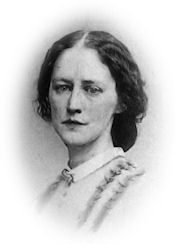
Post image for “What a blackness of darkness, of falsehood and misrepresentation lies behind all this.”—Woolsey family letter; Jane Stuart Woolsey to a friend in Paris.

Brevoort Place, August 8th, 1861.

Your response to my patriotic fervors gave me a sort of chill. We did not seem en rapport. . . . We are heartily ready to record our faith that the war is worth what it may cost, although the end may be only—only! the preservation of the Government, and not, just now, the liberation of the slaves. Perhaps you hold, with Mr. Phillips and Abby (I believe they comprise the entire party) that the war is not justifiable if it “means only stars and stripes.” We think, or to resume the perpendicular pronoun, I think that is enough for it to mean or seem to mean at present. “The mills of the Gods grind slow,” you know, or, if you will let me requote to you your own quotation, “you cannot hurry God.” Don’t you and Mr. Phillips want to hurry Him a little? I would rather, for my part, think with Mrs. Stowe, that the question of the existence of free society covers that other question, and that this war is Eternally Righteous even if it “means only the stars and stripes.” .. . We are all getting bravely over the two or three dreadful days of a fortnight ago, and coming to think that our retreat under the circumstances was not such a bad thing after all. . . . Monday after Bull Run was a frightful day in Washington. Georgy says a thick gloom oppressed them which the knowledge of the safety of those nearest them could not lighten in the least, and that a sad procession of the wounded was passing through the streets all day under the heavy rain. . . . Many of the men are but slightly wounded, and all are perfectly patient, cheerful and only eager for “another chance.” “Tell her about the wound in my hand preventing me from writing,” one man said, for whom Georgy was writing home. “And the wound in your leg?” G. asked. “No, never mind about that.” “And I shall say you fought bravely?” “Oh, no matter about that; she’d be sure of that.” They have known two or three cases of Southern barbarity to our wounded. But the poor wretches expected the same thing at our hands. Dr. Bacon, an intimate friend who has just come home with his regiment, Connecticut 2nd, says in the battle on Sunday he came upon a piece of shade in which four or five wounded Georgians were lying, and what was very painful to him, every man believed that he had come to kill them, lying there disabled. One young fellow called out, “Don’t hurt me, I’m hurt enough already,” and the rest made a feeble show of defending themselves. Of course he dressed their wounds, and did what he could for them with more than usual care and gentleness, and I can bear witness how careful and gentle that must have been, but it was hard to tell which emotion was uppermost with them, gratitude or astonishment. Mr. Maclise, of the 71st, which has come home, says he found a wounded man under a tree, a Carolinian, he thinks, who begged for his life in the same way. “Bless your soul,” Maclise said, “I wouldn’t hurt you for the world; don’t you want some water?” The poor fellow eagerly took the water from his enemy’s canteen. “If I only had a cup I could give you some brandy,” Mr. M. added. “Oh, just look in my knapsack and you’ll find a cup.” So Maclise opened the knapsack, took out a beautiful silver cup, mixed the draught, and made his patient as comfortable as he knew how, bringing home the silver cup, at the Carolinian’s most urgent entreaty, as a souvenir of that sad day. He will try and return it one of these days. But what a blackness of darkness, of falsehood and misrepresentation lies behind all this. These perfectly intelligent men devoutly believed that we would kill them, unarmed, sick and helpless! . . . The “prevailing” Prince comes and goes, and nobody seems to care much about it. We have learned something, or it is that we have too many troubles of our own to care for the pleasures of princes. He overstayed his time at Mount Vernon the other day, and there was a splendid story that he had been captured, but he spoiled the bulletins and the joke by coming back to a soiree at two o’clock at night. . . . We are going, as much for duty as pleasure, to Lenox, to-morrow or Saturday, for a few weeks, to refresh ourselves for the winter. As long as McClellan keeps quiet we shall stay. He resigned one day last week. Col. Davies dined with us yesterday and told us so, from his uncle, General Mansfield, who had seen the letter. The administration attempted some interference in his reforms, and he sent in his resignation. It was immediately hushed up, refused, of course, and he was allowed to have his way.