Following the American Civil War Sesquicentennial with day by day writings of the time, currently 1863.

August 2011

Lenox, Aug., 1861.

My dear Georgy: You need not speak so coolly of our staying here three months. Three weeks will give us enough, I guess. It is actually tiresome not to have anything to do, after being so busy in New York. We only take one paper too now—the Tribune, and that does not come in till four o’clock, so that our mornings are very blank. There is a newsboy here however —think of that! who sells the New York and Boston papers every day on the hotel steps, after the arrival of the stage. And there is a brick store and a telegraph office, connecting with the telegraph in Springfield. Messages come over the wires in the short space of three days, I am told! . . . Is there not some newsstand or book-store, on Pennsylvania Avenue where Moritz can buy you the illustrated papers for the hospitals? I hope so, as we cannot send anything now except perhaps a stray Boston paper which everybody here has finished. I sent word to Edward Gilman, who has been in New York, when he goes home to Maine to mail you every now and then a Bangor paper for some sick Maine volunteers. . . . When we go back, we will constitute ourselves into a society, and do things more systematically and thoroughly. . . .

Our letters must be few and stupid. Your last to us was Eliza’s, written last Monday in camp. What scenes you must have gone through there, in the arrest and examination of those women spies! What strange romance history will be, by and bye, to May and Bertha. Gay ladies and courtly gentlemen, and ragged rebel volunteers, and city brokers, and wily politicians, all assigned their respective cells side by side, perhaps, in Fort Lafayette. You wonder what “horse-cakes” are, which the old woman declared her packets of letters to be, when found between her shoulders. They are gingerbread of the “round heart” consistency, cut in the flat, rude shape of a prancing horse with very prominent ears and very stubbed legs, sold in various small shops in Alexandria, along with candy balls, penny whistles and fly-specked ballads. “Horse-cakes” are an Alexandria institution. You should buy a few for lunch some day in the bakery. . . . We live in the newspapers and in your letters. It is impossible to think of anything else. I have tried on successive afternoons to get interested in Motley’s Netherlands, and give it up as a bad job. One reads a sentence over and over without getting the sense of it. And then, I remembered, that I couldn’t remember a name, or fact, or date in the three volumes of Motley’s other work; so what’s the use of reading anything? “Fort Sumter” is ancient history enough for me. To-day we have quite a budget of news—the  details of Butler’s expedition to Fort Hatteras, which of course had to be successful. They went against the weakest point of the coast, with an overwhelming force. Little as it is, it serves for a subject of brag for us, and the newspapers glory over it as a splendid naval victory in the style of true Southern reports. We have the text of Fremont’s proclamation. It is all very well in itself, but I don’t see the object of setting slaves free in Missouri, and setting soldiers to catch them in Virginia;—shooting rebels out west and letting them off with “a mild dose of oath of allegiance” in Washington. . . . It is my growing conviction that nothing would be worse for the country than to be let off easy in this war. We should learn to think lightly of Divine guidance and Divine judgments. Providence means to humble and punish us thoroughly before full success is granted, and it is best so.
MONDAY, AUGUST 26, 1861.

Went to the Provost Marshalls with Julia this morning and after much trouble got a “Pass” to go on the Boat to Alexandria. Took the Boat with Julia at 1 o’clock. Went directly to the Camp of the NY 27th 3/4ths of a mile back of the City and near Fort Ellsworth East of “Shooters Hill.” Walked over to the Fort with Surgeon Barnes and Lieut Swan, found Lieut Link of Newark & Col Lansing and went through the Fort. Saw Brigade Drill afterwards and back to the Camp. Soldiers in good health.

______

The three diary manuscript volumes, Washington during the Civil War: The Diary of Horatio Nelson Taft, 1861-1865, are available online at The Library of  Congress.

Post image for “The jealousy existing in the military towards the medical department of the army astounds me.”–Journal of Surgeon Alfred L. Castleman.

26th.—I was visited by my Colonel to-day. He introduced the subject of reducing my hospital force. I was extra-polite, and replied that I had not the slightest objection, provided it was done with the understanding that it would shift the responsibility of the care of the sick from my shoulders to those of others. The subject was dropped, and will hardly be renewed. The jealousy existing in the military towards the medical department of the army astounds me. The military commanders claiming that the medical have no authority except through them, has driven the medical officers to assume the other extreme, and claim that they are the only officers in the army who are really independent of command. This quarrel is often bitter, and makes not only themselves uncomfortably captious, but subjects the sick and wounded to suffering whilst these settle their unnecessary quarrels.

Norwood, Near Berryville, August 26.—On a visit of a few days to our relative, Dr. M. The people of this neighbourhood occupied as they are in the one I left. All hearts and hands seem open to our army. Four heavily laden wagons have left Berryville within a few days, for the hospitals below. We are all anxious about Western Virginia, of which we can hear so little. General Lee and General Floyd are there, and if they can only have men and ammunition enough we have nothing to fear.


The army in Fairfax seems quiet. Colonel Stuart, with his cavalry, has driven the enemy back, and taken possession of “Chestnut Hill” as head-quarters. There they are overlooking Washington, Georgetown, and our neighbourhood, all bristling with cannon, to prevent their nearer approach. Some of those young men can almost point from the hills on which they are encamped, to chimneys of their own firesides, the portals of their own homes. The woods are cleared away for miles; even the yard trees are gone, leaving the houses in bold relief, with nothing to shade, nothing to obscure them. I do pity those who were obliged to stay in Southern homes, with Southern hearts, surrounded by bitter and suspicious enemies. My old friend Mrs. D. is sometimes in their lines, sometimes in ours. When our men are near her, they are fed from her table, and receive all manner of kindness from her hands. Some of my nephews have been invited to her table, and treated as her relations. When they entered her house she advanced towards them with outstretched hands. “You don’t know me, but I knew your mother, father, and all your relations; and besides, I am connected with you, and you must come to my house while near me, as to that of an old friend.” Nothing could be more grateful to a soldier far away from home and friends. But these were her bright moments. She has had many trials while in the enemy’s lines. Her husband and grown son are in the Confederate service; she has sent her two young daughters to her friends in the lower country, and has remained as the protector of her property, with her two sons of eight and ten, as her companions. On one occasion her servant was driving the cows from her yard to be milked; from very loneliness she called to the servant to remain and milk them where they were; the very tinkling of the cow-bell was pleasant to her. It was scarcely done when a posse of soldiers came with their bayonets gleaming in the moonlight, and demanded, “Why did you have a bell rung in your yard this evening?” “Do you mean, why did the cow-bell ring? Because the cow shook her head while she was being milked.” “But you don’t have the cows milked in the yard every evening. It was a signal to the rebels—you know it was—and your house shall be burnt for it.” She then had to plead her innocence to save her house, which they pretended not to believe until the servants were called up to prove her statements. They then, with threats and curses, went off. Another night she carried a candle from room to room to seek some missing article. In a short time several soldiers were seen running to her house with lighted torches, yelling “Burn it, bum it to the ground!” She ran to the yard to know the cause; instantly this lonely woman was surrounded by a lawless, shouting soldiery, each with a burning torch, revealing, by its lurid and fitful light, a countenance almost demoniac. They seemed perfectly lawless, and without a leader, for each screamed out, “We are ordered to burn your house.” “Why?” said she. “Because you have signal-lights at your windows for the d__d rebels.” She immediately suspected that no such order had been given, and summoning firmness of voice and manner to her aid, she ordered them off, saying that she should send for an officer. They did go, uttering imprecations on her defenceless head. But a still more trying scene occurred a short time ago. Our soldiers were surrounding her house, when Colonel Stuart sent off a raiding party. During that night the Yankees advanced, and our men retired. The Yankees at once heard that the raiders were out; but in what direction was the question. They came up to her house, and knowing the mother too well to attempt to extort any thing from her, ordered the little boys to tell them in what direction Colonel Stuart had gone. The boys told them that they could tell nothing. Threats followed; finally handcuffs and irons for the ankles were brought. Still those little heroes stood, the one as pale as ashes, the other with his teeth clenched over his under lip, until the blood was ready to gush out, but not one word could be extorted, until, with a feeling of hopelessness in their efforts, they went off, calling them cursed little rebels, etc. The mother saw all this, and stood it unflinchingly—poor thing! It is harrowing to think of her sufferings. Yet, if she comes away, her house will be sacked, and perhaps burnt.


We are sometimes alarmed by reports that the enemy is advancing upon Winchester; but are enabled to possess our souls in patience, and hope that all may be well. I see that they are encroaching upon the Northern Neck. I trust they may be repulsed from that fair land.

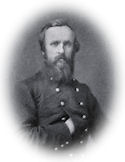
Monday evening, August 26.— Marched today up the beautiful valley, “Tygart’s Valley” I believe, to this pretty camp in the hills, eighteen miles. Saw our general. About forty-five, a middle-sized, good-looking man, educated at West Point. An army man, good sense, good talker—General Reynolds. Oh, what a lovely spot!

_______

August 26, 1861.

DEAR UNCLE:—We are camped somewhere near, I think, the head of Tygart’s Valley, near Cheat Mountain Pass. Several regiments are in sight, and the enemy under Lee so near that our outposts have fights with his daily. We are under a capital general, and are fast getting ready. I think we are safe; if not, we shall be within a very short time. We expect to stay here until we or the enemy are whipped, or back out for fear of a whipping—probably weeks.

We are in [a] lovely little valley on a fine clear trout stream, with high mountains on all sides and large trees over us. A perfect camp, perfectly protected by entrenchments for miles up the valley, pickets and scouts in all directions, etc., etc. A telegraph finished to headquarters of our general from General Rosecrans’ at Clarksburg, and rapid mail carriers daily to the same place. For instance, your letter of the 19th was handed to me at my tent by the courier within half an hour after our arrival here.

Glad Fanny is with you. Lee will not whip us unless we attack him with a force too small. If he attacks us, we are the best off. The postage stamps are all gone.

Sincerely,

R. B. HAYES.

I got four Fremont Journals. Much obliged.

S. BIRCHARD.

_______

SOMEWHERE IN TYGART’S VALLEY, NEAR CHEAT

MOUNTAIN PASS, VIRGINIA,

August 26, Monday evening, 8:30

P.M., after a march of eighteen miles, 1861.

DEAREST:—You will think me insane, writing so often and always with the same story: Delighted with scenery and pleasant excitement.

We are camped tonight in a valley surrounded by mountains on a lovely stream under great trees. With the Third Ohio, Thirteenth Indiana, one-half of McCook’s Ninth and the Michigan artillery, which Mother remembers passed our house one Sunday about the last of May, and McMullen’s Battery, all in sight. Our General Reynolds makes a good impression. We are disposed to love him and trust him. We expect to remain here and hereabouts until the enemy, which is just over the mountain, either drives us out, which I think he can’t do, or until we are strong enough to attack him. A stay of some weeks, we suppose.

What a lovely valley! Joe and I will always stick by Ohio River water. It must be in the summer chiefly made up of these mountain streams than which nothing can be purer. Our mails will come here daily. I got a letter from Uncle delivered at my tent within half an hour after it was up, dated 19th and directed as all letters should be, Clarksburg.

We sent back our band to escort in the Germans who were three hours behind us. I built a bridge for them, etc., etc. How polite they were. We like them so much.

Affectionately,

R. B. HAYES.

Have the daily Commercial sent me directed, “Maj. R. B. Hayes, 23d Ohio Regiment, Clarksburg.”

MRS. HAYES.

AUGUST 26TH.—What a number of cavalry companies are daily tendered in the letters received at this department. Almost invariably they are refused; and really it is painful to me to write these letters. This government must be aware, from the statistics of the census, that the South has quite as many horses as the North, and twice as many good riders. But for infantry, the North can put three men in the field to our one. Ten thousand mounted men, on the border of the enemy’s country, would be equal to 30,000 of the enemy’s infantry; not in combat: but that number would be required to watch and guard against the inroads of 10,000 cavalry. It seems to me that we are declining the only proper means of equalizing the war. But it is my duty to obey, and not to deliberate.

August 26th.—The Terror has full swing at the North now. All the papers favorable to us have been suppressed. How long would our mob stand a Yankee paper here? But newspapers against our government, such as the Examiner and the Mercury flourish like green bay-trees. A man up to the elbows in finance said to-day: “Clayton’s story is all nonsense. They do sometimes pay out two millions a week; they paid the soldiers this week, but they don’t pay the soldiers every week.” “Not by a long shot,” cried a soldier laddie with a grin.

“Why do you write in your diary at all,” some one said to me, “if, as you say, you have to contradict every day what you wrote yesterday?” “Because I tell the tale as it is told to me. I write current rumor. I do not vouch for anything.”

We went to Pizzini’s, that very best of Italian confectioners. From there we went to Miss Sally Tompkins’s hospital, loaded with good things for the wounded. The men under Miss Sally’s kind care looked so clean and comfortable—cheerful, one might say. They were pleasant and nice to see. One, however, was dismal in tone and aspect, and he repeated at intervals with no change of words, in a forlorn monotone: “What a hard time we have had since we left home.” But nobody seemed to heed his wailing, and it did not impair his appetite.

At Mrs. Toombs’s, who was raging; so anti-Davis she will not even admit that the President is ill. “All humbug.” “But what good could pretending to be ill do him? ” “That reception now, was not that a humbug? Such a failure. Mrs. Reagan could have done better than that.”

Mrs. Walker is a Montgomery beauty, with such magnificent dresses. She was an heiress, and is so dissatisfied with Richmond, accustomed as she is to being a belle under different conditions. As she is as handsome and well dressed as ever, it must be the men who are all wrong.

“Did you give Lawrence that fifty-dollar bill to go out and change it?” I was asked. “Suppose he takes himself off to the Yankees. He would leave us with not too many fifty-dollar bills.” He is not going anywhere, however. I think his situation suits him. That wadded belt of mine, with the gold pieces quilted in, has made me ashamed more than once. I leave it under my pillow and my maid finds it there and hangs it over the back of a chair, in evidence as I reenter the room after breakfast. When I forget and leave my trunk open, Lawrence brings me the keys and tells me, “You oughten to do so, Miss Mary.” Mr. Chesnut leaves all his little money in his pockets, and Lawrence says that’s why he can’t let any one but himself brush Mars Jeems’s clothes.

August 26.—The Eighteenth regiment of Massachusetts Volunteers, under the command of Colonel James Barnes, of Springfield, left their camp at Readville, near Dedham, this afternoon for the seat of war. The regiment numbers eight hundred and seventy men, but will be recruited to one thousand and forty within a few weeks. They are uniformed in the conventional blue and gray of Massachusetts, armed with Springfield muskets of 1842, and fully equipped. They have camp equipage, company wagons and ambulances, and sixty horses, a band of twenty-five pieces enlisted for the war, twenty-five thousand rounds of ball cartridges, and twenty-five thousand rounds of buckshot, and, in fact, all the paraphernalia of war ready to fit them for immediate service in the field.

Of the officers, many are specially qualified for their positions. Col. Barnes is distinguished for having been in the same class with Jeff. Davis, at West Point, graduating A one, when Jeff, was No. twenty-seven, in a class of thirty one. Lieut.-Col. Ingraham was in the Massachusetts Fourth, stationed at Fortress Monroe. Major Haves is a graduate of Harvard College, and quite popular. Adjutant Hodge was an officer of the Massachusetts Fifth, and distinguished himself at Bull Run, saving the life of Col. Lawrence. Surgeon Smith was educated in Paris, and was connected with Major Cobb’s battery. Other officers of the regiment have seen active service. Most of the men are farmers and mechanics, of moderate means, excellent health, and unwavering devotion to the cause of the Union.—N. Y. Times, August 28.

—A Correspondent of the Philadelphia Inquirer gives an extended account of a visit of the privateer “Sumter ” to Puerto Cabello, together with a copy of a letter from Raphael Semmes, her commander, to the governor of that place.—(Doc. 9.)

—A Battle occurred at Summersville,[1] in Western Virginia, this morning. The Seventh Ohio regiment, Colonel Tyler, was surrounded whilst at breakfast, and attacked on both flanks and in the front simultaneously. The national forces immediately formed for battle and fought bravely, though they saw but little chance of success. The rebels proving too powerful, Col. Tyler sent forward to the baggage train, which was coming up three miles distant, and turned it back toward Gauley Bridge, which place it reached in safety.

Companies B, C, and I suffered most severely. They particularly were in the hottest of the fight, and finally fought their way, through fearful odds, making great havoc in the enemy’s forces. The rebel force consisted of three thousand infantry, four hundred cavalry, and ten guns. The Union forces scattered, after cutting their way through the enemy, but soon formed again and fired, but received no reply or pursuit from the enemy. Not over two hundred were missing, out of nine hundred engaged. The rebel loss was fearful. Lieut.-Col. Creighton captured the rebels’ colors and two prisoners. The following is a list of national officers known to be killed: Captain Dyer, Company D, of Painesville; Captain Shurtleff, Company C, of Oberlin; Captain Sterling, Company I; Adjutant Deforest, of Cleveland; Lieutenant Charles Warrent; Sergeant-Major King, of Warren. The field-officers are all safe.

—The Twenty-fifth regiment of Indiana Volunteers left Evansville for St. Louis, Mo.— Louisville Journal, August 28.

—Henry Wilson, Senator from Massachusetts, was commissioned to organize a regiment of infantry, with a battery of artillery and a company of sharpshooters attached. In his call he asks the loyal young men of Massachusetts, who fully comprehend the magnitude of the contest for the unity and existence of the Republic, and the preservation of Democratic institutions in America, to inscribe their names upon the rolls of his regiment, and to leave their homes and their loved ones, and follow our flag to the field.

—The War Department issued an important order, prohibiting all communication, verbally or by printing or telegraph, respecting the operations of military movements, either by land or sea, or relating to the troops, camps, arsenals, intrenchments, or military affairs, within any of the military districts, by which information shall be given to the enemy, under the penalty prescribed by the Fifty-seventh Article of War, which is death, or such other punishment as a court-martial shall impose.—(Doc. 11.)

—The Postmaster-General of the United States, acting under the proclamation of the President interdicting commercial intercourse with the seceded States, directed the postal agents of the Government to put an end to transmission of letters to the seceded States, by the arrest of any express agent or other persons who shall hereafter receive letters to be carried to or from these States.—(Doc. 12.)

—Captain Foote was ordered to the command of the United States naval forces on the Western waters—namely, the Mississippi, Missouri, and Ohio rivers.—N. Y. Herald, August 27.

—A naval and military expedition sailed from Fortress Monroe, under the joint command of Commodore Stringham and Major-General Butler. It consisted of the frigates Minnesota and Wabash, the sloop-of-war Pawnee, gunboats Monticello, Harriet Lane, and Quaker City, with numerous transports.—See Aug. 29.

—A Camp of instruction at Scarsdale, Westchester County, N. Y., was opened under command of Brigadier-General E. L. Viele. The camp is about seventy acres in extent, situated on an upland which gradually slopes toward the Bronx River, where there is excellent bathing. All regiments and companies recruited, and not imperatively needed at Washington, as fast as they are sworn in, will be sent to this camp, and there subjected to the most thorough drill and discipline. General Viele has adopted stringent and wholesome regulations for the government of his camp. All officers are required to stay in camp, and put up with soldier’s fare, instead of dissipating their time in the city. No officer will be allowed to wear the insignia of rank until he is sworn in. All the other rules in use among the regular service, for the government of camps, will be enforced at Scarsdale. The name of the new encampment is “Camp Howe.”—N. Y. Commercial, August 27.

—Colonel Jones, of the Fourth Alabama regiment, died at Orange Court House, Va., from wounds received in the battle of Bull Bun.


[1] Summersville is the county-seat of Nicholas County, the next eastt of Kanawha County, and is about fifty miles from Charleston, the central position of the Kanawha Valley. It is about twenty-five miles from Gauley Bridge, and up the Gauley River.

Sunday, 25th—I stayed over night at Sparks’ and attended meeting at the grove again this morning. We had a basket dinner at noon. At the afternoon service the Lord’s Supper was observed. After the meeting we started for home, a distance of eleven miles.

Wednesday, 21st.– McNairy moved his battalion from Camp Schuyler, about thirty miles north, to Huntsville, the county seat of Scott County. This was the day of the noted “Big August” freshet. It rained so much that our wagon train did not get to Huntsville until next day. We took-shelter in the court-house.

Companies A and D were detached on the 25th and sent back to Camp Schuyler.