Following the American Civil War Sesquicentennial with day by day writings of the time, currently 1863.

August 2011

SUNDAY 4

The heat has been greater than ever today. Went to Church with wife and the boys. Lieut Swan & Lieut Gould took breakfast with with [sic] us & Chaplin Buck took dinner with us. He preached at the Capitol this morning. It was too hot for any of us to go out to church this afternoon. The 27th Regt officers and men are now restricted to their own “lines.” The Col or rather Lieut Col must have a pass from Genl Mansfield.

______

The three diary manuscript volumes, Washington during the Civil War: The Diary of Horatio Nelson Taft, 1861-1865, are available online at The Library of  Congress.

Sunday, 4th.—We made a short march of about twelve miles, and bivouacked at a beautiful place within fourteen miles of Livingston.

AUGUST 4TH.—To-day Mr. Walker inquired where my son Custis was. I told him he was with his mother at Newbern, N. C. He authorized me to telegraph him to return, and he should be appointed to a clerkship.

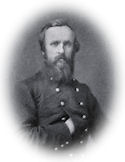
Post image for Hospital, injuries, prisoners, telegraph, news—Rutherford B. Hayes

August 4. Sunday.—Visited the hospital. It is airy and comfortable—the court-house of the county, a large good building. The judge’s bench was full of invalids, convalescent, busily writing letters to friends at home. Within the bar and on the benches provided for the public were laid straw bedticks in some confusion, but comfortable. A side room contained the very sick, seven or eight in number. The total inmates about seventy-five. Most of them are able to walk about and are improving; very few are likely to die there. One poor fellow, uncomplaining and serene, with a good American face, is a German tailor, Fifth Street, Cincinnati; speaks little English, was reading a history of the Reformation in German. I inquired his difficulty. He had been shot by the accidental discharge of a musket falling from a stack; a ball and several buckshot pierced his body. He will recover probably. My sympathies were touched for a handsome young Canadian, Scotch or English. He had measles and caught cold. A hacking cough was perhaps taking his life. Nobody from the village calls to see them!

A hot day but some breeze. We hear that Colonel Matthews with the right wing was, on the morning of the third day from here, near Bulltown, twenty-seven miles distant. Governor Wise is somewhere near Lewisburg in Greenbrier County. Cox [General J. D.] is in no condition to engage him and I hope will not do it. I rather hope we shall raise a large force and push on towards Lynchburg and east Tennessee. Jewettt is doing well.

_______

WESTON, VIRGINIA, August 4, 1861.

DEAR MOTHER:—I write often now, as we soon pass out of reach of mails. We hear the news by telegraph here now from all the home towns, but mails are uncertain and irregular. We are very healthy, but the weather is hotter than any I have known in a great while. Our wounded lieutenant, Jewett, is doing well. His father is here nursing him. The fine large hospital for all this region of country, having one hundred patients belonging to different regiments, is in charge of Dr. Joe. It is the courthouse. The people here do not find us much of a nuisance. Of course, in some respects we are so, but all things considered, the best of the people like to see us. I mean to go to church this pleasant Sunday. My only clerical acquaintance here is an intelligent Catholic priest who called to see Colonel Scammon. I have been cross-examining a couple of prisoners—one a Methodist preacher—both fair sort of men, and I hope not guilty of any improper acts. Good-bye.

Affectionately,

R. B. HAYES.

MRS. SOPHIA HAYES.

_______

NEAR WESTON, VIRGINIA, August 4, 1861.

DEAR LAURA:—As we ride about this exceedingly pretty country and through this reasonably decent village, I am reminded of young ladies in Ohio by occasionally meeting a damsel wearing a stars-and-stripes apron, or by seeing one who turns up her nose at the said stars, etc.

We are leading camp life again—watching Secessionists, studying geography, sending and receiving scouts and couriers and sich like. Colonel Matthews has gone with the five companies of the right wing forty-four miles further up into the hills. We shall follow him if there are any hostile signs up there, and he will return to us if such sign fail him.

You and Jeanie Ahave been of use. The bandages are used in dressing the shocking wound of young Jewett of Zanesville— a lieutenant, handsome, gallant, and intelligent. Just the person you would wish to serve in this way. Dr. Joe hopes he will not be crippled. At first it seemed that he must lose his foot; but your bandages or something else are bringing him up. It will be perhaps months before he can walk.

The court-house here (about like yours) is a hospital for the sick and wounded of all the regiments hereabouts. It would be a glorious thing if some Florence Nightingales would come here. They could be immensely useful, and at the same time live pleasantly in a pretty mountain village, safe as a bug in a rug. Won’t you come? It is easy getting here and cheap staying. Too hot under canvas to write much. Love to all.

Your uncle,

R.

MISS LAURA PLATT,

Columbus.
Post image for A Diary of American Events.–August 4, 1861

August 4.—About five o’clock, this morning, the Second Regiment of Connecticut Volunteers, passed through Philadelphia, Pa., on their way home. The regiment is under Colonel A. H. Terry, and participated in the engagement at Bull Run. In the fight they lost sixteen men killed and wounded. The officers of this regiment deny that it was through hunger that the men were exhausted. The Connecticut men were supplied with full haversacks; and the only drawback in their opinion to final success, was the impetuous feeling to go ahead and fight. In order to get within the enemy’s lines, a long march was necessary to this end. From two o’clock A. M. until ten they marched; and even then the men were unable to rest. To this fact alone, the officers of this regiment attribute, in a great measure, the reverse. The regiment acted as part of the reserve, and did not get into battle till late in the day.—Philadelphia Bulletin, August 5.

—A Meeting was held this evening in Rev. Dr. Adams’ Church, on Madison-square, New York city, to aid in measures taken for the prevention and suppression of intemperance in the National Army. A. R. Wetmore, Esq., presided, and Dr. De Witt offered a prayer. Resolutions were read by Dr. Marsh, which were responded to in an able speech by Rev. Mr. Willets, of Brooklyn, and Paymaster Bingham, of the Twenty-sixth Regiment.—(Doc. 162.)

—Admiral Sir Alexander Milne, Commander-in-Chief of the British forces, at Halifax, in a private letter to the British Consul at Boston, says: “I see a long article in the papers and extracts from a letter from Fort Pickens, alluding to orders I have given; all I can say is that it is not my version of blockade nor my orders on the subject.”—Buffalo Evening Courier, August 5.

—Delaware has contributed two regiments for the war. One is already in the field. The other has not yet been complete, and is commanded by Colonel Charles Wharton, brother of George M. Wharton, of Philadelphia. One company of the regiment is entirely made up of Philadelphians. It is the Hancock Guards, Capt. John F. Heishley. The men are remarkably well fed, clothed, and sheltered. In this particular Delaware has equalled, if not surpassed, the other States. They are encamped at Camp Brandywine, Wilmington. — Philadelphia Bulletin, August 5.

Saturday, 3d.—Moving on through Chestnut Mound, we encamped in quite a rough section of country, in Putnam County, after a march of about twenty-one miles.

SATURDAY 3

Hot still. Went over to the Navy Yard with Julia and Miss Hartly. Went round the shops and on board the Steamer Pensacola which will be completed in a few days. Nothing but cannon, and shot and shells, fill the workshops. Everything there looks warlike. No troops are quartered in the Yard now, four hundred Marines in the Barraks. One of our neighbors boys Willie Lowry fell and was badly hurt today. The Father is at sea. Was down to the camp with wife.

______

The three diary manuscript volumes, Washington during the Civil War: The Diary of Horatio Nelson Taft, 1861-1865, are available online at The Library of  Congress.

Manassas, August 3,1861.

I reached here last night after spending a day in Staunton. When I reached there I found the militia of Rockbridge, and some of the officers insisted upon my remaining a day to aid them in raising the necessary number of volunteers (270) to have the others disbanded and sent home. I was very glad, indeed, that it was accomplished and the others permitted to return home and attend to their farms. I found, upon reaching Manassas, that our encampment had been removed eight miles from there, in the direction of Alexandria; and after a walk of some three hours I reached here about nine o’clock at night, somewhat fatigued. I do not know what our future operations are to be; but think it probable that we shall remain here for some time in idleness. I am free to confess that I don’t like the prospect; without any employment or amusement, the time will pass with me very unpleasantly, and such soldiering, if long continued, I fear, will make most of us very worthless and lazy; perhaps send us home at last idle loafers instead of useful and industrious citizens. Such a result I should regard as more disastrous than a dozen battles. In passing along the road from Manassas, the whole country seemed filled with our troops, and I understand that our encampment extends as far as eight miles this side of Alexandria. I think we have troops enough to defend the country against any force which may he brought against us.


Since this much of my letter was written, Lewis has handed me your note of 25th ult. You say you are almost tempted, from my short and far between letters, to think that I do not love you as well as I ought. You are a mean sinner to think so. Just think how hard I fought at Manassas to make you the widow of a dead man or the wife of a live one, and this is all the return my darling wife makes for it. If I was near enough I would hug you to death for such meanness. In truth, Love, I may say that I never closed one of my short notes until my eyes began to smart. Sometimes I did not wish to write. When we were for some time on the eve of a battle I did not wish to write lest you might be alarmed for my safety. Until the last month, when danger seemed so threatening, I think I have written once a week. But, Love, when you doubt my affection, you must look to the past, and if the doubt is not dispelled, I can’t satisfy you, and you must continue in the delusion that the truest and steadiest feeling my heart has ever known—my love for you—has passed away.

I know, Love, you think I exposed myself too much in the battle. But for such conduct on the part of thousands, the day would have been lost, and our State would now have been in the possession of our enemies. When I think of the result, and the terrible doom from which we are saved, I feel that I could have cheerfully yielded up my life, and have left my wife and little ones draped in mourning to have achieved it. Our future course must be the same, if we expect a like result.

I’ve created a short video using photographs from the civil war and and mixed it with a couple of medleys of civil war music recorded almost 100 years ago.


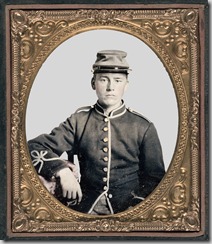
Unidentified young soldier in New York Zouave uniform

All of the photographs are from the U.S. Library of Congress Prints and Photographs Online Catalog.

_________

Description of photographs:

  • Keedysville, Md., vicinity. Confederate wounded at Smith’s Barn, with Dr. Anson Hurd, 14th Indiana Volunteers, in attendance, September 1862.
  • Unidentified soldier in Confederate uniform and forage cap.
  • Chickahominy River, Va. Grapevine bridge built May 27-28, 1862, by the 5th New Hampshire Infantry under Col. Edward E. Cross.
  • Unidentified young soldier in Union uniform with musket, bayonet, and knapsack.
  • Aquia Creek Landing, Va. Embarkation of 9th Army Corps for Fort Monroe, February 1863.
  • Unidentified soldier in Confederate uniform and slouch hat, missing jacket buttons.
  • Cedar Mountain, Va. A Confederate field hospital, 1862.
  • Unidentified young soldier in New York Zouave uniform.
  • Cumberland Landing, Va. Federal encampment April – May 1862.
  • Unidentified young soldier in Confederate shell jacket, Hardee hat with Mounted Rifles insignia and plume with canteen and cup.
  • Military Bridge across the Chicahominy, June 1862.
  • Unidentified African American soldier in Union uniform in front of painted backdrop showing military camp.
  • Rebel gun in front of Fort Hell, April 1865, a Confederate cannon inside of Fort Sedgwick in Petersburg, Virginia.
  • Unidentified soldier in Confederate uniform.
  • Yorktown, Va. Embarkation for White House Landing, Va.
  • Unidentified young sailor in Union uniform.
  • Antietam Bridge, September, 1862.
  • Unidentified soldier in Confederate shell jacket and slouch hat with object hanging from neck in front of painted backdrop showing waterfall.
  • Confederate prisoners at Fairfax Courthouse, June 1863.
  • Unidentified girl in mourning dress holding framed photograph of her father as a cavalryman with sword and Hardee hat.
  • Hand colored; Tending wounded Union soldiers at Savage’s Station, Virginia, during the Peninsular Campaign, 1862.
  • Two unidentified women reading letters.
  • James River, Va. Sailors on deck of U.S.S. Monitor; cookstove at left, July 9, 1862.
  • Unidentified soldier in Confederate uniform and civilian, likely his father or older brother.
  • Harper’s Ferry, meeting of the Potomac and the Shenandoah, July 1865.
  • Unidentified soldier in Confederate uniform.
  • Libby Prison, Richmond, Va., August 23, 1863.
  • Unidentified African American Union soldier with a rifle and revolver in front of painted backdrop showing weapons and American flag at Benton Barracks, Saint Louis, Missouri.
  • Manassas, Virginia. Camp of General Irvin McDowell’s body guard, hand colored photographic print.
  • Unidentified soldier in uniform with young woman, probably his wife.
  • Secret Service agents, Whitehouse, Va.
  • Unidentified soldier in Confederate uniform of the 11th Virginia regiment with knapsack and bedroll.
  • Dinner time in camp.
  • Unidentified woman wearing mourning brooch and displaying framed image of unidentified soldier.
  • Confederate artillery near Charleston, S.C.
  • Unidentified soldier in Union uniform with Company E, 12th Regiment New Hampshire Volunteers hat.
  • Confederate prisoners at Belle Plain Landing, Va., captured with Johnson’s Division, May 12, 1864.
  • 1863, Interior view of Fort Sumter showing ruins and explosion.

AUGUST 3D.—Conversed with some Yankees to-day who are to be released to-morrow. It appears that when young Lamar lost his horse on the plains of Manassas, the 4th Alabama Regiment had to fall back a few hundred yards, and it was impossible to bear Col. Jones, wounded, from the field, as he was large and unwieldy. When the enemy came up, some half dozen of their men volunteered to convey him to a house in the vicinity. They were permitted to do this, and to remain with him as a guard. Soon after our line advanced, and with such impetuosity as to sweep everything before it. Col. Jones was rescued, and his guard made prisoners. But, for their attention to him, he asked their release, which was granted. They say their curiosity to see a battle-field has been gratified, and they shall be contented to remain at home in safety hereafter. They regarded us as rebels, and believed us divided among ourselves. If this should be true, the rebellion would yet be crushed; but if we were unanimous and continued to fight as we did at Manassas, it would be revolution, and our independence must some day be acknowledged by the United States. But, they say, a great many Northern men remain to be gratified as they had been; and the war will be a terrible one before they can be convinced that a reduction of the rebellion is not a practicable thing.