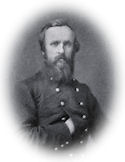
August 3, 1861.—Called on James T. Jackson, a Secessionist, for a map of Virginia—one of the Board of Public Works maps. He said he once had one but his brother had sold it to a captain in [the] Seventh Regiment. Called then on William E. Arnold, a lawyer and Union man. He offered every facility for getting information and gave such as he could; also lent us a good map. Hottest day yet. Dr. Joe ailing. Young Jewett doing well, but getting tired and sore.
August 2011
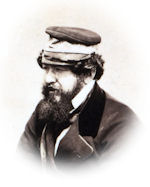
August 3rd.—McClellan orders regular parades and drills in every regiment, and insists on all orders being given by bugle note. I had a long ride through the camps, and saw some improvement in the look of the men. Coming home by Georgetown, met the Prince driving with M. Mercier, to pay a visit to the President. I am sure that the politicians are not quite well pleased with this arrival, because they do not understand it, and cannot imagine a man would come so far without a purpose. The drunken soldiers now resort to quiet lanes and courts in the suburbs. Georgetown was full of them. It is a much more respectable and old-world looking place than its vulgar, empty, overgrown, mushroom neighbour, Washington. An officer who had fallen in his men to go on duty was walking down the line this evening when his eye rested on the neck of a bottle sticking out of a man’s coat. “Thunder,” quoth he,” James, what have you got there?” “Well, I guess, captain, it’s a drop of real good Bourbon.” “Then let us have a drink,” said the captain; and thereupon proceeded to take a long pull and a strong pull, till the man cried out, “That is not fair, Captain. You won’t leave me a drop.”—a remonstrance which had a proper effect, and the captain marched down his company to the bridge.
It was extremely hot when I returned, late in the evening. I asked the boy for a glass of iced water. “Dere is no ice, massa,” he said. “No ice? What’s the reason of that?” “De Sechessers, massa, block up de river, and touch off deir guns at de ice-boats.” The Confederates on the right bank of the Potomac have now established a close blockade of the river. Lieutenant Wise, of the Navy Department, admitted the fact, but said that the United States gunboats would soon sweep the rebels from the shore.
August 3.—At Baltimore, Md., this morning, Sergeants Wallis and Cook, with Officer James Pryor, of the Middle District Police, went on board the steamer George Weems, at her wharf foot of Frederick street, and on her leaving for the usual trip to various landing places on the Patuxent River, proceeded in her as far as Fort McHenry wharf, where they directed Captain Weems to stop. A search of the steamer was here made, resulting in the discovery of concealed arms and ammunition in various out-of-the-way places in the hold. Immediately under the upper deck, between the lower deck and the skylight, were found 200 new Colt’s patent revolvers, done up singly in paper. In the aft part of the hold the officers found a barrel in which rubbish had been placed for several months. Concealed in the rubbish was a valise filled with boxes, each containing 250 rifle percussion caps. There was also found in the hold, separate from the other freight, a halfbarrel of sulphurated quinine, contained in bottles and packages. On the discovery of these articles General Dix directed that the steamer should be detained for a more minute examination of the freight. He also directed that the steamer Planter should be got ready to convey the passengers to their place of destination.—Captain Weems disavowed any knowledge of the contraband articles.—Baltimore American, August 3.
—Governor Gamble, of Missouri, issued a proclamation to the citizens of that State, in which he calls upon all those who are enrolled in the State militia now in arms against the Federal Government, who were called out by his predecessor, Jackson, to return to their homes, promising them protection if they do so. He appeals to the sheriffs of counties and other magistrates, to exercise all the authority vested in them by law, in arresting and punishing every one who may break the peace, molest his fellow-citizens, or retain arms, the property of the Federal Government. He also notifies all those citizens of other States, who may be in arms within the boundaries of Missouri, (in the rebel ranks,) to withdraw to their own States, as Missouri does not need nor desire their presence. After the issue of this proclamation, Governor Gamble received a despatch from the War Department, stating his promise of protection to all those who may lay down their arms would be sustained by the Government. In several counties of Northern Missouri committees of safety have been appointed to suppress rebellion, with the assurance that if they cannot effect that purpose, the military power will be used to its utmost extent.—(Doc. 156.)
—The Charleston Mercury of to-day, says: “We have been provoked beyond endurance by reading the most complacent and gratulatory comments of certain Virginia papers on the charming charity and benevolence of certain citizens and officials of that State toward the invaders of their soil, plunderers of their estates, destroyers of their homes and firesides, and polluters of their women. We demand that every prisoner in Richmond be incarcerated and put in irons. Justice, humanity, and civilization alike cry aloud for ‘stern retribution.’ ”
—Senator Kennedy, of Maryland, in the Senate, at Washington, presented a memorial from the Legislature of that State, denouncing the National Government in unmeasured terms, and protesting against its action in imprisoning Ross Winans and others suspected of conspiracy. Its reception was objected to by several members on account of its disrespectful tone, but it was finally admitted and ordered to be printed, on the ground that it would not do to deny the right of petition.—N. Y.Times, August 5.
—Beriah Magoffin, Governor of Kentucky, issued a proclamation commanding all persons having arms belonging to the State, that have been unlawfully seized, to immediately deliver them up, that they may be returned to the State Arsenal, at Frankfort.—(Doc. 157.)
—The Senate of the United States confirmed numerous army appointments. Among them are Major-Generals McClellan, Fremont, Dix, and Banks; and Brigadier-Generals Hooker, Curtis, McCall, Sherman, Lander, Kelly, Kearney, Pope, Heintzelman, Porter, Stone, Reynolds, Hunter, Franklin, Rosecrans, Buell, Mansfield, McDowell, and Meigs.—Philadelphia Inquirer, August 5.
—The Twenty-ninth Regiment of Pennsylvania Volunteers, under the command of Colonel John K. Murphy, left Hestonville, West Philadelphia, for the seat of war.—Philadelphia Press, August 8.
—Mrs. Lincoln having kindly consented to receive and distribute the havelocks made by the ladies of Katonah and Bedford, Westchester, N. Y., a case was despatched to-day from the Jay homestead to the executive mansion by Pillion’s and Adams’s express, containing 1,300 havelocks, of which 1,165 were made by the ladies of Katonah and its vicinity, and 135 by those of Bedford.—N. Y. World, August 6.
—A letter from Isham G. Harris, Governor of Tennessee, to the editors of the Memphis Avalanche, on the military power of that State, was published.—(Doc. 158.)
—The First Regiment of New Hampshire State Militia, under the command of Colonel Mason W. Tappan, passed through Philadelphia on their return from the seat of war. This regiment composed part of the command of Col. Stone, and marched to Harper’s Ferry, Va. They have been principally on guard duty, and had a skirmish with the rebels at Harper’s Ferry. The men have performed marches on foot to the extent of one hundred and sixty miles since they left Washington. The regiment has twenty ladies with them. They return numerically as strong as when they left, except six of the men, who were taken prisoners.—Philadelphia Bulletin, August 5.
—The House of Representatives, at Washington, passed, with a slight amendment, the Confiscation Bill. The amendment is, that slaves in the military or naval service, or working in the intrenchments of the rebels, will be confiscated.—(Doc. 159.)
—The Sixth Regiment of Wisconsin Volunteers, commanded by Colonel L. Cutler, and the Twenty-first Regiment of Indiana Volunteers, under the command of Colonel J. W. McMillan, arrived at Baltimore, Md.—Baltimore American, August 5.
—The N. Y. Journal of Commerce suggests as “a way by which our troubles can be settled without more bloodshed”—1, an armistice ; 2, delegates from every State, North and South, to meet at Louisville; 3, the delegates to agree upon a modified Constitution; or 4, a peaceable separation.
One of its plans for reconstruction is to have a Northern and Southern section in each House of Congress, and no bill to become a law until agreed to by a majority on both sides!—(Doc. 160.)
—As engagement took place at Messila, N. M., between a body of Federal troops and seven hundred Confederates, under command of Capt. Baylor. Capt. McNeely and Lieutenant Brooks, of thr Federal army, were wounded in the engagement, and twelve of the Confederates killed. Night coming on put an end to the engagement.—Baltimore American, August 21.
—The secret expedition from Fortress Monroe to the eastern shore of the Chesapeake Bar, under the command of Captain Crosby, U. S. A, returned to Old Point Comfort. The object of the expedition was to search for vessels engaged in illegal trade, and to reconnoitre the coast for defences erected by the rebels.— (Doc. 161.)
——-
Late addition to Volume 3:
August 3.—Lient.-Col. Baylor, commanding the rebel forces in Arizona, has issued a proclamation taking possession of the Territory in the name and on behalf of the Confederate States, declaring all offices, civil and military, vacant and no longer existing, and making provision for the government of the Territory until such time as the Confederate Congress may otherwise provide. Col. Baylor, as Governor of the Territory, has also appointed a Secretary of the Territory, Attorney-General, and other officers. —Lieut. R. H. Brewer, late of the first regiment of the United States Dragoons, has arrived in New Orleans, and informs the Picayune that on the 5th ultimo, Gen. A. S. Johnston, who arrived from California, was at Picach, about five miles north of Mesilla, in command of the Confederate forces, which command, tendered by Lieut.-Col. Baylor, the General had accepted. The Confederate forces numbered about five hundred men, and had four pieces of artillery. They were awaiting the approach of four companies of Federal troops (two companies of dragoons and two companies of infantry) under command of Lieut. Moore. Forts Breckinridge and Buchanan had been destroyed.—Mesilla Times, August 3.
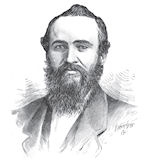
Friday, 2d.—The two companies marched on through New Middleton, crossed the Caney Fork River at Trousdale’s Ferry, and camped on the east bank of that stream.
WESTON, August 1, 1861.
DEAREST:—Do you remember a year ago today we were riding on the Grand Trunk Railroad from Detroit by Sarnia eastwardly? Jolly times those. If you were here, these would be as pleasant. The water in the river below our camp flows past you in the Ohio; in these low water days, about a month after they leave here.
We are now in telegraphic communication with the world. Dr. Joe receives dispatches about medicines and Colonel Scammon about military matters from Columbus and Cincinnati. We had the two county court clerks before the colonel taking the oath of allegiance to the United States and to the new Government of Virginia. They squirmed a little, but were required to do it or go to Camp Chase.
Colonel Matthews left this noon with five companies—right wing—for Sutton, a place forty-four miles south of this place. We suspect that Wise has left western Virginia. If so, our campaigning here is likely to be pacific and uninteresting.
August 2.—I have been out to report myself at reveille, and not feeling like resuming my nap, am seated on my trunk jotting down these lines to my darling. Colonel Jewett arrived last night from Zanesville. He finds his boy doing well. It is still very uncertain what is to be the result. It is probable that no amputation will be necessary, and there is hope that he may not be more than very slightly crippled, He will be unable to use his foot, however, for perhaps months.
Our news is that Wise has continued his retreat burning the bridges after him. This confirms our suspicions as to his abandoning all west of the mountains. There is, however, a report from the East that General Lee is to be sent out here to look after General Rosecrans, with a considerable force. I do not believe it, but if so, we shall have lively times. Colonel Ammen with the Twenty-fourth is reported in our neighborhood. We shall be glad to be with them again.
Puds, here it is Saturday, the 3d, and my foolishness isn’t off yet and won’t be until Monday. It is so hot and pleasant. I am so lazy and good-natured. Joe says, “I wish Webb was here”; I say, I wish you were all here. We may be ordered to move any hour, and it may be [we] shall be here a week hence. We have got our camp into good order—clean and pretty. Joe was pretty sick last night, but is under a nice shade today, as lazy and comfortable as possible. The effect is curious of this fine mountain air. Everybody complains of heat, but everybody is in a laughing humor. No grumbling reaches me today.
I have called on divers leading lawyers and politicians, generally Union men, and find them agreeable people. The courthouse here is a good one and is used as a hospital for all these regiments. About one hundred sick are there. When Joe gets perfectly well, which I advise him not to do, he will have charge of all of them. We have four or six there.
Very affectionately, your
R.
“Love me?” I have heard nothing from Ohio except an occasional newspaper. Write about Uncle and everybody. Our men sing beautifully tonight.
MRS. HAYES.
_______
Diary
August 2, 1861.—A. M. fired pistol with Captain Zimmerman and P. M. Enfield rifle with Captain Sperry. My pistol shooting rather poor. Rifle shooting at one hundred yards good, at three hundred yards, tolerable. Weather hot. In the evening passed the sentinels to try them, back and forth several times. Found them generally defective; they took instruction kindly and I hope they may do well yet.
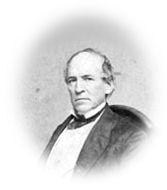
FRIDAY, AUGUST 2, 1861.
The weather is hot now adays, the M. ranging about 90. I have been at the office part of the day writing letters &c at my old table. Doct King has been packing up his books. I have been cleaning out my drawers and throwing away unimportant papers and letters. Chas heard from Fort Leavinworth today. He wrote to one of the officers enquiring for Frank. He is with Genl Lyons Command near Springfield M.O. Wa[l]ked with wife up to Col Smalls camp, called on our return upon Mr & Miss Reynolds.

______
The three diary manuscript volumes, Washington during the Civil War: The Diary of Horatio Nelson Taft, 1861-1865, are available online at The Library of Congress.
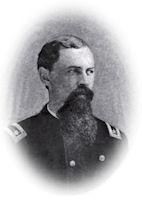
Cairo, August 2, 1861.
Hot! You don’t know what that word means. I feel that I have always been ignorant of its true meaning till this week, but am posted now, sure. The (supposed-to-be) “never failing cool, delicious breeze” that I have talked about so much, seems to be at “parade rest” now and—I can’t do justice to the subject. The health of the camp is much better now than at any time before, since we have been here. There is not a sick man in our company. My health remains gorgeous. We drill now five hours a day, under a sun that cooks eggs in 13 minutes, but we think we feel the heat no more walking than lying around the quarters.
The seceshers this morning took the packet that has been plying between here and Columbus, and have run her off down to Memphis. I thought that Prentiss stopped her sometime since, but this at last closes all communication between the North and South at this point. Our “ossifers” we think are really scared about an attack here, but you could not make the soldiers believe in the like till they see the fight begin. About a thousand of our men were rushed off to Bird’s Point to-day to work on intrenchments, and won’t they sweat?
My chum heard Colonel Oglesby tell an officer two hours ago that there were 17,000 Rebels within 15 miles of the Point. The scouts reported this body at New Madrid, 40 mile’s down the Mississippi, two days since. Yesterday 12 men from the Pekin company and 12 from our’s with some artillerymen went 30 miles up the Mississippi to collect all the boats we could find on the Missouri shore. We found three large flats tied up to trees along the shore which we confiscated. One of them wasn’t very good so we sunk it. The object was to prevent marauders from visiting Illinois. I had charge of the men from our company.
August 2nd.—Mr. Olmsted visited me, in company with a young gentleman named Ritchie, son-in-law of James Wadsworth, who has been serving as honorary aide-de-camp on M’Dowell’s staff, but is now called to higher functions. They dined at my lodgings, and we talked over Bull Bun again. Mr. Ritchie did not leave Centreville till late in the evening, and slept at Fairfax Court House, where he remained till 8.30 a.m. on the morning of July 22nd, Wadsworth not stirring for two hours later. He said the panic was “horrible, disgusting, sickening,” and spoke in the harshest terms of the officers, to whom he applied a variety of epithets. Prince Napoleon has arrived.
AUGUST 2D.—After some brilliant and successful fights, we have a dispatch to-day stating that Gen. Wise has fallen back in Western Virginia, obeying peremptory orders.
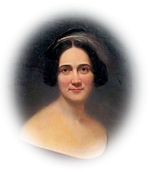
August 2d.—Prince Jerome¹ has gone to Washington. Now the Yankees so far are as little trained as we are; raw troops are they as yet. Suppose France takes the other side and we have to meet disciplined and armed men, soldiers who understand war, Frenchmen, with all the élan we boast of.
Ransom Calhoun, Willie Preston, and Doctor Nott’s boys are here. These foolish, rash, hare-brained Southern lads have been within an ace of a fight with a Maryland company for their camping grounds. It is much too Irish to be so ready to fight anybody, friend or foe. Men are thrilling with fiery ardor. The red-hot Southern martial spirit is in the air. These young men, however, were all educated abroad. And it is French or German ideas that they are filled with. The Marylanders were as rash and reckless as the others, and had their coat-tails ready for anybody to tread on, Donnybrook Fair fashion. One would think there were Yankees enough and to spare for any killing to be done. It began about picketing their horses. But these quarrelsome young soldiers have lovely manners. They are so sweet-tempered when seen here among us at the Arlington.

______
¹ Jerome Napoleon Bonaparte, a grandson of Napoleon Bonaparte’s brother Jerome and of Elizabeth Patterson of Baltimore. He was a graduate of West Point, but had entered the French Army, where he saw service in the Crimea, Algiers, and Italy, taking part in the battle of Balaklava, the siege of Sebastopol, and the battle of Solferino. He died in Massachusetts in 1893.


